Greensboro City Council Meeting: Data Center Moratorium Vote and Regular Agenda – August 18, 2026
STREAMING COPY IN PREPARATION — RECORDING AVAILABLE FROM THE ORIGINAL SOURCE
Greensboro City Council Meeting: Data Center Moratorium Vote and Regular Agenda – August 18, 2026
The Greensboro City Council convened on Tuesday, August 18, 2026, at Council Chambers. The meeting began with a reconvened public hearing from the August 17th special meeting on a proposed data center moratorium, followed by the regular council meeting. After hearing extensive public testimony, the council voted to approve a 180-day moratorium (amended from the originally proposed 120 days) on new data center facilities over 10 megawatts. The regular meeting included consent agenda approvals, recognition of the Greensboro Fire Department’s youth camps, several zoning and annexation public hearings, and board appointments.
Public Comments & Testimony (Data Center Moratorium)
- Multiple speakers urged the council to enact a 32-month moratorium on data centers, warning of environmental, health, and economic risks. One speaker noted that of 25 identified threats from data centers, 12 were direct health and life safety concerns.
- A speaker representing the Protect Guilford County coalition stated that 54% of Greensboro households cannot fully participate in a 140-day public process due to work and family constraints, and described the 32-month moratorium as the “gold standard” developed by the North Carolina Environmental Justice Network.
- Another speaker detailed legal battles involving the Ray Dean/Impact Data Center in Birmingham, alleging inflated investment claims and inappropriate grandfathering.
- A speaker requested the city identify the precise vested rights documents for the Dream Center site at Gateway Research Park, questioning whether original approvals included specific megawatt capacity.
- Several speakers expressed concern about Duke Energy using data center growth to justify rate hikes of up to 20% by 2027, and called for data centers to pay for 100% of their energy infrastructure.
- No speakers opposed the moratorium during the public hearing.
Discussion Items (Data Center Moratorium)
- Councilmember Black requested the city attorney clarify the status of the Dream Center. The city attorney stated that the Dream Center’s original approval was for an educational building with a data center component, that the site plan expired July 2025, and that no developer has claimed vested rights or submitted a new site plan. The land is state-owned and zoned public/institutional, requiring rezoning for a data center.
- Councilmember Parker urged public trust, noting that policy documents are malleable and can be amended, and that council would not approve a data center without strong protections.
- Councilmembers discussed the need for comprehensive land use and zoning regulations, with work sessions planned on water, energy, noise, and environmental impacts.
- Councilmember Thurm explained she favored 180 days (over 32 months) to maintain focus and urgency, with the option to extend if needed.
- Councilmember Holston emphasized the moratorium as a legal pause to develop robust ordinances, and noted that work would begin immediately.
Key Outcomes (Data Center Moratorium)
- Councilmember Marshall moved to amend the previously adopted motion (from August 3, 2026) to change the moratorium period from 120 days to 180 days. The amendment passed on a roll call vote: 7 in favor (Black, Allen, Holston, Thurm, Crawford, Marshall, Parker), 0 opposed, with Councilmember Roth recused.
- Council then adopted the 180-day moratorium ordinance for data center facilities exceeding 10 megawatts. The vote was 7-0 with Councilmember Roth recused.
- The moratorium provides a temporary pause to develop zoning and land use regulations; the council can extend the period if needed.
Ceremonial & Presentations
- The Greensboro Fire Department recognized the success of Camp Spark and Camp Blaze, youth fire service camps that have grown to over 20 campers each. Mayor Pro Tem Roth acknowledged the camps for cultivating young leaders and community service.
Consent Calendar
- The consent agenda was adopted 9-0 with no items removed.
Public Hearings (Zoning & Annexation Items)
- Items I1–I15 involved annexations and zoning changes for residential and commercial developments. All were approved unanimously after public hearings or with no speakers. Key approvals included:
- I1/I2: Annexation and PUD zoning for 35.5 acres on Hackamore Road (Cross Point Homes) – approved 9-0.
- I3–I5: Annexation and zoning for 5.78 acres on Burlington Road (multifamily and light industrial) – approved 9-0.
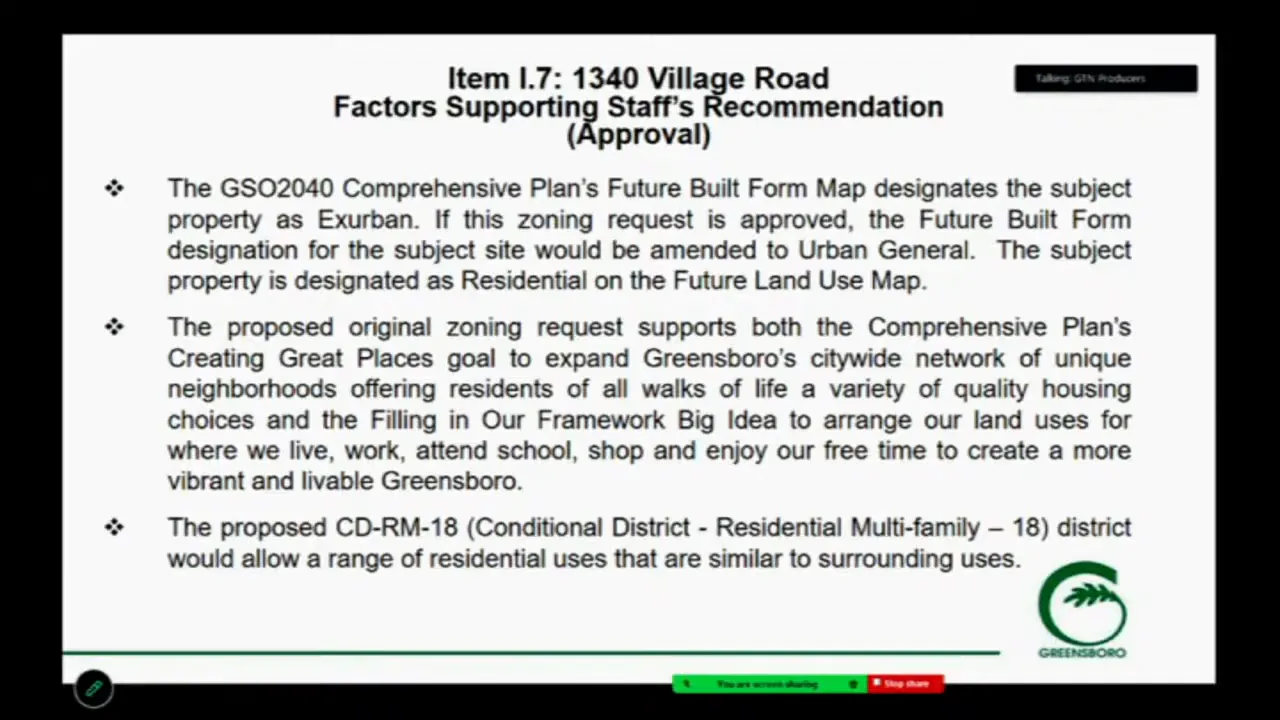
- I6/I7: Annexation and CD RM18 zoning for 21.45 acres on Village Road (additional 55 units) – approved 8-0 (Councilmember recused).
- I8–I10: Annexation and commercial medium zoning for properties on High Cone Road (retail/grocery) – approved 9-0.
- I11/I12: Annexation and light industrial zoning for Stuart Mill Road (solar farm site) – approved 9-0.
- I13/I14: Annexation and R3 zoning for Stuart Mill/Creek Road – approved 9-0.
- I15: Resolution to close portion of Fuller Street to facilitate multifamily development – approved 9-0.
Other Matters
- Councilmember Crawford emphasized that council has been working on data center regulations since January and will continue community engagement.
- Councilmember Marshall clarified that Greensboro does not use Flock cameras; license plate readers (Ricotta) are used with a 30-day data purge policy.
- Board appointments: Ashley White to Historic Preservation Commission, Karen Lilly reappointed to Commission on the Status of Women, Kevin Lightsey to GCJAC – all approved.
- Mayor offered condolences for Chancellor Edward Fort and Nicole Lindall.
- The meeting adjourned after all business was completed.
Meeting Transcript
Good evening. We are in Council Chambers this n this evening, and we are reconvening the public hearing from the August 17th special meeting. We will only hear from the members of the public that signed up to speak from last night's public hearing. And those folks I will call and are listed on my sheet. If you are listed on the sheet from last night, you can speak in person or online. So we are reconvening the meeting from last night, so I'm going to start with my speakers. Is she in the room? Yes. Come on to the podium, and then I will call three, and then the other ones can wait till I call your name. It's incredible. And one of my favorite things is every day to work when I drive to my workplace on home. But something else that I see when I drive around though is kudzu. Um we know this is an invasive vine that devours forests. Um it's important to remember though that kudzu was initially intentionally planted by communities to control erosion. Um it started it solved a short-term problem but created a very massive long-term problem that it didn't realize until later. Um I'm here to ask the council for a thirty-two-month moratorium on data centers. Um, out of concern that these data centers could become like a kudzu that devours our city's resources. Um you have already heard earful about the damage that these data centers could bring. Um I want to highlight some concerns though about the exploitative business practices that they also um are employing to get built. Um data center companies intentionally target lower income and green spaces for development because the real estate is cheaper, um uh that they still get access to all that city's resources. We're already seeing this in the way that there's a disproportionate impact for the currently planned data centers that we'll have on districts one and two. Allowing these facilities to be built without proper oversight will cause lasting harm to these communities. And works against the city's ongoing work in revitalizing those areas as desirable places to live, work, and invest. Furthermore, because data center technology is so new, these companies are taking advantage of the legal gaps in regulation, oversight, and zoning to take what they want before a community fully understands what they're signing up for. You guys have already personally experienced this. And while I know it's outside the scope of uh the state of this moratorium, um, the impact data center was originally approved in Greensboro for a nine megawatt facility, but it's now been expanded to 20 megawatts. Um and the company Ray Dean is openly advertising this site in Greensboro as available for expansion for 100 megawatts, seeking investors. Um, while that data center is outside this moratorium, it's important to recognize that they are already pushing your boundaries to see what they can get away with. Um the company also is involved in a couple legal battles that I wanted to mention to y'all. Um they're at uh Ray Dean, the current company of the Impact Data Center is involved in a uh data center in Birmingham. Um, and uh the the lawsuit that's being brought against it um alleges that the company pulled some uh under-the-table real estate deals to artificially inflate uh the monetary investment to make it look like they put more into the community than they did. Um the lawsuit also alleges that they that this data center was inappropriately grandfathered in by the city because the city claimed the project was approved before the passage of a moratorium, which the community did after they found out what was going on, um, even though in reality the project actually was still in the process of seeking permits for development when the moratorium passed. So you guys are even though it looks like some things are in the way, um there's if I'm not being straight with you. Um Please look up the North Star data um uh impact uh data center policies will get. Thank you. Thank you. All right, I have Jennifer, Danilo, and then Vessa. Thank you. Um good afternoon. My name is Jennifer Barney. I live in District 3. Um I was here yesterday, and while I was listening to everyone speak, I was taking notes. I hope all of you are as well. Um I counted, I made myself a list of all of the possible threats in everyone's complaints from yesterday. Uh that list was 25 items long. Twelve of those items were direct threats to health and life safety. Um, and each item on that list was extremely complex, one more than the last. So I don't believe that you all believe that you can actually address all of these concerns and establish proper regulation to protect this community in just four months. Um that is between 80 and 85 business days that would be shared between this situation and this process and all of the other issues going on with the city, and of course, we know there's elections that are going to be happening during this moratorium period as well. And I know that families cannot swing that.
openpublica.com