OPENPUBLICA · PUBLIC MEETING RECORD
Record of Proceedings
Gulfport City Council Meeting - October 21, 2025
City Council — Tuesday, October 21, 2025
BodyGulfport, Florida
SessionCity Council
DateTuesday, October 21, 2025
StatusFILED
Video Record
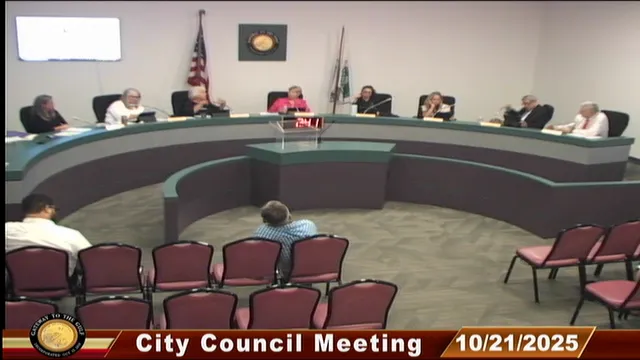
STREAMING COPY IN PREPARATION — RECORDING AVAILABLE FROM THE ORIGINAL SOURCE
Transcript — Verbatim
Speaker numbers apply only to this recording.
Discussion Breakdown — Share of Meeting
Charter Review15%
Ethics15%
Public Comment14%
Procedural13%
Urban Forestry8%
Legal Counsel4%
Community Engagement4%
Flood Management4%
Term Limits3%
Summary of Proceedings
Gulfport City Council Meeting - October 21, 2025
At the regular meeting of the Gulfport City Council held on Tuesday, October 21, 2025, at 6:00 PM at Gulfport City Hall, the council discussed a presentation on forming a resident tree board, reviewed proposed charter amendments from the Charter Review Committee, heard public comments on various topics, and approved several resolutions including electric vehicle charging station fees, a special event for the Gulfport Food Forest, a feasibility study for the Senior Center, and a post-storm recovery interlocal agreement with Pinellas County. The meeting included extensive deliberation on charter changes, with consensus to move forward with most recommendations except for the vice mayor selection method, which was left unchanged.
Presentations
- Resident Tree Board Proposal: Mr. Dean Hay, ISA Certified Master Arborist, presented a proposal to establish a resident tree board to support urban forestry goals, including a 30% tree canopy cover target. Councilmembers expressed strong support, with Vice Mayor Thanos noting the new volunteer portal could facilitate coordination. The council agreed to move forward with staff to develop the board.
Discussion Items
- Charter Review Committee Recommendations: Mr. Joe Guenther, Chairperson, presented recommended changes to nine sections of the City Charter:
- Section 103 (Extraterritorial Powers): Proposed maximum lease term of 5 years (from 30), fair market value appraisal requirement, and deed recording responsibility. Council agreed to draft ordinance.
- Section 302 (Terms of Council/Mayor): Proposed three-year terms (from two) and two consecutive term limits. Council reached consensus to proceed.
- Section 304 (Vice Mayor): Proposed chronological rotation by ward and minimum one-year service requirement. After debate, council voted 3-2 to leave the current language (elected by council) unchanged.
- Section 305 (Removals): Proposed ability to remove council members by three-fourths vote with due process. Council discussed adding a warning/sanction option; consensus to proceed with attorney-drafted language.
- Section 306 (Vacancies & Forfeiture): Proposed automatic forfeiture for losing qualifications, conviction of a crime involving moral turpitude, or excessive absences; plus due process hearing before an independent special magistrate. Council agreed to create a new section for removals and proceed.
- Section 309 (Ordinances & Resolutions): Updated recording method per state law. Consensus to proceed.
- Section 314 (Charter Review Frequency): Changed from every 10 years to every 5 years, with full review by a citizen committee. Consensus to proceed.
- Section 402 (City Manager Qualifications): Removed residency requirement, allowing city manager to live outside the city. Council agreed 3-2 to remove.
- Section 501 (Elections): Removed phrase "as determined by council." Consensus to proceed, noting potential future changes if Section 302 passes. Council directed the city attorney to draft ordinances for the approved items.
Public Comments & Testimony
- Several residents spoke on the tree board proposal, term limits, and charter sections (e.g., Jonathan McCoachy asked about mayoral term limits; Jennifer Donch raised concerns about vice mayor selection).
- Amy Costa announced a Senior Center Foundation fundraiser and a citywide Halloween crawl.
- Courtney Prokopis requested updates on door-to-door sales permits, the Living Shoreline Project timeline, remote public comment, and expressed concern about the cooking ban ordinance.
- Lauren Stern requested childcare during council meetings and raised questions about water bills and delinquent accounts.
- Scott announced the 2026 Pink Flamingo Home Tour (March 7, in Ward 4).
- Multiple residents commented on the charter removal provisions, urging caution about political misuse.
- Jennifer Donch questioned the selection of Lemoine Disaster Recovery for the post-storm interlocal agreement, citing limited resources compared to other vendors.
Consent Calendar
- Item 7a: Approved minutes of October 2 workshop and October 7 regular meeting.
- Item 7b: Resolution No. 2025-85 accepting donation of an ice maker from the Senior Center Foundation.
- Item 7c: Resolution No. 2025-86 amending the EMS ALS First Responder Agreement with Pinellas County. (All approved unanimously by voice vote.)
Resolutions
- 9a (EV Charging Stations): Resolution No. 2025-87 establishing charging rates ($0.30/kWh) and idle fees ($5/hr) at city-owned stations. Unanimously approved.
- 9b (Food Forest Special Event): Resolution No. 2025-88 approving a special event application for the Gulfport Food Forest monthly market. Unanimously approved.
- 9c (Senior Center Feasibility Study): Resolution No. 2025-89 authorizing a $38,000 scope of services agreement with Harvard Jolly-PBK for renovation-expansion feasibility study. Unanimously approved.
- 9d (Post-Storm Recovery Interlocal): Resolution No. 2025-90 authorizing an interlocal agreement with Pinellas County for post-storm recovery services, with Lemoine Disaster Recovery LLC as preferred vendor. Approved 4-1 (Councilmember Shaw dissented).
New Business
- Councilmember Early reported on a positive water billing experience and asked about paddleboard rentals (deferred to winter).
- Vice Mayor Thanos noted no new business.
- Councilmember Jackson had no new business.
- Councilmember Shaw asked about the federal government shutdown impact (none to date).
Council Comments & Reports
- Councilmember Early reported on Florida League of Cities committee work (Municipal Operations Policy), including legislative priorities (sovereign immunity, public records exemption for clerks, open carry, emergency communications, competitive bid thresholds, group homes).
- Vice Mayor Thanos provided updates on Tampa Bay Regional Planning Council, coastal master plan, Florida League of Cities legislative priorities (enterprise fund transfers, extraterritorial surcharges), her town hall recording, design guidelines for elevated homes, and requested a flood insurance presentation (deferred).
- Councilmember Shaw reported on Sun Coast League of Cities, Florida League of Cities (development committee), Midtown Business Collective, Gulfport Merchants Chamber, Young Gulfport Parents Group, and infrastructure updates (25% of stormwater pipe televised).
- Councilmember Jackson reported on remote public comment progress (in contact with vendor).
- Mayor Love addressed code enforcement and permitting, emphasizing compliance with FEMA requirements to protect the National Flood Insurance Program discount. She urged residents with questions to contact her directly.
Key Outcomes
- Charter Review: Consensus to proceed with ordinances for sections 103, 302, 305, 306 (with independent magistrate), 309, 314, 402, and 501; Section 304 (vice mayor) left unchanged.
- Resident Tree Board: Council directed staff to work with Mr. Hay to establish a volunteer tree board.
- Resolutions: All approved except 9d with one dissenting vote.
- Duke Energy Solar Program: Council confirmed continued participation.
- Lincoln Cemetery: No action; awaiting direction from St. Petersburg (property owner).
- Post-Storm Recovery Applications: Mayor Love encouraged all affected residents to apply for the $813 million federal program administered by Pinellas County.
Meeting Transcript
Thank you guys. Thanks for coming to our um, let's see, today's October twenty-first meeting of the Gulfport City Council. If there's any chance that your phone is on, check it now, please and turn it off. Appreciate it. If in fact during the meeting, if you are unclear and you need to have a side conversation with somebody, that's fine. Just if you would go out into the hallway, we'd appreciate it. As always, we have an action pack long meeting tonight, so we will start on time. So the meeting's called to order, and the invocation will be given by Councilman uh Nancy Nancy early tonight, followed by the Pledge of Allegiance. So please stand if you will. Our lives begin to end the day we become silent about things that matter. I pledge allegiance to the flag of the United States of America. Present. City Clerk Carico is present. Thank you. And welcome. Um, especially in uh storms and uh uh to provide more benefits for us for uh things like uh cleaner air as well as uh uh helping us with our utility bills to keep them lower in the summer months. So I I'm referring here to our urban forest and the the trees that make up the urban forest. And um tonight I'm like to present an idea as a proposal um uh it's uh related to the resident tree board. So uh last year or maybe two years ago now I I presented uh a canopy analysis study that I had done off of the 2023 aerial data. We found that there was a 23.1% canopy cover, which is very low uh for the our uh county. And um the if I remember correctly, uh City Council at that time adopted a 30% tree canopy cover goal uh without there being an end date on it. We all know that 2024 was a very challenging year for our community, not just for uh because of the storms, but because of the excessive amount of uh trees that we lost uh before and after the storms uh with people that were concerned about the trees uh during storm season causing damage or uh creating a hazard for the community. We know we we don't have uh data uh in order for us to track exactly how many trees were lost due to the two hurricanes that we had. Um the communities around us uh have estimated that there in their communities as many as 10 to 20,000 uh trees in city right of way were lost, um, and that uh information was published through the Tampa Bay Times. Um and so looking forward, we want to make sure that we are uh not only caring for the existing uh urban canopy cover that we have, but we also want to make sure that any investments that we make to the tree canopy cover are going to be a future storm resilient. Um and there's a lot of ways to do that. So one of the my specialties is community forestry. Community forestry is a departure from municipal forestry in that it involves the community uh to work with city leadership in order to help make wise decisions, bring more uh money through grants to the table, and to do volunteer efforts in order to support the direction that the city leadership wants to go. It originally started in the early 2000s. I'm originally from Detroit and uh worked at a nonprofit that had started community forestry back in the 1990s, and they uh when I was with them, they were planting between six and eight thousand trees per year, all with volunteers, which is pretty remarkable. Um and the the city was at that point was the leader in saying what direction they wanted to go, what the priorities were, and uh if there were specialty neighborhoods that were requesting additional assistance, then we would come in, do the community engagement and figure out what the the uh project was going to be and deliver that project to uh to the community. Um this this model uh encourages a lot more integration and interactivity uh with uh community leaders in order for there to be kind of uh uh a push or an incentive in order to maximize the amount of uh buy-in that the community has. And a lot of times uh uh in community forestry, the tree board can help to uh to bring resources to the table when the budgets for the city are uh restrained or constrained in any way. So um the resident groups, like I mentioned, they they bring the volunteer energy and the labor, but uh they can also bring a lot of uh other um like marketing tools and things like that. Um they can write, as I mentioned, they can write um with in coordination with the city leaders, they can write grants in order to bring more money in. Um they also have the ability to do education and advocacy um through the volunteer network that that could be established as part of it. So resident tree boards is uh is something that's been around for you know more than a hundred years. And uh these are very very common in uh larger municipalities, medium municipalities, toward in the north where the forests are more extensive. But it's a it's a tool that is very uh successful. So resident tree boards is uh is something that's been around for you know more than a hundred years and uh these are very very common in uh larger municipalities medium municipalities toward in the north where the forests are more extensive but it's a it's a tool that is very uh successful um and it help like I mentioned it's uh it's a way for the residents to step forward uh take on some responsibility work with the city leadership and um determine what the what the most uh productive way to uh to approach forestry might be and so you can see that there's uh more than 3400 uh resident tree boards yeah they could also be called tree commissions so but they're all lumped into tree boards uh in the United States um this year um and this is all information that's on the Arbor Day Foundation website so tree boards are one of the uh minimum requirements for uh the tree city USA requirement there's three requirements uh one is the uh having a tree board or a committee spending at least two dollars per capita on on trees or forestry in a whole and that can be any range that could be salaries that could be maintenance any range of uh uh uh budget items and tree boards um have uh varying uh responsibilities depending on what the charter or what the the council and and leadership uh ask of that tree board and sometimes it can shrink sometimes it can expand depending on what the needs are so um one of the th the things that is most productive that I've seen is uh that uh tree tree boards or tree uh commissions can actually be the driving force for tree planting as far as implementation goes uh planning and and execution would all fall in in partnership with city officials or tree giveaway events which we've had uh a few of them in the in the this past year um and so what that does is it allows a single staff member to work with the tree board the tree board then uh advertises through its social network in order to bring additional volunteers to staff the event and then you can have a very efficiently run um uh tree distribution either through plantings or giveaways so that you can uh make those investments in a timely manner uh consistently over many years uh I I did mention that uh engagement in education are uh another common uh uh role uh for the the tree boards and so uh like I did uh two years ago with the urban forestry uh or the tree canopy cover um the the board itself can uh can take that on as a uh responsibility typically it's done every five years and they can take that on as a responsibility and then make a present presentation to this uh to this council here um and then of course uh like I mentioned several times it's all in coordination with uh with uh providing uh professional services volunteer services marketing and all of those things in uh direct collaboration with the the city staff so um we have a you know uh we've met a couple times and we I mean as many residents who have gotten together twice now in order to talk about what's possible and what direction we think would be uh best and this presentation is a result of those two meetings discussing how we as a community can come together in order to support the the tree goals or the tree canopy goal um in the city of uh of goldport okay so uh we mentioned every every five years um the the uh we call them UTCs or urban tree canopy analysis are done uh one of the other things that we could do is compare the uh 2024 to 2025 uh change analysis and what that means is we'll do a 2024 uh analysis do a 2025 and then compare by whatever however we want to break up the scale it could be down to the neighborhood it could be down to the block how many trees we actually lost because of the storms and that's something that you wouldn't have to pay a consultant to do that a tree board could help you with that and then there's of course uh uh operational things like um rec making recommendations for which trees uh uh should be either planted or uh given away in a tree giveaway and uh additionally um they can um the tree board can work with local nonprofits and volunteer groups in order to do uh tree inventories uh so that we know what stock we have out there what the health of that is uh how much benefit accumulative annual benefits that those trees provide so then we can begin to plan a more resilient um uh forest that has fewer pest or storm issues in the future um and so it this is a proposal but if it's adopted uh these are things that I've already mentioned that uh a tree board could do and um these are things that going into the into the new calendar year um we could uh meet with city staff the the tree board if it's approved could meet with city staff in order to figure out what to learn what the goals are as well as to try to figure out what the best way for us as a as a uh a volunteer resident group to interface and to take uh in order to you know to to meet what the the the direction is from from this body uh tree inventories uh so that we know what stock we have out there what the health of that is uh how much benefit accumulative annual benefits that those trees provide so then we can begin to plan a more resilient um uh uh uh forest that has fewer pest or storm issues in the future um and so i this is a proposal but if it's adopted uh these are things that i've already mentioned that uh a tree board could do and um these are things that going into the into the new calendar year um we could uh meet with city staff the the tree board if it's approved could meet with city staff in order to figure out what to learn what the goals are as well as to try to figure out what the best way for us as a as a uh a volunteer resident group to interface and to take uh in order to you know to to meet what the the the direction is from from this body so um next steps um i i i would i welcome any discussion on this uh this is something that's near and dear to my heart and I think that it's a a very vital uh role um but uh if if this is something that the city and residents are interested in then we could begin to develop the the processes who's on the on the board and what the the roles might be in the future uh this is just another slide uh pretty much the same thing I've already said and that's the end thank you thank you um if you want to stay up here for just a minute dean in case there's any questions we usually go in speaking order to see if anybody has any questions of you so council member early thank you for that presentation that was great what is the optimal um membership volume for a city depending on the responsibilities oh the responsibilities not the city size per se it it it can it's not typically by the city size um it it typically is by the role and the the roles could be as simple as just meeting once a year in order to talk about what the issues are all the way to Massachusetts is the most uh progressive model where tree boards actually uh um they reside over the tree uh like protection ordinance and tree removal permits which is kind of on the the extreme so they need more yeah okay thank you thank you very much mayor totally in favor of this and um with our new volunteer portal it would be easy to make you know it come together and have a place you know to coordinate through um and I think it would be ideal for doing an inventory again handling tree giveaways and helping with that and um and even you know it could be that people come and get a tree and if we have enough volunteers there they could go home with that person and plant it for them if they they're not not able to that themselves and make sure that they plant it in the right place so that it thrives you know because sometimes I know I just got a tree and so I had somebody help me decide where I was going to plant it right in the middle of my new front yard and instead she said no no no you got to move it over here because it it won't get enough sun because there's an oak tree over there.
SUMMARIZED BY OPENPUBLICA AI
TRANSCRIPT VIA PUBLIC VIDEO
openpublica.com
openpublica.com