Half Moon Bay Planning Commission Meeting - April 10, 2025
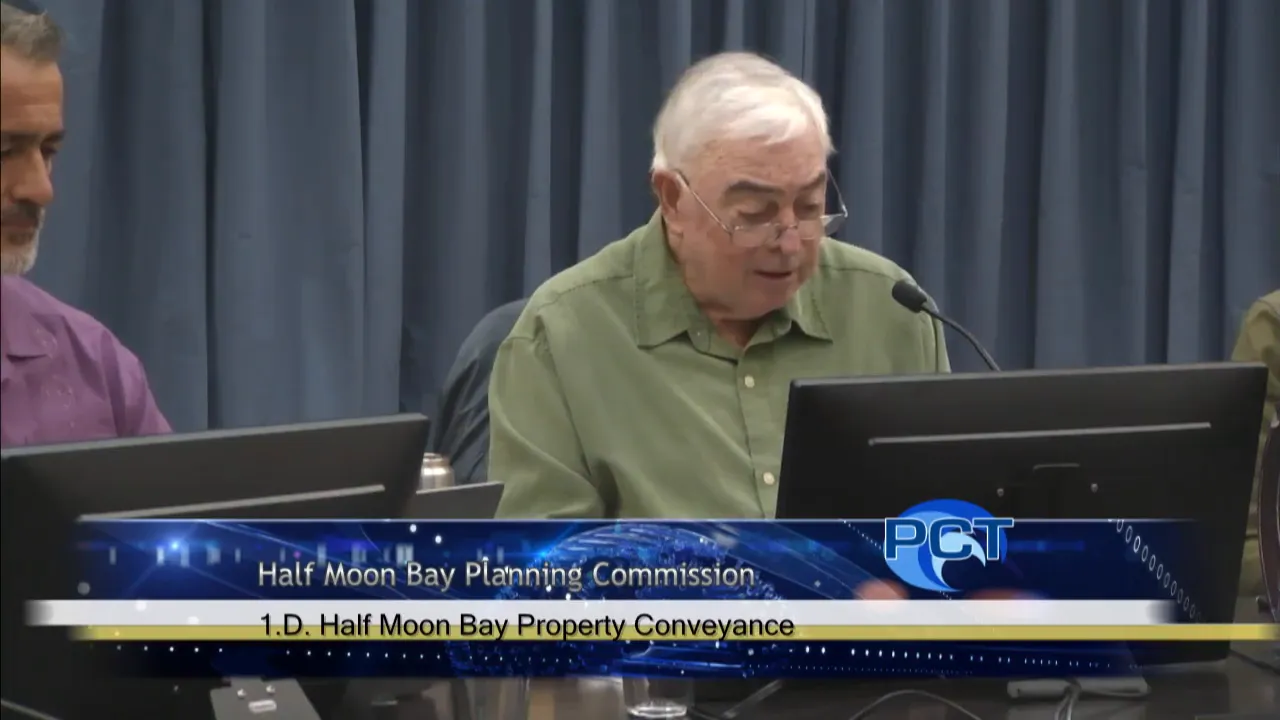
STREAMING COPY IN PREPARATION — RECORDING AVAILABLE FROM THE ORIGINAL SOURCE
Half Moon Bay Planning Commission Meeting - April 10, 2025
Note: The agenda and transcript indicate the meeting date as April 8, 2025, but the user instructed to use April 10, 2025.
Introductory paragraph: The meeting covered a study session on coastal development permit findings, a public hearing for a building improvement project at 334 Purissima Street, adoption of a local hazard mitigation plan into the Safety Element, and a general plan conformance determination for property conveyance to the Coastside Land Trust. All actions were approved unanimously.
Study Session: Coastal Development Permit Findings
- Deputy City Attorney Marlene Dalinger presented on discretionary versus ministerial approvals, requirements for making findings, and specific findings required for coastal development permit (CDP) approvals, including conformance with the Local Coastal Program. She explained that findings must bridge the analytic gap between evidence and the decision, and that the commission has broad discretion in interpreting subjective policies. Commissioners asked about the role of precedent, substantial conformance, and the ability to modify conditions of approval. Staff clarified that conditions must be tied to implementing LCP policies and be roughly proportional to impacts.
Public Hearing: 334 Purissima Street – Coastal Development Permit, Architectural Review, and Use Permit
- Project Description: Change of use from auto body repair to industrial storage, creation of two tenant spaces (locksmith business and construction material storage), exterior improvements including new doors, windows, standing seam metal roof, landscaping, ADA upgrades, and closure of a side opening. The project requires a use permit because the proposed use is conditional in the commercial downtown zone.
- Staff Recommendation: Approve with findings and conditions, but strike condition A7 (hours of operation) as the businesses have no public interface.
- Public Comment: None.
- Commission Deliberation: All commissioners expressed strong support, noting the need for light industrial storage in the city, the aesthetic improvements, and the removal of the mansard roof. Vice Chair Gorn made a motion to approve with the strike of condition A7, seconded by Commissioner Rems. The motion passed unanimously (5-0).
Adoption of Local Hazard Mitigation Plan into the Safety Element
- Staff Presentation: Director Lakeho explained that AB 2140 allows local governments to avoid paying 6.25% of FEMA disaster recovery costs if they adopt their Local Hazard Mitigation Plan (LHMP) into the Safety Element. The City Council adopted the 2021 LHMP in 2021, and this action recommends incorporating it by reference into the 1991 Safety Element. The Safety Element update is underway but not complete.
- Discussion: Commissioners questioned the optional nature, the outdated information in the plan (e.g., hazard maps, staff names), and the process. Staff confirmed the plan is already adopted and the action is to comply with state law. A motion to recommend approval passed unanimously.
General Plan Conformance Determination for Property Conveyance to Coastside Land Trust
- Staff Presentation: The city proposes to convey 21 parcels in the North Wavecrest Planned Development area to the Coastside Land Trust for habitat restoration, wetland protection, and trail improvements. A finding of conformance with the General Plan and Local Coastal Land Use Plan is required. Staff identified relevant LUP policies supporting conservation, public access, and the lot retirement program.
- Discussion: Commissioner Hernandez disclosed ex parte communication with the Land Trust COO. Questions addressed deed restrictions, appraisals, and the legal description discrepancy for two parcels. Staff noted the parcels were acquired via tax sale, and the city is donating those serving a public purpose while selling others to recover costs for the mitigation fund. The city is working to correct deed discrepancies. The Wavecrest CDP has already been approved. A motion to adopt the resolution passed unanimously.
Key Outcomes
- Study Session: No formal action, but educational topic completed.
- 334 Purissima Street: Coastal Development Permit, Architectural Review, and Use Permit approved with condition A7 struck. Unanimous vote.
- Local Hazard Mitigation Plan: Planning Commission recommended City Council authorize amendment to the Safety Element. Unanimous vote.
- Property Conveyance: General Plan conformance finding adopted. Unanimous vote.
- Director’s Report: Staff announced a new policy to respond only to public comments submitted by 3:00 PM Monday before meetings; comments after that will be forwarded without responses. Recent permits issued include a second-story addition and an emergency CDP for the coastal trail reroute at Murata Road. Upcoming training on April 29 on transportation topics.
Meeting Transcript
Welcome to the April 8th, 2025 Planning Commission meeting. We are live on Channel 27, and as well as interpretation and Pacific Coast TV. Those that want to speak have three minutes to speak and can be we'll take the uh attendees here in the audience first and then go to Zoom. Um I think that's pretty much it in a nutshell. So I'll call the meeting to order and invite everyone to join in the Pledge of Allegiance. May we have a roll call, please, Bridget? Yes. Commissioner Rems. Commissioner Gossett? Here. Commissioner Hernandez. I am present. Vice Chair Gorn. I'm here. And Chair Reddick. Here. All Planning Commissioners are present this evening. At this point, we invite members of the public to address the commission on anything whatsoever other than items on our agenda tonight. Um double I see no one raising their hand on Zoom or in the room. All right. Well, we won't open public hearing at that point. We'll go to uh item number one A, which is our uh study session on coastal development permanent permit findings. Marlene, are you to lead that for us? I think from the city attorney's office. So good evening, Commissioners. Marlene Dalinger, Deputy City Attorney for City of Half Moon Bay. Tonight is our last installment of a series of such study sessions that we've been doing for the planning commission about planning commission role and decision making and the planning process. So just list of topics here that will come up. Discretionary versus ministerial approvals, requirements for making findings generally. So just list of topics here that will come up, discretionary versus ministerial approvals, requirements for making findings generally, and then some specific information on findings required for coastal development permit approvals, looking at determinations of general plan or local coastal land use plan conformance, and then also I'll say a few words about conditions of approval for coastal development permits. So first, looking at discretionary approvals. So sort of big picture of looking at coastal development permits, many of your meetings, if not most, include project applications or a determination on a project seeking a coastal development permit. And in chapter 18.20 of the city's municipal code, that chapter sets out the process and requirements for considering and approving or denying CDPs. And I'll get into the specifics of those approvals, but first I want to just say that this type of consideration of coastal development permit approval is an example of a discretionary approval. And what is a discretionary approval? So discretionary approvals are ones that involve deliberation and sort of application of judgment. If a project does meet the requirements, the commission makes findings of conformance with city requirements or places conditions on the project and approves it, or it makes findings of non-conformance with the city's requirements and denies the project. So those are the pathways. But city requirements that apply to discretionary project approvals often use subjective language, and therefore they require applying subjective judgment and interpreting the language of a policy to determine whether a project complies with it. A different type of approval are ministerial approvals. These generally don't come to the Planning Commission. These are ones where a city sort of review is essentially applying a checklist or clear objective requirements with fixed standards or measurements to a project. These types of approvals are often issued at a staff level, that's the case in Half Moon Bay, as it does in other cities, though building permits and seeking a permit for an ADU or examples of ministerial approvals. Okay. So looking at again how this applies to coastal development permit approvals. Most development in Half Moon Bay requires a coastal development permit unless there's some specific exemption exempting a project from needing one. And the city's code requires that a CDP be approved, can approved or conditionally approved after the planning commission makes specific findings. And I'll be on the next slide be showing you what those categories of findings are. But first when I say make some big picture points about findings. So when a planning commission decides whether to approve or deny a project, it needs to, based on whether it meets city requirements, the decision needs to be supported by findings.
openpublica.com