Hampton City Council Work Session on November 13, 2024: Vacant Building Registry and Outside Agency Funding
STREAMING COPY IN PREPARATION — RECORDING AVAILABLE FROM THE ORIGINAL SOURCE
Hampton City Council Work Session - November 13, 2024
The Hampton City Council held a work session on Wednesday, November 13, 2024, at 1:00 PM in Council Chambers, 22 Lincoln Street, Hampton, VA. Mayor Donnie R. Tuck presided. Present were Vice Mayor Jimmy Gray, Councilmembers Chris L. Bowman, Steven L. Brown, Billy Hobbs, and Martha Mugler. Councilmember Hope L. Harper was excused (out of town on City business). The agenda included a briefing on a proposed Vacant Building Registry Ordinance, a discussion on the Outside Agencies Funding Program, and a closed session. No regional issues or new business were reported.
Discussion Items
1. Briefing on Proposed Vacant Building Registry Ordinance (24-0484)
Assistant City Attorney II Anne Ligon presented the proposed ordinance. She defined a vacant building as a house or structure continuously vacant for 12 months or more. Key issues from vacant properties include aging neighborhoods (homes passed to out-of-state adult children or held up in probate), pests, disrepair, and squatters. The proposed ordinance mirrors state code (Va. Code) and requires registration if a building has been vacant for more than 12 consecutive months AND meets at least one of three conditions: (1) it is a derelict building (endangering public health/safety, vacant over six months, not connected to utilities), (2) it is a site of criminal blight (drug activity, prostitution, or repeated firearm discharge inside the structure), or (3) an unauthorized person is living in it.
Registration requires the building address, owner/agent contact info, expected duration of vacancy, compliance measures with building/health codes, and proof of a rodent abatement plan. An initial $100 registration fee and a $100 annual renewal fee are proposed, with a $200 civil penalty for failure to register. Enforcement would involve monitoring by codes enforcement and Hampton Police Division, sending notices of violation, and filing warrants in debt in General District Court for civil penalties. State code does not allow criminal penalties.
Council questions:
- Councilman Bowman asked if the civil penalty includes criminal charges; Ms. Ligon said no, state code only allows civil penalties. He also asked about squatters; Ms. Ligon said removal requires a private civil action.
- Councilman Brown asked if the city already has a registry; Ms. Ligon said no, this would be new.
- Vice Mayor Gray asked whether the 12-month vacancy starts anew or can be looked back; Ms. Ligon said the city can look back 12 months with documentation.
- Councilwoman Mugler asked how the $100 fee was determined; Ms. Ligon said state code allows up to $100.
2. Outside Agencies Funding Program Discussion (24-0481)
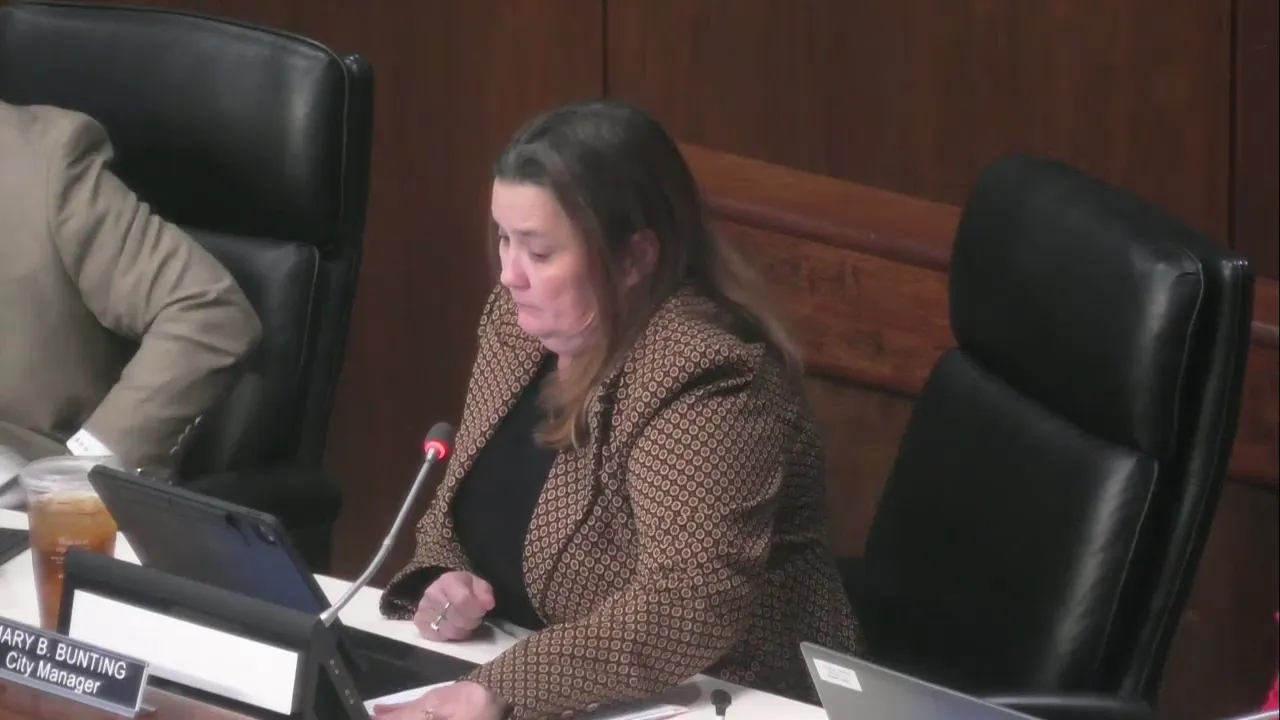
City Manager Mary Bunting reminded Council that in 2008, funding was restricted to agencies with a direct governmental nexus (e.g., food banks, homeless services). She noted updated thinking about expanding to groups aligned with the strategic community plan. Budget Director Lori Green summarized three options:
- Option 1 (short-term): A general funding source allocated competitively throughout the year. Pros: flexibility in amount and priority area. Cons: funding may not be equally distributed; early allocation may exhaust funds.
- Option 2 (short-term): Allocate funding for each strategic priority area. Pros: consistent attention to each area. Cons: limited flexibility; costs vary; increased funding needed to avoid inequity.
- Option 3 (long-term): Funding allocations tied to specific outcome-driven goals in the finalized strategic plan. Pros: targets community-endorsed priorities; builds momentum. Cons: requires reporting requirements, additional staff time, and possibly procurement processes for for-profit providers.
Council discussion:
- Mayor Tuck asked if AI could reduce staff burden for option 3; staff said it is a possibility.
- Vice Mayor Gray expressed concern about a long-standing moratorium on adding new agencies and asked whether existing agencies would be grandfathered or all would reapply. He favored opening opportunities for new agencies aligned with strategic priorities.
- Councilman Bowman suggested capping expansion funding at $30,000–$50,000 per agency.
- Councilman Brown cautioned that expansion becomes competitive, requiring a well-thought-out process to avoid disputes.
- Councilwoman Mugler asked to clarify the short-term vs. long-term distinction; staff explained short-term is for FY26 if desired, long-term depends on completion of the strategic plan.
- Vice Mayor Gray expressed support for option 3 (outcome sourcing) after clarification that it would not replace annual outside agency allocations but would target specific gaps. Mayor Tuck also leaned toward option 3.
No formal decision was made, but the City Manager noted that a decision is needed around this time to incorporate changes into the budget process.
Closed Session
At 1:37 PM, Council made a motion to enter closed session pursuant to Va. Code sections 2.2-3711(A)(3) (real property acquisition at Peninsula Town Center), (A)(6) (investment of public funds in the LaSalle Corridor), and (A)(1) (appointment to the Virginia Air and Space Center Board). The motion carried 6-0 (all present members voting aye). The closed session was held in the Community Development Conference Room on the fifth floor. Council reconvened in open session at 3:15 PM.
Key Outcomes
- The Council took no formal votes on the Vacant Building Registry Ordinance or the Outside Agencies Funding Program; both were discussion items for future action.
- Councilmembers expressed directional support for expanding outside agency funding, with a general leaning toward option 3 (outcome-based funding tied to the strategic plan).
- The Council unanimously approved the motion to enter closed session (6-0) and unanimously certified the closed session (6-0) via Resolution 24-0486.
- The meeting adjourned at 3:15 PM.
Meeting Transcript
Good afternoon and welcome. I'd like to ask our clerk to call the roll, please. Councilman Bowman. Present. Councilman Brown. Here. Vice Mayor Gray. Present. Councilwoman Harper. Councilman Hobbes. Present. Councilwoman Muggler. Present. Mayor Tuck. Present. And Councilwoman Harper is out of town on city business. I'd like to ask our city manager to introduce this afternoon's agenda, please. Thank you, Mr. Mayor. Mayor and Council members. First off, today we have a briefing on a proposed vacant building registry ordinance. This was something that the general that the city council sought in the General Assembly session, and our assistant city attorney to Ann Liggan is going to be the presenter for this item this afternoon. Good afternoon. Excuse me, before you continue. It's better. Okay. I can get closer if you need me to. Alrighty. So we'll start out with the vacant building general definition. It's a house or structure that has been continuously vacant for a period of 12 months or more. All right. And some of our issues presented by vacant housing. Our first would be aging neighborhoods. One of the issues is that older neighborhoods that may have residents who have lived in these homes for a long period of time. These older residents pass on, often leaving their homes to adult children who are sometimes out of state and tend to hold on to these homes for sentimental value and leave the homes vacant. Or they can be held up by probate or other issues, also leaving these homes to be remained to be vacant. This is a problem we often see in our codes enforcement. An owner will pass on, or either not have a will or leave it to an adult child. And then we don't have any information for how to contact this person. Vacant structures are they attract things like pests, rodents. When these structures are not maintained properly, they fall into disrepair, creating property maintenance issues like holes in the roofs, rotting wood, overgrowth, high grass, their issues with keeping the property secure. One of the major issues with a vacant property is squatters. So it had to be vacant for 12 months or more and had to be a derelict building. And if the structure is a derelict building, meets the definition of criminal blight, or if an unwanted person is living in the structure. So a derelict building is defined as a building that might endanger the public's health, safety, or welfare, and for a continuous period in excess of six months, it has been vacant, ordered up, and not lawfully connected to electric service, uh, water or sewer service. Criminal blight is defined as a condition existing on real property that endangers the public health or safety of the residents and is caused by drug use, possession manufacturing, or distributing of legal illegal substances, prostitution, or repeated firearm discharge within the structure, not just outside of the structure has to be inside of the structure. So our proposed ordinance mirrors what state code said state code says. If a building has been vacant for more than 12 months consecutively and meets one of the following, a derelict building, the site of criminal blight, or an unauthorized person is living in the building, then the owner must register the building on an annual basis. Um to register such building, the following must be provided: the address of the building, the name, address, and phone number of the owner, or the owner's agent if they have like a property manager who's managing the building for them, how long the building is likely to remain vacant and why. A description of the measures to ensure compliance with all applicable building health and property maintenance codes and proof that there is an ongoing rodent abatement and prevention plan.
openpublica.com