Hampton City Council Work Session - March 26, 2025: Precinct Changes, Budget Briefing, and Resident Polling Results
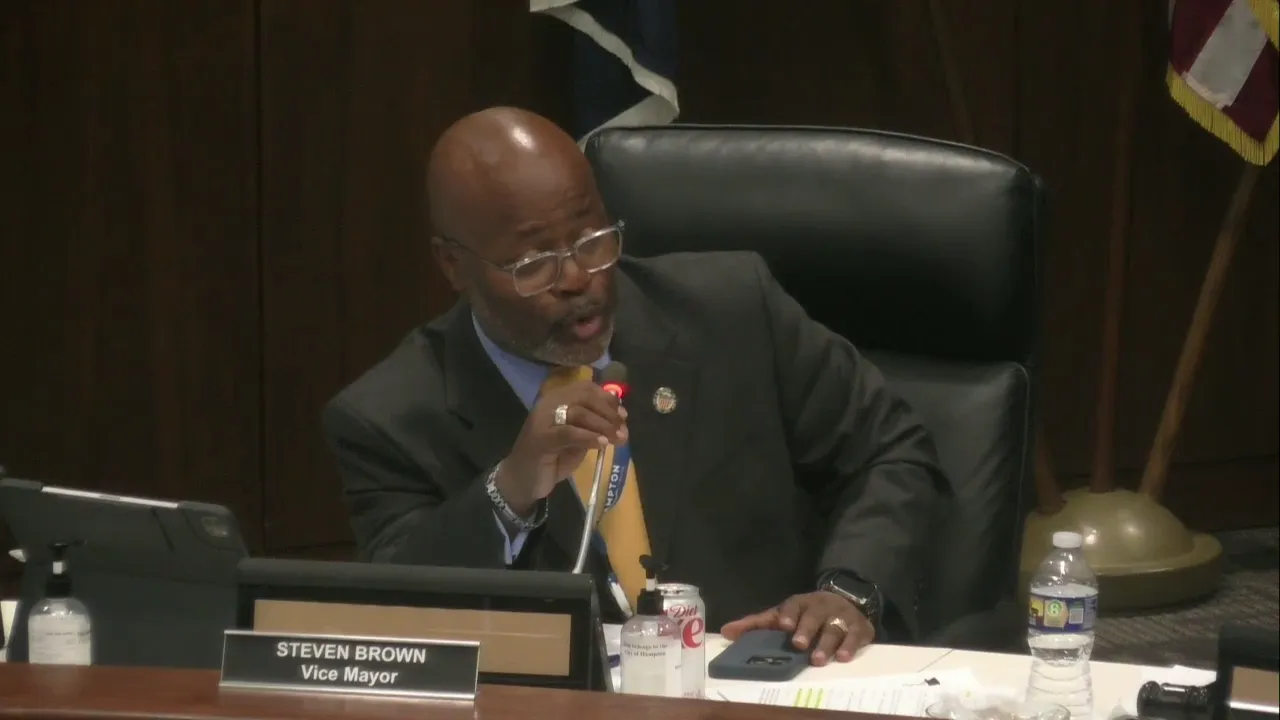
STREAMING COPY IN PREPARATION — RECORDING AVAILABLE FROM THE ORIGINAL SOURCE
Hampton City Council Work Session – March 26, 2025
The Hampton City Council held a work session on Wednesday, March 26, 2025, beginning at 1:06 p.m. (due to technical difficulties) and adjourning at 5:37 p.m. All seven council members were present. The session covered three main agenda items: recommendations from the Hampton Electoral Board regarding precinct and polling place changes, a preliminary revenue estimates briefing for the FY2026 budget, and the results of the I Value resident polling. The council also entered a closed session for legal and personnel matters. No votes were taken on the substantive agenda items, but the council gave direction on the precinct proposals and received information on the budget and polling.
Electoral Board Recommendations on Precinct and Polling Place Changes
The council heard from the Hampton Electoral Board on two proposals: (1) relocating the East Hampton precinct from Phoebus High School to the Hampton University Convocation Center, and (2) a broader set of changes including consolidating or moving several precincts (City Hall, Syms Middle School, Phoebus Library, and Peake/Langley).
East Hampton Precinct Relocation:
- Rebecca Winn (Chair) supported the move, citing infrastructure issues at Phoebus High School (no Wi-Fi, poor cell service, long lines), the location outside the precinct boundary, and the need for equal access. She noted 3,833 registered voters in the precinct (as of February 2024) and that 1,854 voted in the November 2024 election. She stated the Convocation Center would provide better amenities, no additional cost, and would bring the polling place inside the precinct.
- Matthew Scott (Secretary) supported the move, emphasizing the poor conditions at Phoebus High School, the need to address long lines, and the one-time opportunity to improve voting. He noted the change would not occur until 2026 at the earliest.
- Thomas Harmon (Member) supported the move as part of a larger effort to eliminate three “bad” precincts (City Hall, Syms, Phoebus Library) and consolidate services.
Second Recommendation (Multiple Precinct Changes):
- Ms. Winn voted against this proposal, arguing it was driven by one individual (former Republican chair Carl Anderson), that it disproportionately affected black and brown communities, military families, students, and disabled veterans, and that it would create voter confusion. She noted that Asbury and Phillips precincts (the largest) were not included in the changes.
- Mr. Scott and Mr. Harmon voted in favor, citing security concerns at City Hall, lack of handicap parking at Syms, and small size at Phoebus Library.
Council Discussion and Direction:
- Council members expressed concerns about traffic near Hampton University, voter confusion, and the timing of changes given current federal executive orders. Several noted that many citizens had not complained about existing precincts.
- Council members Harper, Mugler, and Ferebee suggested keeping the East Hampton precinct at Phoebus High School and exploring a separate precinct for Hampton University students. Councilman Bowman, Vice Mayor Brown, and Mayor Gray concurred.
- On the second recommendation, all council members except Councilwoman Campbell expressed opposition to making changes at this time. Ms. Campbell saw some benefit in addressing large precincts and early voting lines but agreed not to act now.
- Outcome: The council directed staff to prepare information on creating a separate precinct for Hampton University (requiring at least 500 registered voters) and to return with options. No changes to the current precincts will be advanced; the city attorney will not prepare public hearing notices for the electoral board’s recommendations.
Budget Briefing - Preliminary Revenue Estimates
Chief Financial Officer Karl Daughtrey presented preliminary revenue projections for FY2026, assuming a real estate tax rate of $1.14 per $100 of assessed value (a reduction from $1.15). Key points:
- Total general fund revenues are projected at $469.8 million (a $20.6 million or 4.6% increase over FY2025).
- Recurring revenues: $455.5 million (up $14.9 million, 3.4%). Of that increase, $5.7 million is committed to specific purposes (schools, convention center, etc.), leaving $9.2 million available for council appropriation.
- One-time revenues: $14.3 million (including $5.6 million more than FY2025, largely due to the buy-in fee for the Western Tidewater Regional Jail).
- Primary revenue drivers: real estate assessments (5.7% growth, $6.9 million increase), meals tax (4% growth), sales tax (6.4% growth), lodging tax, and state revenues.
- Risks: Federal policy changes (workforce reductions, tariffs) could impact consumer-driven revenues; the city manager recommends delaying most new spending until impacts are clearer.
- The governor’s vetoes and amendments to the state budget (released March 25) are under review; the General Assembly will reconvene April 2.
- No council action was taken; the manager’s recommended budget will be released April 15.
I Value Resident Polling Results
Director of Media and Communication Dacia Scott presented results from the FY2026 budget engagement campaign. Key statistics:
- 1,141 total respondents (1,085 online surveys, 56 in-person).
- Demographics: 66% female, 32% age 50-64, 66% white, 21% black, 35% from zip code 23669.
- Real estate tax rate: At the start of the survey, 40% preferred $1.14; at the end, 44% supported $1.14. The majority of respondents (over 50%) ended up supporting $1.14 after viewing project lists.
- Courthouse security fee: 72% favored an increase ($10 to $15 or $20).
- Public works fees: 61% wanted to continue current guidance on wastewater; 51% on stormwater; 74% supported legislation to reduce solid waste fees by $0.47.
- Staff compensation: 44% said ensuring competitive wages should be the top priority before other spending.
- Top operating budget priorities: Critical traffic signal system, enhanced training materials for police, upgrading lieutenants to captains, full-time medic firefighters, and IT systems engineers.
- Top capital budget priorities: Housing stabilization, literacy programs, and human resources specialist.
- Lowest priorities: Buck Road Barking Garage, streetcar facility construction, and Green Fleet Initiative.
- The city manager emphasized that the polling is preference-based and not binding; a final report will be provided to council.
Closed Session
At 4:20 p.m., the council entered closed session under Virginia Code §§ 2.2-3711.A.1, .3, and .7 to discuss an appointment, real property acquisition in Coliseum Central, and legal consultation on pending litigation. The motion passed 6-0 (Mayor Gray absent). At 5:37 p.m., the council certified the closed session and adjourned.
Key Outcomes
- No changes to precincts will be made at this time. The council directed staff to explore creating a separate precinct for Hampton University students and report back.
- Preliminary revenue estimates were presented; no action taken. The manager’s recommended budget will be released April 15, with public hearings April 23 and May 7, and final vote May 14.
- Resident polling results were received for budget consideration; the final report will be provided to council.
- Closed session was held for appointment, property acquisition, and legal matters.
Meeting Transcript
Good afternoon, everyone, and welcome to the Hampton City Council work session. Uh Madam Clerk, will you call the roll, please? Councilman Bowman. Present. Vice Mayor Brown. Here. Councilwoman Campbell, present. Councilwoman Theorby. Present. Councilwoman Harper, present. Councilwoman Mugler, present. Mayor Gray. Present. And so I will ask the city manager to uh introduce the first item on the agenda. Thank you, Mr. Mayor. As you and the council members know, but for the benefit of the public, at our last meeting, you received a briefing from our city attorney about proposed recommendations by the Hampton Electoral Board concerning precinct and polling place changes. And the council indicated that you would like to hear from the electoral board as to their rationale for some of the changes and that you had questions that you would like to ask them. And so I'm I'm pleased to introduce members of the Hampton Electoral Board as well as our our voting registrar who is also here with you with them today. Our voting registrar is Tara Morgan, she's in the audience, and members of our electoral board, our chair Rebecca Wynne, uh Vice Chair Thomas Harmon, and also Secretary Matthew Scott. And so uh they are here to uh I think they may say some things first, but I know you have questions as well, so that you can determine you know whether you wish to proceed with one or both of their recommendations. As Ms. Signor mentioned last time, um the council um is is vested with deciding whether to advance one, both or none of them. There is a process by which you would need to do that, including a public hearing. So there will be no vote today, but we would want to know whether you would like the city attorney's office to prepare the necessary public hearing notices, which would be the next step. And of course, even after council would weigh on that, there's a very there are processes that would require going to the state and having the state approve any such changes. So I'm just briefly summarizing that for the public that may be hearing about this for the first time. Um but today is really just your chance to hear from the electoral board members themselves. Okay. So is that uh Ms. Muyen, are you first up? Should I speak here? You can use the podium if you like. As an initial order of business, the only correction I think uh may be needed is that I'm pretty sure that there are two separate processes by which this can happen. One is through City Council, the other is through an approval process with the um uh attorney general for the Commonwealth of Virginia. It's an either-or, I believe we would have to check the statutory code. I believe it's also available in the code book. Um, but I did take a look at that more recently, and I'm pretty sure it's an either-or, but not both. Um again, I haven't looked at that. I'm just kind of commenting based off of that opening intro. Mr. Mayor, would you like me just to address that point briefly? Okay. So, in any event, an ordinance by council is required. The either-or is for the sort of uh civil rights, the Virginia Civil Rights Act process. There's either an extended public process that you can go through, or the submission to the attorney general for the certificate of no objection. Most localities use the attorney general process because the other process is much more difficult and extended, but in any event, an ordinance by a city council is required. Okay, yeah, I just wanted to add clarity where I thought there might be some. Um introduced and passed by our board. One of the motions was a unanimous vote that we can all speak to with regard to the recommended uh relocation of the East Hampton precinct to the um from Phoebus High School to the Hampton Convocation Center.
openpublica.com