Hampton City Council Work Session: Homelessness, Camping Ordinance, Public Safety, and Budget – May 14, 2025
STREAMING COPY IN PREPARATION — RECORDING AVAILABLE FROM THE ORIGINAL SOURCE
Hampton City Council Work Session – May 14, 2025
The Hampton City Council held a work session on May 14, 2025, covering four major briefings: a regional homelessness study, a proposed camping and storage ordinance, a downtown public safety action plan, and amendments to the Fiscal Year 2026 budget. The session also included a closed session for appointments, real property disposition, and legal consultation. The meeting lasted approximately three hours before the closed session.
Briefing on Homelessness and Housing Instability
- Consultant Griffith (via Zoom) presented key findings of the Virginia Peninsula Homelessness Study, conducted mostly in 2024. The study found that homelessness on the peninsula is increasing, with a projected 15% year-over-year increase in calls from literally homeless households for the next three years. Over 2,000 individuals experience homelessness annually, with Newport News and Hampton bearing the greatest burden. Concerning trends include rising first-time homelessness, higher income brackets falling into homelessness, increasing acuity, longer durations of homelessness, rising chronic homelessness, and significant racial disparities.
- Seven recommendations were made: structural changes for collective impact, fortifying a regional homeless response system, expanding access to housing for households with the most barriers (including delaying emergency shelter investments until rapid rehousing and permanent supportive housing goals are met), investing in a regional financial strategy, eliminating barriers to services, developing an unsheltered response strategy (including a regional outreach strategy), and pursuing long-term housing solutions through zoning changes.
- City Manager Mary Bunting stated that the city does not see the recommendations as an "either/or" and that regional conversations about a shelter continue. She noted that managers have convened human services directors to deliver strategic recommendations within 90 days.
- Human Services Director Dr. Tamra Timoni Porter presented local services, including the continuum of care, definitions of homelessness (literal, imminent risk, etc.), the housing crisis hotline (operating Monday–Friday, 8 a.m. to 7 p.m.), coordinated entry, prevention, outreach, rapid rehousing, permanent supportive housing, and local grant funding. She highlighted challenges: uncertainty of federal funding, limited staffing (three dedicated staff), difficulty in accurate counting (point-in-time count of 412 in 2024, a 14% decrease from 2023), individuals refusing services, and lack of affordable housing.
- Council discussion included questions about demographic data, landlord partnerships, veteran services (VASH vouchers), local versus federal funding flexibility, and the potential for using technology (e.g., AI) to improve the housing crisis hotline. Councilmember Campbell noted that transitional housing can disqualify individuals from permanent housing assistance.
Briefing on Proposed Camping and Storage Ordinance
- Senior Deputy City Attorney Brandy Law presented a proposed ordinance prohibiting camping, sleeping, or storing items on public property, following the U.S. Supreme Court decision in Johnson v. Grants Pass. The ordinance defines "camp" broadly and includes exceptions for authorized use and beach hours. Violation is a Class 1 misdemeanor, but police must first give a verbal warning and provide information on alternative accommodations. Property stored in violation may be seized and held for 30 days (trash, hazardous items, or weapons may be disposed of immediately).
- Council discussion focused on the definition of "reasonable time" to comply, with several members requesting a minimum time frame. Councilmember Mugler suggested that some details could be handled in policy rather than the ordinance. The city attorney agreed to specify a minimum time and include the housing crisis hotline as a required notification. Council also discussed littering, enforcement on private property, and the importance of providing resources to officers. Council agreed to advance the ordinance with suggested changes.
Briefing on Downtown Public Safety Action Plan
- Police Chief presented the plan following recent shootings (three fatal shootings in the downtown area in six months) and a large disturbance at Buckroe Beach. Immediate actions include reassigning two officers to downtown from 6 p.m. to 2 a.m., conducting nightclub task force inspections, and offering free security assessments. The chief also described the Buckroe Beach incident: a pop-up party advertised via social media drew about 400 students, resulting in fights and the beach closure. Several students were charged with assault and disorderly conduct. The city is coordinating with schools and monitoring social media proactively.
- Council discussion included concerns about recurrence of large gatherings and the need for earlier preparation. City Manager Bunting noted that the city manager's office and the Office of Youth and Young Adult Opportunities will work with police to provide proactive communication and organized activities. Vice Mayor Brown suggested using school channels to reach students and parents with preventive messages. The chief acknowledged that 400 unruly students are difficult to manage even with advance notice.
Legal Tools for Addressing Problem Businesses
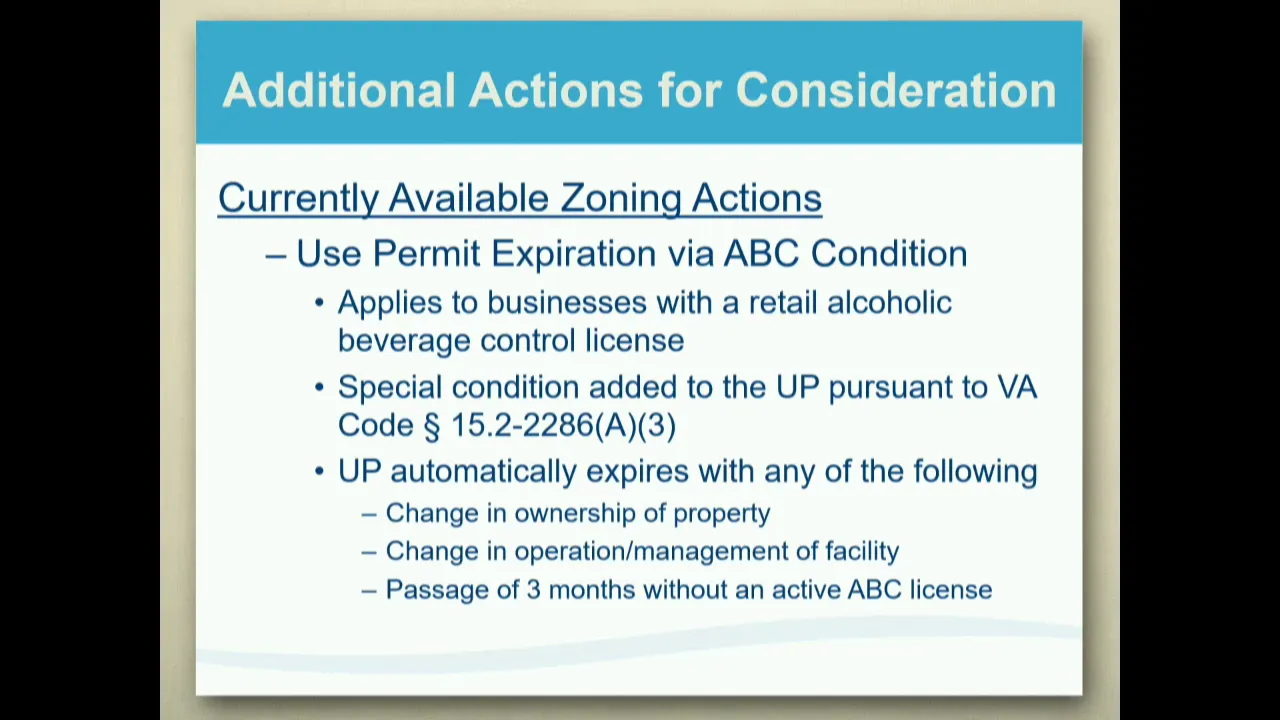
- Assistant City Attorney Jessica Krauss outlined existing land use tools: revocation of use permits (currently requires a criminal conviction for a zoning violation), amendment of use permits, and conditions such as automatic expiration of use permits if an ABC license is inactive for three months. She presented options for strengthening tools: adding a period of validity for use permits (e.g., two-year renewal), creating a process for council-initiated amendments, establishing clear revocation procedures, and revising standard conditions to be more enforceable (e.g., requiring HPD approval of security plans).
- Assistant City Attorney Ann Lingen presented nuisance and blight actions under Virginia Code, including citizen petitions to impanel a grand jury.
- Council discussion emphasized the need for more robust, consistent conditions for use permits, especially for nightclubs and entertainment venues. Vice Mayor Brown proposed a tiered enforcement system (e.g., warnings, reduced hours, revocation) to build a case over time. Councilmember Campbell raised health department violations as a potential basis for revocation. Council expressed support for staff to develop stronger, cookie-cutter conditions and a clearer revocation process.
Budget Discussion: FY2026 Amendments
- City Manager Bunting announced that additional revenue from two sources will allow restoration of cuts and a higher wage increase. The city assessor identified $750,000 in supplemental real estate assessments from large projects receiving certificates of occupancy after the land book was finalized. Hampton City Schools, benefiting from the state's removal of the support cap, agreed to increase reimbursements to the city by $504,000. Total new revenue: approximately $1.254 million.
- Interim Budget Manager Angelique Schenck proposed using these funds to restore the Safer Communities and Community Violence Prevention Grant activities (vetoed by the governor) and to increase the general wage increase for city employees from 3.5% to 4%. Administrative amendments with no net impact were also presented, including moving funds for the Elizabeth Lake Special Assessment and Virginia Air and Space Science Center, and placing vetoed grant funds into contingency pending possible restoration.
- Council expressed support for the amendments, which were to be adopted at the evening meeting.
Key Outcomes and Next Steps
- Camping and Storage Ordinance: Council directed staff to advance the ordinance with revisions, including a minimum reasonable time for compliance and inclusion of the housing crisis hotline in warnings. The ordinance will be brought back for a vote at the June meeting.
- Downtown Public Safety: The action plan is in effect. Staff will continue to develop proactive messaging and coordinate with schools, and the legal team will work on strengthening use permit conditions and revocation processes.
- Budget: The FY2026 budget will be adopted at the evening session with the proposed amendments, restoring violence prevention programs and providing a 4% wage increase for city employees.
- Closed Session: Council voted unanimously to convene a closed session under Virginia Code Sections 2.2-3711.A(.1), (.3), and (.8) to discuss appointments, real property disposition in the Hampton Roads Center area, and legal consultation on a federal grant. The open meeting was adjourned into closed session at 4:00 p.m.
Meeting Transcript
Good afternoon and welcome to the Hampton City Council work session. I'd like to ask the clerk to call a role, please. Councilman Bowman. Present. Vice Mayor Brown. Here. Councilwoman Campbell, present. Councilwoman Farabee. Councilwoman Harper. Present. Councilwoman Muggler. Present. Mayor Gray. Present. And we have several presentations on our agenda this afternoon. And so I'm going to turn it over to City Manager to introduce the first. Thank you, Mr. Mayor and Council members. The first item up today, and actually it really encompasses a couple different presentations, is a briefing on homelessness and housing and stability. Council may recollect that a regional study was commissioned by the City of Newport News, but with our excuse me, support and the support of other cities and on the peninsula some time ago. I think it was in July of last year, it began. And that report was recently concluded. Newport News City Council got a briefing on the study findings at their meeting yesterday, and we had asked the consultants to come today and present to you. So you will be receiving you know a nearly identical report, with the only differences being maybe some nuances about the Hampton information versus the Newport News information. Once we complete that presentation and make a few remarks and answer your questions about that, we'll then transition into a briefing from our human services director who's in the audience, Dr. Tamra Timoni Porter, who will talk about the things that we do currently on a local level to try to work with people who are dealing with housing issues. Whether it, you know, it's someone who is maybe has a place to stay, but it's not a permanent place to stay, they're couch surfing with a friend or family member all the way to the people that you find sometimes actually literally living in homeless encampments or what have you. And we'll talk about what we've been doing, what we are doing, and what we're trying to do in the future in that regard. So it's going to be a combined presentation, starting at the regional level and then transitioning into a Hampton specific level. Um, who else is there with him? Uh, we had to do this by Zoom because of some uh personal travel timing issues, and Newport News also received this from Zoom uh yesterday as well. With that, I'm pleased to turn it over to Mr. Griffith. Thank you for letting me be here today. Um my colleague Jonathan, uh he's on bereavement leave. Uh he may attempt to pop into this meeting today if possible, but if not, um I'll be giving the presentation to everyone. Um here today to talk about the key findings and recommendations uh from the Virginia Peninsula Homelessness Study. Um that was conducted mostly in 2024. Um so we'll get started. First, I want to acknowledge um and thank the City of Hampton, uh, the mayor, city manager, and this council uh for your openness and willingness to participate uh and be a partner in this study. Um the study, the robustness of the study would not have been possible without your participation as well as all the participation, participation from all localities on the Virginia Peninsula. Want to thank Newport News for commissioning the study as well. Uh, and participation from York County, City of Williamsburg, James City County, Picosan, as well as partners from the homeless response system, including the Planning Council, uh, and the Greater Virginia Peninsula Homelessness Consortium, uh, which Hampton is a part of. So these were homeless study objectives. Um first was to analyze the root causes of homelessness on the peninsula and gain an understanding of what uh is causing homelessness. First was to analyze the root causes of homelessness on the peninsula and gain an understanding of what is causing homelessness. Two was an assessment of services to be able to identify gaps in services and needed changes to the response system as a whole. And three was to be able to optimize resources. That way the scarce resources available to the homeless response system are having the maximized impact as possible. So this is our approach within the study.
openpublica.com