Hampton City Council Work Session: Poverty Briefing and Community Meeting Policy - May 28, 2025
STREAMING COPY IN PREPARATION — RECORDING AVAILABLE FROM THE ORIGINAL SOURCE
Hampton City Council Work Session: Poverty Briefing and Community Meeting Policy - May 28, 2025
On May 28, 2025, the Hampton City Council met for a work session with all seven members present. The council received a detailed briefing on poverty in Hampton and discussed options for strengthening the city's community meeting policy for legislative land use applications. After the briefings, the council unanimously approved a motion to enter closed session and later certified that session before adjourning. Note: The agenda listed a 1:00 p.m. start time, while the minutes record a 6:00 p.m. call to order; the official meeting timestamp is 18:00:00 UTC.
Briefing on Hampton's Poverty Landscape
- City Manager Mary Bunting introduced the briefing, led by Deanna Valentine, Director of Economic Empowerment and Family Resiliency.
- Hampton's poverty rate is 13%, slightly above Suffolk and below Newport News, Norfolk, and Portsmouth. Unemployment is about 4.2%.
- Median household income in Hampton is $67,758, compared to Virginia's median of approximately $90,974—a gap of more than $23,000.
- The ALICE (Asset Limited, Income Constrained, Employed) population, or working poor, makes up 40% of the city's population; combined with those in poverty, more than half of the city is financially struggling. Statewide ALICE average is 29%; in Hampton, 31% of households are ALICE.
- Poverty is distributed in scattered pockets rather than concentrated entire neighborhoods. Historic Phoebus has a median income of $30,428, versus $90,000–$97,000 in nearby areas—a difference of about $60,000.
- Ms. Valentine identified barriers: disconnects between residents and providers, budget cuts and staffing shortages, systemic barriers (repeat evictions, criminal records), competing priorities, and social complexity.
- Proposed strategies: a centralized, updated resource guide or app; the Hampton Stone Soup Initiative roundtable; targeted workforce training with Virginia Peninsula Community College; living-wage employment; guaranteed income pilots modeled on Richmond and Alexandria ($500 per month); expanded affordable childcare; ghost kitchens and community marketplaces; repurposing existing spaces for temporary housing.
- The two initial workforce info sessions had very low turnout: three attendees at the first and one at the second. Council members emphasized a two-pronged outreach strategy, using mail, neighborhood associations, churches, and direct neighborhood events.
- Council commended the resource-rich nature of Hampton but expressed concern that the poverty rate exceeds state and national averages. City Manager Bunting noted the benefits cliff as a structural disincentive.
Briefing on Options for Community Meeting Policy
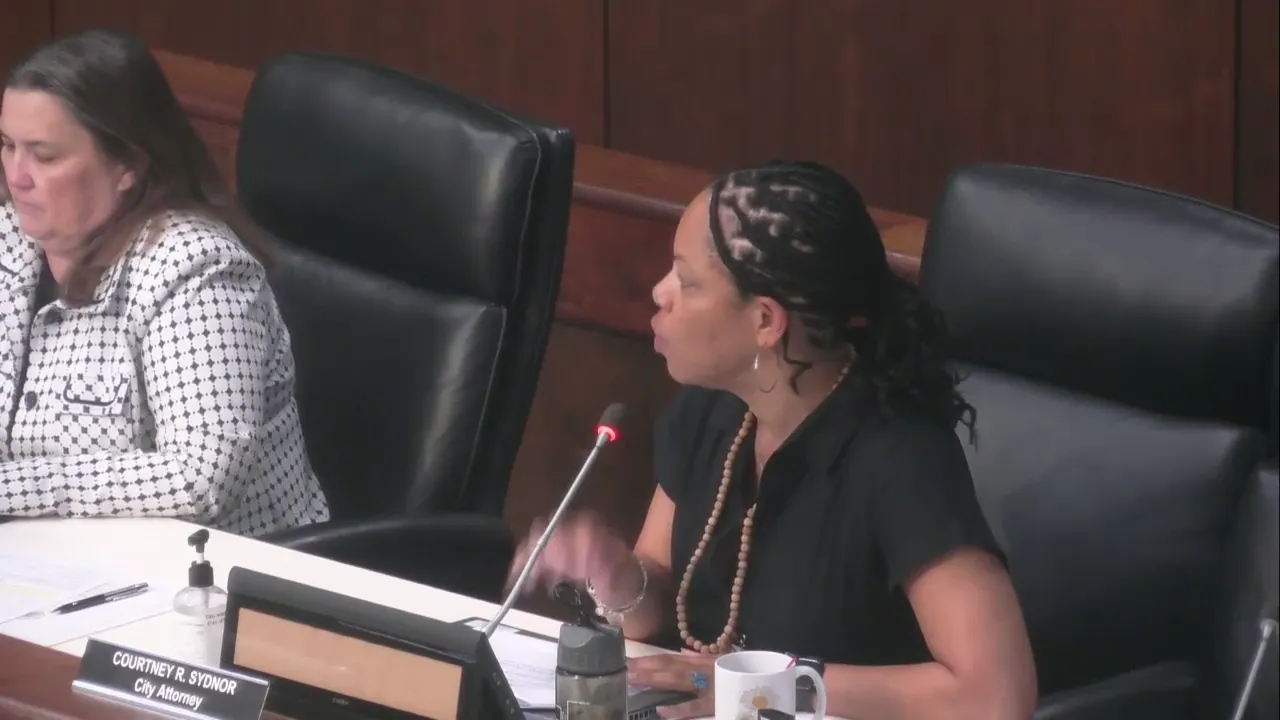
- Presenters: City Attorney Courtney R. Sydnor and Community Development staff (the minutes refer to David Lynch, while the transcript and presentation credit Steven/Stephen Lynch).
- Currently, community meetings are strongly encouraged but not required for rezoning and use permit applications. The council asked whether a legal requirement could be imposed.
- Three options were presented: (1) require meetings for all rezoning and use permit applications with no exceptions (Norfolk's model); (2) require meetings but allow waivers; (3) maintain the current encouragement-only practice.
- Norfolk's model mandates a neighborhood meeting for all development applications reviewed by the Planning Commission. Applicants can partner with a neighborhood organization or host their own with prescribed notice.
- Potential waiver categories: city, HRHA, or EDA-owned properties; designated business parks; public education institutions; uses aligning with land use plans; non-residential adjacent areas; and no anticipated traffic impact.
- Notice currently uses a three-quarter-mile radius. State code requires written notice to adjacent property owners and those across the street, with a five-day notice period for Planning Commission hearings; council discussed setting a longer standard.
- Council feedback generally supported a mandatory requirement with limited waivers, particularly for public safety-sensitive uses (e.g., covert operations) or where the city or an affiliate is the applicant. There was concern about too many waivers and inconsistency. Several members proposed adding electronic feedback windows and standardizing timelines.
- City Manager Bunting noted the requirement could add time to the development process, but council members believed early notification to developers would mitigate that.
Closed Session and Certification
- The council voted unanimously (7-0) to enter closed session at 3:20 p.m. pursuant to Virginia Code Sections 2.2-3711.A(.1), (.3), and (.8), to discuss an appointment to the Community Policy and Management Team (CPMT) and potential real property acquisition in the Buckroe and Phoebus areas, with legal consultation.
- After reconvening in open session, the council voted unanimously (7-0) to approve a resolution certifying the closed session. The meeting adjourned at 4:25 p.m.
Key Outcomes
- The poverty briefing was informational; no formal action was taken.
- Council directed legal and community development staff to draft a formal community meeting policy with mandatory meetings for rezoning and use permit applications, limited waivers for public safety-sensitive and publicly owned land uses, and clear notification standards. The draft will be brought back for council review.
- The council unanimously approved the closed session motion and the certification resolution.
Meeting Transcript
Good afternoon and welcome to Hampton City Council Work Session. Madam Clerk, will you call the role, please? Councilman Bowman. Present. Vice Mayor Brown. Here. Councilwoman Campbell. Present. Councilwoman Fairby. Present. Councilwoman Harper. Present. Councilwoman Muggler, present. Mayor Gray. Present. And we have two presentations this afternoon. I'm going to uh ask City Manager to uh introduce the first one. Thank you, Mr. Mayor. We're very excited to give you an update presentation from our director of economic empowerment and family resiliency, Miss Deanna Valentine. This is a presentation she's done for some community groups most recently, I believe. Well, maybe there's been some that I'm not aware of, but the Macedonian Call Group that is a group of faith-based leaders. Uh they were very pleased with the presentation, and I we thought it would be good not only for the full council, but more importantly for the larger community to see the work that Ms. Valentine is doing and how we're approaching the work of trying to lift more people out of poverty and some of the challenges and barriers that people who are in poverty find when they try to move from poverty to self-sufficiency. It is it is one of the council's strategic priorities, and it is something that we want to address as a larger community. It's not something government alone can address. So as we as I start going through this presentation, sort of keep in mind where we are in regards to the rest of the region for poverty and some of the initiatives that we might potentially look at. It's very unique, but when it comes to poverty, it's even more unique specifically because there are not entire communities that are entrenched in poverty in the city. There are more pockets of poverty. So we're hovering somewhere about 23,000 less than the state median income. So that gives us it shows us that we have some opportunities to not only increase the median income for our households, but to also look at attracting employment and providing skills and training to our our residents so that they would be able to work up to that median household income and even be able to surpass that. Again, you will see on here highlighted in purple where we are above, you know, where we're we're in the middle. Um Mayor Gray mentioned during um some of the the budget information sessions that Hampton has been in the middle, in the middle in regards to salary, and this also shows where we're in the middle in regards to median income. When we look at our poverty landscape, we see that there is a correlation between poverty and crime, but there's also a correlation between poverty and where we see that female-led households tend to be more highly impoverished than those households that are either headed by two household members, two heads of households, or by male household members. The Alice population, as you all may know, is asset limited, income constrained, and employed. The individuals that are in this population are those people that are classified as the working poor. These are people that don't necessarily qualify for state benefits like SNAP or Medicaid, but also don't necessarily make enough money to get out of the situation where they currently are. And so any sort of a critical illness vehicle might need repairs. Housing repairs could very easily slide these individuals and these families backwards into poverty from where they've so hard tried to work out of. So on this slide, you can see that you know, black households make up the majority of people that are living in poverty. Our Alice households for the whole city is 31%. When we look at the Alice households in comparison to the people that are currently in the families that are currently living in poverty, we see that people of color and minorities tend to make up a larger portion of both those people living in poverty and the Alice population. The state average for the Alice population is 29%. So we're we have more people and more families living in that Alice threshold, the working poor than the state currently has as a whole. So I I went through that section a little bit quicker because I wanted to be able to spend more time on what poverty looks like, providing a little bit more texture to it, a little bit more depth to it, so that we start to realize that poverty is not just about finances, it's everything that contributes to poverty, so that we're we're not we're having a full, you know, 100% view of what we can do to be able to combat it. So when we look at situational contributors to poverty, there are disconnects. So over the last, I guess, six months at this point, one of the things that I have been able to identify is that there is a disconnect between the people that need the benefits and the people that are providing the benefits. Hampton is resource rich. However, the people that need the benefits don't necessarily know where to reach out, they don't necessarily know who to connect with. And then that disconnect gets even that gap gets even broader when there's a lack of communication or a lack of follow-up.
openpublica.com