Hampton City COVID-19 and School Reopening Forum - February 18, 2021
STREAMING COPY IN PREPARATION — RECORDING AVAILABLE FROM THE ORIGINAL SOURCE
Hampton City COVID-19 Update and School Reopening Forum
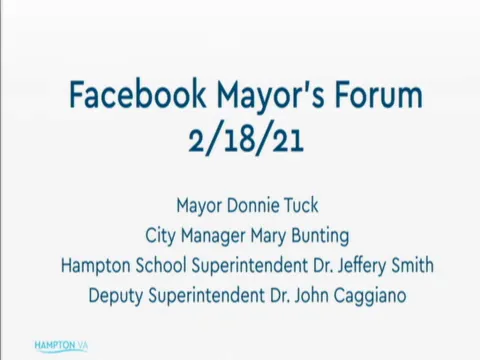
On February 18, 2021, Mayor Donnie Tuck hosted a Facebook Live forum with City Manager Mary Bunting, Communications Strategist Robin McCormick, Hampton City Schools Superintendent Dr. Jeffrey Smith, and Deputy Superintendent Dr. John Caggiano. The forum provided updates on COVID-19 metrics, vaccination progress, and detailed plans for expanding in-person learning in Hampton City Schools.
COVID-19 Metrics and Vaccination Update
- Hampton had 8,275 total COVID-19 cases and 88 resident deaths as of the update.
- The seven-day moving average of new cases had dropped to approximately 50 cases per day, down from about 140 in late January, but positivity remained high at about 18–19%.
- Vaccination numbers: about 16,000 Hampton residents had received a first dose and 2,500 were fully vaccinated. The region vaccinated over 5,000 people at the Hampton Roads Convention Center through a partnership with the health district.
- Virginia's weekly vaccine allocation increased to about 129,000 doses, with Hampton receiving roughly 1,575 doses per week. City Manager Bunting noted that military and federal partner vaccinations were not yet reflected in state numbers.
- Over 1,900 Hampton City Schools staff members had been vaccinated.
School Reopening Plan
- Superintendent Smith announced three key dates: February 22, March 8, and March 15, 2021.
- February 22: Pre-K, kindergarten, and select students in self-contained special education settings return.
- March 8: Grades 1, 2, 3, 6, and 9 return.
- March 15: Grades 4, 5, 7, 8, 11, and 12 return.
- Instructional models: Pre-K uses one teacher for both in-person and virtual students; elementary uses separate in-person and virtual teachers; secondary uses a concurrent hybrid model with SWIVL camera technology that allows teachers to move around and engage both in-person and virtual learners simultaneously.
- Mitigation strategies: universal mask use, physical distancing (minimum 3 feet, targeting 6 feet where possible), handwashing, cleaning/disinfection, contact tracing, and HEPA air purifiers in every classroom.
Public Questions and Comments
- Parents asked about switching between in-person and virtual learning. Officials responded that secondary students may have flexibility to move between formats, while elementary changes may require a teacher change and depend on student-to-teacher ratios.
- Parents expressed concerns about teacher vaccination timing, temperature checks, and communication of COVID-19 cases. Officials explained that random temperature checks occur, and trained nurses follow contact tracing protocols with direct notification of affected individuals.
- Other questions covered SOL testing (will be administered), summer school (planned and not mandatory), after-school programs (continuing in collaboration with the city), athletics and activities (details on school website), and small business relief (waiting on federal congressional action).
Key Outcomes
- Hampton City Schools will proceed with the phased reopening schedule as announced.
- SOL assessments will be administered this year, as no federal waiver was granted.
- The city will offer summer learning programs with potential expansion based on learning-loss data.
- The new state vaccination registration website and phone bank are available; officials urged residents to verify their registration.
- Further guidance on small business relief awaits federal COVID-19 relief package decisions.
Meeting Transcript
Farm Bureau Federation. Since 1926, Farm Bureau has been working to preserve Virginia farms and our rural heritage. Visit our website at VAFB.com. Hello everyone and welcome to Real Virginia, a show about Virginia agriculture and the people who produce the wonderful local products we enjoy. Brought to you by the Virginia Farm Bureau. Farmers dealt with a more familiar challenge than COVID-19 last year. Bad weather. Chef Tammy Brawley shows us how to make a palate-pleasing fresh pesto. And we visit Scenic Highland County in this week's County Agricultural Close Up. Atlantic to my heart. Welcome back to Real Virginia, everyone. We're coming to you this week from Hill Farm in Louisa County, where it's cold and dry. But last year, 2020 was record breaking for Virginia rainfall. Ricky Gibson has more on how it affected farmers and their crops. While 2020 was a remarkable year for everyone, Virginia farmers dealt with an old nemesis. Excessive moisture. In addition to seeing one of the warmest years on record in the old Dominion, several localities received record breaking rainfall, and rainfall statewide was above average. For instance, 62.65 inches of rain fell in Roanoke last year, the most ever recorded. Farmers in the Richmond area saw the third highest level of precipitation in the books. Farmers in Southside Virginia said the trouble started last spring and just got worse. We had significant amounts of rainfall in both May and June, specifically the third week of May and the third week of June. It rained pretty much all week, both those weeks of each month. And to survive the summer, and it doesn't like too much water too fast. So obviously, in a perfect world, we prefer June to be dry and uh July to be wet. But we had the exact opposite this year. Um right at planting, we had a frost the second week in May, which we later found out at the end of the season was more detrimental than we thought to begin with. The late freeze in March kind of slowed field work up, slowed crops up that were already in the field. Um the organic produce we put in the field around April the 1st. Um that was growing well. We started and then we planted tobacco after that. Late, late April, early uh May. Um, everything was growing well, and then we got to June. In June, the second week of June, I believe, we had about a week of rain, solid. And so with the organic produce in the field, the cabbage especially, cabbage grows from the inside out, and it grew so fast in that week that a lot of it burst and split. And so that's not marketable. So I lost probably 3,000 pounds to the acre of organic cabbage in the field due to the excess of rain from that one week. It's easy to see how excess rain can damage crops. But growers say weather extremes can affect an entire crop season and beyond. We get into late June, it turns dry. And uh it got dry normally with that. Tobacco is starting to fill out, starting to come in the top in July. And so we started to have to irrigate in at least in my area. Some other areas weren't as dry. Um, we had to irrigate for about two weeks or so. Then it started raining again. And that was helpful for the tobacco, but say my neighbor that I partner with with uh old Dominion Organic Farms, he had squash in the field. Well, all that excessive rain brought on disease in the field, and he lost a lot of his squash production. Um with that dry spell and then the wet spell. I believe it hurt the uh quality of the tobacco that we had in the field. Um, a lot of growers had fields where the some spots in the field were still green at at harvest and all the spots were ripe and yellow like you wanted it to be overright.
openpublica.com