OPENPUBLICA · PUBLIC MEETING RECORD
Record of Proceedings
Heber City Council Meeting - July 21, 2026
City Council — Tuesday, July 21, 2026
BodyHeber City, Utah
SessionCity Council
DateTuesday, July 21, 2026
StatusFILED
Video Record
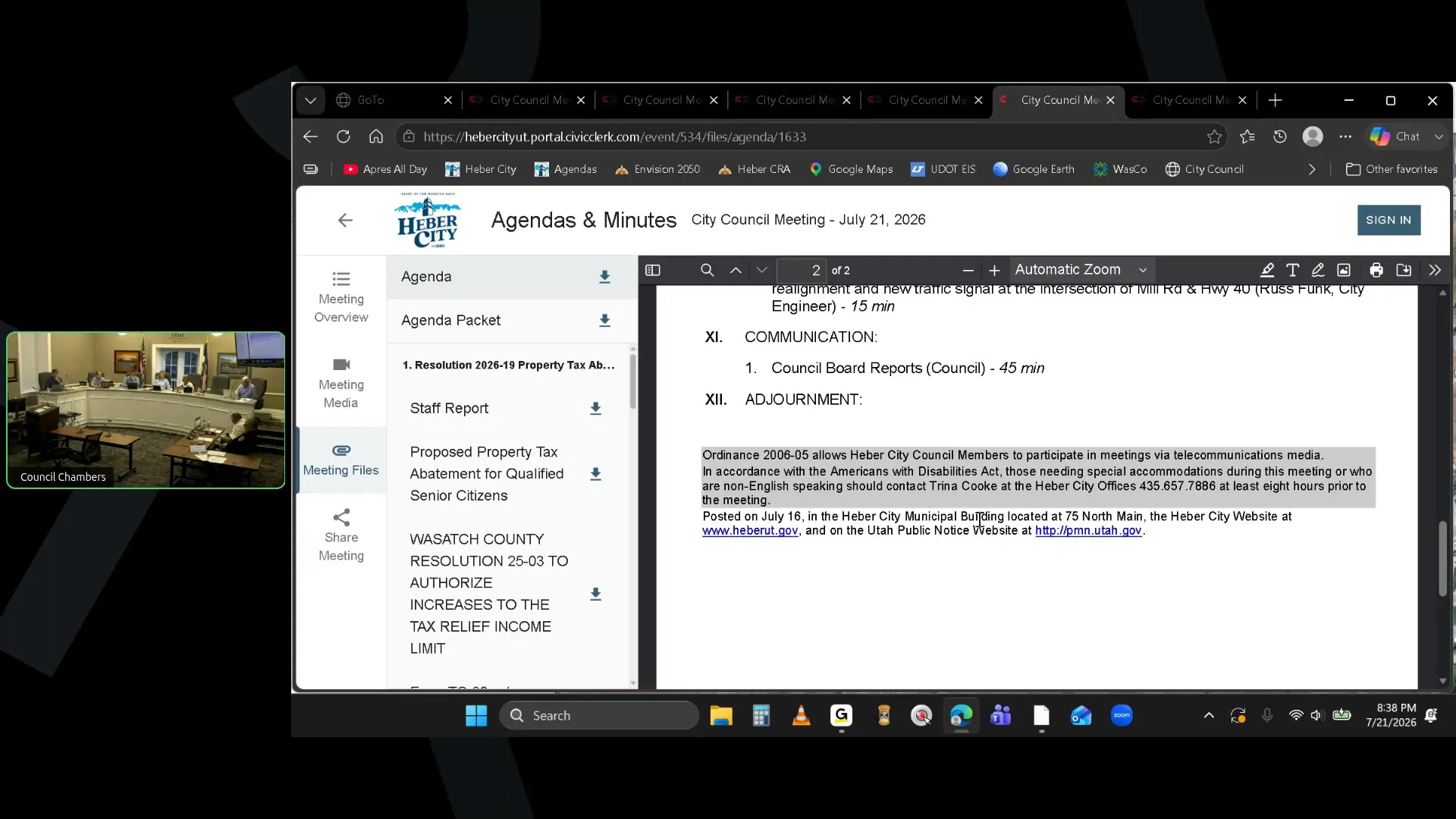
STREAMING COPY IN PREPARATION — RECORDING AVAILABLE FROM THE ORIGINAL SOURCE
Transcript — Verbatim
Speaker numbers apply only to this recording. Names come from transcript evidence. “Possibly” marks uncertain attribution.
Discussion Breakdown — Share of Meeting
Engineering And Infrastructure18%
Public Engagement16%
Affordable Housing12%
Water And Wastewater Management8%
Procedural6%
Public Safety5%
Environmental Protection4%
Transportation Safety4%
Historical Preservation4%
Summary of Proceedings
Heber City Council Meeting - July 21, 2026
The Heber City Council held a work meeting at 5:30 PM and a regular meeting at 6:00 PM on July 21, 2026. The work meeting focused on a proposed property tax abatement for senior citizens. The regular meeting included the swearing-in of a new police officer, a public hearing on a land vacation, and action items on a salt storage structure replacement and a UDOT betterment agreement for intersection improvements. Council members also gave extensive reports from various boards and committees.
Consent Calendar
- Approved the June 16, 2026 and July 7, 2026 city council meeting minutes with a correction: changed "resection basin" to "retention basin" on page two of the June 16 minutes. Motion passed 5-0.
Public Comments & Testimony
- Wasatch High School Marching Band (via email read by Council Member Barney): Requested that the city not ban fireworks during Pioneer Days, as the band operates a fireworks stand to fund uniforms, props, staff, instruments, and transportation. The council acknowledged the request and suggested the band promote a donation QR code via the city newsletter.
- Melissa Burrough: Questioned the road alignment for the Mill Road realignment project, asking why the road does not go straight instead of curving. City Engineer Russ Funk explained that the alignment ensures better sight lines and safety.
- Brian Balls (representing Heiner family): Expressed support for the UDOT betterment agreement, stating it improves safety at the intersection. He clarified he is not an employee of Council Member Mike Johnston and is representing the Heiners voluntarily.
- Rulon Gardner (developer representative): Supported moving the project forward and expressed willingness to negotiate cost sharing, but noted that the Heiner family did not anticipate the high costs. He asked for the city's help in sharing the burden.
- Bruce Zollinger (representing Doug, Cole, and Sandy Heiner): Asked the council to consider the entire intersection as a regional road and to be generous in sharing costs. He noted an original agreement had cost sharing among all four corner property owners.
- Jami Hewlett: Accused Council Member Mike Johnston of having a conflict of interest because Brian Balls is his employee (Balls denied this). She expressed frustration with development, stating the city is maxed out on land, parks are insufficient, and taxes keep rising. She also alleged City Manager Matt Brower is under investigation (Brower clarified he is not under investigation; a compliance review is being conducted). She criticized the cost of the UDOT agreement and called for spending cuts.
- Colden Heiner (property owner): Expressed willingness to work toward a solution and patiently move forward.
Discussion Items
- Resolution 2026-19 – Property Tax Abatement (Work Meeting): Mayor Heidi Franco proposed a property tax abatement program for low-income senior citizens, modeled after Wasatch County programs. She cited a 53% increase in property values from 2021 to 2022 and high inflation. The program would use funds from a development agreement (Sixth Amendment) and rely on the county to qualify applicants. Council members expressed support but suggested a sunset clause, broader eligibility (including renters and utility relief), and intentional budgeting. No vote was taken; the item will return on August 18, 2026.
- New Police Officer Oath of Office: Police Chief Parker Sever introduced new officer Noah Roylance, a local graduate of Wasatch High School and the police academy. Officer Roylance was sworn in by City Recorder Trina Cooke, and his wife pinned his badge.
- Public Hearing – Vacation of a Portion of Springs at Coyote Ridge Phase 4 Plat (Ordinance 2026-12): Planning Manager Jamie Baron explained that a portion of the plat and a public right-of-way easement need to be vacated to realign Gilbert Peak Drive for the upcoming development of the Morelco property (Thrive Development). No public comments were made. Council approved unanimously 5-0.
- Pioneer Days Holiday Fireworks Prohibition (July 22-25): Fire Marshal Clint Neerings and Fire Marshal Troy Morgan explained that the fire district did not take the ban lightly. Despite recent rain, the area remains extremely dry due to lack of snowpack and above-average temperatures. Three fires were currently active in the county. The Division of Forestry, Fire, and State Lands approved the prohibition. The city placed A-frame signs and reader boards and is pushing alerts via social media. No formal vote was required; the prohibition was already approved by the state.
- Decision on Repair or Replacement of Public Works Salt Storage Structure: City Engineer Russ Funk presented a report from Sunrise Engineering recommending removal and replacement of the failed salt shed (estimated cost $522,700) over repair ($493,100), due to long-term reliability and operational concerns. The budget had only $232,000 allocated; the city hopes to recover costs through litigation against the original builder. Council approved replacement 5-0.
- Approval of UDOT Betterment Agreement ($875,822.15) for Mill Road & Highway 40 Realignment and Traffic Signal: Russ Funk explained that UDOT will widen Highway 40 and install a traffic signal at Mill Road, conditioned on the city realigning Mill Road perpendicularly. The city is responsible for the realignment cost. Staff had been negotiating with the Heiner family (property owners) for a property swap and cost sharing. Council expressed concern about the risk of paying the full amount if negotiations fail. After extended public comment and discussion, Council Member Cheatwood moved to approve the agreement with the understanding that negotiations continue and that the city expects at least a 50% cost share from the developer/property owners. The motion passed 5-0.
Key Outcomes
- Property Tax Abatement: Not voted; will be brought back on August 18, 2026.
- Ordinance 2026-12 (Land Vacation): Approved unanimously (5-0).
- Salt Storage Structure Replacement: Approved unanimously (5-0) to proceed with design for replacement, with cost recovery sought through litigation.
- UDOT Betterment Agreement: Approved unanimously (5-0) with condition that the city negotiate a minimum 50% cost share from the developer/property owners.
- Fireworks Prohibition: Not a council vote; state-approved prohibition in effect July 22-25, 2026.
- Council Board Reports: Extensive updates were given, including:
- Airport Advisory Board: Bylaw review ongoing.
- Animal Control: RFP for facility expansion being prepared; feral cat policy updates.
- Heber Valley Special Service District (sewer): Holding pattern pending studies; odor control and dredging ongoing; rate increase likely.
- Heber Valley Railroad: Sold out for Polar Express; discussions on 600 West improvements and roundabout; pedestrian bridge considered.
- Tourism & Economic Development (Heber Valley): Consultant hired for updated vision; tourism increasing; Grand Hyatt sending visitors to Midway.
- Historical Preservation Commission: Reconnaissance study for national historic district; 30+ properties identified; ghost tours and bell tower tours planned; CAMS offered to purchase plaques.
- North Village Special Service District: Focus on capacity, drought mitigation, and aging infrastructure; new water tank under construction.
- Parks, Open Space, Trails, and Trees (POSTT): Trails updates, pump track discussion, tree subcommittee struggling; committee on hiatus for summer.
- Personnel Policy Committee: Regular meetings; employee manual updates; proactive on employee relations.
- Fire Advisory Board: New station in Hideout; public survey distributed; monthly CPR/first aid classes.
- Housing Authority: Pursuing executive director; streamlining qualification process; ribbon cutting for Self-Help Homes on August 11, 2026.
- Wasatch Open Lands Board: Two parcels under consideration; another open space bond may be proposed; public awareness campaign.
- Heber Light & Power: New headquarters opened; focus on day-ahead energy market, financial stewardship, and resilience; rate increases planned.
- County Community Caring Coalition (Morgan Murdock): Analyzed SHARP survey; mental health improving; annual Family Dinner in the Park on September 14, 2026.
- 9/11 National Day of Service Committee (Morgan Murdock): Event on September 12, 2026; goal of 250 projects.
Adjournment: The meeting adjourned at 9:32 PM with a motion passed 4-0 (Council Member Johnston had departed).
Meeting Transcript
This conference will now be ready. All right, welcome everyone. Thank you so much for joining us on a lovely rainy afternoon. Today is July 21st, 2026. It's now 5 31 p.m. And we are starting our Hebrew City Council work meeting. The first item on the agenda in the work meeting is resolution 2026 19. It's a proposed property tax abatement that I am proposing as mayor. I want to welcome the council members that are in attendance online. We have Mike Johnston in the chambers. We have Sid Ostergaard, Aaron Sheetwood, and Morgan Murdoch. We hope that Yvonne can join us soon. I didn't get any excuse from her. All right, everyone. Let's dive in to the PowerPoint, please. That's the second agenda item, please. I mean, the second agenda piece of information. This is going to explain the rest of the information. And Anthony, are you running the mouse? No, I'm happy to run it. I just didn't know where the mouse was. You'll do it. Okay. So everyone, I felt like this was a ginormous need because we have senior citizens that are stuck between when they bought their houses 20, 30, 40 years ago and are trying to retire and live in them. And then the incredible inflation that's happened. So this is the first time I've ever proposed a redistributive policy for our city. Yet I'm basing it on the Wasatch County programs. So let's dive in, Anthony to the first slide. I think we need to spend most of our time right here because the process is very straightforward. We don't know how many applicants there would be at this point. We also don't know how much money we would have for this proposed abatement. But I think the real reason is to look at the reason why. What's the purpose of trying to do a program like this? Um, this morning I had a mayor's meeting for the Wasatch back, and about five of us were talking. And I asked if any of them were had done or were interested in this, and they had not. Even Camus, Mayor McCormick at Camus is telling me I want to do this for utility credits for our senior citizens, because I think that's the best way to help seniors stay in their home. And that's the problem is that we have a real affordability issue in our city. We all feel it. We all know what's happening with inflation and our property values. But I really thought that that 2010 AMI was interesting. In 2010 and 2015, we were in the 55,000 or the $60,000 range. Again, I think many of our seniors bought or built their homes before that time period, where they had an you know a lower income that was average. They might have been a little bit better off, but that was the standard, right? The economic standard in our city. We were not a high-income city. Now it's really increased, and we believe it's only going to continue to increase to be able to afford to live here. But then look at the poverty rates from the Census Bureau, right?
SUMMARIZED BY OPENPUBLICA AI
TRANSCRIPT VIA PUBLIC VIDEO
openpublica.com
openpublica.com