OPENPUBLICA · PUBLIC MEETING RECORD
Record of Proceedings
Heber City Council Meeting: Tax Rate, Budget, & Development Items - August 18, 2026
City Council — Tuesday, August 18, 2026
BodyHeber City, Utah
SessionCity Council
DateTuesday, August 18, 2026
StatusFILED
Video Record
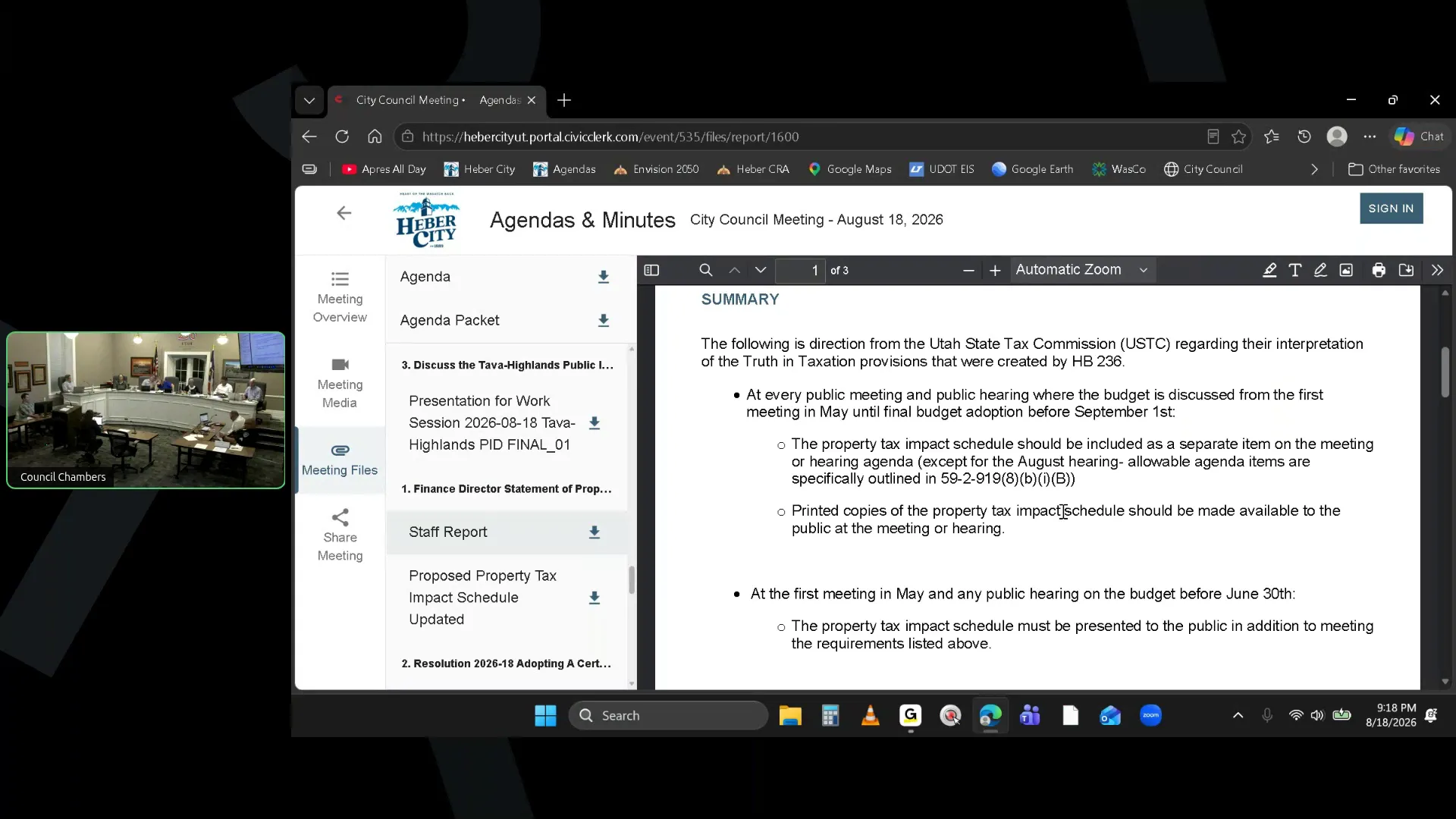
STREAMING COPY IN PREPARATION — RECORDING AVAILABLE FROM THE ORIGINAL SOURCE
Transcript — Verbatim
Speaker numbers apply only to this recording. Names come from transcript evidence. “Possibly” marks uncertain attribution.
Discussion Breakdown — Share of Meeting
Affordable Housing19%
Engineering And Infrastructure15%
Budget Equity Analysis12%
Public Engagement11%
Procedural6%
Public Safety6%
Annexation5%
Fiscal Sustainability5%
Public Private Partnerships4%
Summary of Proceedings
Heber City Council Work & Regular Meeting Summary - August 18, 2026
The Heber City Council met on August 18, 2026, for an afternoon work session and evening regular meeting. The council addressed a wide range of topics including a legislative update, affordable housing strategies, several development proposals, a public safety update, and the adoption of the FY 2027 budget and a certified tax rate increase of 4.2%.
Consent Calendar
- Approved the August 5, 2026, Special Meeting minutes.
- Approved Ordinance 2026-15, a Development Agreement for State Automotive (435 W 100 S), with an amendment to remove Section 8(a) from the agreement. Motion passed 5-0.
Public Comments & Testimony
- Seth Plaizier: Opposed the 4.8% property tax increase, urging the council to scrutinize the budget for necessity and avoid passing costs onto residents.
- Linda Middleton: Criticized the strain placed on Heber City infrastructure by county and regional developments (golf courses, skiing, water sports), urging vigilance from the council.
- Julie Franklin: Requested "No Parking" signs on 100 West between 600 South and 1000 South, citing dangerous conditions for pedestrians, children, and individuals in wheelchairs.
- Catherine Moore: Raised concerns about food truck grease stains, generator use instead of electric outlets, and excessive noise from a car show.
- Jeff Pierce: On behalf of senior residents, urged the council to reject the property tax increase and consider zero-based budgeting.
- Jami Hewlett: Expressed frustration that questions from the previous meeting regarding budget cuts and annexation details had not been adequately addressed.
- Todd Bay: A 30-year resident opposing the tax increase, asking if the city had exhausted budget cuts before seeking more revenue.
- Scott Phillips: Supported the proposed tax increase as a measure of fiscal responsibility, noting deferring purchases only postpones necessary costs.
- Jenna Strom: Requested greater transparency from the city on delinquent property tax collection and its potential to offset the tax increase.
- Kimberly Montoya (submitted): Opposed the tax increase, requesting a transparent line-by-line review of the budget to find cuts.
Discussion Items
- Legislative Discussion & Updates: Lobbyist David Stewart provided updates on state elections, the UDOT bypass process, data center legislation, and MIDA. Mayor Heidi Franco highlighted significant upcoming costs for the Heber Valley Special Service District (HVSSD) ($300 million for wastewater improvements) and the Heber Valley Railroad. She raised concerns about state funding cuts to programs like Meals on Wheels. Council discussed priorities for the legislative session and the upcoming Olympic planning submissions.
- Affordable Housing 101: Steve Waldrip, Senior Advisor to Governor Cox, led a comprehensive presentation on the state's housing challenges. He detailed the supply shortage, the disconnect between income and home prices (ratio of 6-10x in Heber City), and the generational risk of declining homeownership. He discussed state programs like the SHIP loan program and emphasized the need for municipalities to embrace infill and density. Council discussed deed restrictions, impact fees, PIDs, and water availability.
- Blue Sign Annexation: Planning Manager Jamie Baron presented the proposed annexation at 2600 N Hwy 40. The Planning Commission recommended residential only, while the developer and staff explored including commercial. Council members debated the appropriate mix, density, trail connectivity, stormwater management, and open space preservation. The item was deferred to the next meeting for further refinement.
- General Public Safety Update: Chief Parker Sever provided updates on the animal shelter, a new K9 team in patrol school, and a new comfort/tracking dog (Copper) funded by donations. He gave a detailed presentation on the city's Flock license plate reader system, explaining its capabilities, data retention (30 days), auditing features, and safety benefits in solving crimes, locating missing persons, and stopping theft rings.
- Finch Creek MDA Amendment: Consultant Denna Woodbury presented amendments to the Master Development Agreement, reducing units from 127 to 108, removing commercial components, and requesting exceptions to design standards due to topography. The council was generally supportive of the revised plan but requested more specific information on affordable housing unit placement and phasing.
- Discuss the Tava-Highlands Public Infrastructure District (PID): Project representative Max Martin and Community Development Director Tony Kohler presented the PID. The focus was on the proposed use of the required 10% public amenity fund ($2M+) to construct a critical section of College Way and make improvements to Highland Park and the dog park. Council discussed transparency, the importance of the road connection for the area, and Mayor Franco's interest in directing some funds toward a future art center.
Key Outcomes
- Certified Tax Rate Adopted (Resolution 2026-18): The council voted unanimously (5-0) to adopt a 4.2% certified tax rate for Fiscal Year 2027, a reduction from the proposed 4.8%. The reduction was based on anticipated Heber Light and Power dividends and a desire to lessen the burden on taxpayers.
- Fiscal Year Final Budget Adopted (Resolution 2026-20): The council voted unanimously (5-0) to adopt the FY 2027 budget, directing staff to adjust departmental budgets proportionally to reflect the newly approved 4.2% tax rate.
- Property Tax Abatement Program Continued (Resolution 2026-19): A motion to approve the Mayor's proposed Property Tax Abatement for seniors as a one-year pilot program with an $80,000 cap failed by a vote of 2-3. A subsequent motion to continue the item to the next city council meeting passed unanimously (5-0).
Meeting Transcript
This conference will now be recorded. If we're nowhere near, then I'll just stay. They've got a lot of others from that work. Okay, thank you. All right, welcome everyone. Today is August 18th, 2026. It is now 4.01 p.m. And this is a meeting of the Heber City Council. We're in our work meeting. I want to welcome everyone that's here in the chambers as well as perhaps online. And welcome our city council members. So in the chamber right now, we have Cidal Sherkard, Mike Johnston, myself, Heidi Franco, Aaron Sheetwood, Morgan Murdoch, Yvonne Barney is asking to be excused for another half an hour given another assignment that she had, and she will try to join us as soon as possible. All right, everyone, our first agenda item is a legislative discussion and update with our city lobbyist David Stewart. David, would you like to come forward and turn on a sitting microphone or do you want to stand? Okay, the green light needs to be on, and then you need to eat the microphone, please. Not actual. Can you hear me there? Yes, thank you. Okay. Thank you. Yeah. So David Stewart and Mayor, thank you and counsel. Uh happy to be here today. Uh was asked to kind of come and give a brief update on some elections as well as kind of the interim and what's coming uh down the pipe. Um as I'm sure you're probably if you're political hacks like I'm guessing if you're a city councilman or mayor, you probably are. Um in the prime in and really in Utah, obviously the primaries are what the real election is. There's not really any real swing seats necessarily. I mean, there's a couple house seats maybe in play in the uh in the general, but for the most part, most of the stuff that happens in the primaries is what's gonna ultimately happen. So in the Senate, uh, because of those elections, you had the Senate president uh lost, uh, which was at the time, you know, leading up to him uh losing was not a big surprise. I mean, things uh is again if you're paying attention to the media and everything else was not a big surprise, but you know, six, seven months ago, you would have never predicted it. And so with that, uh some other retirements, uh, Senator McKay also lost. So in the Senate of the 29 members, there will be five uh new of the majority party. Um and part of that is I mean, there's currently a independent third party can't uh person that's in the legislature when Dan Thatcher resigned, uh, but the Republicans will win that seat back. So there are going to be five new faces. Um there will that that will then obviously with the Senate president losing will trigger a I mean, every two years there's a leadership election, but before it would have just been a coronation, if you will. Um now it will be a true election. You have Senator Vickers from Southern Utah challenging Senator Cullmore, um, who is the current majority leader of note of interest. Two years ago they ran against each other for majority leader, and most people viewed that as kind of the precursor of the real, if you will, election. And you know, candidly, I don't see that changing. I think Senator Cullomore will beat Senator Vickers again and will be the next Senate president. Um if that's the case, philosophically, he's pretty well aligned with where Stuart Adams was. There had a lot of similar focuses on transportation and water and other infrastructure as well as education and things like that. And so, you
SUMMARIZED BY OPENPUBLICA AI
TRANSCRIPT VIA PUBLIC VIDEO
openpublica.com
openpublica.com