OPENPUBLICA · PUBLIC MEETING RECORD
Record of Proceedings
Hobbs City Commission Work Session on Long-Term Financial Sustainability and Proposed GRT Increase - October 12, 2026
City Commission — Monday, October 12, 2026
BodyHobbs, New Mexico
SessionCity Commission
DateMonday, October 12, 2026
StatusFILED
Video Record
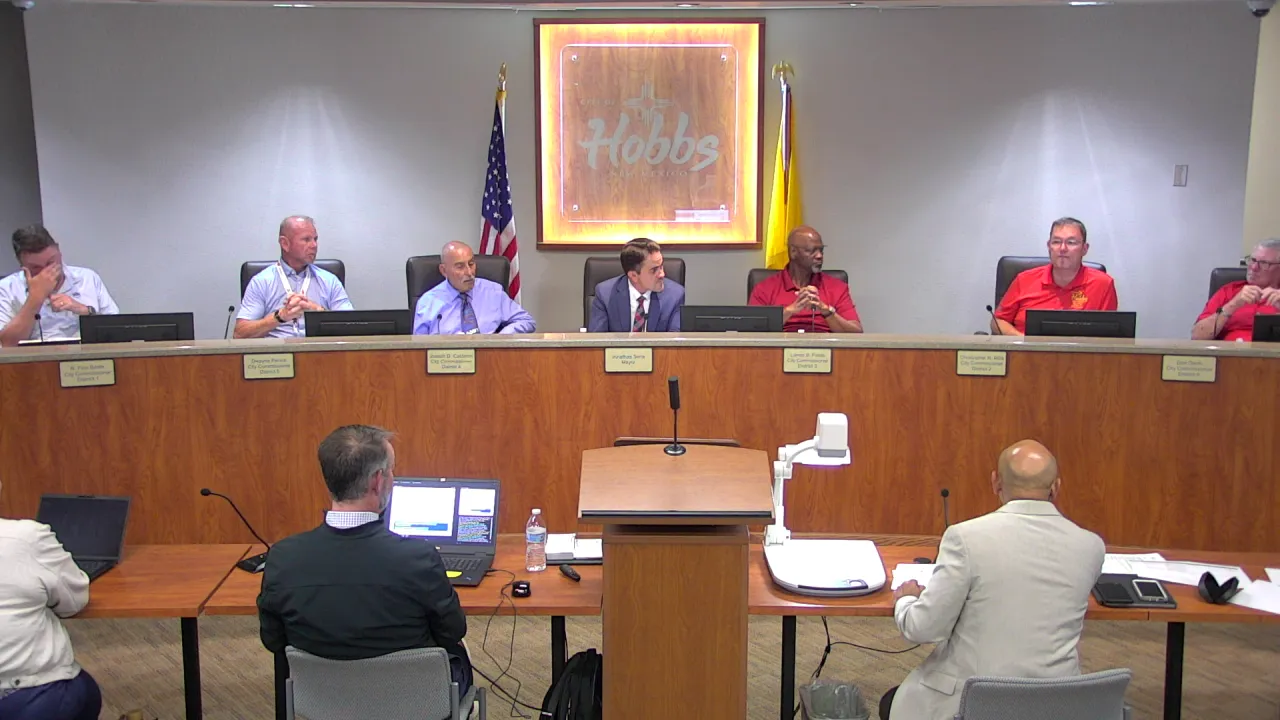
STREAMING COPY IN PREPARATION — RECORDING AVAILABLE FROM THE ORIGINAL SOURCE
Transcript — Verbatim
Speaker numbers apply only to this recording. Names come from transcript evidence. “Possibly” marks uncertain attribution.
Discussion Breakdown — Share of Meeting
Fiscal Sustainability57%
Public Engagement18%
Engineering And Infrastructure8%
Public Safety8%
Economic Development6%
Procedural3%
Summary of Proceedings
Hobbs City Commission Work Session on Long-Term Financial Sustainability and Proposed Gross Receipts Tax Increase - October 12, 2026
The Hobbs City Commission held a work session on Monday, October 12, 2026, at 4:30 p.m. to discuss the city's long-term financial sustainability and a proposed gross receipts tax (GRT) increase. City staff presented on the city's financial challenges, including impacts from House Bill 6, a projected operating shortfall of $6.87 million for FY27, and the need for capital improvements. The proposed GRT increase of approximately 0.6125% (to a total rate of 7.175%) could generate an estimated $14.7 million by the end of FY28, if approved and effective July 1, 2027. No formal vote was taken; the session was intended for discussion and public input.
Public Comments & Testimony
- Jerome Brielli (business owner): Strongly opposed to the tax increase, arguing that the amount requested does not align with the need (citing $20 million for roads) and that the city should cut funding elsewhere, such as subsidies. He warned that if the increase passes, it will go to a referendum and likely be voted down.
- Teddy Everidge (business owner): Questioned whether each city department has been audited and evaluated to identify shortfalls before raising taxes. City Manager Gomez confirmed that departments are reviewed annually through the preliminary budget process and a staffing analysis is underway.
- Mr. Foster (former student of Mayor Sena): Expressed support for the city staff's presentation and acknowledged that while the decision is difficult, it appears necessary. He emphasized the need for reliable infrastructure (roads, sewer) and public safety.
Discussion Items
- City Manager Manny Gomez opened the session, noting that discussions began on September 9 and September 21. He acknowledged community concerns about timing and the specific increase amount (needed $6.87 million vs. potential $14.7 million generated). He explained that House Bill 6 shifted GRT from business location to destination of services, costing the city an estimated $15-20 million annually.
- Todd (Finance Director) presented slides showing the city's revenue history, population growth (20% since 2010), annexation of 17 square miles (38 miles of added roads), and service expansions (parks, golf course, fire station). He noted that the city has already cut 30% from initial department requests, eliminated or consolidated 125 positions, and deferred capital replacement. The FY27 preliminary general fund budget shows a $6.87 million gap between payroll/operating expenses and estimated revenue. The city maintains a 45% reserve ratio ($51 million cash against a $115 million expense budget), but that only covers about 5.4 months of operations.
- Commissioner R. Finn Smith questioned the reserve target, suggesting that with less revenue volatility under HB6, a lower reserve may be appropriate. He argued that the city's geographic growth and quality-of-life investments (airline subsidy, golf course) are essential and should be maintained.
- Commissioner Dwayne Penick advocated for renegotiating contracts such as the airline subsidy (currently at 100% occupancy guarantee) and other social service agreements to cut costs. He emphasized that every bit helps.
- Commissioner Christopher R. Mills noted the severe infrastructure needs, citing a sewer collapse on Grimes Street and another on Turner Street, and stressed that maintaining sewer and water services is a fundamental responsibility.
- Commissioner Don R. Gerth commended staff for their transparency and hard work, stating that the increase, while unpopular, may be necessary.
- Fire Chief Mark Deporto described the impact of budget cuts on his department: no Class A uniforms, helmets, radios, or ambulance purchases; call volume has doubled since 2009 but staffing has not kept pace. He noted that Lubbock, Midland, and Roswell have recently passed tax increases for public safety.
- Police Chief Jimmy Jones reported that the police department had 109 sworn officers in 2014 but only 42 when he took over in June 2026. He has since added 8 officers (now 50), restarted a school resource officer program, and launched a pre-academy program. He warned that as hiring improves, the need for vehicles, equipment, and training will increase, reducing the year-end "clawback" of unspent funds.
- Public comments (as summarized above) were taken from three individuals.
Key Outcomes
- No formal decision or vote was taken on the proposed GRT increase. The session was informational.
- Commissioners discussed the possibility of a future referendum if the increase is passed, as noted by public commenters.
- City staff committed to continuing the financial transparency website and engaging with the public via phone, email, and social media (text my gov).
- The next steps include further deliberation and potential action at a future regular meeting. The city manager and finance director will continue to present the facts and options to the commission and residents.
Meeting Transcript
430. And today we're gonna have a work session about long-term financial sustainability. That option proposed gross receipts tax increase. And we'll have city staff to present. Mr. Gomez, city manager. Uh thank you, Mayor. Commissioner, staff, and members of the public. Um, good afternoon and uh welcome to all to today's work session. Um, as you mentioned, Mayor, the discussion of the city's uh long-term financial sustainability option, the proposed uh gross receipts tax increase. Uh this uh discussion uh first began on September 9th uh during your commission meeting and again at your regularly scheduled meeting on September 21st. As we continue this discussion, uh we recognize that we're hearing from our community. Some residents have expressed concerns about the timing of the proposed gross receipt tax increase, particularly at a time when fuel prices and other household expenses remain high. Those concerns are understandable. Families and businesses are carefully watching their cost, and the city is doing the same. We respect those concerns and recognize the importance of being thoughtful and transparent as we consider decisions that affect our community. Another question we've heard is why the city is considering the specific increase of the need is only approximately 6.87 million dollars. This proposed increase could potentially generate approximately 14.7 million dollars by the end of June of 2028, which is the completion of the end of fiscal year 2028. And once again, this if approved will kick in effect July 1 of 2027. So we won't see the potential total 14.7 after a 12-month or a uh fiscal year has gone through. Okay. The proposal is that the proceeds from the new enactment will be used by the city for general municipal purposes. The first of its kind for the city of Hobbes in 33 years. One way to understand the impact of House Bill 6 and your here will hear about and see in our PowerPoint presentation about House Bill 6 is to think of the city's revenue like a household that depended on two regular checks. House Bill 6 substantially reduced what had been the larger check. Since then, inflation and economic activity have increased the amount of the remaining check, i.e. the retail, but they have not replaced what was lost. And the city is paying those same higher costs as well. So while revenues may appear higher today, the city has not been made whole, and in fact has lost 15 million to 20 million dollars annually. If approved, the increase will address two distinct financial needs within the organization. The first is the city's operating needs, the funding required to support payroll, maintain staffing levels, and provide the day-to-day services our residents depend on. As we revisit our PowerPoint presentation this afternoon, you will recognize the 6.87 million dollars shortfall regarding payroll and operations, expenditures outpacing revenues. The second is the city's capital needs. Today's discussion is not simply about whether to increase taxes, it's about understanding the steps the city has already taken, identifying the financial challenges that remain, and determining how to sustain essential services and maintain our community's infrastructure for the future. Identifying the financial challenges that remain, and determining how to sustain essential services and maintain our community's infrastructure for the future. Our responsibility is to present the facts, explain the options, and have an open and transparent conversation with you and our residents about the financial choices before us. So at this time, Mayor, Commission, staff members of the public, I will now uh pass on to Todd and Deb to share the PowerPoint presentation. Thank you. Uh thank you, Manny. Thank you, Mayor, City Commission, City Staff, the public that are here today, and those online. Um again, this is obviously stable today, um, but recurring revenue keeps um must keep pace uh with recurring expenses. And so many stated as far as the last general fund GRT increase was 33 years ago, and that was a 0.25% increase. Uh, we did have small increments back in 2003, which was dedicated infrastructure, and then 2005 with the um construction of the uh wastewater treatment plants, uh, there was a dedicated increase of environmental tax of 0.0625%.
SUMMARIZED BY OPENPUBLICA AI
TRANSCRIPT VIA PUBLIC VIDEO
openpublica.com
openpublica.com