Solid Waste and Recycling Workshop - February 27, 2025
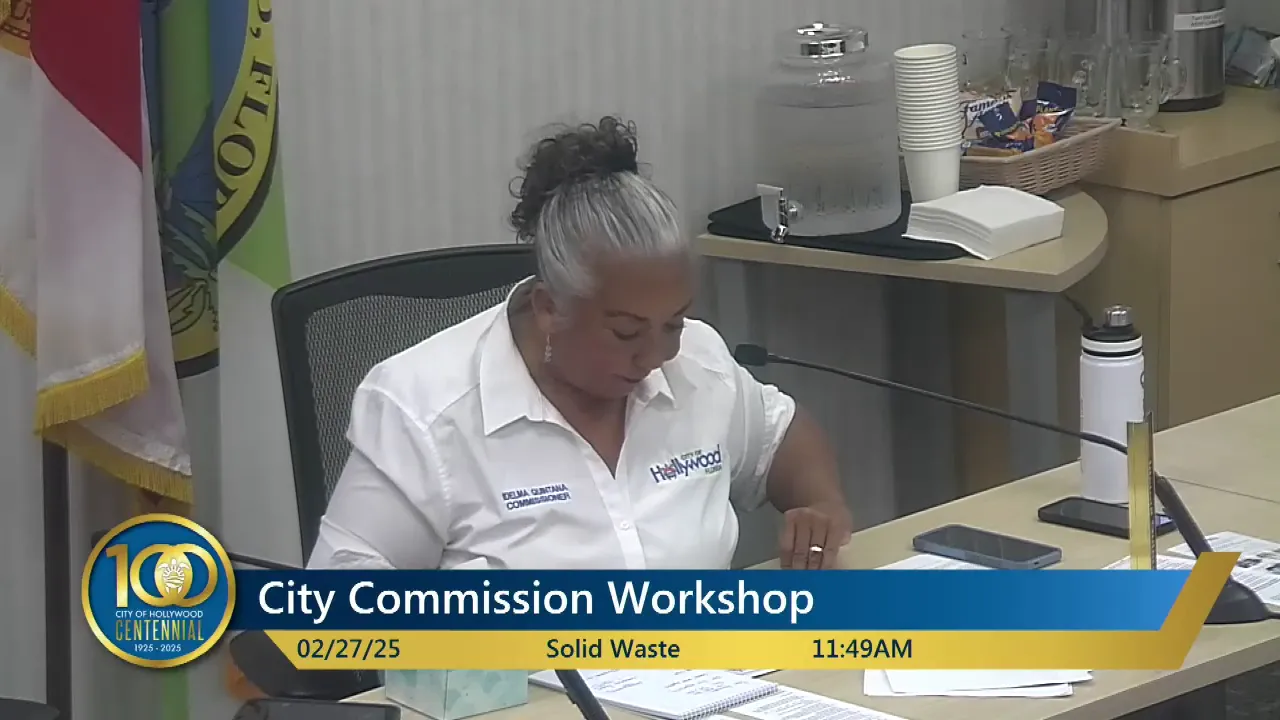
STREAMING COPY IN PREPARATION — RECORDING AVAILABLE FROM THE ORIGINAL SOURCE
Solid Waste and Recycling Workshop - February 27, 2025
The Hollywood City Commission held a workshop on February 27, 2025, to receive an in-depth overview of the city's solid waste and recycling program, discuss current contracts, and explore future opportunities for cost savings, service improvements, and environmental sustainability. The workshop covered residential and commercial collection, recycling, composting, disposal options, and the Solid Waste Authority of Broward County (SWA).
Presentation Overview
- City Manager George Keller opened the workshop, noting the commission's request for a deep dive into solid waste.
- Assistant City Manager Gus Zambrano, Environmental Services Manager Tony Tiru, and Public Works Director Joseph Kroll presented.
- Waste Pro Contract: Began October 1, 2019, 10-year term expiring September 30, 2029, with one 3-year renewal option requiring commission approval. Services include twice-weekly garbage, weekly recycling and yard waste, monthly bulk, illegal dump pickups, and cart delivery. The city pays for garbage and recycling disposal; Waste Pro handles bulk and yard waste processing. Waste Pro contributes $110,000 annually for education.
- Composting Pilot: Approved in June 2024 as a 1-year pilot with $50,000 set aside. 17 residents participated, diverting 1,620 pounds of material from the landfill. Interest increased after a demonstration at Party on the J.
- Broward County Drop-off Sites: The city partners with the county for household hazardous waste, electronics, and construction debris (C&D). Usage increased from 4,000 to nearly 11,000 for C&D from 2014 to 2024. Beach sweeps on the second Saturday of each month attract 50–75 volunteers collecting 75–125 pounds of trash.
- Commercial Haulers: 15 licensed haulers, annual registration $2,000, franchise fee of 30% on gross sales, generating $5.7 million in revenue for the general fund in FY2024.
- Expenditures and Revenues: Total FY2024 expenditures: $19,330,000. Largest expenses: Waste Pro ($10.4M), garbage disposal ($3.7M), bulk and yard waste ($665,000), recycling processing ($495,000). Residential fees of $47/month estimated to generate $19,547,676.
- Solid Waste Authority (SWA): The city joined the SWA interlocal agreement in June 2023, contributing $188,646 annually. 28 cities participate. Commissioner Shuham serves on the executive board. The SWA is still in early stages; a master plan has not yet been developed. The authority can only move forward with 80% approval from participating municipalities and the county. Any party may opt out at any time.
- Potential Next Steps: Amend the current Waste Pro contract to address disadvantages for both parties; begin bid process for 2029 (starting in 2027) possibly including a commercial component; solicit better pricing for bulk, yard waste, and recycling; consider joining the waste-to-energy ILA (Win Waste) when the next opportunity arises; and evaluate participation in the SWA if it becomes operational.
Discussion Items
Contract Amendment and Future Bidding
- Staff proposed amending the current contract to establish a more fluid partnership. Specific issues include the disposal cost for bulk and yard waste—the city pays Waste Pro $34/ton, but Waste Pro is charged $52/ton, creating a loss. Commissioner Hernandez asked about the impact; staff noted that amending would likely increase city costs. Mayor Levy suggested splitting the city into zones for the 2029 residential contract to attract more bidders, noting that Waste Pro was the only bidder in 2019. City Manager Keller agreed that zones would encourage competition, especially for alley-heavy areas.
Commercial Collection Consolidation
- Mayor Levy opposed an exclusive commercial contract citywide but supported exploring consolidation in downtown and beach areas to reduce truck traffic and alley damage. He noted a three-year notice given under state law, with an opportunity starting in May 2025. Commissioner Hernandez volunteered to lead meetings with the business community, with support from Public Works. Commissioners Gruber and Biederman agreed exclusivity should be limited to dense commercial corridors. Vice Mayor Quintana suggested also studying Washington Park Industrial Park. Commissioner Callari emphasized the need for a fair fee structure if dumpsters are shared.
Yard Waste Carts
- Commissioner Biederman advocated for reintroducing green carts for yard waste, especially for non-alley neighborhoods, to reduce street litter and clogged drains. Staff noted costs of $55–60 per cart. Commissioner Hernandez argued that the current allowance of 3 cubic yards of loose yard waste would require 10 carts, making it impractical. Mayor Levy asked about impact on collection efficiency; speakers from Waste Pro and Coastal Waste noted that green carts work well in Fort Lauderdale, even with palm fronds (open lids). Staff will explore feasibility and cost.
Composting and Education
- Commissioner Shuham emphasized the need to expand the composting pilot by streamlining the sign-up process. She highlighted a school-based composting program at Orangebrook Elementary. Commissioner Callari suggested field trips to waste facilities and incentives like scholarships. Commissioner Hernandez supported youth education and stricter enforcement of landscaping ordinances. Vice Mayor Quintana noted the pilot contract with Renewable expires June 2025 and requested a
Meeting Transcript
All right, welcome everyone. Today's February twenty-seventh, twenty twenty five. We are here for a solid waste and recycling program overview workshop of the city commission. Thank you to everybody that's in attendance here. We have uh vendors and industry here. We have of course uh public works uh and uh city management. Um see even Chris Rostreck is here, he's always uh looking a ways to uh better deal with trash. Um and so a lot of folks are here and involved. Um City Manager, take it away. Good morning, thank you, Mayor, Vice Mayor and Commissioners, and to uh all members of the public and uh interested parties and the staff that are here today. Yes, I'm gonna bite my tongue with all the puns that are laying out there on the on the table today. So um you might remember it, of course, many times in the past we've had discussions on uh subjects related to solid waste, and the commission had asked for workshops so that we could dig deeper and spend some time into some of the different elements that are involved there. So here we are today. Uh you know, we will obviously talk about our uh residential contract, uh commercial and roll off services, and we'll spend some time on recycling, disposal processing, and some other related topics. So the uh the presentation is fairly long. Uh and we will get through it as quickly as we can. If we can hold off some of our comments till the end, it'll help kind of get through it quickly and kind of have it as a piece, and then there'll be plenty of time for questions and comments. The solid waste and recycling division manager for the city of Fort Lauderdale, and uh had contributed greatly in terms of uh time and information to this effort today and works directly with Nancy Gassman, who's the uh assistant director of public works for Fort Lauderdale, who I used to work with. And uh and our presenters today will be uh Gus Ambrano, Tony Tarou, and Joseph Kroll. So um with that I'll I'll turn it over to Gus to lead off and we'll get those to you shortly and move on through the presentation. Thank you. Thank you, uh City Manager. Yeah, we have some copies coming down for you. So I'll be brief up here. Uh, but this is uh our agenda for today. Uh we'll talk uh one slide on introduction to solid waste. There's actually an official EPA definition. And then we'll uh uh I will hand it off to Tony. Um and he will talk about the rest uh in regards to solid waste collections, and then uh of course uh Joseph will take it on uh to closing. Uh but we have the solid waste collections and processing and disposal. We're gonna get into uh all the processes and options of processes that we have available. I will give you a snapshot of expenditures and revenues, and uh we'll remind you of the solid waste authority of Broad County that's uh currently underway and the status of their work and then some potential next steps for consideration as we look forward to improving this process and our uh our methodology for solid waste. So next slide is the EPA definition. I want to take a second I'm not about to be here very long anyway. Uh I want to take a second to actually read the definition because it's very interesting. Um for those of you who love to I hate to say this, talk trash. Uh solid waste uh actually as any garbage or refuse sludge from a wastewater treatment plant, water supply treatment plant, or air pollution. All air all pollution, um, air pollution control facility and other discarded material resulting from industrial commercial mining and agricultural operations from community activities. You'll see some acronyms you might hear throughout the presentation that's used uh often in the industry, municipal solid waste, MSW, construction debris C and D, Household Hazard Waste is H HW, electronic waste. Uh but these are all the different kinds of waste and how they're categorized. That's it for me. I'd like to pass it on to Tony Tarou, who is our environmental services manager. Tony, take it away. All right, good morning, everyone. Sorry about that. Where's my so I'm I'm here to talk about uh our waste provider, which is Waste Pro, Waste Pro USA, and I work closely with them daily with the uh manager from Waste Pro. So the contract began in uh October 1st, 2019, and it is a 10-year term, which will be expiring September 30th, 2029. And there is a one, three-year renewable option that will need commission approval. At this time, I'm just gonna talk about the services that Waste Pro currently provides with the current contract that we have. So we have twice a week.
openpublica.com