Howard County Council Legislative Public Hearing - February 17, 2026
STREAMING COPY IN PREPARATION — RECORDING AVAILABLE FROM THE ORIGINAL SOURCE
Howard County Council Legislative Public Hearing - February 17, 2026
The Howard County Council held a hybrid legislative public hearing on Tuesday, February 17, 2026, at 7:00 p.m. to receive testimony on legislation introduced on February 2, 2026. The meeting was conducted in person and via WebEx, streamed on the council website and broadcast on Comcast/Verizon. Council members present included Vice Chair Christiana Rigby, David Yungmann, Liz Walsh, and Chair Opel Jones (arrived later). The meeting began with the Pledge of Allegiance led by Girl Scout Troop 2219.
Appointments and Reappointments
Multiple appointments and reappointments were considered, with testimony from most nominees:
- CR26-2026 – Jonathan D. Nelson – Opioid Restitution Fund Commission: Mr. Nelson testified in favor, citing his personal experience in the recovery field and his history in Howard County.
- CR27-2026 – Asaf Buchner – Advisory Board on Consumer Protection: Mr. Buchner testified in favor, noting 20 years of financial experience and a focus on consumer education.
- CR28-2026 – Darryl Burnett – Board of Health: Mr. Burnett testified in favor, highlighting his previous 11-year service on the board, master’s degrees in public health, and experience with FQHCs.
- CR30-2026 – Bryan Lee Thompson – Agricultural Preservation Advisory Board: Mr. Thompson testified in favor, describing his work on a farm, landscape business, and desire to bring a younger farmer’s perspective.
- CR31-2026 – Amanda Kristen Walker de Rodriguez – Board to Promote Self-Sufficiency: Ms. Rodriguez testified in favor, introducing herself as CEO of TurnAround (rape crisis and domestic violence center) and offering council members a tour.
- CR29-2026 – Meghan Stepanek – Board of Health: No testimony.
- Reappointments – Asian American and Pacific Islander Commission (CR32‑CR36): None of the reappointees (Khin Rupa Waddy Maung, M.D.; Jodie Wang; Misako Aoki; Naresh C. Das, Ph.D.; Dhaval Shah) signed up to testify.
- Tabled appointments (CR147-2025, CR176-2025, CR211-2025, CR1-2026, CR4-2026, CR5-2026, CR6-2026, CR8-2026): No sign-ups for testimony.
Financial Items
- CB11-2026 – Multi-Year Grant Agreement Renewal – Howard County Housing Commission – NonProfit Collaborative:
- Administration (Felix Fashin, Deputy Chief of Staff): Stated strong support. The 10-year renewal (fiscal impact ~$4.65 million – a $2.2 million increase from the original) would expand the collaborative by ~8,200 square feet to accommodate 12 additional nonprofits. 62% of rent is subsidized. A pending amendment reduces total cost by ~$380,000.
- Lois Mikola (ACS): Expressed full support, noting the collaborative is always fully occupied and has a waiting list of 12 nonprofits. Co-location reduces overhead and fosters collaboration.
- Peter Engel (Howard County Housing Commission): Supported the bill, calling the collaborative a “smart investment.” The commission holds the master lease and subleases to nonprofits.
- Melissa Rosenberg (Autism Society of Maryland): Described transformative effects, serving 18,000+ individuals annually, and cited examples of collaboration and resource-sharing.
- Sue Geckle (HopeWorks): Stressed that the subsidy ensures stability and allows funds to go to survivor services rather than facility costs.
- Jackie Ng (Cooksville resident, former ACS board member): Voiced strong support, recounting the collaborative’s evolution and urging continuation.
- Jennifer Broderick (Bridges to Housing Stability): Supported, noting the space allowed her organization to re-orient and share resources.
- Ryan Powers (Howard County Citizens Association): Supported but called for additional accountability measures, such as public advertising of tenant openings and selection criteria, and expansion of mailbox services.
- Lisa Markovitz (People’s Voice Columbia): Supported unequivocally, trusting the Housing Commission and NPC to manage terms.
General Legislation
- CB12-2026 – Landlord Tenant Relations – Eviction Notice Requirement:
- Tracy Rezvani (Office of Consumer Protection): Supported, describing the bill as a simple extension of existing state law (from 6 to 14 days’ notice) with multilingual information requirements.
- James Bell (housing advocate, Ellicott City): Strongly supported, explaining that the typical 40–50-day gap between warrant and eviction means tenants need maximum notice to prepare. He noted the Howard County Sheriff’s office already provides about a week’s notice, and this legislation places the obligation on landlords.
- Jackie Ng (Housing Affordability Coalition): Supported, calling it “a good start” that promotes fairness and reduces homelessness.
- Jennifer Broderick (Bridges to Housing Stability): Supported, emphasizing that 14 days provides a realistic window for service providers to intervene and prevent eviction.
- CB13-2026 – Executive Reorganization – Department of General Services – Mail and Fleet:
- Dawn Tinker (Assistant CAO): Supported, stating the reorganization will align with other jurisdictions and improve continuity, with no immediate fiscal impact and one position reclassified.
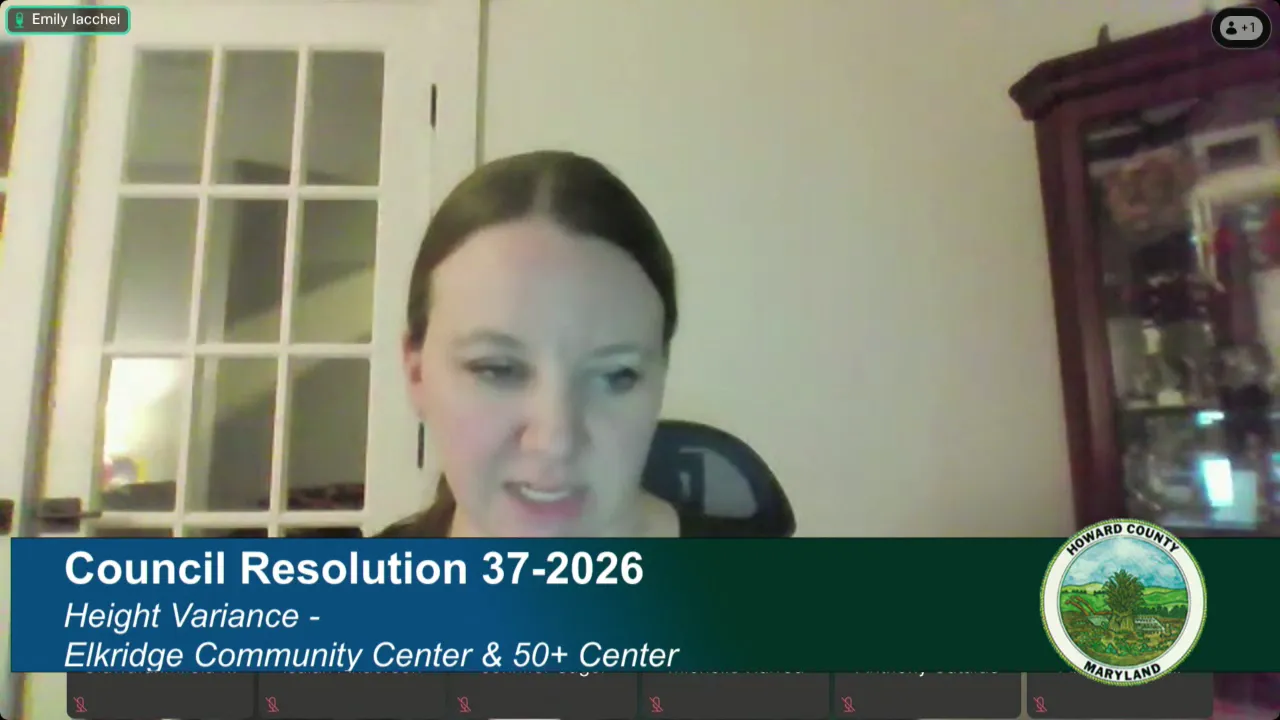
- CR37-2026 – Height Variance – Elkridge Community Center and 50 Plus Center:
- Emily Ayaki (Bureau of Real Estate Management): Supported, explaining the 72,000 sq ft recreation center includes a 48-foot gymnasium that exceeds the 34-foot height limit, and alternative designs were considered but found less effective.
- CB14-2026 (ZRA 214) – Age Restricted Adult Housing Apartments – New Conditional Use (sponsored by Yale Presbyterian Church):
- Jonathan On (counsel for Yale Church): Supported, arguing the conditional use (not by right) allows context-sensitive senior housing, supporting age-in-place and faith-based stewardship. He stated the bill balances flexibility with oversight.
- Alan Schneider (Howard County Citizens Association, Clarksville): Opposed, citing 14 issues. Key points: the ZRA is too substantial for a one-off amendment (affecting 57 parcels per DPZ, not <14 as claimed); should be handled in comprehensive zoning; lacks ADA criteria; and the applicant refused to increase MIHU from 15% to 20%. Councilmember Walsh asked about federal religious land use protections; Schneider acknowledged the law but maintained that comprehensive zoning should be used.
- CB15-2026 (ZRA 216) – Animal Hospitals – Permitted Use in M-1 Zoning District (sponsored by Southern Veterinary Partners/Mission Pet Health):
- Steven Rosenthal (Chief Medical Officer, CVCA Care for Pets/Mission Pet Health): Supported, stating the zoning update reflects modern veterinary medicine (fully enclosed, quiet, clean) and will support a state-of-the-art cardiac care facility, creating skilled jobs and activating commercial space.
Tabled Legislation (No Testimony)
- ZRA 219 (CB4-2026) – Activity Centers – Age-Restricted Adult Housing: No testimony was offered.
Key Outcomes
- No votes were taken at this public hearing.
- The council will hold a work session on Monday, February 23, 2026, at 10:00 a.m. in the C. Vernon Gray Room.
- Final consideration of legislation will occur at the legislative session on Monday, March 2, 2026, at 7:00 p.m. in the Banneker Room.
- Written testimony will continue to be accepted until council action.
Meeting Transcript
This webinar is being recorded and summarized. Good evening. This is the council's. Nope, it's not that. This is the council's February legislative public hearing, in which we'll hear testimony for legislation introduced on February 2nd, 2026. This evening is a hybrid meeting, which is being conducted in person and via WebEx Teleconference. It is also available to the public through live stream on the County Council website and broadcast on channels 44 Verizon and 1,071 on Comcast. You can also stream it. Sign up to testify on legislation that is the subject of this public hearing was done online and was available in person prior to the start of the session. The cutoff for testimony sign up was at 7 p.m. this evening. The council will hold a work session on Monday, February 23rd at 10 a.m. in the C Vernon Gray Room. Council members, please provide agenda items for the work session to our council administrator no later than 9 a.m. Wednesday, February 18th, tomorrow. A legislative session for final consideration of certain legislation that is the subject of this public hearing will be held on Monday, March 2nd at 7 p.m. in the Banneker Room. Public participation for these meetings will be available in person, virtually via WebEx and viewed live stream through the County Council website. At this time, I will do a roll call of the council members. Ms. Young? Here. Mr. Youngman. Here. Ms. Walsh? Here. I'm Christiana Rigby and Dr. Opal Jones, our chair will be with us shortly. Tonight we have some very special guests with us to lead the reciting of the Pledge of Allegiance. Girl Scout Troop 2219. Ladies, take it away. Thank you. It was great leading, ladies. We'll now proceed with our regular uh regular February legislative public hearing. If there are any students who will be testifying this evening, um for those in person, please come up to the front row so that we may call you up to testify. And those virtually, please contact Isaiah Anderson by raising your virtual hand on the WebEx or sending an email to him at IAnderson A N D E R S O N at Howard County MD.gov. We will allow students to testify first so they may get home at a reasonable time. You do have back to school tomorrow, sadly. Sign up to testify on legislation that is the public that is the subject of this public hearing was done online or in person prior to the start of the session. Please note that while we are receiving testimony this evening, we continue to receive written comments, which will be fully considered by the council prior to taking action. Anyone who signed up to testify this hearing will be called to testify. When you are called upon to testify, please state your name and the city or town of your home address. Representatives from nonprofit organizations will have up to five minutes to speak. Individuals and other organizations have up to three minutes. Individuals who have indicated that they are testifying through an interpreter may be allowed a total of five minutes with interpreter translation. You may not yield your time to another speaker. You will be notified at the 30-second mark to begin to wrap up by the administrator, and then you'll be notified when your time to speak is finished. You must conclude when your time is up.
openpublica.com