Howard County Council Monthly Meeting - March 9, 2026
STREAMING COPY IN PREPARATION — RECORDING AVAILABLE FROM THE ORIGINAL SOURCE
Howard County Council Monthly Meeting - March 9, 2026
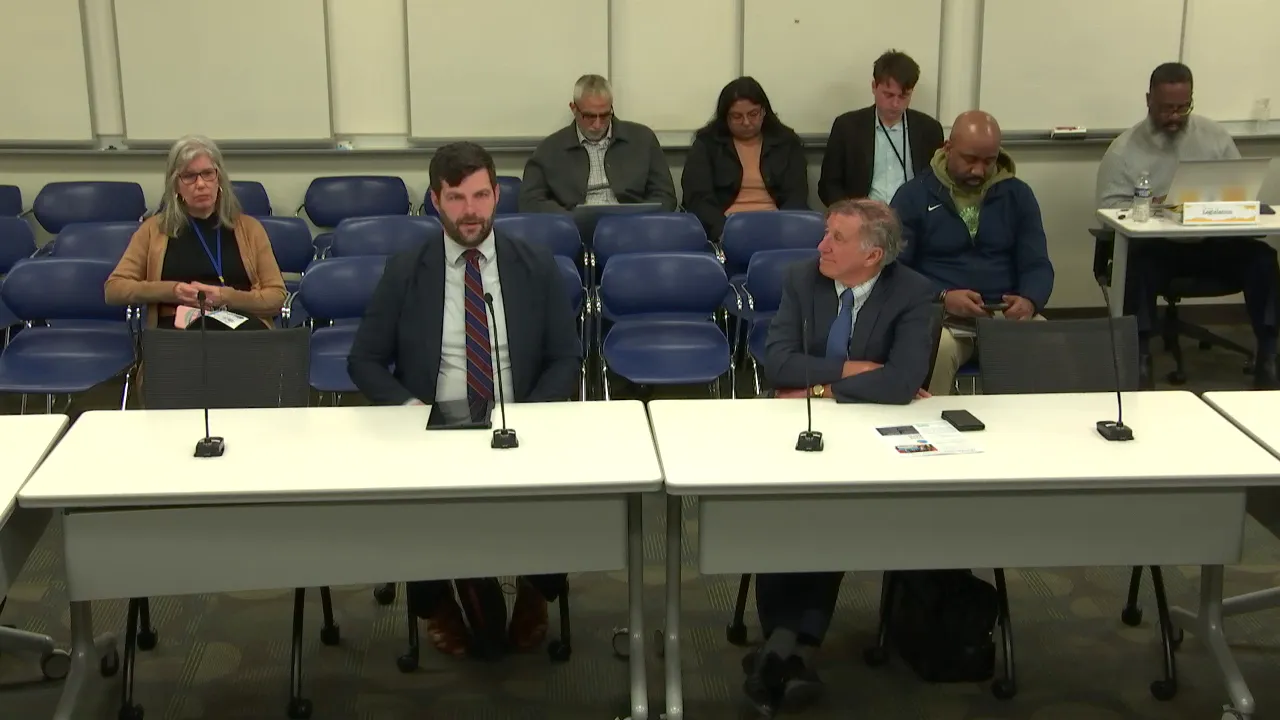
The Howard County Council held its monthly hybrid meeting on March 9, 2026, at 10:00 a.m. The primary agenda item was a presentation and discussion on Maryland's Prescription Drug Affordability Board (PDAB). Councilmembers present included Vice Chair Christina Rigby (presiding), Liz Walsh (District 1), and Deb Jung (District 4); Councilmembers Opel Jones (Chair) and David Yungmann were absent. The meeting also included brief reports from the Council Administrator and County Auditor, with no questions or discussion.
Presentation: Maryland's Prescription Drug Affordability Board
Benny DeMarco, President of the Maryland Health Care for All Coalition, and Andrew York, Executive Director of the Maryland Prescription Drug Affordability Board, presented on the board's mission and upcoming actions.
-
Overview and History: DeMarco explained that the coalition's goal is to make healthcare more affordable, noting that 30 to 40 percent of Marylanders cannot afford necessary prescription drugs. He emphasized that high drug costs drive up insurance premiums—one-third of Blue Cross Blue Shield premium costs are for high-cost drugs—and strain state and local government budgets. He cited Anne Arundel County's spending on prescription drugs for employees exceeding library budgets. Maryland created the nation's first Prescription Drug Affordability Board in 2019, initially with authority limited to state and local government drug costs. A 2025 law (sponsored by Delegate Bonnie Cullison and Senator Don Gile) expands the board's authority to all Marylanders one year after it sets upper payment limits for state and local governments.
-
Progress and Plans: York described the board's cost review studies for six drugs: Farxiga, Jardiance (diabetes), Ozempic, Trulicity (diabetes), Skyrizi, and Pixim (autoimmune diseases). The board has determined that the first four drugs cause affordability challenges and is working to set upper payment limits (UPLs) for state and local governments, which would apply to county employees. The UPLs will be implemented through regulations. York noted the board also pursues non-UPL policies to help patients. The board aims to take initial UPL action on Farxiga and Jardiance early in 2026, with other drugs later in the year; savings are expected to begin when regulations take effect, possibly aligning with calendar year 2027 based on Colorado's timeline.
-
Discussion: Councilmembers asked about the impact of the new Maryland AHEAD model, pharmacy benefit managers (PBMs), and how local governments can support the board's work. York explained that the AHEAD model currently carves out drugs but a comment period (ending March 20, 2026) is considering including them, which could promote pharmacy transparency. Regarding PBMs, York described how rebates and confidential pricing obscure actual drug costs, though the Inflation Reduction Act's Medicare negotiation is improving transparency. Councilmember Walsh requested a deeper explanation of the insulin pricing example.
-
Call to Action on Legislation: DeMarco requested council support for House Bill 484 (Delegate Natalie Ziegler) and Senate Bill 587 (Senator Karen Lewis Young), which would prohibit drug corporations from taking Maryland tax deductions for advertising. An Attorney General opinion confirmed constitutionality. The bills would direct savings to Medicaid and health insurance premiums. The hearing for SB 587 was scheduled for Wednesday, March 11, 2026, before the Senate Budget and Taxation Committee.
-
Council Response: Vice Chair Rigby, Councilwoman Walsh, and Councilwoman Jung expressed support for writing a letter supporting SB 587 to Senate Chairman Guy Guzzone and President Bill Ferguson, as well as to Senator Young and the Speaker. The deadline for the letter to be included in the committee record was 6:00 p.m. that day. Council staff was directed to prepare the letter.
Reports
The Council Administrator and County Auditor provided brief reports. No questions or discussion followed. The meeting was then adjourned.
Key Outcomes
- The council expressed support for and directed staff to draft a letter endorsing Senate Bill 587 (disallowing tax deductions for prescription drug advertising) to key state legislators, with a deadline of 6:00 p.m. on March 9, 2026.
- The PDAB presenters committed to continuing engagement with Howard County, including a future public forum when the board's authority expands to all Marylanders.
- No other formal votes or decisions were taken during the meeting.
Meeting Transcript
This webinar is being recorded and summarized. Good morning. This is the council's monthly meeting for March. The proceeding this morning is a hybrid meeting, which is being held in person and via WebEx Teleconference. It's also available to the public via video stream online at the county council website. This time I'm going to do a roll call of our council members. Ms. Walsh? Here. Ms. Young. Here. And Mr. Youngman and Dr. Jones are not with us. And I am Vice Chair Rick B. We're going to begin today with a discussion about Maryland's prescription drug affordability board. So thank you, guests. Please introduce yourselves for the folks online, and we may begin. Perfect. My name is Andrew York, and I'm the executive director of the Maryland Prescription Drug Affordability Board, and I will be speaking in just a moment. Good morning. My name is Benny DeMarco. I'm the uh president of the Maryland Health Care for All Coalition. Um if it's okay, Madam Vice Chair will start. Well, thank you very much for this opportunity. Uh I'm a big fan of Howard County. Got a lot of wonderful friends here, and I want to thank Councilwoman Walsh and Councilwoman Young for hosting uh us to be here and the vice chair for letting us speak. Um we really appreciate this. Uh we are uh Maryland's premier healthcare advocacy organization. We've ran since 1999, and we have three goals, which are set out in this document. I gave you one is to achieve quality affordable health care for all Marylanders, and thanks to the leadership of a lot of folks in Howard County and elsewhere. We've gone from 13% uninsured to 6%. That's under attack now, but we're fighting back, and we're we're gonna keep going in Maryland forward to reach 0% uninsured. Another one of our goals is health equity, and we've worked to create health equity resource communities across the state to reduce health uh disparities. That's been very successful, also. But we're here today to talk about our third main goal is to make health care more affordable. And what we've concluded is that one of the number one ways to do that is by making high-cost drugs uh more affordable. The simple matter is drugs don't work if people can't afford them. And we know that 30 to 40 percent of Marylanders actually can't afford the drugs they need, either can't pick them up at the counter or have to cut out other food, other necessities to afford their drugs. That is unconscionable, can't continue. Also, all of us suffer because of our insurance companies have to pay so much for the prescription drugs that our premiums are higher. Blue Cross Book Shield says that one-third of their premium costs are high-cost drugs. That is a burden on all of us. And third, state and local governments pay high amounts for these prescription drugs. Your your neighbor uh county executive uh Stuart Pittman says that in in that and in Reno County, they spend more on uh prescription drugs for employees of the county than on libraries. That really is unconscionable. So that's why in 2019 we led the effort. Uh Stuart Pittman, County Executive Anne Reno County says that in Anne Runnel County, they spend more on the cost of prescription drugs for their employees than on libraries, and that is really unconscionable. Um for those reasons, we fought very hard for the creation of the nation's first prescription drug affordability board.
openpublica.com