Howard County Council Monthly Meeting - April 13, 2026
STREAMING COPY IN PREPARATION — RECORDING AVAILABLE FROM THE ORIGINAL SOURCE
Howard County Council Monthly Meeting - April 13, 2026
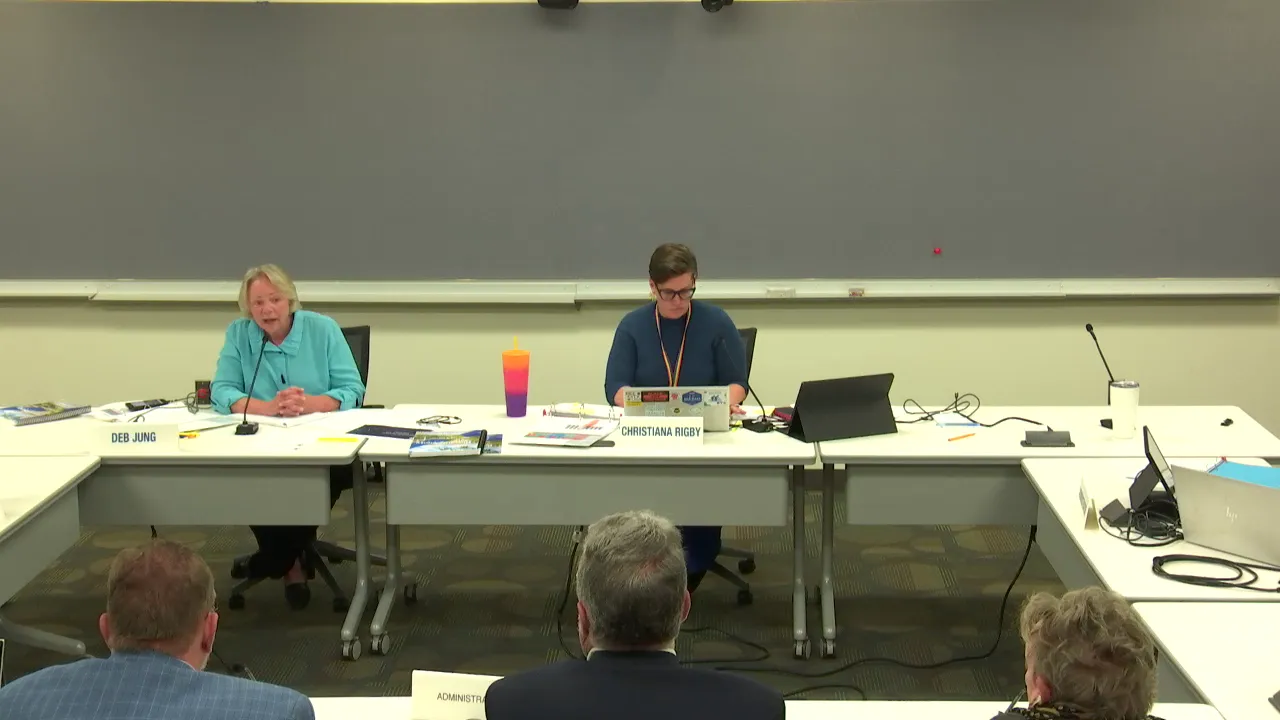
The Howard County Council convened its April monthly meeting on Monday, April 13, 2026, in a hybrid format. The agenda included the Spending Affordability Advisory Committee (SAAC) annual report, the Annual Comprehensive Financial Report (ACFR) for FY2025, and council reports. Councilmembers present were Vice Chair Christiana Rigby, Liz Walsh, Deb Jung, and David Yungmann; Council Chair Opel Jones was expected to join later. No formal votes were taken.
Spending Affordability Advisory Committee Annual Report
-
SAAC Chair Holly Sun presented the committee's FY27 recommendations. Members Todd Arnerbrunn, Dr. Richard Clinch, and Alan Flynn Giles detailed the county's economic outlook and revenue projections, with additional members joining online.
-
Dr. Clinch reported that county fiscal health is driven by income and property taxes, which account for about 90% of revenues. He cited stress from Maryland's economic slowdown and federal cuts: Maryland has lost 15.3% of its federal employees, 11.3% of Howard County residents are federal employees, and federal procurement in the county fell 15% from $4.3 billion. Howard County ranks fifth in federal jobs, seventh in share of employment, fourth in procurement dollars, and second in procurement per capita among Maryland counties.
-
Mr. Arnerbrunn projected FY27 revenue growth of 6.3% over FY26, driven largely by property taxes, but cautioned that income tax revenues are volatile and the long-term growth rate is 3.6%. The committee recommended limiting expenditure growth to 4%, using any surplus to rebuild reserves, and limiting general obligation bond issuance to $75 million with a focus on deferred maintenance (countywide need exceeds $400 million, including about $200 million for schools).
-
Ms. Giles emphasized that Howard County is maturing: by 2030, 20% of residents will be over 65, school enrollment is declining (400 fewer students this year), and aging infrastructure demands investment. She called for responsible long-term planning.
-
Councilmembers questioned the committee. Deb Jung supported making SAAC full-time and asked about capital gains; David Yungmann questioned why Howard County lags the state in recovery and noted federal contractor exposure; Liz Walsh asked about contractor mix; Christiana Rigby asked about reserves and the gap between SAAC's $75 million bond recommendation and the county executive's $120 million proposal. Dr. Sun described the higher amount as a "calculated risk." Ms. Rigby stated she would struggle to approve $120 million in GO bonds and that the discussion did not change her perspective. She also presented a per-acre revenue comparison suggesting multifamily transit-oriented development can be revenue-positive.
Annual Comprehensive Financial Report FY2025
-
Director of Finance Rafiu H. and CLA manager Jonathan Griffin presented the audited FY2025 financial statements. The county received an unmodified (clean) opinion.
-
New GASB standards applied: GASB 101 (compensated absences) required a $33 million restatement of FY24 governmental activities and $1.2 million for business-type activities; GASB 102 requires tracking of concentrations and constraints, including reliance on property/income taxes, eight collective bargaining units, the charter debt limit, and mandated spending.
-
Key financial changes: property tax revenue rose $51 million from a rate increase (1.014 to 1.044 per $100 of assessable base); other taxes rose $71 million, driven primarily by income tax; general fund expenditures increased $47 million, including $10 million to the Housing Opportunity Fund and pay-go capital costs (North Laurel Pool, land for a high school); cash and pooled investments rose $51 million; pension and OPEB liabilities decreased.
-
Discussion of OPEB: the county funds retiree health care for all component units; the funded ratio is approximately 22–23%, with a net liability of about $226 million for the county portion and over $900 million including schools. The county pays about $13.5 million annually toward the liability.
-
Councilmember Jung asked about the water and sewer fund; Mr. Healy noted the fund has a total net position of $538 million but only about $200 million available beyond capital assets, and the county's water/sewer infrastructure is 40–50 years old. Ms. Jung expressed concern about aging pipes and rate increases.
-
Mr. Healy provided general fund reserve trends: 26.8% in FY25, down from 32.4% in FY24 and a peak of 36.9% in FY23. He said rating agencies have warned that falling below 25% would trigger a review, reinforcing the importance of maintaining the AAA rating.
Reports
- The council received reports from MACo/NACo, the Chair, the Council Administrator, and the County Auditor. No questions were raised, and the meeting was adjourned.
Key Outcomes
- Received the SAAC annual report and its recommendations (4% expenditure growth cap, $75 million GO bond limit, reserve replenishment, focus on deferred maintenance).
- Received the FY2025 ACFR with an unmodified audit opinion.
- Councilmembers voiced concerns about the county executive's proposed $120 million GO bond issuance versus SAAC's $75 million recommendation; no vote was taken.
- No formal actions or resolutions were adopted during the meeting.
Meeting Transcript
All right. Good morning, everybody. Happy Monday, happy spring. This is the council's April monthly meeting. The proceeding this morning is a hybrid meeting, which is available in person and via WebEx teleconference. It's also available to the public via video stream online at the county council website. This time I'm going to do a roll call of the council members. Mr. Youngman. Here. Ms. Young. Good morning. Ms. Walsh. I'm here. Welcome. And Dr. Jones should be joining us shortly. I'm Christiana Rigby and I am here. So we're gonna start with our spending affordability advisory committee annual report presentation. Please begin. Good morning. First of all, uh good morning, Holly Sun. Um chair for the spending for advisory committee for FY27. Thank you very much for having us here. I have some colleagues, so I want to have them introduce yourself before but before that, I want to say a couple words. One is that uh I have been very pleased to be serving in the spending full of advisory committee for many years now, on and some years as uh assisting one of the member as one of the members there. Uh the for the last several years has been uh serving as a chair. So um I want the first thing I want to say I'm very thankful for all the committee members, those like uh make time here, but also online and the and also those have been participating throughout the years on that. They really did think a lot of their time diving to the issues and being very thoughtful um and provide great advice, but also have been working extremely hard. Uh so I just want to take a moment to thanks everyone for four years serving uh in that uh committee and provide continue to help to all the elected officials and the government uh internal financial and fiscal planning. So that was one part. The other part point I want to make is that I personally feel that the county's uh SAC uh committee as a really important, a very robust um mechanism. It kind of helped uh provide a platform to collect a lot of uh wisdom from the representative from different industrial economic and also other entities here and provide a good opportunity to exchange thoughts, gathering information, and also really and try to I I believe committee have been doing best, try to look at a big picture, long-term trend, long-term assistance sustainability issues there. That's kind of being the core of that there. That's really really important. Again, the elected officials and government obvious also by informed by other ways, budget hearings, also other parts, direct connection with the community, but nevertheless, the committee itself, there I feel served as a very important role as the process and to provide a lot of important information suggestions to decision makers. So, with that, uh, I will shut my mouse and have folks um besides me introduce themselves. Uh there are also a couple like have a little technical uh ability to log in online, so I'm still working on that. Um thank you. Um and well, I figured we could go through with the presentation and then we'll write our questions down as we're going through, um, and then we'll kind of go back through and and ask some follow-up if that works for everyone. Right. Sorry, thought I Dr. Richard Clinch, director of the Jacob Prantz Institute, University of Baltimore. I've done a fiscal and economic report for the county now over the last three administrations. Uh so you've seen my uh my work before. Todd Arnerbrunn. This is my eighth year on the committee and second as vice chair. Um lived in the county now for 40 years, so I'd like to be here.
openpublica.com