Howard County Council Legislative Public Hearing – May 18, 2026
STREAMING COPY IN PREPARATION — RECORDING AVAILABLE FROM THE ORIGINAL SOURCE
Howard County Council Legislative Public Hearing – May 18, 2026
The Howard County Council held a hybrid legislative public hearing on Monday, May 18, 2026, at 7:00 p.m. The meeting was streamed online and broadcast on local channels. The council heard testimony on numerous appointments, financial bills, and two major zoning proposals: CB25 (age-restricted cottage clusters) and CB31 (temporary moratorium on data centers). The hearing included special appearances by students from local high schools who testified on appointments and CB31. No final votes were taken; the council will consider budget legislation on May 20 and non-budget items on June 1, 2026.
Appointments and Reappointments
- Adult Public Guardianship Review Board: Joseph C. Hudzik (attorney member) testified, highlighting his experience in health care law and federal oversight.
- Asian American and Pacific Islander Commission: New appointments: Ning Li, Keith Louie, Seema Agarwal-Harding, Swati Sharma, J. Jason Zhao; reappointments: May-Fong Tsay, Young Ran Smith, Kimberly Eggborn, Sameer C. Ahirrao. Speakers emphasized community engagement and supporting immigrant families.
- Commission for Women: Rebecca Paulson Fields, Bronzwyn Palmer, and student Jenna M. Campbell (junior at River Hill High School) testified. Campbell won first place in the commission's Women's History Month poster contest.
- Martin Luther King, Jr. Holiday Commission: New appointments: Angel M. Robinson, Khalida S. Burton, Raeleena C. Collington, Allison Corinne Nichols, Anjali Thaker (sophomore at Glenelg High School); student Shemika Preston also testified via WebEx as a candidate for District 4.
- La Alianza Latina Commission: Sandy Pagan and Erika Tustin testified, with Pagan emphasizing early childhood education and Tustin describing community programs.
- Recreation and Parks Board: Student member Eli Lua Debbie (junior) testified, detailing his research on AI and energy efficiency.
- Historic Preservation Commission: James R. Bartlett testified, noting his architecture background and experience repurposing historic industrial buildings.
Public Comments & Testimony
- Student Testimony (CB31): Multiple students from Illuminate Maryland and other groups strongly urged passage of CB31. Rashid Gutsum (junior, Marriott's Ridge HS) stated that current zoning dates to 1993 and that a temporary moratorium is needed to study energy, water, and noise impacts. Siddharth Kerr Gouger (River Hill HS) noted that data centers can consume energy comparable to small towns and millions of gallons of water annually. Drew Doberia (junior, River Hill HS) cited that an average facility can use up to 500,000 gallons of water per day and a hyperscale center can demand electricity equivalent to 80,000 homes.
- CB25 (Cottage Clusters): Francine LePresti (Columbia resident and former data center operator) supported the zoning change but recommended raising unit size limit to 1,200 sq ft and ensuring Columbia inclusion. Housing Affordability Coalition (Jackie Ying Ng) wholeheartedly supported, recommending affordability guardrails such as limiting expensive amenities. Cindy LaFollette (District 1 resident) expressed concerns about density, flooding, and parking, urging minimum lot size of 1 acre and homeownership requirements. Barry Mehta (developer) supported but opposed mandatory DAP (Design Advisory Panel) review, calling it costly and cumbersome; he recommended a 22-foot height limit for two-story cottages. Joel Horowitz (Columbia) raised concerns about ambiguous amenity definitions and a 10-acre minimum parcel size being too large.
- CB31 (Data Center Moratorium): The majority of testifiers supported the bill.
- Francine LePresti provided technical detail on data center types, recommending a 20-megawatt threshold and an 18-month sunset.
- Dave Arnt (Maryland Legislative Coalition) highlighted air pollution from diesel generators and noise vibrations; noted that Montgomery, Baltimore City, and Prince George's counties are also considering moratoriums.
- Stu Cohn (Howard County Citizens Association) supported but questioned the bill's definition of "temporary" and exemption for public schools/colleges/libraries; suggested task force membership criteria.
- Carl Latkin (Sierra Club) noted that Baltimore City passed a one-year moratorium the prior week and Montgomery County is considering two years; warned that data centers could increase electricity costs and offset climate goals.
- Doug Siglin (Chesapeake Climate Action Network) urged the council to direct the task force to specific outcomes, such as 100% carbon-free energy from day one and battery backup preference over diesel.
- Monica O'Connor (HOCO Climate Action) cited a Gallup poll showing 70% of Americans oppose local data center construction; warned of water consumption up to 5 million gallons per day per facility and electricity cost increases.
- Murdy Chala (30-year resident) described Meta's Hyperion project in Louisiana requiring 5 gigawatts of power (equivalent to 750,000 homes) and Maryland's total generation capacity of 12 gigawatts; called for an environmental impact statement.
- Ruth Alice White (45-year resident) noted the state study due later in 2026 and stressed the need for Howard-specific impact analysis.
- John Bonstingle (retired teacher) urged consideration of societal harms beyond local impacts.
- Kelly Schultz (Maryland Tech Council) respectfully opposed the moratorium as drafted, arguing an 800,000 sq ft data center could generate 5,000 construction jobs, 500 permanent jobs, and $14 million in annual state tax revenue; she requested exemptions for public health and national security facilities.
- Shemika Preston (candidate for District 4) supported an 18-month pause, emphasizing need for transparent job creation data, clean energy requirements, and community benefit agreements.
- Collective Bargaining (CB26-28): Deputy CAO Jamar Harry testified in support, detailing COLA increases and new steps. For Police Lodge 21: 1% COLA effective July 2027, 3% effective Jan 2028, and a new Step 22 (3.25% above Step 21); fiscal impact $1.2M in FY27, $4.2M in FY28. For Supervisors Lodge 143: 4% COLA effective Jan 2027; FY27 impact $289,000. For Dispatchers: 1.5% COLA July 2026, 1.5% Jan 2027, 3% Jan 2028, plus new Step 20 and Step 21; FY27 impact $158,000, FY28 $325,000. Councilmember Walsh questioned disparity between dispatcher and officer increases.
- Emergency Appropriations and Supplemental Budget: Yosef Cabeta (DPW) explained SAO1-FY2026 for $1M to cover snow removal budget overruns due to eight snow events. Holly Sun (budget director) presented CB29 (emergency $1.7M shortfall for snow removal, corrections overtime, and SDAT billing correction) and CB30 (emergency $5.2M for employee health self-insurance fund due to high claims and specialty prescriptions).
- School Budget Transfer (CR74): Darren Conforti (HCPSS) requested approval of $3.635 million year-end categorical transfers, budget neutral.
- Pay Plan and Retirement (CB32, CR75): Ms. Bennett testified that CB30 (health fund) addressed unexpected cost increases from the Inflation Reduction Act, large claims (16% increase), and specialty drugs; CR75 establishes FY27 retirement incentive; CB32 sets FY27 pay plan with collective bargaining adjustments.
Discussion Items
- CB25 – Age-Restricted Adult Housing Cottage Clusters: Department of Planning and Zoning (Julia Sauer) supported the ZRA as missing middle housing, noting 200+ attended a public webinar and the Planning Board voted 3-0 to recommend with modifications (reduced perimeter setback from 50 ft to 25 ft, refined landscaping, clarified ODP process). Testimony from public raised concerns about unit size, height (20 ft limit), parking, lot minimums, and affordability. No council deliberation occurred; hearing was for testimony only.
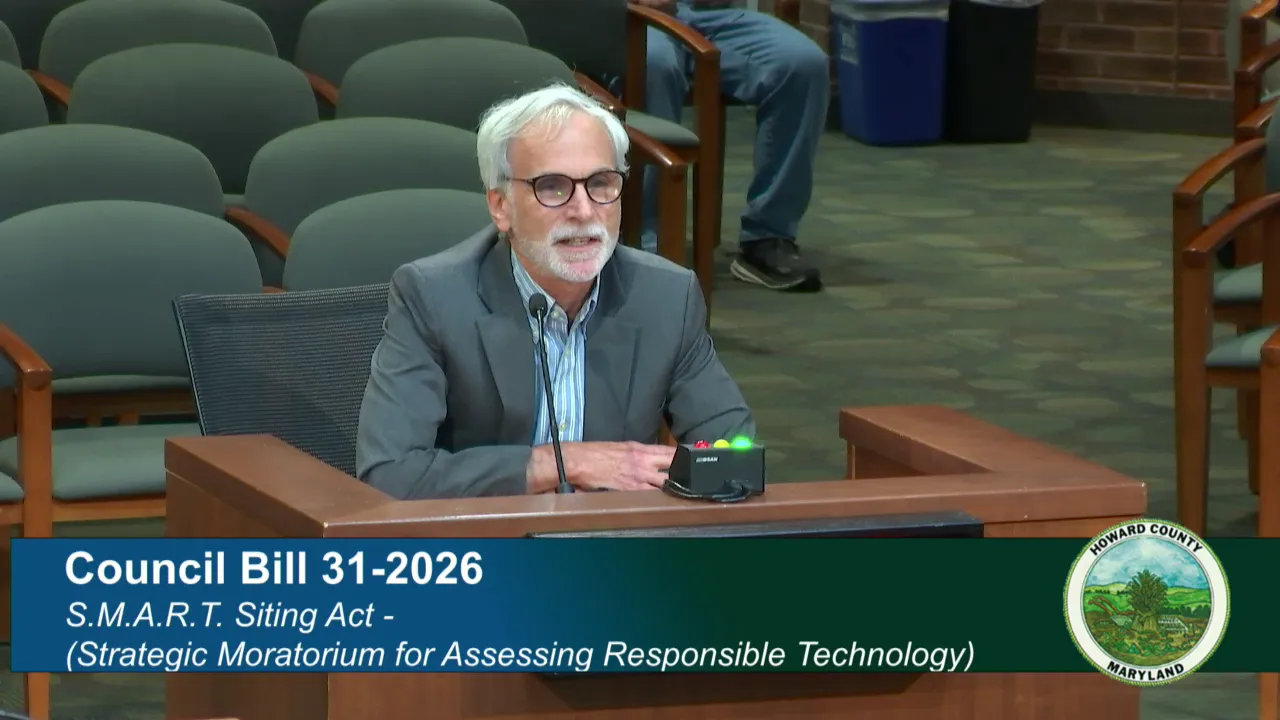
- CB31 – S.M.A.R.T. Siting Act (Data Center Moratorium): Introduced by Vice Chair Rigby, who stated it would create a temporary pause (up to 18 months) and a task force to study data center impacts and recommend best practices. She emphasized using the time to prepare for future development. Testimony was sharply divided: environmental and community groups strongly supported, while industry representatives (Maryland Tech Council) opposed a flat moratorium, advocating a faster study without a freeze. No council deliberation during the hearing.
Key Outcomes
- No votes were taken on any agenda item during the legislative public hearing.
- The council will hold a legislative session for final consideration of budget legislation (CB26-30, SAO1, CR74-75, CB32-39, etc.) on Wednesday, May 20, 2026, at 12:00 p.m. in the Banneker Room.
- A legislative session for non-budget legislation (appointments, CB25, CB31, and fee resolutions) will be held on Monday, June 1, 2026, at 7:00 p.m. in the Banneker Room.
- The council administrator noted that written testimony will be fully considered before actions are taken. A work session for possible additional review is scheduled for Tuesday, May 26, 2026, at 10:00 a.m. in the C. Vernon Gray Room.
Meeting Transcript
This webinar is being recorded and summarized. Good evening, everyone. This is the council's May legislative public hearing in which we will hear testimony for legislation introduced on May 4th. This evening is a hybrid meeting, which is being conducted in person and via WebEx Teleconference. It is also available to the public through live stream on the County Council website and broadcast on channels 44 and 1071. Sign up to testify on legislation that is the subject of this public hearing was done online and was available in person prior to the start of the session. The cutoff for testimony sign up was at 7 p.m. this evening. If needed, the council will hold a work session on Tuesday, May 26th at 10 a.m. in the C Vernon Gray Room. Council members, please provide agenda items for the work session to our council administrator no later than 9 a.m. Tuesday, May 19th. A legislative public, a legislative legislative session for final consideration of certain budget legislation that is the subject of this public hearing will be held on Wednesday, May 20th at 12 p.m. in the Banneker room. A legislative session for final consideration of non-budget legislation that is a subject of this public hearing will be held on Monday, June 1st at 7 p.m. in the Banneker Room. Public participation for these meetings will be available in person virtually via WebEx and viewed live streamed through the County Council website. At this time I'm going to do a roll call of the council members. Ms. Rigby. Here. Miss Young. Here. Mr. Youngman. Here. Miss Walsh will be joining us shortly. And I am. I'm here. Oh, I'm so sorry. I just saw a bunch of stuff where you sit, so I thought you were here. So yes, you are here virtually. Good to see you. Virtually. And I am Opal Jones. Tonight we have some very special guests with us to lead the reciting of the Pledge of Allegiance, Boy Scout Troop 540. Whenever you're ready to threw me off for a second, we usually when we have Boy Scouts, they're young and adorable and the voices are high, and I hear this I pledge allegiance. I'm like, oh man, those aren't Boy Scouts at all. Right, Man Scouts. Thank you, gentlemen. We will now proceed with our regular May legislative public hearing. If there are any students who will be testifying this evening, for those in person, please come up to the front row so we can call on you to testify. Those testifying virtually, please contact Isaiah Anderson by raising your hand on the WebEx or by sending him an email at Ianderson at Howard County MD.gov. Please note that while we are receiving testimony this evening, we continue to receive written comments, which will fully which will be fully considered by the council prior to taking action. Anyone who sign up to testify at this hearing will be called to testify. When you are called upon to testify, please state your name in the city or town of your home address. Representatives from nonprofit organizations will have up to five minutes to testify. Individuals and other organizations have up to three minutes to testify. Individuals who have indicated that they are testifying through an interpreter may be allowed a total of five minutes with interpreter translation. You may not yield your time to another speaker.
openpublica.com