Howard County Hearing Examiner: Variance Petition (July 31, 2026)
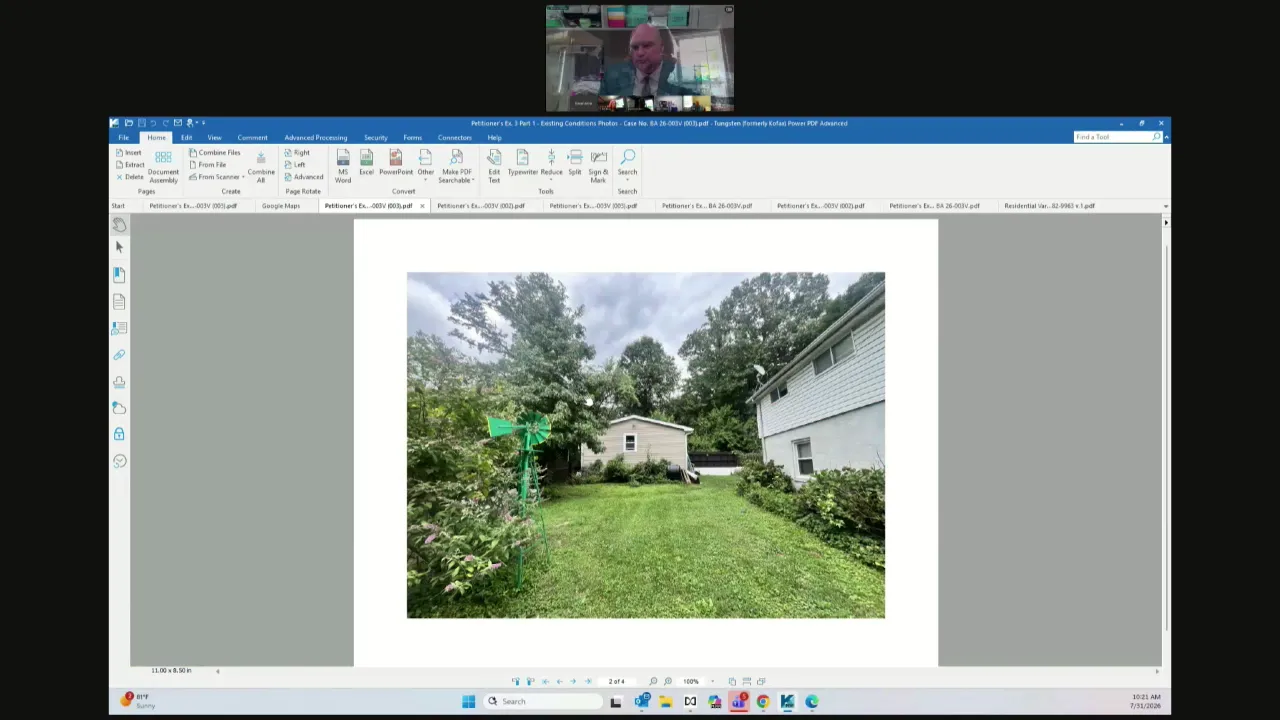
STREAMING COPY IN PREPARATION — RECORDING AVAILABLE FROM THE ORIGINAL SOURCE
Howard County Hearing Examiner: Variance Petition – July 31, 2026
On Friday, July 31, 2026, at 10:00 a.m., the Howard County Hearing Examiner, Joyce Nichols, convened a hybrid meeting to consider BA 26-003V, a residential district variance petition filed by Nicholas Bennett for property at 8250 Mission Road, Jessup, MD. The petition requested four variances related to an existing single-family dwelling (built 1958) and an accessory shed constructed in late 2024. After hearing testimony from the applicant and his engineer, the Hearing Examiner took the matter under advisement, stating a decision and order would be forthcoming.
Discussion Items
-
Case Overview: Attorney Adam Baker (Rosenberg Martin Greenberg) presented on behalf of Nicholas Bennett. The property is a 9,626-square-foot lot (RSC zone) improved with a 2,375-square-foot dwelling. The shed, built without permits, triggered a violation notice (March 27, 2025). Subsequent survey revealed the existing dwelling also encroached into required setbacks. The applicant sought to ratify the conditions and obtain legal compliance.
-
Variances Requested:
- Principal dwelling: Front yard setback reduction from 30 ft to 29 ft (1-ft reduction); Rear yard setback reduction from 30 ft to 29 ft (1-ft reduction).
- Accessory shed: Side yard setback reduction from 7.5 ft to 1.2 ft (6.3-ft reduction); Rear yard setback reduction from 10 ft to 5.1 ft (4.9-ft reduction).
-
Testimony of Nicholas Bennett (Applicant):
- Acquired property in 2009; shed built in late 2024 for storage. Neighbors were notified and expressed no objection; the closest neighbor (1.2 ft side) offered to write a letter of support. The lot is among the smallest on Mission Road, with mature landscaping and fences limiting visibility of the shed from the street and most neighbors.
-
Testimony of Paul Sill (Professional Engineer):
- Licensed PE in Maryland, owner of SIL Engineering Group. He prepared the site plan and described the lot's topography: the property rises approximately 5–7 ft from the front retaining wall to the rear, with drainage ditch and retaining wall at front. The lot is irregular and narrow compared to neighbors (two adjacent lots are twice the size; the rear lot is five times larger).
- Sill testified that the existing house’s location (1958) and the lot’s shape create practical difficulties for strict compliance; relocating the house would require reconstruction. For the shed, requiring full setbacks would force an awkward, elongated structure near the house. He confirmed the variances are the minimum necessary to legalize existing conditions, that they would not alter neighborhood character, impair adjacent property use, or harm public welfare. The shed is not visible from the road and only visible from one neighbor’s property.
- Sill further noted that no variances are sought for conditional use criteria, and the property is not in a historic district.
-
Closing Argument: Attorney Baker emphasized that the hardships were not created by Mr. Bennett (house pre-dated his ownership; lot subdivision from 1947). The applicant has cooperated with county staff and kept neighbors informed. No objections were presented at the hearing.
Key Outcomes
- The Hearing Examiner accepted Petitioners’ Exhibits 1 through 7 into evidence.
- No decision was rendered at the hearing; the case was concluded subject to a forthcoming written decision and order.
- The Hearing Examiner noted that the shed is not abnormally large and is comparable to sheds on neighboring properties.
Meeting Transcript
Being recorded and summarized. We are now recording. Thank you. Good morning, everybody. It is July 31st. It is approximately 10 o'clock in the morning. We are here for BA26-003 V, a request by Nicholas Bennett for four variances. And I'm going to turn the case over to you, Mr. Baker. Thank you very much, Madam Hearing Examiner. For the record, Adam Baker and Jamie Orr with Rosenberg Martin Greenberg here on behalf of Mr. Bennett. I also have with us this morning Paul Sill, who was our engineer on this matter. If you'd like, I can do a brief introduction and then we can call witnesses and submit evidence. Just a little bit of background. It's improved with a single family dwelling and most recently an accessory shed, which is really the catalyst for why we're here today. And again, my client purchased it in 2009. Um for not having pulled permits and for also locating the shed within the required setback. Both of these items were news to him, so he reached out to me and and after a series of back and forths, we ultimately filed the variance uh case for the shed. When we brought Mr. Sill on to perform the survey and prepare the site plan for the case, it was discovered that the existing dwelling is located within the required setbacks. So we added that relief in addition to the variance setbacks for the shed. So again, as you indicated, there are four variances, two of which pertain to the existing dwelling front and year front and rear yard setbacks, as well as for the shed, a side yard setback and a rear yard setback. Um our first witness this morning is Nicholas Bennett. Before before we call Mr. Bennett, I just have a technical question for you, Mr. Baker. Let me just verify the variances. All right. So you you want a front yard for the principal, a reduction of one foot from 30 feet to 29 feet, correct? Correct. Okay. You want a reduction in the rear yard for the principal, um, again, from 30 feet to 29 feet, a reduction of one foot. That's correct. Okay. Um you want to reduce the side yard setback for the shed from 7.5 feet to 1.2 feet. Correct. Okay, so that's a reduction of 6.3 feet. This other one is the one I'm a little uncertain on. The last variance is is to reduce the rear setback for the shed from 10 feet to 5 feet or 5.1, or uh what exactly are we is the right number that we're reducing it to? It's 5.1 feet. Okay, so that's a reduction of 4.9 feet. Yeah, thank you. 4.9 feet. Okay, all right. I've got this. All right, so Mr. Bennett, you've been called as a first witness. I need you to I need to swear you in. Thank you, sir.
openpublica.com