Planning Commission Meeting and Study Session - September 27, 2022
STREAMING COPY IN PREPARATION — RECORDING AVAILABLE FROM THE ORIGINAL SOURCE
Planning Commission Meeting and Study Session - September 27, 2022
The Huntington Beach Planning Commission convened on Tuesday, September 27, 2022, at 5:00 PM for a Study Session on the 2021-2029 Housing Element Update, followed by a Regular Meeting at 6:00 PM. The Regular Meeting included a public hearing on the Bella Terra Residential Project, approval of consent calendar items, and other business. All seven commissioners were present, with Commissioner Mandic recusing herself during part of the Study Session due to a potential conflict of interest.
Study Session: Housing Element Update (5:00 PM - 5:30 PM)
- Staff presented an overview of the 2021-2029 Housing Element Update, focusing on Appendix B (RHNA and adequate sites) and implementation programs. The city's total RHNA is 13,368 units, including over 5,000 for very low- and low-income households.
- Proposed strategies to accommodate the RHNA include RMH rezoning of three sites (Chuck E. Cheese, Frontier Yard, Reliable Lumber; 428 units, moderate/above moderate) and Affordable Housing Overlays on properties in the Gothard Corridor, Golden West College, SP 14, SP 9, and SP 7 (allowing up to 70 du/acre with 20% low-income requirement). A buffer of 15-30% above RHNA is recommended to ensure compliance.
- Commissioners asked about developer interest, density assumptions, ADU programs, earthquake fault concerns, and the Affirmatively Furthering Fair Housing (AB 686) analysis. Staff clarified that the overlays sunset after the sixth cycle or when RHNA is met, and that no-net-loss rules apply.
Regular Meeting (6:00 PM)
Public Comments & Testimony
- Bella Terra Residential Project: Several speakers addressed the commission. Lindsay Parton (DGM Capital) thanked the city for support. Ben Pickens (HB resident) expressed support but requested improved architecture and greenery. No public comments were made on non-agenda items.
Discussion Items
22-747 Bella Terra Residential Project (GPA 21-001, ZTA 21-003, SPR 21-002, AEIR 21-002)
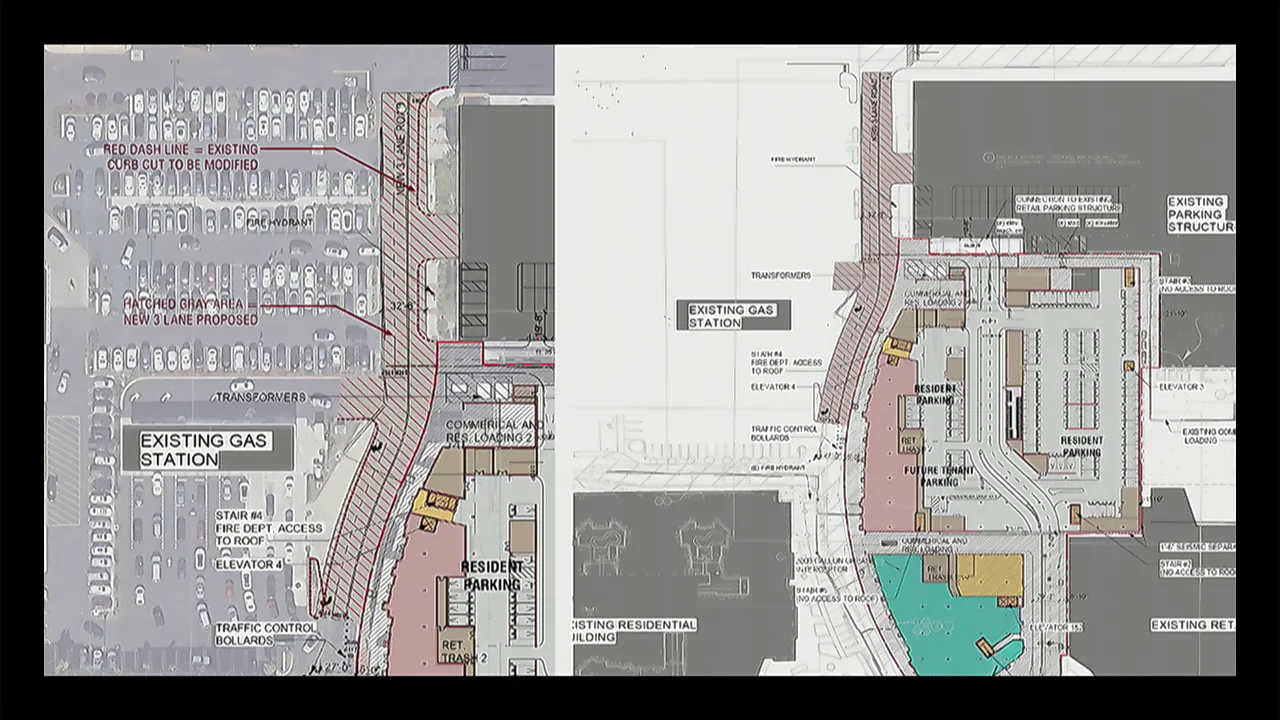
- Staff presented the proposal to demolish the existing 149,000 sq. ft. Burlington department store and 30,000 sq. ft. adjacent retail, constructing a seven-story mixed-use infill with 300 apartment units (45 affordable, 15%), 25,000 sq. ft. retail/restaurant, and a 404-space podium parking garage. The project required a General Plan Amendment (revising land use designations), Zoning Text Amendment (dividing Area B into subareas B.1 and B.2, updating development standards), Site Plan Review, and an Addendum EIR.
- The applicant (Christopher Golder, DGM Capital) addressed commissioner questions, confirming the highest occupied floor is 75 feet, architectural features up to 100 feet (specific plan allows 120), EV parking per Title 24, and planned trash enclosures. Traffic mitigation includes a new lane on Crescent Road to improve Costco gas station queuing and a dedicated pedestrian bridge from the parking garage to residences.
- Commissioners Scandura and Mandic proposed conditions: pedestrian bridge, directional signage, customer-only parking signs, and preserving parking spaces for EV charging stations. Commissioner Scandura also proposed amending the specific plan to allow appeals of director decisions to the Planning Commission first.
- Commissioner Ray opposed, citing the seven-story height exceeding the specific plan and arguing that a full EIR rather than an addendum was needed due to cumulative impacts from Costco and previous development.
Consent Calendar
- 22-817: Approve minutes of March 8, 2022 – Approved unanimously.
- 22-818: Approve minutes of March 22, 2022 – Approved (Commissioner Rodriguez abstained).
- 22-819: Approve minutes of April 12, 2022 – Approved (Chair Perkins abstained).
- 22-820: Approve minutes of April 26, 2022 – Approved (Chair Perkins abstained).
Key Outcomes
- Bella Terra Residential Project: The Planning Commission voted 6-1 (Commissioner Ray dissenting) to recommend approval to the City Council of the Addendum EIR, General Plan Amendment, Zoning Text Amendment (with specific plan amendments), and Site Plan Review (with conditions including pedestrian bridge, directional signage, customer-only parking signs, and preservation of parking spaces for EV charging). The decision is appealable to the City Council within 10 calendar days.
- Specific Plan Amendment (Straw Vote): Approved unanimously to change appeal procedures for site plan reviews and parcel maps within Specific Plan 13, allowing appeals first to the Planning Commission then to the City Council.
- Consent Calendar: All four sets of minutes were approved as noted.
- Next Meeting: The next Planning Commission meeting is scheduled for Tuesday, October 11, 2022, at 5:00 PM (Study Session) and 6:00 PM (Regular Meeting), focusing on the Housing Element Update and its subsequent EIR.
Meeting Transcript
Nature Center really is one of the jewels of the city, and a lot of people don't know about the uh I'd like to call the September 27, 2022 Planning Commission meeting to order. And would staff take the roll call. Sure, good evening, uh Commissioner Adam. Present. Commissioner Manick here. Commissioner Acosta or Vice Chair Acosta Galman. Here. Uh Chair Perkins. Here. Commissioner Scandura. Here. Commissioner Rodriguez. Here. Commissioner Ray. Here. We have a quorum. Thank you. Thank you. Okay, do we have any public comments? We have no one signed up to speak for public comments. Okay, thank you. Next on the agenda is our study session item, which is the housing element update. Do we have a report from staff? Uh yes. Um sorry, Nicole. I will begin the presentation. Thank you. Thank you. Good evening, Chair Perkins and Commissioners. The item we will discuss tonight is the 2021 to 2029 housing element update. The goal of the study session is to introduce this item and take questions from the planning commissioners that we can answer in the public hearing staff report. Just to give a quick overview of tonight's presentation, we will focus the study session on appendix B of the housing element, which discusses the RENA and sites identified to accommodate the RENA. We're also um going to talk about the implementation programs within section four that implement the RENA through the proposed rezoning action and affordable housing overlays actions. So just a quick refresher, the document has a few different sections. At the last study session, we talked about the population and housing profile and the constraints and resources section. Tonight we're going to go over appendix B, which covers the RENA and the sites identified to accommodate the RENA, and section four, which is the goals and implementation action section, particularly the adequate sites implementation actions. So here we have the city's 2021 to 2029 RENA. You may have seen this a few times before by now. Um the arena gives every jurisdiction a quantified housing need by income category. As you can see, the total number of units to demonstrate zoning capacity for is 13,368. Just over 5,000 units are for very low and low-income households, about 2300 are for moderate income, and 5,215 for above moderate income. So this table shows an overall breakdown of the city's strategy to accommodate the arena. Uh project projections or sorry, the arena through projects that are approved or pending and will be occupied during the planning period, ADUs and the hotel motel conversions. So next, this is some information on the methodology of the adequate sites section, which is appendix B in the housing element. So the site's inventory has properties that some of them are smaller and some of them are larger. And it we were required to do additional analysis in order to justify including those sites in the inventory. So if you, if you're in appendix B, you'll see some very detailed analysis of small sites as well as the larger sites. Also, because the city identified capacity for more than 50% of its lower income RENA on nonvacant properties, HCD required a detailed sites analysis for those as well. The city needed to show substantial evidence that the property will be developed and demonstrate that the existing use uses would not be an impediment to developing housing on those sites during the planning period. The substantial evidence described in the housing element includes past redevelopment trends on similar properties, existing conditions of the properties in the inventory, as well as an economic feasibility analysis that the city provided as appendix D to the housing element.
openpublica.com