OPENPUBLICA · PUBLIC MEETING RECORD
Record of Proceedings
Indianapolis-Marion County Metropolitan & Economic Development Committee Meeting – November 9, 2026
City-County Council — Monday, November 9, 2026
BodyIndianapolis, Indiana
SessionCity-County Council
DateMonday, November 9, 2026
StatusNEW · FILED
Video Record
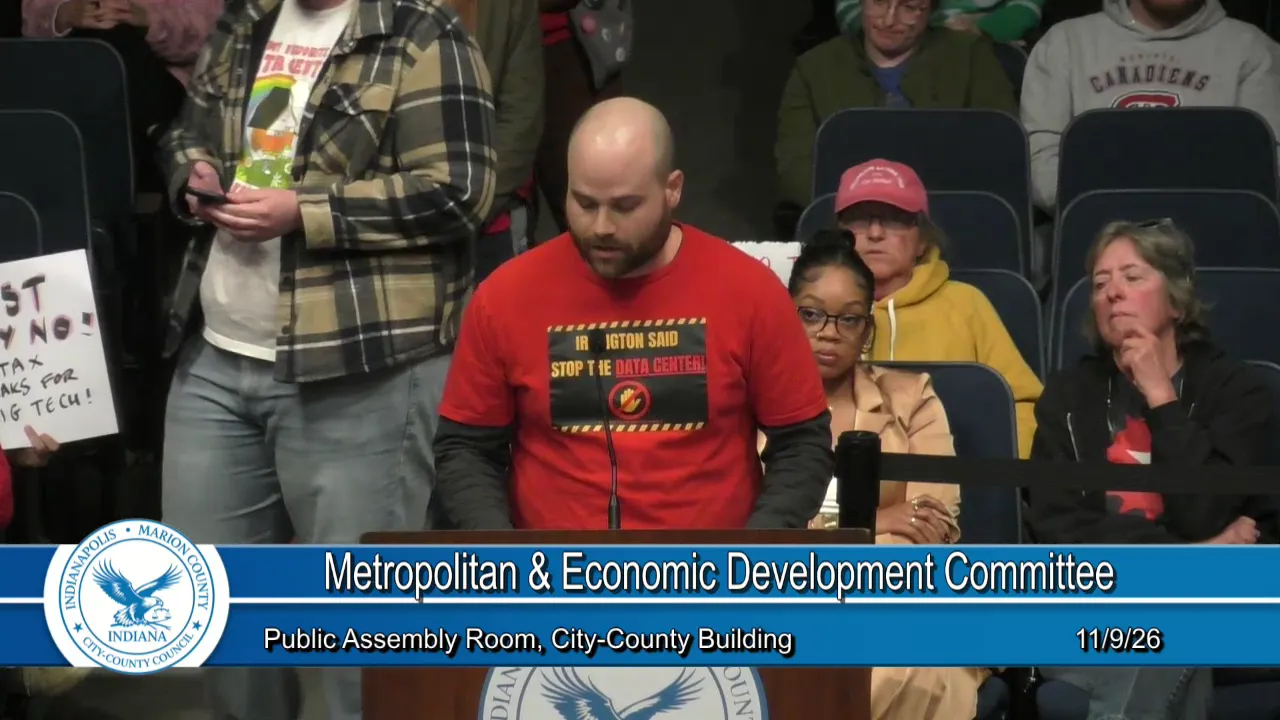
STREAMING COPY IN PREPARATION — RECORDING AVAILABLE FROM THE ORIGINAL SOURCE
Transcript — Verbatim
Speaker numbers apply only to this recording.
Discussion Breakdown — Share of Meeting
Economic Development20%
Affordable Housing14%
Parking Management11%
Data Center Regulation11%
Procedural10%
Taxation9%
Tax Abatement6%
Public Safety4%
Community Engagement3%
Summary of Proceedings
Indianapolis-Marion County Metropolitan & Economic Development Committee Meeting – November 9, 2026
On November 9, 2026 (agenda start 5:30 p.m. local / 10:30 UTC), the Indianapolis-Marion County City-County Council's Metropolitan and Economic Development Committee met in the Public Assembly Room of the City-County Building. Chair Vop Osili presided; no minutes were provided, so this summary is based on the agenda and transcript. The committee took action on parking-minimum elimination, the county recorder's fund request, three improvement-district budgets, three affordable-housing PILOTs, and two DC Blox tax-abatement resolutions.
Discussion Items
-
Proposal No. 237, 2026 – Parking minimums resolution. Councilor Brown asked the committee to recommend that the Metropolitan Development Commission remove all parking minimums city/countywide. He argued minimums increase housing costs, delay development, create excess surface parking, and burden stormwater and heat islands. DMD is conducting a parking study and plans to report to the committee in January. Several council members preferred waiting for that study; Councilor Jones cited Fountain Square/Fletcher Place businesses impacted by storm-sewer construction; Councilor Cahill wanted explicit ADA protections; Councilor Hart and Councilor Roberts supported the request as a pro-development signal. A motion to postpone to February failed 7–7. The committee then approved a do-pass recommendation; the chair counted 10 in favor and 4 opposed.
-
Proposal No. 322, 2026 – County recorder's perpetuation fund request. Recorder Faith Kimbrough requested approval to use $42,000 ($3,500/month) from the recorder's Perpetuation Fund for 2026 office expenses, including a Property Fraud Alert and Veterans Honors promotion with billboards, radio/TV, and a 2027 special event. She reported 2,200 new Property Fraud Alert sign-ups since the last meeting, about 15,000 total. Members praised the revised ad design but asked about radio/TV advertising reaching outside Marion County and suggested targeted social media; the recorder said she would consider an amendment to add social media. The committee voted do pass, with all voting members in favor.
-
Proposal Nos. 342, 343, 344 – 2027 district budgets. The committee approved the Greater Virginia Avenue Corridor EID budget of $79,750, the Woodruff Place EID budget, and the Downtown EED budget of $5.5 million. Presenter Michael Taft said the Virginia Avenue corridor focused on maintenance, landscaping, marketing, and event sponsorships after Shelby Street construction. Woodruff Place's Hannah Saunders described about $53,000 in projects; the ordinance states $45,000 in revenue and the attached budget sheet lists $53,500 in funded expenditures. Downtown Indy Alliance's Taylor Schaefer said there are 819 eligible parcels, assessed value grew about 8%, and the EED fee rate will decrease to 0.509% of eligible assessed value. The 2027 Downtown budget includes $1 million for the low-barrier shelter, $100,000 for public-safety technology, expanded homeless-outreach staffing, reduced contract cleaning, and additional safety ambassadors. Proposal 342 carried 13–0; Proposals 343 and 344 carried on voice votes with one audible no each. Note: the printed 344 ordinance contains a recital referring to calendar year 2025 even though the submitted budget is for 2027.
-
Proposal No. 347, 2026 – M22 Housing LP tax abatement. Crestline Development's Camden Rumkey requested approval of a statement of benefits for M22 North, a 116-unit mixed-use project at 2204 North Meridian Street, with a $33.65 million real-property investment, four new full-time jobs averaging $24/hour, a 10-year 80% real-property abatement, and estimated abatement savings of about $3.99 million. The developer committed 10% of units to households earning 30% or less of AMI through the DMD master-lease program; a correction from the development principal extended that commitment to 15 years. DMD's Jenny Foltz clarified the project is not a LIHTC/PILOT affordable project but a market-rate deal receiving an abatement for including deep-affordability units and supportive services. Councilor Cahill calculated the subsidy at roughly $2,769 per affordable unit per month and questioned the value. The committee voted to postpone the proposal to the January 2027 committee meeting.
-
Proposal Nos. 348, 349, 350 – Affordable-housing PILOTs. DMD's Ashley Miller presented three proposed payments in lieu of taxes: Richardson Townhomes (about 40 units, 20% set aside for veterans experiencing homelessness), Westgate Commons (about 216 units), and Lugar Towers (about 298 units, over 80% elderly/disabled). All are 100% affordable projects using low-income housing tax credits, with average AMI at or below 60%; proposed PILOT terms are 15 years with 3% annual escalators and at least 30 years of affordability. DMD explained that of 21 spring-round applicants, only Laurel Wood Apartments/Rownie Terrace had been awarded tax credits to date. Councilor Brown praised the Lugar Towers team for addressing terrible conditions at the property. One public commenter, a low-income housing resident, criticized property management and mold/embezzlement issues. The committee voted to send all three to the full council with a do-pass recommendation.
-
Proposal Nos. 345, 346, 2026 – DCB Indianapolis LLC dba DC Blox tax abatements. DC Blox seeks approval of real and personal property statements of benefits for a two-building data center at 305 Fintail Drive. The project is a $1.8 billion investment, with about $384.4 million in real-property improvements and $1.43 billion in personal property, expected to support about 600 construction jobs and 21 permanent jobs at an average of $51.43/hour. The requested incentives are a reassigned 10-year 50% real-property abatement and a 10-year 85% personal-property abatement. DC Blox says it would pay about $9.7 million in real-property taxes and $18.3 million in personal-property taxes during the abatement, and would contribute about $30 million in community commitments, including East Side Talent Bridge, Ellenberger Park, Irving Circle, and Washington Square Mall work. Land use was approved by the MDC and is under judicial review; the project sits in the Irvington-Brookville TIF allocation area. IEDI president Andrea Rector Gary said the incentive was evaluated through the city's standard due-diligence and includes clawbacks; the city declined to use the full 40-year personal-property exemption. The proposal drew strong support from Councilor Hart as an east-side investment, but Councilor Nielsen, Councilor Barth, Councilor Brown, and others opposed it, citing overwhelming resident opposition and insufficient public benefit. A motion to send it to the full council with no recommendation failed. A motion to send it with a do-not-pass recommendation passed 11–2.
Public Comments & Testimony
-
Proposal 237: Eight commenters supported eliminating parking minimums. Speakers included a Transit Riders Union representative and East Side residents; one resident estimated 970,000–1.3 million residential parking spaces are required by current rules, and another speaker with epilepsy said parking mandates make life harder for people who cannot drive and supported ADA parking expressed as actual spaces rather than percentages.
-
Proposals 348–350: One public commenter spoke critically about low-income housing management and supported changes like less restrictive felony screening; no other public comments were made on the PILOT package.
-
Proposals 345–346: The public comment period was extensive and overwhelmingly opposed. More than 20 residents and community members spoke against the abatements. Opposition speakers included the president of the Irvington Community Council, who said the council voted unanimously to oppose; a Friends of Irving Circle officer who said the group did not want the company's 'blood money'; residents of Irvington, Decatur Township, and the East Side concerned about toxic brownfield contaminants, proximity to an elementary school, noise, heat, water and electricity demand, the AI-market bubble, and the lack of permanent jobs. Several speakers called the incentives a $113 million handout and demanded DC Blox pay full taxes. One speaker asked Councilor Hart to recuse himself over his previous employment at SHI International/Vmware and alleged conflict-of-interest concerns; another said the East Side already received $685 million in investment over five years. No public speaker supported the DC Blox abatements.
-
No public comments were received on Proposals 322, 342, 343, 344, or 347.
Key Outcomes
- Proposal 237: do-pass recommendation approved (chair's count 10–4); motion to postpone failed 7–7.
- Proposal 322: do-pass recommendation approved by roll call.
- Proposal 342: 2027 GVAC EID budget approved 13–0.
- Proposals 343 and 344: 2027 Woodruff Place EID and Downtown EED budgets approved on voice votes.
- Proposal 347: postponed to the January 2027 committee meeting.
- Proposals 348, 349, and 350: do-pass recommendation approved.
- Proposals 345 and 346: no-recommendation motion failed; do-not-pass recommendation passed 11–2.
- Full council will take final action on the committee's recommendations, with the DC Blox proposals expected at the December full-council meeting.
Meeting Transcript
Good evening, everyone. Welcome to a meeting of the Metropolitan Economic Development Committee. I would like to ask my colleagues to introduce themselves, and I will start with Council Roberts. Thank you, Mr. Chair Nick Roberts, District 4. Thank you, Mr. Chair Brienne Delini, District 2. Thank you, Mr. Chair. Jesse Brown, District 13, near North Near East Side. Thank you, Mr. Chair. Brian Mowery, District 25. Thank you, Mr. Chair. Paul and A, District 22. Thank you, Mr. Chair, Michael Paul Hart, District 20. Thank you, Mr. Chair, Derek Cahill, District 23. Thank you, Mr. Chair. Ron Gibson, District 8. Uh thank you, Chairman Osley, Andy Nielsen, District 14. Thank you, Mr. Chair. John Barth, representing Council District 7. Thank you, Chairman Ollsley. Kristen Jones, District 18. Thank you, Chairman Osley, LeRoy Robinson, District 1. Very good. Let us begin immediately then with proposal number 237, which requests that the Indianapolis Department of Metropolitan Development eliminates eliminates parking minimums within the city of Indianapolis and Marion County. Mr. Chair. Yes, uh Council Hart. Before we begin, can I have a quick point of order to ask a clarification to council? Please proceed.
SUMMARIZED BY OPENPUBLICA AI
TRANSCRIPT VIA PUBLIC VIDEO
openpublica.com
openpublica.com