OPENPUBLICA · PUBLIC MEETING RECORD
Record of Proceedings
Environmental Sustainability Committee Meeting - November 16, 2026: August Flooding and Climate Resilience
City-County Council — Monday, November 16, 2026
BodyIndianapolis, Indiana
SessionCity-County Council
DateMonday, November 16, 2026
StatusNEW · FILED
Video Record
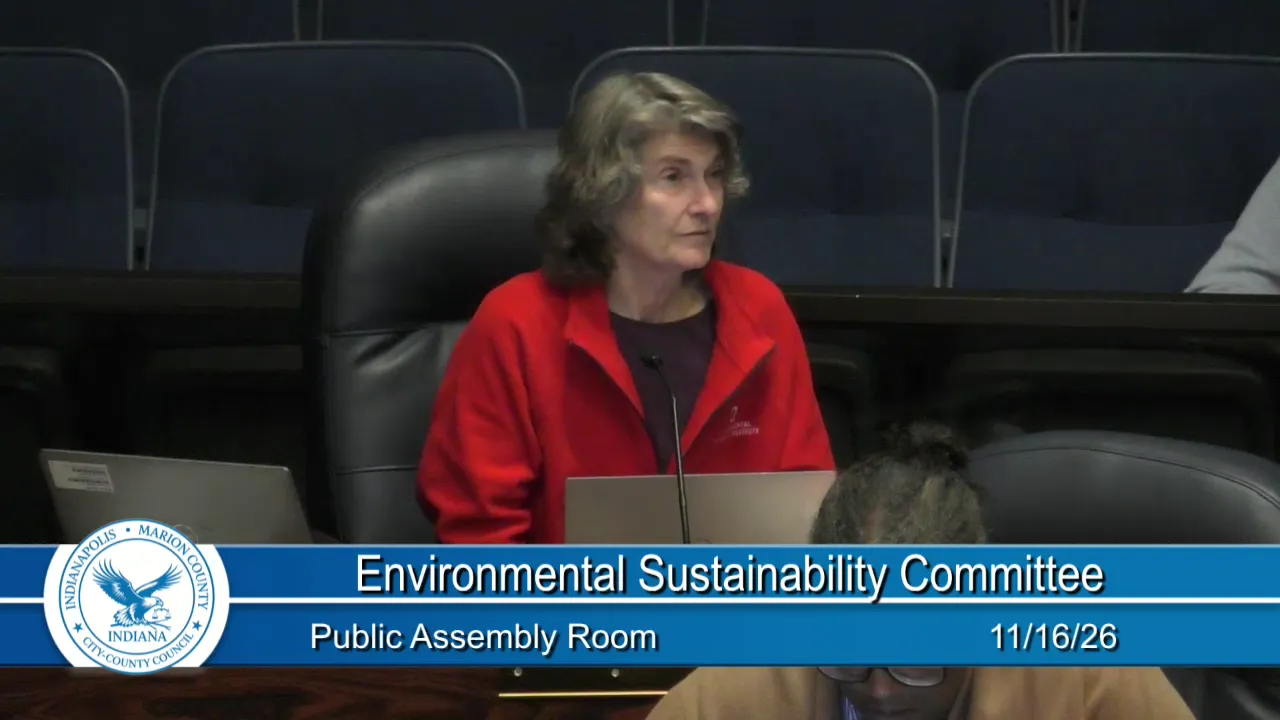
STREAMING COPY IN PREPARATION — RECORDING AVAILABLE FROM THE ORIGINAL SOURCE
Transcript — Verbatim
Speaker numbers apply only to this recording.
Discussion Breakdown — Share of Meeting
Climate Change63%
Stormwater Management26%
Emergency Management8%
Flood Management3%
Summary of Proceedings
Environmental Sustainability Committee Meeting - November 16, 2026
The Environmental Sustainability Committee of the Indianapolis-Marion County City-County Council met on November 16, 2026, to discuss the August flooding and its implications for climate resilience. The meeting featured a communication from the Metropolitan Emergency Services Agency (MESA) and a presentation from the Environmental Resilience Institute (ERI) at Indiana University. No formal votes were taken; the committee focused on gathering information and planning future action.
Communication from MESA
- Mo McReynolds, Director of the Office of Sustainability, read a statement from MESA regarding the August floods. MESA recommended four steps for community preparedness: (1) sign up for emergency alerts by texting MESAINDY to 67283, with a goal of 10% community enrollment; (2) assemble disaster preparedness kits; (3) meet neighbors and share contact information; and (4) take the Community Emergency Response Team (CERT) training. MESA emphasized that community cooperation is key to resilience.
Presentation by the Environmental Resilience Institute (ERI)
- Janet McCabe (ERI, Indiana University) presented updated climate projections for Indiana. Key findings included:
- Earth's climate is warming, with Indiana experiencing hotter temperatures, changes in precipitation, and more extreme weather.
- The rate of temperature increase has accelerated since 1960.
- Statewide precipitation is increasing, with the southeast seeing the greatest rise.
- Warmer air holds more water, leading to more intense rainfall events that can overwhelm infrastructure.
- New modeling shows a 10% increase in extreme storms (≥2 inches in 24 hours) since 1971-2000, with another 10% increase projected.
- Marion County could see up to 10 additional days per year with temperatures above 95°F by the 2020s.
- McCabe noted that El Niño is not expected to dramatically affect Indiana this year, but climate change remains the primary driver of extreme weather.
Discussion Items
- Councilor Barth (Chair) highlighted that the August flood affected districts 7, 2, and others, with many residents still displaced (over 150 people in hotels). He stressed the need for proactive planning rather than reactive response.
- Councilor Hart questioned the use of 1971-2000 as a baseline for precipitation data, suggesting longer historical records should be considered. He also noted that property damage correlations may be skewed by increasing development and property values.
- Councilor Brown raised concerns about stormwater funding, noting that current systems primarily address street-level pooling, not major upstream flooding. He asked about innovative funding mechanisms (e.g., green necklace programs) used by other cities.
- Councilor Barth emphasized the need to integrate climate projections into city policy and advocate for state-level changes, particularly regarding water management and development regulations.
Key Outcomes
- The committee will await the after-action report on the August flooding to inform further policy action.
- Chair Barth committed to increasing the urgency of climate resilience efforts, including working with academic partners and advocating at the State House.
- Councilor Hart suggested coordinating with the Central Indiana Redevelopment Association (CIRA) and local mayors on regional water distribution planning.
- The committee will continue to engage with MESA and ERI for additional data and recommendations.
Meeting Transcript
Okay, good evening, everyone, and welcome to the Environmental Sustainability Committee. Um we have a couple of interesting issues tonight that I'll tee up here in a minute, but let's start um with um introductions from the committee members starting with Councillor Hart. Thank you, Mr. Chair, Michael Paul Hart, representing District 20. Thank you, Mr. Chairman. Mike Dilk, District 24. Thank you, Mr. Chair, Derek Cahill, District 23. Thank you, Mr. Chair. Jesse Brown, near North Side, Near East Side District 13. Thank you, Mr. Chair McGrawbert, district four. Thank you, Mr. Chair Brian Delaney, District 2. Thank you, Chairman Barth, Andy Nielsen, District 14. Thank you. And I'm John Barth, representing Council District 7, and I'm chair of the committee. So just a few comments to tee things up this evening. The flooding that we experienced in August affected a great many people. It especially affected uh three council districts, Council Boots, Councilor Delaney, and myself. Um for me, it was Rocky Ripple and Broader Pool and for Councillor Delaney, um, Ravenswood, which has hit the hardest um uh and a lot of people still recovering um across the region. So I wanted to spend some time digging into um especially the risks of uh future uh flooding um and the effects of climate on on flooding, and we're fortunate to have uh someone with us from Indiana University uh to talk about that. Um but before we get to that introduction that uh director McReynolds is going to do. I wanted to note that I did um re request the uh metropolitan emergency services agency Mesa to come and uh present tonight. They were not able to, um, so they are gonna they sent a letter um that uh the director is gonna read. So that will be short and we'll um engage with them at a future meeting. So the bulk of the meeting will be focused on um uh the information from um Janet McCabe. So before we get there, uh let me uh turn it over to uh director McReynolds to share the um the communication and then we'll jump into the introduction for for Janet McCabe. Thank you, Counselor. Welcome thank you, committee, for having us this evening. Um on behalf of our colleagues in the Metropolitan Emergency Services Agency, I wanted to share this message. The floods in August are a reminder of the immense impact whether emergencies can have on our community, the Metropolitan Emergency Services Agency and its dedicated or otherwise known as Mesa, and its dedicated employees work to minimize the impact of emergencies and disasters, man-made and natural in and recovery by coordinating information in Marion County. Excuse me, I missed a line. Man-made and natural in Marion County and its thriving cities and communities through education, planning, response, and recovery by coordinating information, public service response and resources. Here are four things Mesa recommends to Indianapolis community members to better prepare for the next disaster. Listed in order of time intensity. Number one, text Mesa Indy, capital M E S A I N D Y to 67283.
SUMMARIZED BY OPENPUBLICA AI
TRANSCRIPT VIA PUBLIC VIDEO
openpublica.com
openpublica.com