Marion County Election Board Meeting - April 6, 2024
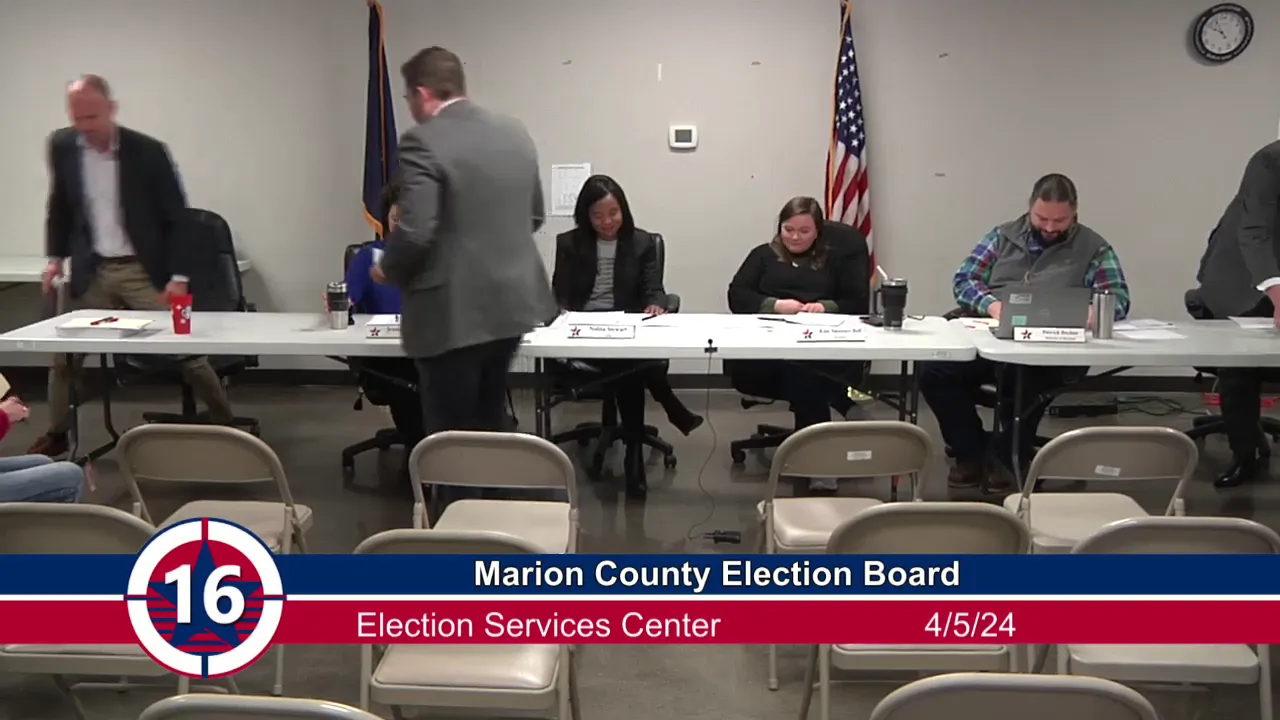
STREAMING COPY IN PREPARATION — RECORDING AVAILABLE FROM THE ORIGINAL SOURCE
Marion County Election Board Meeting - April 6, 2024
The Marion County Election Board met on April 6, 2024, to conduct public testing of voting machines, approve contracts, address a voter registration clarification from IPS, hold hearings on campaign finance fines, adopt a new campaign finance policy, and approve a rental agreement for tabulators. The meeting also included updates on upcoming elections and poll worker training. All votes were unanimous unless noted.
Consent Calendar
- Approval of Minutes: Minutes from January 29, February 23, and March 8, 2024, were approved unanimously.
Public Comments & Testimony
- Nick Roberts (candidate): Filed report 3 minutes late at 12:03 p.m. instead of 12:00 p.m. on deadline. The board waived the $50 fine unanimously.
- Mya Castillo (Lawrence candidate): First-time candidate with a zero-balance committee; did not file annual report. The board reduced the $1,000 fine to $259.90 (maximum reduction for first offense) unanimously. Staff offered assistance to close the committee.
- John Fencil (Pike Township Constable): Filed annual report more than 20 days late due to caregiving duties and business; first offense. The board reduced the $1,000 fine to $259.90 unanimously.
- Angela Moore (candidate): Treasurer failed to file annual report; report later filed. The board reduced the $1,000 fine to $259.90 unanimously. Others with 2023 annual fines who did not appear: fines remain in effect, but committees remain eligible for settlement under the prior policy.
Discussion Items
- Contract Approvals:
- Elect Staffing Logistics: Not-to-exceed $172,000 for delivery/pickup of voting equipment through Dec 31, 2024. Approved.
- Elect Staffing Mechanics: Not-to-exceed $96,680 for on‑election‑day support and key pickup through Dec 31, 2024. Approved.
- Dentons Bingham Greenbaum LLP: Not-to-exceed $50,000 for legal representation on IPS redistricting matter (due to conflict of interest with current counsel). Approved.
- IPS Voter Registration Clarification: The Marion County Board of Voter Registration sought the election board’s interpretation of whether state law allows technical corrections to the IPS redistricting plan certified in December 2022. Discussion identified 103 parcels with agreed‑upon errors. The board concluded that VR may proceed with these technical corrections; more complex disputes (unclaimed or double‑claimed parcels) require court action. Motion passed unanimously to allow VR to update the precinct key for technical corrections.
- Campaign Finance Policy Update: Approved a new policy effective April 6, 2024, removing the automatic settlement structure and requiring unpaid fines to be referred to the city’s Revenue Recovery Unit after 60 days. All open committees will be notified.
- Rental Agreement for DS 850 Tabulators: Approved $81,600 to rent two high‑speed tabulators for the primary and general elections, due to expected high turnout and limited availability of equipment.
Key Outcomes
- All three contract approvals passed unanimously.
- Resolution allowing VR to implement technical corrections to IPS redistricting plan passed unanimously.
- Campaign finance fines were waived or reduced as noted; new policy adopted unanimously.
- DS 850 rental agreement approved unanimously.
- The CAN‑9 notice of primary election was presented as filed.
Updates & Next Steps
- Early in‑person absentee voting begins April 9, 2024, at the clerk’s office and eight satellite locations.
- Voter registration deadline: April 8, 2024 (online by midnight; paper applications accepted until noon April 9 due to Eclipse Day closure).
- Inspector training set for April 21–22, 2024, offering free CLE credits.
- Poll worker safety emphasized; a new state law effective July 1, 2024, makes poll worker intimidation a felony.
Meeting Transcript
All right, good morning, everyone. Happy Friday. We'll get the I'll call the election board, Marion County Election Board meeting to order here on April 5th is the 905. Before we jump into the agenda, I'll do uh and have the board um do introductions uh as well as counsel and staff. So I'll start with myself, Nolita Stewart, Chair. Kate Sweeney Bill, Secretary. Good morning, Jennifer Ping, Vice Chair. Patrick Becker, Director of Elections. Ethan Hudson, OCC attorney. Brad Boswell and I'll sign counsel. I think that's everyone for introductions. Good morning, everyone. Uh today's a big day here at the Electric Service Election Service Center. Uh the primary reason we're here today is to do our public testing. And so I think we can have the commence public testing while we go through the OSCB agenda. Can we we need to all agree to get started here? Damon, are you ready to start public testing? We're gonna have more votes. Okay. Um Director Becker, did you want to give the audience or everyone watching any background on public testing or why we do it? Sure, thank you, madam chair. So um the public test is something that's required by law every election. Um we uh I believe the last time that this board met was um to ratify the ballot, which um was in March, and after that point um we um take all that um information that we've coded into the software and we start loading it onto the actual voting machines. Um and so in Marion County we have ballot marking devices that are called express votes. Um those hold ballot styles for every ballot in the county so that when you go to vote anywhere, uh we have a ballot for you. And then we also have uh tabulators which are called DS200s, and those are um digital scanners that tabulate the ballots after they've been marked on the express vote. Um, and so part of the um logic and accuracy testing that occurs after the ballot is ratified is literally going through all of our machines. So we have uh about 225 um DS200s that we uh deploy every election, and then we've got um 2008 express votes, um, and all of those get tested um prior to today's public test. Um and what that consists of is um we pre-mark test ballots and we know what those results are anticipated based on how we mark those ballots, and then we tabulate those ballots and we make sure that the results equal what we're expecting. Um so they're pre-marked ballots, their test ballots that are pre-marked and predetermined outcomes, and then we make sure that the tabulators are meeting those predetermined outcomes uh that we're expecting. The test that we're gonna be doing today consists of a portion of our fleet. What's required by law is that we test five percent of our machines and the uh the state through the voting systems technical oversight program in ball state, um, they work to provide us a randomized um order of our machines, and we go from their randomized order and we have to pull the top five percent and and test those. So, what these folks are gonna get ready to do is uh what we've been doing for the last three or four weeks is opening up machines about uh testing ballot marking devices and then testing them, running them through tabulators and making sure the results match what we are expecting. Uh to that end, uh what I would provide to the board, these are um what we call summary. This is a summary report from our election reporting management software. So this is the software that actually tabulates all of the results from all of the different DS200s. And if you want to flip through this, this is our zero report. So at the beginning of the test, there are no votes loaded into the uh ERM, the election reporting uh software, and then um this is our uh the report that we get from our DS-850. So because we have two uh DS-850s, which are the high speed tabulators, uh, we're required to test at least one of them. Um, and so this is the zero report for that 850. So again, you'll see no results um on those right now. After the test is concluded, uh we'll have uh totals from the test. Um so that'll be totals for the DS-850 because we do um run the ballots through that, and then totals from what was loaded in through the DS 200s, and those will be on the summary report that you just looked at. Um and I think that is hopefully extensive enough. Very good. You've got zero reports for all the time. Yeah, and then each of the DS200s have zero reports that are printed out. Um so when we and this is true on election day too, and an inspector would open their machine, they would print a zero report showing that no votes are on that DS 200, and those zero reports and the total tapes are returned to us at the end of the night on election night. Great. Thank you, Director Becker.
openpublica.com