OPENPUBLICA · PUBLIC MEETING RECORD
Record of Proceedings
Indianapolis Vision Zero Task Force Meeting – November 5, 2026
Other Meetings (J-Z) — Thursday, November 5, 2026
BodyIndianapolis, Indiana
SessionOther Meetings (J-Z)
DateThursday, November 5, 2026
StatusNEW · FILED
Video Record
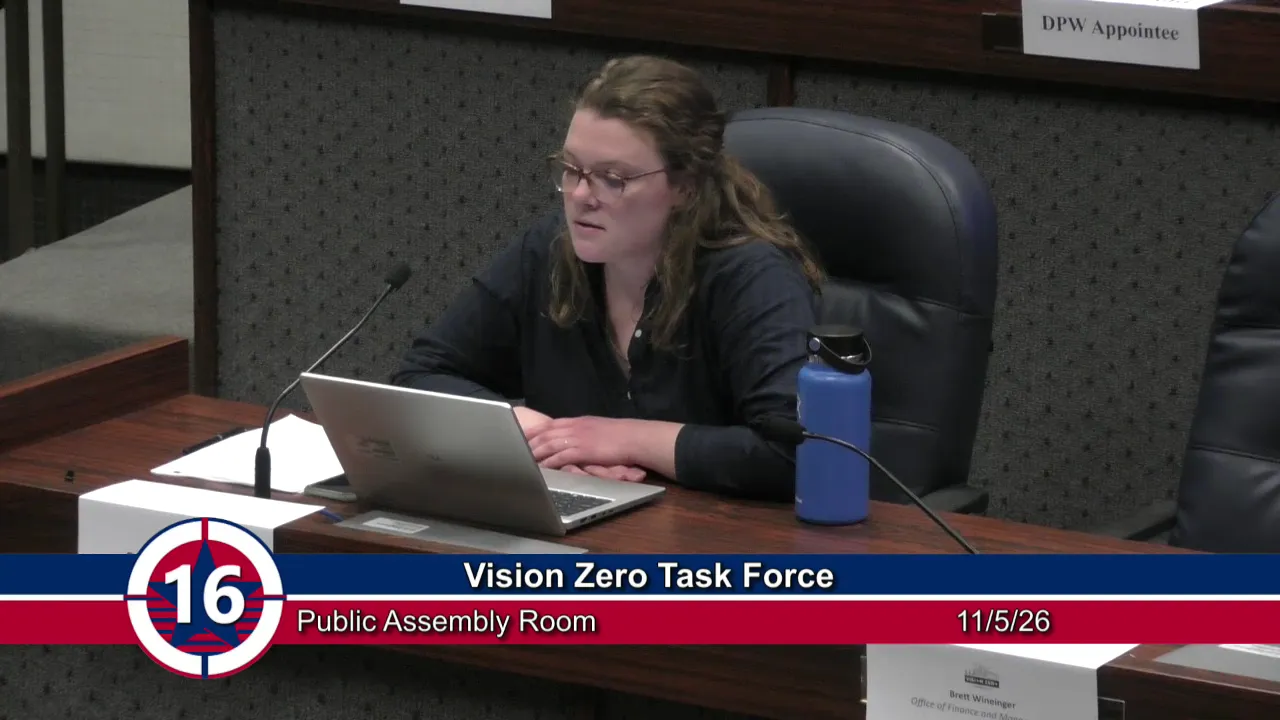
STREAMING COPY IN PREPARATION — RECORDING AVAILABLE FROM THE ORIGINAL SOURCE
Transcript — Verbatim
Speaker numbers apply only to this recording. Names come from transcript evidence. “Possibly” marks uncertain attribution.
Discussion Breakdown — Share of Meeting
Transportation Safety41%
Public Safety26%
Traffic Safety12%
Public Works9%
Public Engagement9%
Community Engagement3%
Summary of Proceedings
Indianapolis Vision Zero Task Force Meeting – November 5, 2026
The Indianapolis Vision Zero Task Force convened on November 5, 2026, at 4:00 p.m. (per the agenda) to review progress on eliminating traffic fatalities and serious injuries by 2035. Chairman John Barth (City-County Council, District 7) led the meeting, which featured a crash data update from Vision Zero Administrator Leandre Little, a traffic enforcement presentation from IMPD Captain Fred Ilnicki, discussion among task force members, and public testimony.
Public Comments & Testimony
- Connie Zable Schmucker (Advocacy Director, Bicycle Garage Indy) expressed frustration with slow progress and called for significantly increased funding, citing examples from Milwaukee and Richmond, VA that allocate more resources.
- Councilor Jesse Brown (City-County Council) relayed constituent concerns including the 4:00 p.m. meeting time limiting participation, confusion about the transition from tactical urbanism to quick build projects, support for license plate readers in Vision Zero enforcement, and a need for more visible enforcement and near-miss reporting.
- Christina Hartley (District 13) stated that since the last task force meeting there had been 58 traffic fatalities, including two children. She called the $1 million for quick build “insulting” and urged immediate action rather than experiments with children’s lives.
- Millie Via Schrodak (Director, Healthier Together) asked what structures exist for regular review of action items, assignment of responsibility, and cross-departmental coordination, and how community feedback is incorporated.
- Dr. Rafael Alamia (resident) echoed the need for cohesion from the Mayor’s office to ensure consistent implementation.
- Jacob Morales (Central Indiana Cycling) urged an administrative process for sidewalk snow removal enforcement (currently requiring court action), noted that local fire stations refused to fill water barriers for tactical urbanism projects due to “moral disagreement,” and called for better complete streets compliance from DMD and BNS.
Discussion Items
Opening Remarks & Budget Update: Chairman Barth described the city’s structural infrastructure funding challenge and celebrated the General Assembly’s passage of Proposal 192, enabling a sustained increase in local infrastructure dollars. Councilor Andy Nielsen added that the 2027 budget includes dedicated funds for quick build and a sidewalk fund, and that the city is poised for a “once in a generation” investment in infrastructure.
Vision Zero Administrator’s Report: Leandre Little presented preliminary 2026 crash data (January 1 – September 30): 61 fatal crashes, 538 serious injuries. Of the fatalities, 36 involved motor vehicles/motorcycles, 23 were pedestrians, and 2 were cyclists. Vulnerable road user deaths (pedestrians and cyclists) accounted for 44% of all fatalities (25 lives lost); 12 motorcycle riders had died (up from 10 the prior year). Serious injuries to vulnerable users stood at 74. Overall traffic fatalities declined 16% compared to 2024 and nearly 50% from the 2021 peak. Pedestrian fatalities, however, increased. Little then outlined the new DPW Rapid Response Quick Build program: launched with $1 million in 2026 supplemental funding, it will receive $1 million annually from 2027 through 2030, with total funding projected to reach nearly $6 million by 2030. The program uses semi-permanent traffic-calming materials (e.g., bollards, raised crosswalks) that can be deployed in months rather than years, bridging the gap between community-led tactical urbanism projects and full capital improvements. A Board of Public Works contract for materials was awarded in October 2026; deployment is expected in spring 2027. The program will be data‑informed and performance‑based, with community engagement.
IMPD Traffic Enforcement Presentation: Captain Fred Ilnicki, commander of the IMPD Traffic Division, emphasized IMPD’s commitment to enforcement and education. He reported that as of September 2026, officers had conducted 33,800 traffic stops, roughly half on the High Injury Network (HIN). His goal is to raise that share to 60–70%. Citywide, 17,600 crashes occurred, 43–44% on the HIN. Ilnicki described the new Carfax‑based digital crash reporting system for minor property‑damage crashes (under $2,500) that began in October; it has reduced officer dispatches by 60% and shortened wait times for motorists. He also highlighted successful use of license plate readers (LPRs) and public safety cameras, leading to arrests in recent fatal hit‑and‑run cases. Six IMPD officers were recognized by the Indiana Criminal Justice Institute for making 25 or more OWI arrests each. Ilnicki urged the public to report traffic concerns and to avoid sharing sensitive video before investigations are complete.
Task Force Discussion & Agency Responses:
- Taylor Feierstein (Health by Design) read prepared remarks on behalf of the advocacy community. She cited fragmented oversight, insufficient staffing for tactical urbanism, and the need to align capital spending with the HIN. She called for greater transparency, meaningful community engagement, and direct mayoral action.
- Eva Flick (Interim Director, Department of Business and Neighborhood Services) responded by describing her department’s work with right‑of‑way permits and maintenance‑of‑traffic plans. She noted that the new “right‑of‑way case type” in the Mayor’s Action Center had generated 600 inspection requests since March 2025. She committed to continued evaluation of enforcement processes and to strengthening collaboration with DPW and Vision Zero.
- Councilor Derek Hale asked about classification of “motorized bikes” in crash data. Captain Ilnicki acknowledged limitations in dropdown categories on state crash forms, which may not capture e‑bikes and scooters accurately. Hale also raised the need for advance warning signage at tactical urbanism installations.
- Chairman Barth and other members praised the work of DPW and IMPD and highlighted concrete examples of collaboration, such as speed studies on Kessler Boulevard shared with IMPD.
Other Updates: Leandre Little announced that the Vision Zero team will expand with additional dedicated staff and a new bike‑pedestrian coordinator position. The city’s Vision Zero dashboard will be upgraded to a hub page with real‑time crash data and fatal crash review reports. A public open house on Community Power Infrastructure (tactical urbanism) will be held December 8, 2026, from 4:00–5:30 p.m. in the City‑County Building. The Vision Zero Ambassador program, led by Health by Design, will launch in 2027. Little also requested updated contact information from task force members to support preparation of the 2027 annual report.
Key Outcomes
- Program Funding: The DPW Rapid Response Quick Build program was formalized with $1 million per year in the 2027–2030 capital plan, for a total of $6 million by 2030. The task force endorsed aligning capital spending with the High Injury Network.
- Technology: IMPD’s Carfax electronic crash reporting system for minor crashes went live in October 2026, with 60% of eligible crashes now handled without officer dispatch.
- Coordination and Staffing: The Vision Zero team will receive additional staff, including a bike‑pedestrian coordinator. BNS committed to enhancing right‑of‑way enforcement and collaborating with DPW. The city is pursuing better cross‑departmental coordination, including regular sharing of speed data between DPW and IMPD.
- Public Engagement: The city will host a tactical urbanism open house on December 8, 2026, and launch a Vision Zero Ambassador program in 2027. The online dashboard will be updated with user‑friendly crash data.
- Next Steps: The 2026 annual report will be prepared over the winter and presented at the next task force meeting, expected in May 2027. The administrator will work with task force members to compile data and highlight Vision Zero‑aligned activities across departments.
Meeting Transcript
Okay, well good afternoon and welcome to the October uh not October, the no November uh meeting of Vision Zero Task Force. Thanks for everyone all the task force members and everyone in the audience, everyone watching at home. Um a lot of things to talk about today. We have a great agenda. Thank you to our Vision Zero administrator for putting it together. Um very notable thing I wanted to talk about in my introduction is one of the challenges we faced as a city um broadly and as a group that is um advancing this um uh very aggressive goal is resource allocation um and not just resource allocation, just um have enough resources to do the work we need from an infrastructure standpoint, even though as and just to reinforce um the work of Vision Zero comes with everybody pulling from the same men of the rope and doing um their part to um ensure uh we're making the moves we we need to do uh to achieve the goal we're trying to achieve. But disproportionately a lot of the work falls upon um uh the Department of Public Works in the IMPD, which we'll be hearing from today. Um but we've talked about a lot in the and the controller has reminded us that we have a lot of challenges um when it's coming to infrastructure dollars, and that has to do with the fact that um Indianapolis as a city and Marion County as a county um has a structural problem in that how we are funded uh and that we are uh exporter of tax dollars to other parts of the state um that are intended to be used for infrastructure. And um recently uh the General Assembly with um due to close collaboration from the city council was able to uh put something um out there that is um the general assembly passed an opportunity for us to match dollars and to dramatically increase the amount of revenue coming into the city for infrastructure. And um uh I'll ask Councilor Nielsen um is the expert in that. So when I pass it to him, I'll ask him just to give a brief, very brief summary of what that means for our city as far as dollars. Um but we are gonna have uh many more dollars um for infrastructure uh next year. The caveat being the General Assembly put an intentional uh limitation on what it can be spent on, but that then gives us some flexibility with other dollars. So that's a that's a major um update that's come since the last time we were here, and it should give us some relief and some momentum on the work that we're trying to all do together. Um so I'm gonna close uh those introductory comments. I'm gonna ask everybody uh on on the task force to introduce themselves, and then I'm gonna ask my two fellow counselors if they have anything to say to to open things up, then we'll get into the agenda. But again, I'm John Barth. I'm uh chair of the committee, and I am um the member of the council represents Council District 7, and go right here to introductions. Uh thank you, Mr. Vice President Andy Nielsen, uh City Council uh District 14 on the east side. Thank you, Mr. Chair Derek Hale, uh District 23, City County Council. Chief Malone. Ernest Malone, Chief Indianapolis Fire Department. Mark St. John, Chief Engineer for the Department of Public Works. Tanya Terry, Chief IMPD. Addison Pollock, Director of Community Engagement with AARP Indiana. Eva Eva Flick, interim director for the Department of Business and Neighborhood Services. Taylor Feierstein, Director of Healthy Communities for Health by Design. Megan Vuksich, Director for the Department of Metropolitan Development. Lucas Kneekamp with Marion County Prosecutor's Office. Okay, thank you all. And um again, just gonna add to my opening comments, um, give some deference to my fellow counselors. So uh Council Nielsen, any anything you want to say um in opening in and then Council Kills. Um thank you, Chairman. Uh nothing I think other than what you've highlighted. I think especially over the and I know the administrator will cover this uh a little bit today in the presentation, so I don't want to steal his thunder in that um you know we are making progress uh in the budget as it relates to infrastructure, but also um safety measures, hard safety measures as it relates to I think what what the public conventionally thinks of Vision Zero, while we know it's much broader than that. So there are a few items as it relates to to quick build and a dedicated sidewalk fund that I think are some particular highlights in the 2027 uh budget that uh live in the budget now will be opportunities that we need to obviously increase those. Uh but I think as uh 2027 rolls in with uh with the state match uh with revenues that will come from uh proposal 192 that we passed in August, there's gonna be a truly a uh uh kind of a once in a generation investment and sustained investment in infrastructure uh that we can both address the quality of our infrastructure, but safety being uh a priority and obviously um a need as well. So thank you, sir. Counselor Cahill.
SUMMARIZED BY OPENPUBLICA AI
TRANSCRIPT VIA PUBLIC VIDEO
openpublica.com
openpublica.com