Joplin City Council Work Session - July 14, 2025
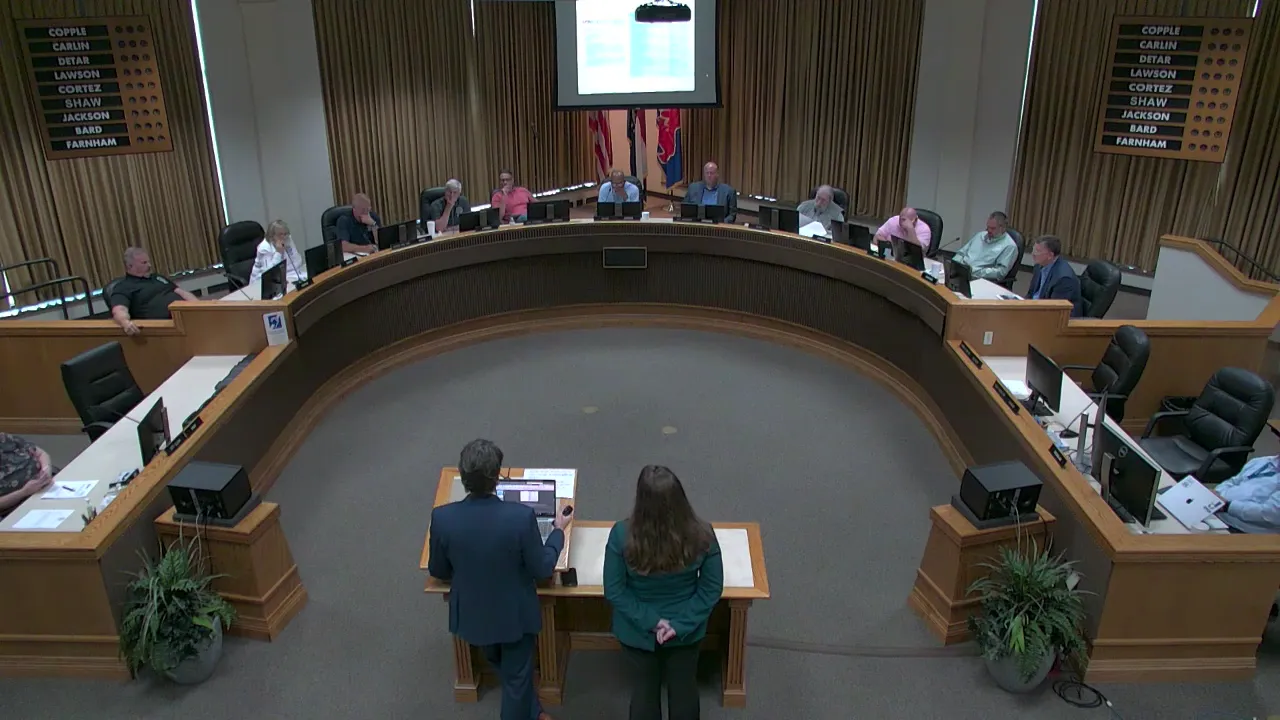
STREAMING COPY IN PREPARATION — RECORDING AVAILABLE FROM THE ORIGINAL SOURCE
Joplin City Council Work Session - July 14, 2025
The Joplin City Council held a work session on July 14, 2025, covering four major agenda items: updates to animal outdoor housing ordinances, metrics for mid-alley street lights, a proposed stormwater policy codification, and the results of a public works operational assessment. The council also discussed several other matters including a resident complaint, a mural policy, and the chamber of commerce agreement.
Animal Outdoor Housing Ordinance Update
Ryan Talkin (Health Department) presented a review of current ordinances governing outdoor animal shelters and tethering. He compared Joplin’s code to those of Minneapolis, Kansas City, Nashville, O’Fallon, and the State of Missouri. Current code allows removal only in cases of “substantial and immediate” harm. Staff recommended updates including: defining adequate shelter size (allow animal to sit, stand, turn, lie), requiring bedding (at 50°F with nestable bedding below 35°F), a wind/rain break, and at least one shelter per animal. Council members expressed concerns: Mr. Jackson asked about enforcement timing and the rule of one shelter per animal; Mrs. Carlin asked about the “teeth” of the code and suggested adopting the Missouri statute; Mr. Koppel cautioned against requiring non‑absorbent bedding and raised the issue of shelter capacity at the Humane Society. Council directed staff to proceed with updates aligning local ordinance with state standards, incorporating the presented suggestions.
Mid‑Alley Street Light Metrics
Mr. Robine presented a proposed scoring system (70‑point threshold) to prioritize installations of mid‑alley street lights. The system weights various factors (crime, pedestrian safety, community complaints) and requires 51% neighbor approval. Mr. Koppel strongly criticized the matrix, arguing it would not address high‑crime areas (e.g., 100 incidents only score 50 points). Mr. Bard opposed the ongoing cost ($196,000/year) and questioned whether lights deter crime, noting his own car was broken into despite nearby lights. Mr. Jackson suggested alternative approaches such as bulk‑purchasing motion lights for residents. Council agreed the current metric needs adjustment to make the threshold more attainable and to give greater weight to crime. Staff will retool the matrix and explore partnership options.
Stormwater Policy Codification
Mr. Johnson proposed consolidating scattered stormwater regulations into a single chapter to improve transparency, consistency, and compliance. He noted that Algar Martin recommended this and could assist. Mr. Koppel raised concerns about staff capacity given the ongoing ARPA projects and suggested deferring to fall 2026. Mrs. Carlin agreed. Council gave direction to move forward but with a realistic timeline, likely after ARPA work subsides. Mr. Johnson also updated the council on the Jasper County floodplain remapping project, warning that some properties will be added or removed from flood zones, causing citizen dissatisfaction.
Public Works Operational Assessment
Baker Tilly presented findings from their assessment of the Engineering, Facilities, and Infrastructure Maintenance divisions. Key observations: 50% of current staff will be eligible for retirement by 2030; there are opportunities to improve documentation for APWA accreditation; technology (field mobile devices, Central Square asset management) can streamline data entry; and additional positions (crew leads, management analyst, GIS specialist, and engineering/fleet managers) may be needed. Mr. Koppel questioned the accuracy of the benchmarking data and suggested postponing accreditation due to ARPA workloads. Mr. Ditar supported technology investments. Council acknowledged the report but agreed that accreditation and new hires should be considered after current major projects are completed.
Key Outcomes
- The council directed staff to revise the animal housing ordinance based on presented recommendations.
- The mid‑alley street light metric will be reworked with higher weighting for crime and a more attainable threshold.
- The stormwater policy codification will proceed but on a delayed timeline.
- The public works operational assessment recommendations were received; accreditation and additional hires will be revisited after ARPA projects.
- Council discussed other matters: a response to Sut‑Mid Ridge residents will be sent; Century Link settlement details are not yet public; murals should perhaps be limited to Joplin school logos; and a financial update on the chamber contract will be provided at a future informal meeting.
Meeting Transcript
Good evening, everyone, and welcome to Monday, July 14, 2025 in the Joplin City Council work session. Let's crank this off with our first item on the agenda, which is the Joplin Animal Outdoor Housing Item. Good evening, Mr. Talkin. How are you? I am doing good. What's up here? It is your show now. Appreciate it. So tonight we are going to discuss uh Joplin animal outdoor housing. Um go over our objectives here. Objectives are that we review the relevant Joplin City ordinances for animals and outdoor shelters. We're going to review the sample codes and ordinances from other jurisdictions. Um Mr. Buckles uh came with his concerns and he uh provided a couple of ordinances and I've included some of those. Uh discuss recomm recommended updates to the Joplin ordinance and answer and receive guidance from council. If it's all right with you, Mr. Mayor, um, I'd like to discuss cats as well, straight and feral cats as well. Please proceed, yes. So Joplin Code allows a removal of animals without owner consent um only in certain situations. So basically, when does a code allow entry uh onto private property without consent and without warrant? So it's very uh very specific situations where it allows that. So the code uses the terms um substantial and immediate. Um those are used kind of throughout the code in the uh sections 185 and 18141, which are the sections that are uh of concern today. Um the prosecutor likes to use the word absolute, so is it absolute? Is there an absolute um if you did not remove that animal would have the absolutely caused harm? So that's kind of the lens that we put those those through. So kind of dive into this here animal and immediate danger from neglect or abuse and in substantial harm. Uh that's one of the lenses, animal and immediate danger due to sickness or injury, um, neglect from lack of adequate care, as defined by the code. The code it uh defines the housing minimums. Um we'll dive into this here a bit further. But the housing minimums, if they're suitable to the age uh condition species of the animal, uh defines uh food, water, vet care uh not being provided at adequate intervals would be would be reasoned. Um then animal if it's abandoned. The definition of abandon in that in our code is three days, and it has to be a verifiable three days. Uh when in pursuit of an animal in violation of code. So that would be a situation where maybe a dog is um vicious, it attacks somebody, we are in pursuit of that animal, it goes into a person's yard. We have the ability to go into that yard and retrieve the animal. Uh the code does not allow us to go into a residence, only into outside property. So we can't go inside. So for that, it would require a warrant. Um when I wrote this, this was back in February, so it was kind of on the lens of cold, but uh the code also in 185 gives us the ability to enter vehicles. If a dog is in a car or animal uh is in a car for uh for heat reasons and it's invisible distress, uh it gives us the ability to enter that car and remove the animal out of that out of that vehicle. So I included on here tethering. Um part of this discussion, sort of, they kind of go hand in hand, and we get a lot of questions on this. So tethering is not allowed within Joplin City limits, but there are exceptions. So they can be tethered if it's if it's temporary in nature, they're outside, they can be outside for um not to exceed 30 minutes, so they can take them outside bathroom breaks. Uh when in a vehicle in transit, they can be tethered in so they don't jump out of a moving vehicle. And then the code also states for law enforcement reasons, service dogs, veterinary, and USDA. And then if they are tethered, um the rules for that is uh non-choke collar, uh minimum tether length must be three times the uh minimum tether length is three times body length of animal, free of objects that can tangle or strangle. Uh they shall weigh no more than one eighth the body weight of the animal and not in periods of extreme weather.
openpublica.com