Joplin City Council Work Session on Zoning Code Amendments - October 13, 2025
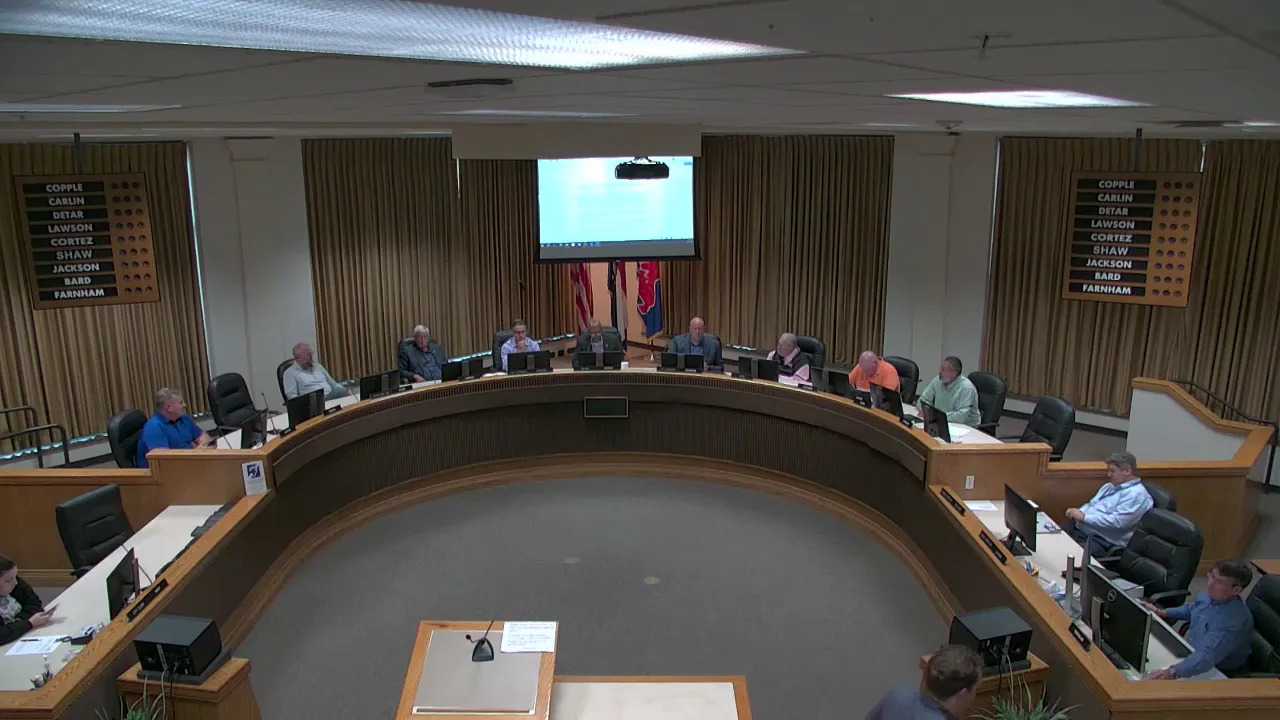
STREAMING COPY IN PREPARATION — RECORDING AVAILABLE FROM THE ORIGINAL SOURCE
Joplin City Council Work Session – October 13, 2025
This work session, held on the evening of October 13, 2025, was dedicated to a detailed presentation by city staff of 38 proposed amendments to the newly adopted form-based zoning code. Council members reviewed the changes, asked clarifying questions, and provided informal direction to advance the ordinance for formal consideration at the next regular meeting.
Discussion Items
- Staff Presentation of 38 Zoning Code Amendments – Troy Bolander and Tyler (staff) presented a comprehensive set of updates to the zoning code adopted three years ago. Key amendments included:
- Allowing certain accessory outbuildings on large rural lots (over 40,000 sq. ft.) to be placed in front of the primary structure, subject to a 60‑foot setback.
- Clarifying that the 185‑foot mailing requirement applies only to special use permits and rezoning, not street vacations.
- Adding encroachment agreements to the fee schedule for public hearing cases.
- Removing specific fee amounts from the code and referencing an external fee schedule to avoid outdated information.
- Updating bike lane design standards to emphasize protected bike lanes (buffered or raised) per NACTO guidelines, moving away from shared lane markings.
- Allowing major utilities (e.g., substations) in non‑industrial districts via special use permit.
- Updating marijuana use regulations to reflect recreational use, consistent with Missouri statute, and prohibiting on‑site consumption at dispensaries.
- Permitting apartments by right in the C‑3 (highest intensity commercial) district to facilitate mixed‑use development.
- Allowing outdoor auto sales, drive‑up storage, and animal care by right in C‑3, subject to enhanced site design standards.
- Codifying a waiver of rezoning fees for historic preservation properties.
- Adjusting setback requirements, fence materials, and buffer standards to provide flexibility for infill and redevelopment.
- Clarifying definitions for large vehicle storage, modular vs. manufactured homes, and mobile vendor/micro businesses.
- Requiring lot mergers for multi‑lot duplex developments to prevent piecemeal sales.
- Prohibiting invasive species in ground cover and allowing cultivated native landscaping if maintained in a neat and organized manner.
- Redefining the historic preservation overlay to differentiate between historic landmark districts (HL) and historic districts (HD).
- Council Questions – Several council members sought clarification:
- Mr. Kobel asked whether the encroachment section would affect parklets; staff confirmed it applies to alleyway encroachments and fire escapes, not sidewalk cafés.
- Mr. Lawson asked about bike lane changes and existing sharrows on Main Street; staff explained that sharrows are considered less safe and future designs will prioritize separation.
- Mr. Bart inquired if Section 37 (flexibility in walkable design guidelines) could apply to front porch railings; staff confirmed it allows adjustments in neighborhoods where traditional designs are not present.
- Mr. Jackson raised a concern about a local business operating a membership lounge that circumvents sales tax on marijuana products. Staff noted the proposed amendments do not address that loophole, and the issue of on‑site use at non‑commercial facilities remains unresolved. Mr. Jackson urged future action to prevent revenue loss.
- Mr. Shaw expressed concerns about residential overcrowding in single‑family homes leading to excessive street parking and multiple vehicles. He also cited downtown parking issues from apartment dwellers and construction dumpsters occupying public spaces. Staff noted that residential parking is not currently regulated and that downtown parking enforcement had been relaxed. Council discussed requiring off‑street parking for each vehicle and potentially revisiting parking meter enforcement, but such changes would need to go through the Planning and Zoning Commission.
- Joy asked about regulation of roll‑off dumpsters during construction; staff confirmed they are regulated via engineering permits when placed in public rights‑of‑way.
Key Outcomes
- Council expressed general consensus with the staff recommendations and directed the city attorney to bring the ordinance off the table for first reading at the next regular council meeting. No formal vote was taken.
- Concerns raised by Mr. Shaw about residential overcrowding and downtown parking will be explored separately, with staff to prepare potential options for future consideration. Any parking regulatory changes would require Planning and Zoning Commission review.
- The work session concluded without further action.
Meeting Transcript
Good evening, everybody, and welcome to the October. What day is it? 13th. 2025 work session of the Joplin City Council. We have one item on the agenda this evening. And I think Troy, you're gonna kick us off. Yes, I'll kick it off, and Tyler's doing the heavy lift. And I like I said, I have to thank him for putting all this together. He's he's documented the changes, what he's heard from uh from the city manager, from this body, from citizens, builders, developers, and he's been really patient with me when I stand in front of and complain about it. So he's documented that as well. Um so thank you, Tyler. Um you know we adopted our new code about three years ago, and it was a totally new code. In fact, it was a total new totally new code since we join first adopted zoning. Um I believe it was back in the 1940s. This is the zoning code back then, 24 pages long. So that was one of the first codes, zoning code Joplin adopted. Um this code is based on, as I mentioned last time we discussed at the council meeting. It's a form-based code, it's really heavy on design and site planning, and not so much on the restrictions I use as it's really how towns and communities used to develop. You may have an old grocery uh neighborhood grocery store in your neighborhood, and in this code you would be able to do that with some regulations applied to it. Um it's really the traditional way of city planning. What is old is new again. It's coming back to that form-based code. You'll find it in most cities now and down in new urban areas, even old urban areas like Kansas City, they review redeveloped their downtown. So you're starting to see that type of planning again. Um our previous zoning code was really based on the automobile, more suburban style. Uh really the context was what um what you did outside of the downtown or the dense areas of town. So everything is is coming back to the central city again. Um we knew when we implemented this new code, there'd probably be some changes we'd have to make. Uh we we just didn't know what would happen until after we implemented it. So that's why we're coming to you tonight uh to look at some suggested changes, see if you agree with them. Um you'll see some of the changes that specifically I think that came from this body, if I remember correctly, was you know what type of housing we allow and some residential neighborhoods. We did make the change with a heavy emphasis on the character of the neighborhood. We did get some pushback um being too strict in that implementation from builders. We think we found a compromise. There are some parts of uh uh neighborhoods, say for instance on Wall Avenue. We had a traditional neighborhood there, um, but it was destroyed by the tornado. You're starting to find, even though you it's a kind of a classic um older home design, uh bungalow type style, you do find driveways in the front. So should we allow that today? We probably should since we've already allowed it. But we do have some older style neighborhoods where there are no driveways in front. We have alley access, everything's done by the alley. So we do want to preserve that. We don't want uh a suburban type uh style home in a Murfreesburg or historic neighborhood. So we do we have preserved that. So we think we found a good compromise for that. We also have landscaping um regulations we looked at, especially if it uh pertains to native landscaping. We have a lot of people doing that now, but they have to realize you just can't uh let the seeds grow from your yard and call it native. They still have to be maintained. I have one, and it's actually to me it's more work to maintain a native landscaping than it is just having uh having a yard with traditional landscaping. So uh we think we found some good regulations for that.
openpublica.com