Joplin City Council Informal Session - Health Department Annual Update - June 1, 2026
STREAMING COPY IN PREPARATION — RECORDING AVAILABLE FROM THE ORIGINAL SOURCE
Joplin City Council Informal Session - Health Department Annual Update - June 1, 2026
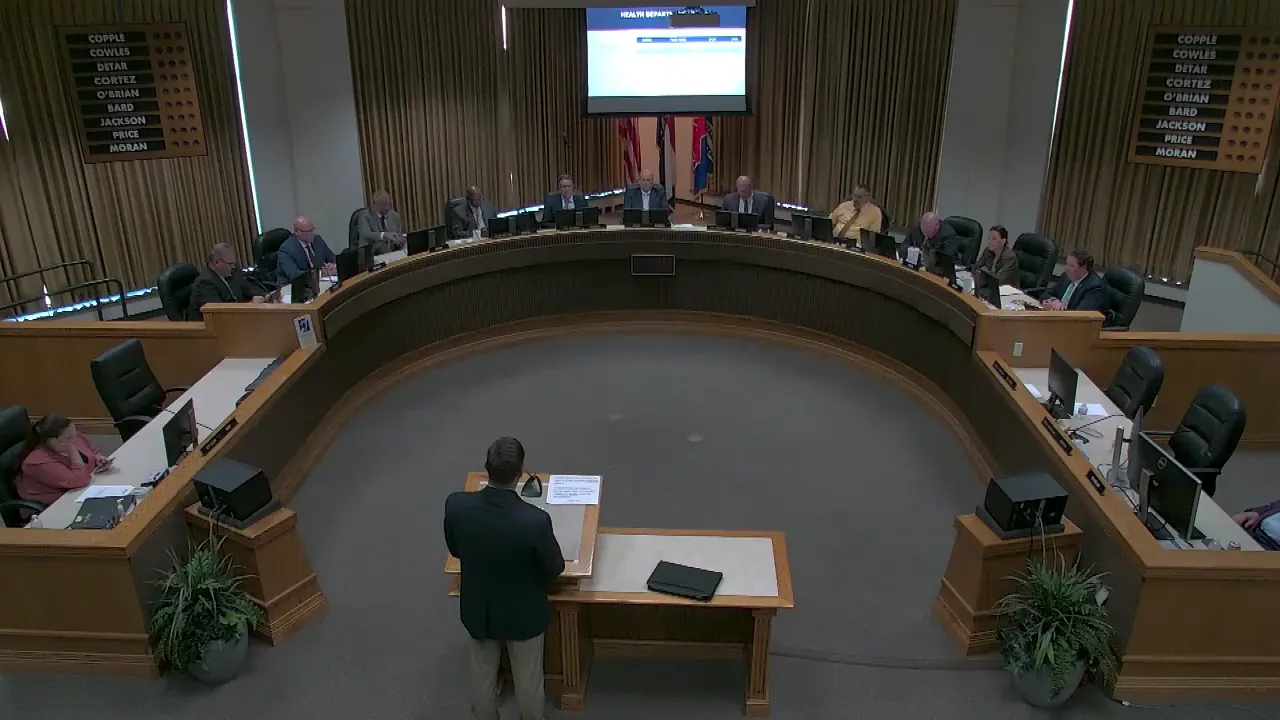
Ryan, representing the Joplin Health Department, presented the annual update to the City Council during its informal session on June 1, 2026. The presentation covered department history, key metrics, staffing, programs, and future goals. No votes or formal actions were taken.
Health Department Annual Update
- Ryan noted the department dates to 1889, when the salary was $75 per month (equivalent to about $36,000 per year in today’s money, excluding the requirement to provide one's own horse).
- Key metrics for the past year showed mixed trends: overall flat performance; animal control numbers were down; vaccinations were trending down, which Ryan attributed to a national decline in vaccination rates; environmental health inspections were down slightly from the previous year but up from 2023.
- The department covers diverse programs: regulatory (food inspections, child care inspections, swimming pools, mosquito fogging), supplemental food assistance (WIC), health promotion, communicable disease investigations, and emergency preparedness.
- Staffing updates: Recent retirements included Joyce and Julie from WIC, and custodian Lisa. All positions are filled except a WIC vacancy; Ryan acknowledged an error in the slide that indicated no vacancies.
- Notable staff tenure: 55 years, 31 years, 30 years, 15 years, 13 years.
- Key initiatives: New flooring installed, paint project completed, new animal control truck acquired, restructuring in WIC due to mandated changes, software upgrades, health fair organized by Megan, and creation of the NICE group (a coalition of local nurses).
- Future goals were presented as part of the update; Ryan took questions from council members.
Key Outcomes
- No decisions or votes were taken; the presentation was for informational purposes only.
Meeting Transcript
So we'll get started here for the uh informal session of the Joplin City Council and Ryan. Looks like it's your show this evening. So glad to have you here. Thank you. So health department update, the annual update. A lot of this has been kind of already presented this year due to departmental updates and program updates. Pictures of her staff, pictures of our main building there. So last year I included this slide and I left it in again this year, just basically for the benefit of new council members. I I find this interesting. So back in the archives, uh department dates to 1889. Um back in the early 1900s, there was a salary of 75 dollars a month. You do the math on that. It's about 900 a year, and it mentioned in the article that they had to provide their own horse. So I don't know, kind of found that interesting. If you do the math on that uh according to AI, anyways, uh that equals about $36,000 a year in today's money. So that does not include the uh have to bring your own horse, but um so some of our key metrics that we track, as you can see here, some are up, some are down. Uh overall, we're pretty well flat on the year on the metrics that that we track. Animal control numbers are down. Um shelter um complications, I think kind of contribute to that. Vaccinations are also trending down, um, kind of coincides with national. Uh there's a kind of a national decline in vaccination rates. And environmental health inspections numbers were also down just a little bit from the previous year, but up from 2023. Beginning of 2025, we had some staffing vacancies, getting new staff hired, trained, all those things. So I think that kind of reflects on that. Uh health department's part of the charter. We're a diverse department. Uh we do everything from regulatory programs to uh supplemental supplemental food assistance, health promotion, health wellness, uh communicable communicable disease investigations, um, vaccinations, things like that. So we cover a lot of different programs. Um just kind of break it down by the by each division, the administrative administrative division, that's where we print birth and death records, uh, we do the health education programs, coalitions, things like that, the grant managements. Um we do a community health needs assessment every three years, uh improvement plans, and so on. Medical side, and that's upstairs. We have registered registered nurses in that in that program. We do vaccinations, uh communicable, communicable disease investigations, so things that think of things like E. coli, hepatitis A, TB, salmonellas, stuff like that. Um STI testing, and then we also have um CPR classes and training out of that uh division as well. On the WIC side of things, that's the other side of upstairs. Uh that's income-based supplemental food and education. Um the income guidelines for that are currently set at 185% of the of the poverty level. Um for a family of one, that's uh about 29,000. And for a family of four, that's about 59,500. So it's kind of put that into perspective. We have a contract with the state for emergency preparedness. So that's a section of ours, and then work site wellness. Megan came a few weeks ago and presented on that. So um, so we're that's kind of a newer program within the department. Uh environmental health and animal control, those are our primary regulatory side. Um so we do uh inspections in there, we do food inspections. That's for like restaurants, food trucks, things like that. Um basically anywhere that's providing food to the public. That's kind of the criteria to have a health permit.
openpublica.com