Kauai County Planning Commission Meeting – March 11, 2025
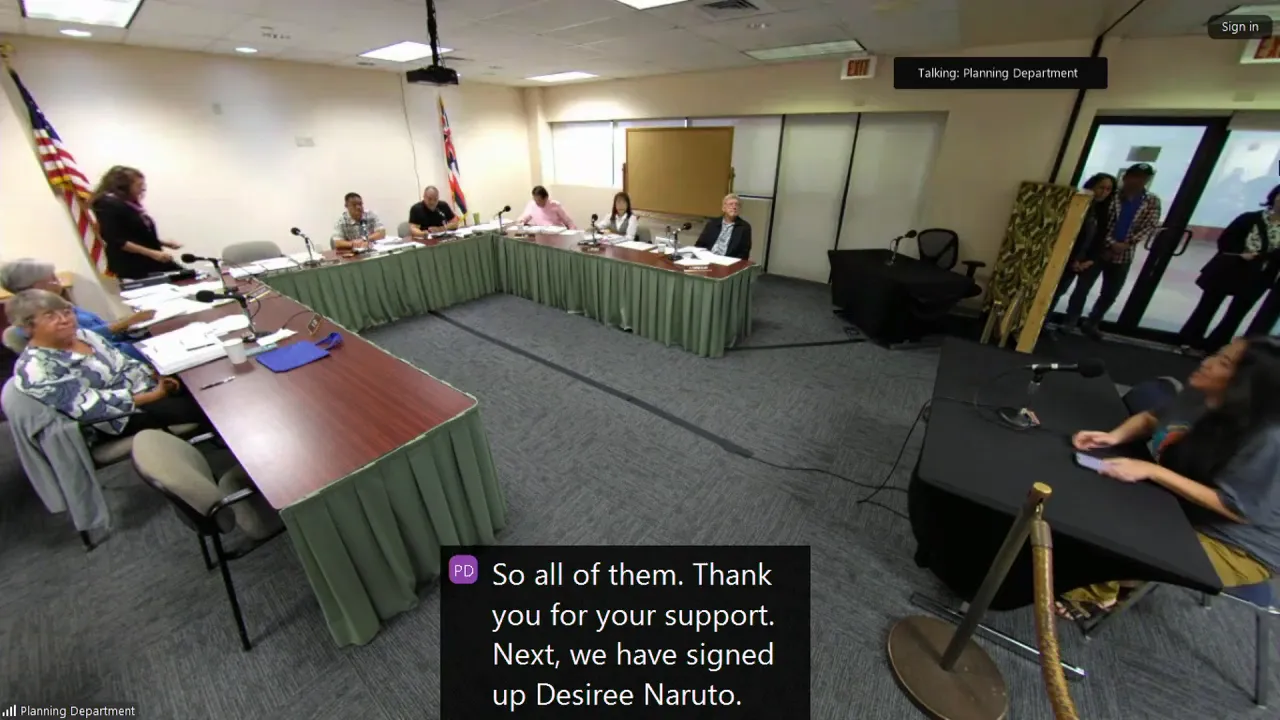
STREAMING COPY IN PREPARATION — RECORDING AVAILABLE FROM THE ORIGINAL SOURCE
Kauai County Planning Commission Meeting – March 11, 2025
The Kauai County Planning Commission met on March 11, 2025, at approximately 10:20 AM HST. The agenda was amended to move the public hearing on Bill 2942 (zoning amendment for farmers' and artisans' markets) to the first business item. The commission heard extensive public testimony, deliberated on multiple agenda items, and took actions including recommending approval of Bill 2942 with amendments, approving a composting facility use permit with conditions, deferring several zoning amendment items to April, and approving a warehouse-to-laundry conversion.
Public Comments & Testimony
On Bill 2942 – Farmers'/Artisans' Markets Zoning Amendment:
- Carl Imperado, representing Hanole Wendy Hub and community association, opposed the bill as written, stating it would allow weekly multi-day markets without public hearings or adequate standards for noise, traffic, parking, and sanitation. He recommended requiring use permits with public hearings, conditioning approval on neighborhood support, limiting markets to one day per week, and deleting definitions for larger market types.
- Billy Carter (Koai Gorbaynuts, representing culinary food artisans and micro businesses) supported the bill, arguing that micro businesses with brick-and-mortar stores should still be allowed at farmers markets because they employ locals, anchor the market, and should not be punished for growth.
- Michael Young (Holo Collective) strongly supported the bill, stating it creates a level playing field for all markets and allows local manufacturers to sell their goods. He noted he lost significant income when the Princeville market was shut down.
- Nalinish Yoka (Natalie Earth photography) supported the bill, saying the Princeville market closure caused a 75% income loss and that the bill helps artisans and farmers cope with rising living costs.
- My Couple (representing family) supported the market as a source of community and safe gathering.
- Bradley Smith (farmer, 25 years) supported the bill, emphasizing that farmers markets are vital for small farmers to sell produce at full price and that without them, small farms would disappear.
- Desiree Hirani (Loom and Prosper Vintage, coordinator of Princeville farmers market) supported the bill, noting the market supports mothers, families, and local entrepreneurs. She argued that three hours a week is not an inconvenience and that the market fosters community connection.
- Mark Marshall (retired county employee, avocado farmer) supported the market as an essential outlet for farmers.
- Rampai Marshall supported the market, noting it helped them after landslides affected their land.
- Kelly Organics (soap maker) supported the bill, saying markets provide affordable entry for small businesses that cannot rent storefronts.
- Rosalie Kaohilae (81-year-old artisan) supported the market as a vital income supplement and community space.
- Brian Allen (General Manager, Princeville Hanalei Community Association) provided neutral comments, acknowledging the importance of markets but also the need for balanced regulation.
- Makahala Calma (Director, Hanalee Watershed) opposed the bill, citing lack of review by state parks, past disturbances from events in Hanale parks (lights, amplified sound, construction), and concerns about enforcement of product sourcing and marine regulations. She stated the ordinance does not adequately protect communities.
- Abna Mipul (farmer) supported the market, saying it is essential for selling produce and supporting his family.
- Dr. Flora Kriyaf (Chinese medicine doctor) supported the market but felt the bill was rushed.
On Compost Kauai – Composting Facility:
- Dirk Fuma supported the permit, calling the operators visionaries who provide a solution for food waste and circular economy.
- Zero Waste Kauai representative supported the permit, emphasizing the need for composting to divert waste from the landfill and improve soil nutrition.
- Yoshit Lodz (Sergeant of Arms, Kino Neighborhood Association) read a letter of strong support, citing environmental benefits, alignment with state goals, and community engagement. He also testified on behalf of Kino Kailua, noting they are building their own composting project.
- Jack London (nearby resident) expressed general support but raised concerns about potential noise from heavy equipment, vermin control, and burning. He requested mitigation details.
On Plantation Camp Zoning Amendments (Milla and Kawanui): No public testimony was offered.
On Warehouse-to-Laundry Conversion (Unfinished Business): No public testimony was offered at this meeting (public hearing was previously closed).
Discussion Items
Bill 2942 – Zoning Amendment for Farmers'/Artisans' Markets: Commissioners discussed concerns about protecting cultural and historic sites, preventing permanent structures, and ensuring public access. Staff noted that the definition could be amended to clarify that permanent improvements are prohibited and that public access must be provided. Commissioners also discussed parking standards and the need for community input. A motion was made to recommend approval with amendments, including language to prohibit permanent structures and to require public access. The motion passed unanimously.
Compost Kauai – Class 4 Zoning Permit, Use Permit, and Special Permit: Applicants presented their vision for a small-scale, decentralized composting facility to divert food waste and support local agriculture. They addressed concerns about noise (small equipment operating 9 AM–5 PM, seven days a week), odor (following EPA and DOH guidelines), vermin (trapping and covered piles), and no burning. They noted they are working with the Department of Health and will install leachate catchment. Commissioners questioned about neighbor response (mostly supportive, one expressed home value concerns) and invasive species mitigation (covering with gill nets and tarps). The department recommended 10 conditions, with an amendment to condition 10 to include the word "revoked." The motion to approve with conditions and amended condition 10 passed unanimously.
Plantation Camp Zoning Amendments (Milla and Kawanui): The planning department presented proposed zoning amendments to allow for form-based codes that preserve plantation camp character and enable workforce housing. The department acknowledged an error: for Kawanui, a component was missing and would be added in April. Both landowners (Sean Smith for BBC Pernet for Milla, and Howard Green/Ken Robinson for Kawanui) expressed intent to provide workforce housing and preserve existing structures. Commissioners discussed wildfire mitigation and subdivision restrictions. A motion to defer all related agenda items to the April meeting passed unanimously.
General Plan Report (H1): The department requested a deferral to April due to the long-range planner being out sick. Motion passed unanimously.
Unfinished Business – Use Permit for Warehouse-to-Laundry Conversion: The department issued a supplemental report with recommended condition 11 to limit noise to 55–60 decibels in compliance with Hawaii Administrative Rules. The applicant accepted the condition, noting the facility will be fully enclosed with one commercial washer and dryer, and that employees live nearby. The motion to approve with conditions, including the new condition 11, passed unanimously.
Key Outcomes
- Bill 2942: The Planning Commission voted unanimously to recommend approval with amendments to the County Council. Amendments include prohibitions on permanent structures and a requirement for public access.
- Compost Kauai: The Commission approved the Class 4 Zoning Permit, Use Permit, and Special Permit with the department's 10 conditions, plus an amendment to condition 10 allowing revocation if conditions are violated (vote: 5–0).
- Plantation Camp Amendments (Milla & Kawanui): All related agenda items (GPA 2025-3, ZA 2025-5, ZA 2025-6, GPA 2025-3, SA 2025-3, and the additional Kawanui items) were deferred to the April 2025 meeting (vote: 5–0).
- General Plan Report (H1): Deferred to the April meeting.
- Warehouse-to-Laundry Conversion (U-2025-2): Approved with conditions including the new noise limit condition 11 (vote: 5–0).
Meeting Transcript
I like calling the back of order there was an issue with the webcast streaming. I'd like to repeat that the meeting commenced at it two AM. All commissioners are present. The agenda was amended and approved to move item for the first item of business for today. Oh yeah. Okay. Hello, House Landing Commissioners. My name's Carl Imperado. I'm speaking on behalf of the Hanole Wendy Hub and a community association. I want to begin by pointing out that neither the sphere nor the letter of the CZO contemplates allowing scores of vendors to sell products in Koai's parks and neighborhoods. Those markets are completely unlike any of the other retail uses that are addressed in the CCO. And for the most part, they're incompatible with the compared character of our neighborhoods and parks. So if we're going to allow them, approval should require public hearings, community input, and deep consideration of each market's noise, traffic, parking, sanitation, and community disruption impacts. We should not enable undue commercialization of our neighborhoods of parks. Unfortunately, the zoning amendment as written proposes to allow weekly multi-day markets with no public hearings and almost no standards of requirements to protect the impacted neighborhoods and parks. So we recommend three major changes to the proposed zoning amendment. First, if commercial uses of our parks and neighborhoods are to be allowed, approval should not be a routine ministerial matter. It should be approval based on an exception basis and public hearings. Therefore, use permits should be required for all markets that would impact neighborhoods and parks. The use permit process would enable neighborhood concerns to be expressed, considered, and addressed, and provide some assurance that the approved markets would meet the standards of compatibility with non-detriment to the community. Second, the use permit approval should be conditioned on the support of the residents of the impacted neighborhood and on meeting standards to minimize the market's impacts on the impacted neighborhood or park. The permitting process should evaluate all impact and include restrictions and requirements as needed on the size and the hours of the market, noise and amplified music, bathrooms and waste, traffic and parking, and neighborhood disruption. It would be disastrous to leave it up to either parks and recreation or the owners of quasi public land to decide these standards, restrictions, and requirements because neither of them have the incentives or responsibility to protect the public interest. Finally, markets that would impact neighborhoods or parks should never be allowed to operate for more than one day a week. We shouldn't contemplate the approval of markets that would operate more than one day a week. So the zoning amendment should be changed to delete the definitions of artisans market two, farmers market two, and change the definitions of artisans market one, farmers market one to be redefined to no more than one day a week. I thank you very much for the opportunity to present these concerns, and I want to let you know, of course, that our community association board hopes to work constructively with the planning department to ensure that the final product adequately protects our neighborhoods and parks. Thank you. Thank you. Next we have sign up Billy Carter. Good morning, commissioners. My name is Billy Carter. I'm here representing businesses designated as culinary food artisans as well as micro businesses. Businesses such as mine, Coai Gorbaynuts, other businesses like Outpost Coffee, Midnight Bear Bakery. We're businesses that have grown out of farmers markets. I started my business solely at farmers markets, and over a year of attending those, I was able to grow to multiple markets and then finally open brick and mortars. We appreciate being included on this bill. Some people have said larger micro businesses like my own shouldn't have a place at the farmers markets because we have brick and mortars. However, there's three main points that I want to make to advocate for my style of business. One is that we employ locals, and so this allows us to you know pay people who maybe don't want to work in an inside environment, you know, thrive in these outdoor sales. We also we act as anchored businesses for the market, so much like uh larger shopping center that gets larger businesses to bring in customers. We act as these type of businesses, not only to bring customers to the market, but to bring crowds of customers in certain zones within the market, so that the smaller and startup businesses, the mom and pops, the woman-run businesses can draw up our crowds and make money on uh you know off of our customers as well. Um the last point is that um we shouldn't, as growing businesses, be punished for growing by saying now you're not allowed at the farmers markets as businesses grow, you don't cast off what made you grow, you build upon that. So I appreciate the consideration for micro businesses as well as a culinary food artisans, people come to eat. Thank you. Thank you for your testimony. Okay, next we have to find up the Michael Young. Sorry. Uh aloha, my name is Michael Young. Uh my wife and I have owned Holo Collective.
openpublica.com