OPENPUBLICA · PUBLIC MEETING RECORD
Record of Proceedings
Kerrville City Council Workshop - February 10, 2026: Stormwater Fees, Disaster Recovery, River Trail, Airport Pact
City Council & associated boards — Tuesday, February 10, 2026
BodyKerrville, Texas
SessionCity Council & associated boards
DateTuesday, February 10, 2026
StatusFILED
Video Record
STREAMING COPY IN PREPARATION — RECORDING AVAILABLE FROM THE ORIGINAL SOURCE
Transcript — Verbatim
Speaker numbers apply only to this recording.
Discussion Breakdown — Share of Meeting
Water And Wastewater Management48%
Flood Recovery23%
Parks and Recreation11%
Airport Management5%
Fiscal Sustainability4%
Affordable Housing4%
Economic Development2%
Public Engagement2%
Transportation Safety1%
Summary of Proceedings
Kerrville City Council Workshop - February 10, 2026
The Kerrville City Council met in a workshop on February 10, 2026, at 4:00 p.m. at City Hall, 701 Main Street, Kerrville, Texas. Agenda items were for information and discussion only: stormwater fee restructuring, a Kerr Together disaster recovery update, the Adopt a River Trail pilot, and the Kerrville-Kerr County Joint Airport Board interlocal agreement. No formal action or votes were taken, no executive session was held, and the workshop adjourned at approximately 5:32 p.m.
Public Comments & Testimony
- The public comment period was called at the start of the workshop; no public comments appear in the transcript.
Discussion Items
Stormwater Fee Structure (Agenda Item 2A)
- Utilities Director D. Barrera and Assistant Utilities Director C. Clark, joined by Eric Felthaus of NewGen Strategies, presented stormwater rate options tied to the 2020 Stormwater Master Plan. The plan identifies needed drainage projects and recommends a stable revenue source.
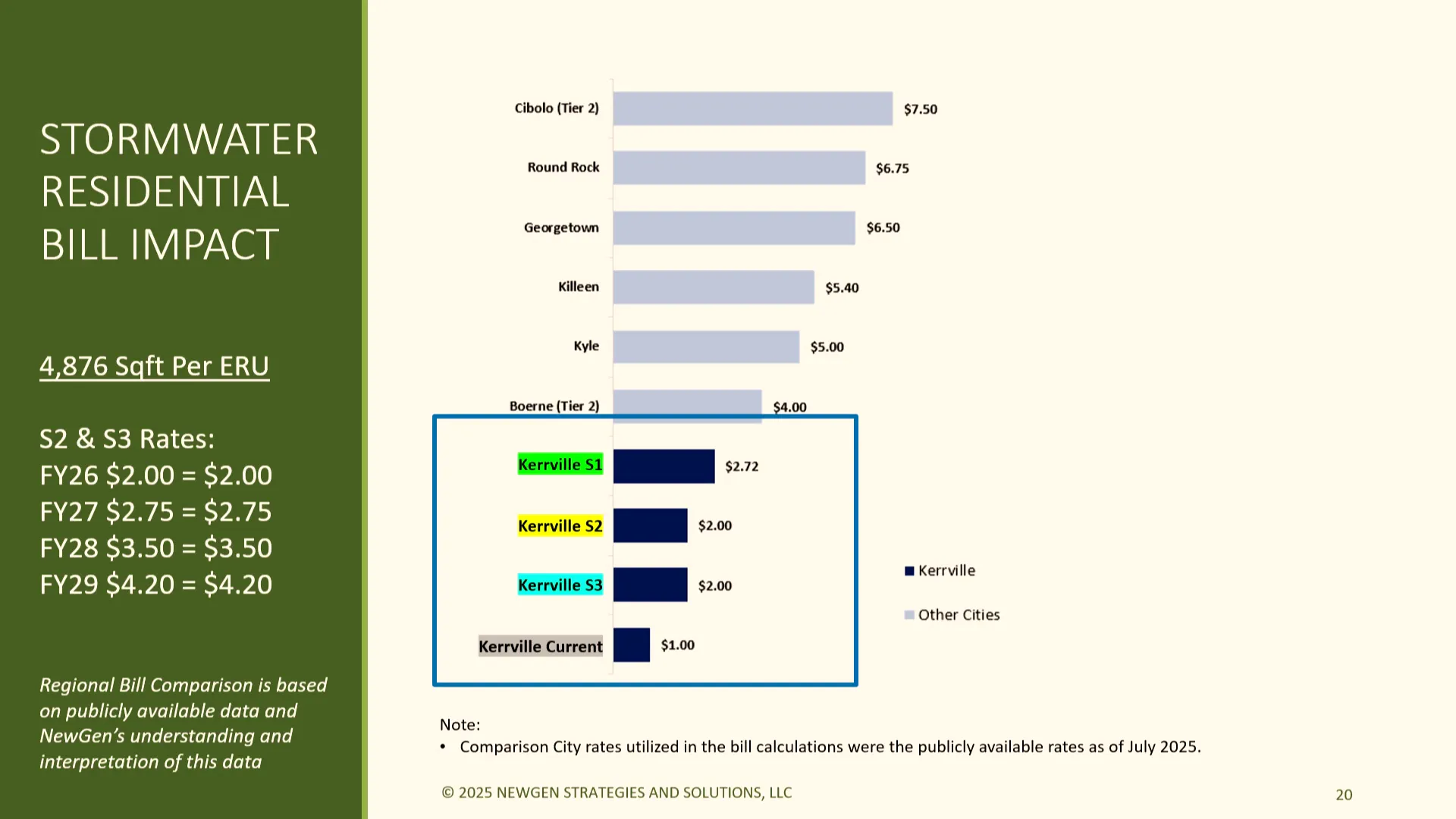
- Existing rates referenced during discussion were $1 for residential, $2 for multi-unit, and $3 for commercial. The proposed O&M funding assumption allocates about 5% of Public Works and Streets staff time to drainage, escalated by the Municipal Cost Index through FY 2031. Several Council members questioned the round 5% figure and why historical expenses were not used; staff said a review of staff hours showed both departments used about 5%.
- Capital assumptions included a bond issue of about $4.76 million in 2027 and another of about $3.9 million in 2030, with 20-year terms, 4% interest, first debt-service payments in 2028 and 2031, and combined annual debt service of roughly $645,000 by FY 2031. The consultant applied a 92.6% billing-data confidence factor and targeted total revenues of about $1.09 million to $1.092 million annually by FY 2031.
- Three scenarios were presented: (1) keep the current structure and apply equal percentage increases, with the FY 2026 residential rate proposed at $2.72; (2) charge a flat $2 per ERU in FY 2026 for all customer classes, with one ERU equal to 4,800 square feet of impervious cover; and (3) charge per ERU with tiered residential rates, with FY 2026 rates of $1.50 for tier 1 (0-2,350 sq ft), $2 for tier 2 (2,351-4,877 sq ft), and $2.50 for tier 3 (4,878 sq ft and above), while multi-unit and commercial pay $2 per ERU.
- The consultant also showed monthly residential bill comparisons with other cities. Council members questioned whether those comparisons were valid because cities use different rate structures, ERU definitions, and customer mixes; one member suggested comparing by assessed valuation. Other Council members said the presentation seemed 'backwards' because rate assumptions were shown before the project list, and they asked for a copy of the presentation and more time to understand the assumptions.
- Assistant City Manager Hornes summarized the core question as how to fund stormwater projects equitably and noted staff likely would recommend deferring the stormwater rate proposal to a later council meeting.
Kerr Together Disaster Recovery Update (Agenda Item 2B)
- William Witson of Kerr Together Long Term Recovery said recovery work is organized around housing, emotional and spiritual well-being, business assistance, public infrastructure, and river healing. He said Kerrville is ahead of most long-term recovery efforts and has been called the 'gold standard' for collaboration.
- He reported more than $13 million in recovery projects and assistance so far, a one-stop shop for survivors, and Community Foundation LIFT funds providing small-business grants up to $50,000 and zero-interest loans; about 60% of grant funds had been committed.
- Witson said the team is awaiting a $14.7 million Texas Comptroller's Office decision related to the 'electronic highway,' is working with UGRA on flood warning improvements, and expects a draft economic impact assessment with Texas A&M and Schreiner University by the end of February 2026. A U.S. EDA infrastructure grant application is expected in the next 30-60 days and would require a 20% local match on a $4-$6 million project.
- He described a river working group and about $1.9 million in proposed river restoration funding, plus the San Antonio Botanical Garden's initiative to plant more than 50,000 trees over three to five years after flood-affected Guadalupe River areas lost more than 90% of their tree cover.
- Mary Campana of Habitat for Humanity said Habitat is completing 40 repairs and 10 new homes in the Maripulsa development for flood-displaced families. There are 19 active repair sites, seven families already back in their homes, three full rebuilds in progress, and 11 homes under construction in Maripulsa, with four expected by the end of February and two per month after that.
- Campana said sweat equity is waived for disaster homes, but the homes carry income-qualified deed restrictions, and Habitat launched its regular affordability program on February 1. She said 98% of funds Habitat has received are being reinvested locally, about $1.1 million to date. In response to a Council member question, she said Habitat is considering starting a repair program for other homeowners in need after the disaster effort, subject to board discussion.
- Tara Bushnoe of UGRA reported on the flood warning system: UGRA has long funded stream and rain gauges, launched a cloud-based data viewer for testing in December, and leads the Kerr Together Flood Warning System Working Group. UGRA has executed an interlocal agreement with Kerr County to administer Texas Water Development Board funds and is selecting an engineer by the end of February 2026.
- Initial improvements targeted for summer 2026 will prioritize Senate Bill 3 sirens within hearing distance of camps and western Kerr County communities, which have the shortest warning lead time; predictive modeling, education, and public safety training are longer-term components.
Adopt a Trail Program (Agenda Item 2C)
- Jeremy Walther of the Kerrville Urban Trail System presented the Adopt a River Trail pilot along the one-mile river trail segment from G Street Trailhead to Schreiner University Trailhead. The segment is divided into five adopted sections.
- Adopters include Texas Master Naturalists, Master Gardeners, Peterson Health employees, and Schreiner University for two sections; patients transitioning from Kerrville State Hospital are helping with irrigation. Landowners along the segment have given written permission for access and improvements.
- The program has planted more than 200 trees and is on track to plant more than 1,000 by the end of spring. Goals include restoring riparian habitat, supporting community healing through action, building citizen stewardship, and eventually creating a river trail conservancy and expanding the program along the entire river trail system.
- Walther identified challenges including irrigation, deer damage, developing restoration-ready plants, volunteer stamina, landowner transitions, funding, and coordination. A temporary TCEQ irrigation permit application was submitted with UGRA assistance to pump river water during high-flow conditions.
Joint Airport Board Interlocal Agreement (Agenda Item 2D)
- Assistant City Manager M. Hornes said the city and county co-own the airport through the Joint Airport Board, and the interlocal agreement was last updated about four years ago. Recent airport purchasing requests and condemnation proceedings showed areas that may need revision, including financial processing, purchasing thresholds, fund balances, and grant front-loading.
- The county commissioners court appointed a subcommittee to meet with city liaisons to review possible ILA updates. Councilman McKinney is the City Council liaison. Any proposed amendments would be brought back to the City Council and Kerr County Commissioners Court for consideration.
- Councilman McKinney said revisiting the agreement about every four years is not too soon.
Key Outcomes
- This was a workshop only; no motions, resolutions, or votes were taken.
- Stormwater fee: Council asked for more time and presentation materials to review; staff indicated a rate proposal may be deferred to a future council meeting so the Council and public can better understand the scenarios.
- Airport ILA: City and county representatives will continue subcommittee talks on interlocal agreement updates and return with recommendations.
- Recovery and trail items were informational, with upcoming milestones including UGRA engineer selection by the end of February 2026, Habitat home completions beginning at the end of February 2026, an EDA application expected in 30-60 days, and flood-warning siren work prioritized for summer 2026.
- No executive session was held; the workshop adjourned at approximately 5:32 p.m.
Meeting Transcript
Go ahead and call to order this city council workshop for February 10, 2026. Do we have anybody signed up to speak? Yes, sir. Let's move right into 2A New Stormwater fee structure. Mr. Barrera. Yes. Good afternoon, Mayor and Council. So for this item, we're going to be going over our stormwater fee structure. So keep in mind this all stems back to our stormwater master plan, which was in our 2020 master plan. That plan identified major projects, not major, just projects in general that needed to be taken care of. And so it also recommends consistent revenue stream to be able to get those products together, whether it's fee schedule or other funding grant funding bonds. And you'll see that in the presentation here a little bit, and how we're going to make some recommendations to get that funding that's needed. Eric Felthaus is here with the New Gen Strategies. So he's going to cover this more in depth, and then we'll be able to answer any questions. On the third line down the new program additional ONM, that's for new projects that are being finished, new capital that's coming online. Anytime you have something like that, there's going to be some uh operation and maintenance that goes along with it. And so we wanted to make sure that we programmed some of that in to cover the operation and maintenance of uh new programs coming online. Then at the bottom line, you see the total ONM for uh stormwater starting in 2026. We do have it uh increasing by the um MCI uh municipal cost index uh all the way out to 31. I'm lost already. So the the first column is five percent of of uh budget really has nothing to do really with stormwater. It's just five percent was picked up, and then we take five percent of some bigger budget item to put in here. Well, the first column, like the 788,000, that's the approximate budget of the public works department. So, and then we take five percent of the 788,000 to get to the 39,000. Okay, so five percent of that is just for just for maintenance of the stormwater pieces. Uh so why why is it five percent? That was discussed with staff internally, and and that was the number that they came up with estimating you want to step in? Yeah, please. Yeah, so we we evaluated all the um the staff hours that go towards uh drainage, and that's how we came up with five percent. So when you add up all of streets hours, it went just to um drainage. Just salaries. No, just the hours, the hours uh work hours, work hours. Yes, sir. So it'd be salaries, there's more than salaries. Right. So we we did the salaries, added all that up, and then came up with the five percent of all those salaries and came up with some numbers that can kind of back into this this scenario.
SUMMARIZED BY OPENPUBLICA AI
TRANSCRIPT VIA PUBLIC VIDEO
openpublica.com
openpublica.com