OPENPUBLICA · PUBLIC MEETING RECORD
Record of Proceedings
April 28, 2026 City Council Workshop: Recovery, Drainage Fee, Water & Zoning Updates
City Council & associated boards — Tuesday, April 28, 2026
BodyKerrville, Texas
SessionCity Council & associated boards
DateTuesday, April 28, 2026
StatusFILED
Video Record
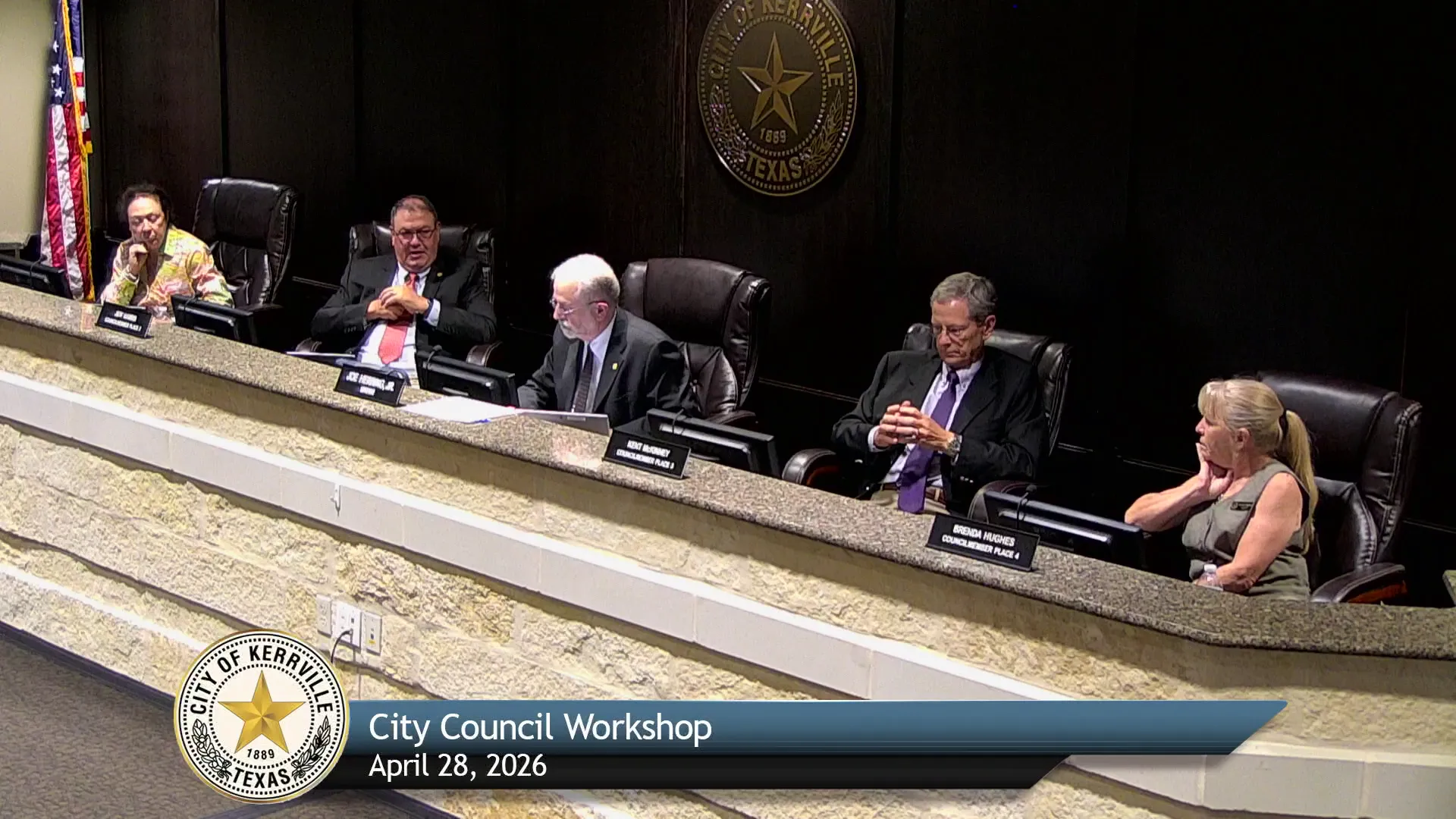
STREAMING COPY IN PREPARATION — RECORDING AVAILABLE FROM THE ORIGINAL SOURCE
Transcript — Verbatim
Speaker numbers apply only to this recording. Names come from transcript evidence. “Possibly” marks uncertain attribution.
Discussion Breakdown — Share of Meeting
Water And Wastewater Management26%
Flood Recovery22%
Parking Management14%
Public Safety11%
Engineering And Infrastructure9%
Environmental Protection5%
Technology and Innovation3%
Parks and Recreation3%
Public Engagement2%
Summary of Proceedings
April 28, 2026 City Council Workshop: Recovery, Drainage Fee, Water & Zoning Updates
The Kerrville City Council held a workshop on April 28, 2026, at 4:00 PM at City Hall. The workshop covered updates from the Kerr Together long-term recovery effort, a proposed stormwater drainage fee, revisions to Chapter 110 (Waterworks and Wastewater), and amendments to Chapter 60 (Zoning). No public comments were registered, though one citizen spoke during the stormwater discussion. The council also entered executive session to discuss the potential sale of the former police station property.
Kerr Together and Flood Warning System Update
- Tara Bushnoe, UGRA General Manager, reported on the flood warning system: the Guadalupe River Flood Warning System Working Group meets monthly; a state grant (SB3) funds sirens; Federal Signal sirens have been delivered and installation is underway in western Kerr County near youth camps, using private property easements for placement above the 500-year floodplain; a public data viewer will be released soon; a new USGS gauge is online at Lynx Haven Crossing; predictive modeling is in progress. The system will include multiple notification tools beyond sirens. Council members asked about siren triggers, sound levels (70 decibels at range), and public education.
- William Whitson, Long-Term Recovery Consultant, provided a broader update: approximately 200 projects across all disaster recovery areas; estimated total recovery cost $102 million, with a $170 million shortfall; 50,000-tree river restoration initiative (800,000 seeds collected); dive teams (San Antonio Search and Support and Rampart Vigilance) have been contracted for 90 days with $150,000 funding from H-E-B to remove debris; one-year anniversary planning is underway with a public calendar of events. Council discussed balancing memorial observances with July 4th celebrations (250th anniversary) and noted the importance of safety and coordination.
Stormwater Drainage Fee
- D. Barrera presented a proposed tiered stormwater utility fee. The current flat fee ($1 residential, $2 multi-unit, $3 commercial) generates $156,600 annually but operating costs are $267,262, creating a deficit. The proposal uses an Equivalent Residential Unit (ERU) of 4,876 sq ft based on rooftop area. Residential tiers: Tier 1 (≤2,350 sq ft) starts at $1.50/month in FY27, rising to $3.64 in FY31; Tier 2 (2,351–4,876 sq ft) starts at $2.00, rising to $4.85; Tier 3 (>4,876 sq ft) also starts at $2.00, rising to $4.85. Multi-unit and commercial fees = (building sq ft ÷ 4,876) × rate. Example: a 40,000 sq ft shopping center would pay $16.40/month initially. Rates would increase annually to $4.85/ERU by FY31. Revenue would cover O&M and build a fund balance for capital projects. Implementation targeted for October 1, 2026, pending ordinance readings on May 12 and 26. Council requested estimates for large retailers (e.g., H-E-B, Lowe’s, Home Depot) and institutions (e.g., Schreiner University) and discussed potential rate caps. A visitor (Brinkman) questioned whether the fee applies to all impervious cover or just rooftops; Barrera clarified it is based on rooftop area only.
Updating Chapter 110 (Waterworks and Wastewater System)
- D. Barrera reviewed planned revisions: directing all fees to the annually adopted fee schedule; updating definitions; removing outdated or redundant sections; adding clarifications for water wells, reclaimed water, and year-round conservation measures. A major change is a simplified 5-stage drought contingency plan (Stage 1 = normal, mild, moderate, severe, emergency), with consistent watering times (starting at 7 p.m. as requested by council). Council discussed the definition of development costs and the use of “recommend” vs. “require” for best practices; staff will monitor effectiveness and consider enforcement if needed.
Updating Chapter 60 (Zoning Code Amendments)
- D. Paxton presented amendments regarding battery energy storage systems (BESS) and data centers. Staff recommends allowing them only as conditional use permits in industrial districts, with setbacks: 500 feet from 100-year floodplain, 1,000 feet from Nimitz Lake, 300 feet from residentially zoned areas, parks, schools, and hospitals, and 300 feet from major/minor arterials (with access requirement). Additionally, an 8-foot masonry screening wall and a water usage agreement/capacity analysis are required. Council members expressed strong concerns about fire safety and water use, with several favoring making the regulations so restrictive that such facilities would be infeasible within city limits to avoid state preemption. Council suggested increasing setbacks (e.g., to one mile) and requested staff to analyze whether the proposed regulations would effectively prohibit BESS and data centers. Staff will provide further analysis.
- Also discussed: parking ratio revisions for multi-tenant retail. The current ratio is 1 space per 250 sq ft for public area only; staff proposed reducing to 1 per 300 sq ft for all multi-tenant retail over 2,000 sq ft. Alternatives included a three-tier system (1:200 for <10,000 sq ft, 1:250 for 10,000–30,000 sq ft, 1:300 for >30,000 sq ft). Council preferred the three-tier option but requested further data on peak times (weekends, evenings) and discussed whether restaurant parking should exclude back-of-house areas. No final action was taken.
Preliminary FY2027 Budget Information
- This item was deferred to a later workshop or regular council meeting at the request of City staff due to time constraints.
Executive Session
- Council unanimously voted to enter executive session under Texas Government Code Section 551.072 to discuss the potential sale of real property at 429 Sidney Baker (former police station).
Key Outcomes
- Staff will provide a sample of stormwater fee impacts for large commercial properties and institutions prior to the May 12 reading.
- The flood warning system and dive team contracts are moving forward; one-year anniversary planning will continue with a coordinated calendar.
- The Chapter 110 revision will be presented for first and second readings in May.
- For Chapter 60, staff will refine BESS/data center regulations to be more restrictive and analyze whether proposed setbacks effectively prohibit them within city limits. Parking ratio amendments will be further studied with additional data.
- The executive session discussion on the former police station property did not result in public action.
Meeting Transcript
Do we have anybody signed up for public comments? No, sir. Yeah. We're gonna move on to item two A, Car Together update. Mr. Whitson. He was here earlier. Do you want to kick yourself? Yeah, you want to kick yours off if the mayor's good with that. With me. Please. Please, of course. Sorry, I'll I'll show up William a little. Oh wow, Martin was pretty zippy on that. Well, good afternoon, Mayor, Council members. I'm Tara Bushneau with Upper Guadalupe River Authority. I was here in February to have an update on the flood warning system, and so we've accomplished a lot since then, and so just wanted to come back and give some more updates now. Um I'm gonna concentrate on four main areas, starting with the working group activities. So the Guadalupe River Flood Flood Warning System Working Group, which is organized under KERT Together continues to meet regularly about once a month now, and we have been focusing on various topics with the system development, defined the vision for the comprehensive system, and that will be implementing it in phases. So we continue the working group continues to be a vital partner for communication and for feedback and input, and your team members from City of Kerrville have been active and very and valuable participants in the working group. So for telecommunications, uh Kerpa Ker K-PUB and LCRA's grant application to the Texas broadband office for the middle mile funding, as you know, is approved and LCRA has begun to implement uh building the infrastructure for the private LTE network that the sirens and the future rain gauges and water level gauges are gonna communicate on. So they're progress to date, they have built the new hunt tower, and they have now it just got to update since I sent the slides that they have four signed co-location agreements. So it's a combination of new towers and then can they put their hardware on existing towers so they need to get the agreements for them, and they have already ordered the long lead time materials to get those here faster. So because the the state funding that's currently available is directed from the Texas Water Development Board specifically for counties to implement an outdoor flood warning system that includes sirens, uh Kerr County and UGRA have entered into an local interlocal agreement for UGRA to implement the flood warning systems according to that grant. Um as you know, we're a small team at UGRA, and so we needed to add to our bench a bit through these wonderful um partners. And I just want to say first Kerr Together continues to be a wonderful partner to UGRA, William Whitson and Kim Fouts have been a huge asset to me. They're my constant phone friend, and they've helped to ensure that the process moves as quickly as we can, but also diligently and with transparency. And West Consultants is our prime engineering consultant to implement the system through West. We have several sub-consultants who've added expertise in key areas like predictive modeling, um, civil engineering, outreach, and education, as well as on the equipment itself. So I'm going to share the next specific updates that are related to the initial phase that's focused on sirens, but I just wanted to communicate that the comprehensive system is still the goal and the big picture. So we will have a system that's built on a robust data collection platform that's gonna then a network that is going to assimilate all of that data that's coming in. And then sirens are one of the several out public notification tools that are going to be used. So we've accelerated the tasks for the initial siren installation in order to meet the expectations that the water development board has for the SB3 program that's focused on those. So as soon as we got the West consultant team on board, we asked them to support us with an initial purchase of sirens. UGRA selected federal signal sirens with installation and coordination by Omni Warren. So that the sirens have been delivered and the install phase is underway. Um it's gonna and it's focused on that the sirens broadcast to areas where Kerr County youth camps are located in western Kerr County. And that was the focus for the initial phase because those camps are located next to water bodies that have a short response time between when it starts to rain and then when the river increases, also because of the number of people they serve and the timing of their operations, and going up on private property for the location of the sirens was preferable because the right of way along the roads of 1340 and 39 are in the floodplain, and the electronics of the sirens have to be according to our development board's rules elevated above the 500-year floodplain, and then there's additional installation considerations in the floodplain. So for all of those reasons, um, we have been trying to work through the installation being being on private property for the initial phase, and also location to electricity because they have to have two forms of power. Electric and ours are gonna have electricity as the primary AC power and then solar as the secondary. So these are our sirens at the facility where they were manufactured in Illinois before they shipped. So another initial phase priority is the release of the public data viewer. This um has been used by our emergency managers for the last couple of months, and we've gotten their feedback to make changes before we release it publicly on UGRA's website.
SUMMARIZED BY OPENPUBLICA AI
TRANSCRIPT VIA PUBLIC VIDEO
openpublica.com
openpublica.com