OPENPUBLICA · PUBLIC MEETING RECORD
Record of Proceedings
Lacey City Council Worksession - September 8, 2026
City Council — Tuesday, September 8, 2026
BodyLacey, Washington
SessionCity Council
DateTuesday, September 8, 2026
StatusFILED
Video Record
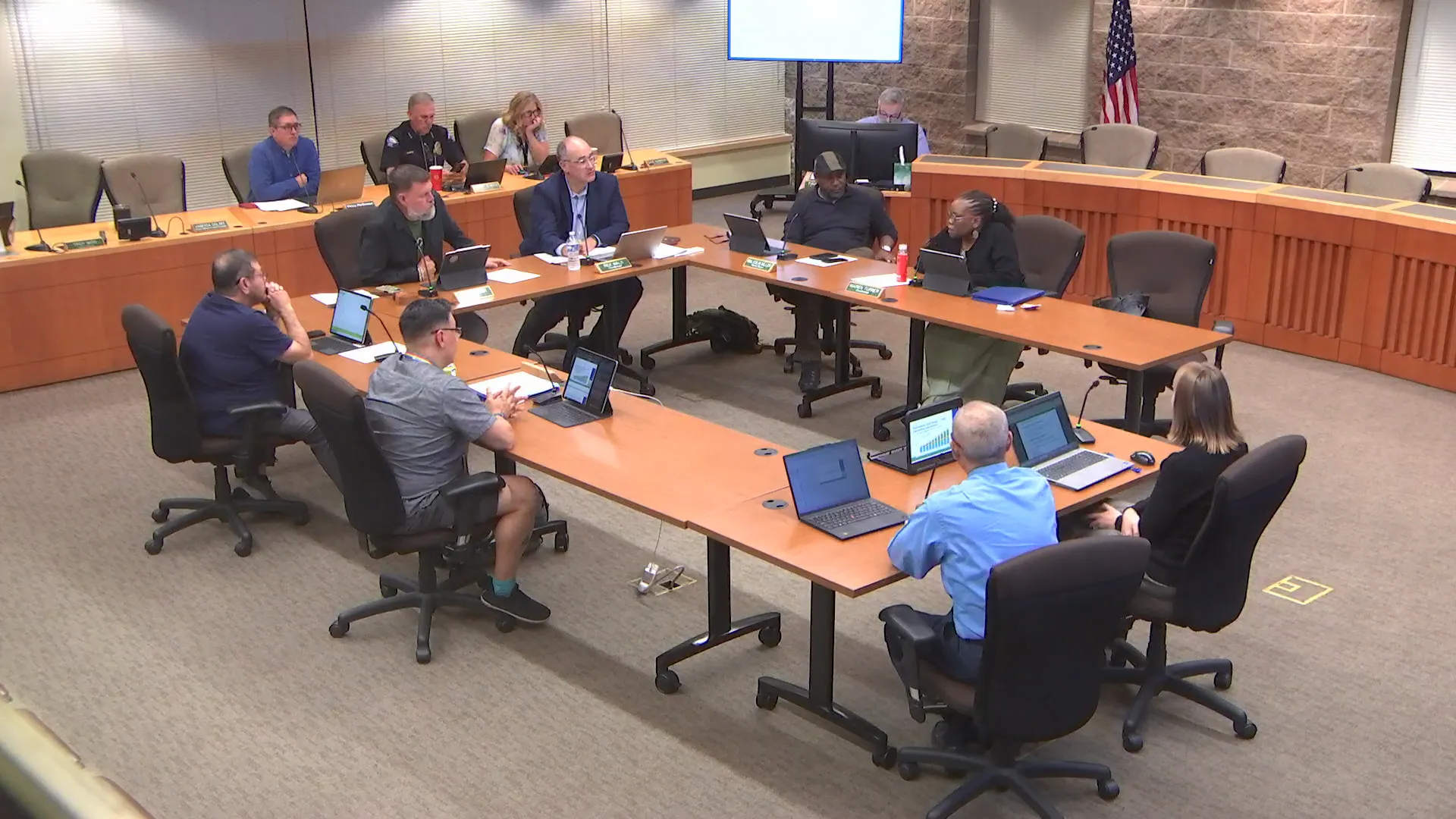
STREAMING COPY IN PREPARATION — RECORDING AVAILABLE FROM THE ORIGINAL SOURCE
Transcript — Verbatim
Speaker numbers apply only to this recording.
Summary of Proceedings
Lacey City Council Worksession - September 8, 2026
The Lacey City Council held a work session on Tuesday, September 8, 2026 at 6:00 PM in Council Chambers and online. The meeting included public comments on the Franz Anderson interlocal agreement, review of a telecommunications license application, preliminary 2027 revenue and expenditure estimates, and discussion of interjurisdictional committee assignments.
Public Comments & Testimony
- Stephanie Scott, Lacey resident, spoke on the Franz Anderson interlocal agreement amendment. She urged the council to incorporate input from people with lived experience of homelessness, emphasized the value of a regional housing-first model, and offered three choices: increase investment in existing supportive housing, work with a different provider, or continue with LIHI under strict accountability. She stressed the need for regional collaboration and direct input from those experiencing homelessness.
- Daryll Bullock, Lacey resident, read a statement prepared by Kathy Martin questioning the management record of the Low Income Housing Institute (LIHI) at Maple Court. Martin requested data on housing placements, successful transitions, staff turnover, and spending of prior funds ($4.5M+ allocated). She strongly recommended no vote on additional funding until such information is provided.
Discussion Items
A. Sealink Networks Inc. Telecommunications License Application Communications Manager Donna Feliciano presented the application for a five-year telecommunications license to allow Sealink to install fiber infrastructure within city rights-of-way as a pass-through to Westport, without providing local services. The license is required under federal law. Key terms: $1,000 application fee, $2 million liability insurance, performance bond. Council noted the city cannot deny the application if conditions are met. Final action will occur via consent agenda on September 15, 2026.
B. Revenue and Expenditure Estimate Finance Director Troy Woo and Deputy Finance Director Chelsea Knight presented preliminary 2027 estimates. Revenue highlights: sales tax growth of 2.6% (about half from state tax base changes), property tax increase of $147,866 (1% plus new construction), utility tax up 9.2% (including new cable tax collecting ~$650,000/year), interest income projected to increase 58% due to expected rate hikes. Expenditure pressures: salaries/benefits up $3.6M across all funds; district court costs rising from $534,000 to an assumed $1.6M; election costs increasing $338,000 due to county overhead changes; utility expenses of $419,000. The general fund shows a $4.6M deficit; staff targets reducing it to $3M through budget controls and potential revenue enhancements. City Manager Rick Walk outlined a three-prong approach: revenue enhancements, economic development investments, and expenditure control. Council discussion on stormwater rates leaned toward a 9.5% increase for one year (rather than a multi-year plan) to ease resident burden, with formal direction expected at the September 22 budget workshop. Council also discussed using interest income from other funds to offset general fund pressures.
C. Council Interjurisdictional Committee Assignments City Manager Rick Walk asked whether to assign councilmembers to five alternate positions vacated by former Councilmember Dunning. Council opted not to make formal reassignments now, but to have primary members coordinate ad-hoc replacements as needed pending the filling of the vacant council seat. A full reassignment will occur in January.
Key Outcomes
- The Sealink Networks license application will be forwarded to the September 15 regular meeting for final action on the consent agenda; no opposition was expressed.
- Council generally supported a 9.5% stormwater rate increase for one year, with formal direction to be given at the September 22 budget workshop.
- Staff will continue refining the 2027 budget to reduce the general fund deficit from $4.6M to $3M, including consideration of using interest income as a revenue source.
- No formal committee alternates were appointed; a temporary informal system will be used until the council vacancy is filled.
Meeting Transcript
Okay. It is six o'clock on September 8th, 2026, and I'm call this Lacy City Council work session to order. Councilmember Cox is going to be attending remotely, but all other council is present. Also, want to acknowledge that we, the city of Lacey, are on the ancestral lands of the tribal people, the Treaty of Medicine Creek, including the Nisqualian tribe and the Squawks and Highland tribe. With that, can't get a motion to approve this evening's agenda. Move to approve the agenda as published. Second. It's been moved and seconded. Any discussion. Seeing none, all in favor of the motion signify by saying aye. Aye. Is there anyone opposed? That motion unanimously carries. We have an approved agenda. First up on our approved agendas or public comment. We do have one person who signed up for public comment. Stephanie, can you please approach the podium over here and introduce yourself and you'll you'll have three minutes for public comment. Alright, uh, good evening. My name is Stephanie Scott, she her, and I'm here tonight in advance of the Franz Anderson vote next week, because I'll be at a school board meeting next week uh talking about AI cameras in our schools. Um I am a community member who's a Lacey resident. I am deeply involved in supporting housing insecure and homeless individuals in this community. And I'm here tonight to remind this council that we cannot solve a regional housing crisis by continuing to make decisions without listening to the people living through it. People with lived experience are your constituents just as much as any business or property owner is. Regional governing bodies, including this council, have continued making decisions that leave our community increasingly overdependent on the low housing and uh low income housing institute with few alternatives when that provider doesn't deliver. We need to be honest about how we got here if we want to move forward. Policy decisions and lack of accountability created this situation and have contributed to a narrative that housing first is ineffective when in reality our region hasn't fully invested in the combination of quality housing and services at the level needed to truly implement housing first. I am asking this council to remain committed to a regional housing first approach. Homelessness doesn't stop at the city boundary, and neither should our solutions. When you make decisions about shelter, supportive housing, eligibility, providers, and transition from homelessness, you need to hear directly from the people who are experiencing these systems. There are already mechanisms to do this if you don't know where to begin. You have the Regional Housing Council's homeless services advisory board and lived experience housing steering committee. You could seek input from McKinney Vento liaisons to understand what these decisions mean for the over 1,000 homeless NTPS students and their families, and quite frankly, stop being confrontational with people who share their lived experience. Our local jurisdictions have to start building this input into your decision-making processes before decisions are made and throughout implementation and evaluation. Franz Anderson is a perfect example of why this matters. Changes to AMI eligibility will change who gets access to extremely limited supportive housing. And because Franz Anderson and Maple Court are connected to any regional strategy for transitioning people out of the jungle, these decisions have consequences beyond one building that will deeply impact the closure of the jungle. A camp with a population of 300 plus that includes people from Lacey and people swept from Lacey and people who will return to Lacey when trespass notices go up. I believe this council has three choices that must be informed by lived experience and regional collaboration to be effective. Rather than invest in Franz Anderson, as currently proposed, you could increase investment in the supportive housing we already have in this region and improve the things that matter most, including services to increase and expedite successful exits into permanent housing, freeing up critical spots to people awaiting placement. You could lead the way on working with a different provider and start developing real people centered alternatives to our overdependence on LIHEA. Or third, you could continue working with LIHEA with real accountability, set measurable performance standards, require regular perform regular reporting, establish consequences when expectations aren't met. Don't give away public property to LIHEA without getting accountability for outcomes for the people they serve. And regardless of which route this council chooses, give people receiving services a regular, meaningful seat at the table to share their experiences as part of the evaluation and accountability process. Please stay regional, listen to lived experience, and hold providers accountable. Thank you. Thank you. Thank you.
SUMMARIZED BY OPENPUBLICA AI
TRANSCRIPT VIA PUBLIC VIDEO
openpublica.com
openpublica.com