Lafayette City Council Workshop: Vision Zero and Speed Camera Discussion - March 25, 2025
STREAMING COPY IN PREPARATION — RECORDING AVAILABLE FROM THE ORIGINAL SOURCE
Lafayette City Council Workshop: Vision Zero and Speed Camera Discussion - March 25, 2025
The March 25, 2025 City Council workshop focused on two traffic safety items: the Vision Zero Safety Action Plan (presented by Public Works and consultants) and a discussion on automated speed safety cameras (AVIS) led by the Police Department. The meeting also included a new ideas segment where council discussed regional minimum wage coordination. No formal votes were taken; direction was provided for staff to continue developing the Vision Zero plan and to monitor AVIS developments, with emphasis on potential collaboration with Boulder County on US 287.
Discussion Items
Vision Zero Safety Action Plan
- Crash Analysis: Over a 10-year period (2013–2022), Lafayette recorded 67 serious injury crashes and 19 fatal crashes. Severe crashes were concentrated on state highways (US 287, Arapahoe Road) and at signalized intersections. Overrepresented crash types included broadside, approach turn, sideswipe, and bicycle/pedestrian crashes.
- High Injury Network (HIN): 11 segments (4.74 miles) and 12 intersections were identified; these accounted for 61% of segment crashes and nearly 70% of intersection crashes on evaluated local roads.
- High Risk Network (HRN): A separate risk-based analysis added 6.87 miles of roadway based on factors like missing sidewalks, speed, lighting, and vulnerable road users. Combined HIN + HRN = 9.1 miles of total safety network.
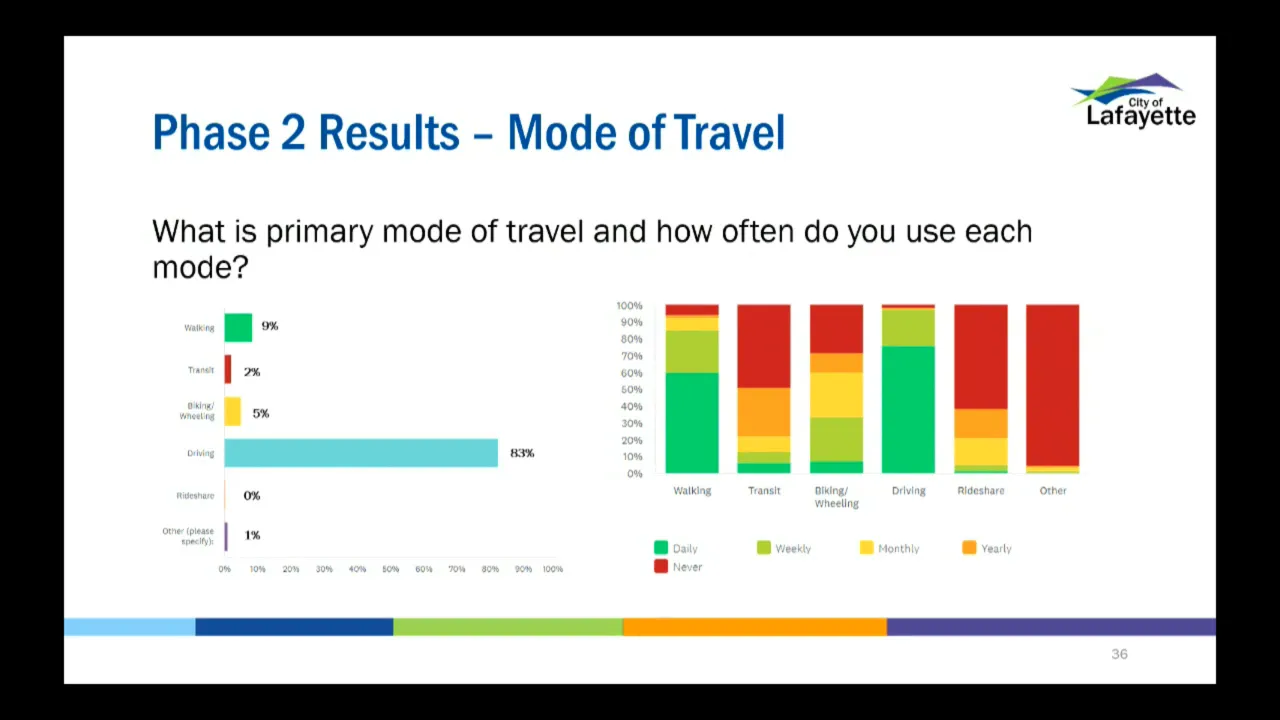
- Public Engagement: Phase 2 survey (Feb 26–Mar 14, 2025) received 275 responses; 95% of respondents lived in Lafayette. Over 60% walk/use transit/bike at least monthly. Respondents showed strong support for radar feedback signs, flashing yellow arrows, and enhanced pedestrian crossings.
- Prioritization Methodology: Staff proposed weighting factors: 50% crash history, 20% risk score, 10% equity, 10% community input from the Multimodal Transportation Plan (statistically significant survey), and 10% from Phase 2 engagement. Council expressed general support for the approach while noting the need to incorporate perceptions of safety.
- Next Steps: Draft plan expected back to council around May 2025, followed by public review and final adoption. Implementation will rely on regional grants, corridor studies, and capital projects.
Speed Safety Cameras (Automated Vehicle Identification System)
- Background: Colorado law (CRS 42-4-110.5) authorizes AVIS in school zones, residential neighborhoods, work zones, park-adjacent streets, and designated corridors. Mobile and stationary options exist.
- Pros/Cons: Mobile systems are flexible but require personnel and suitable parking; stationary cameras cost $23,000–$25,000 each plus $12,000–$15,000 annual maintenance. Data processing fees are $5–$7 per violation. Maximum fine is approximately $40.
- Council Discussion: Several council members supported exploring a pilot project on US 287, potentially partnering with Boulder County (which is already studying AVIS on that corridor). Staff recommended monitoring other cities (Longmont, Aurora, Boulder) and completing the Vision Zero plan before pursuing AVIS.
- Direction: No final decision; staff will continue research and report back as more data becomes available.
New Ideas
- Minimum Wage Regional Coordination: Councilor Barnes reported that Longmont City Council is considering a "fishbowl" public meeting to discuss the impact of increasing minimum wage. Barnes suggested Lafayette participate to understand regional effects. Mayor will hold one-on-one conversations with each councilor to determine the scope of Lafayette's internal discussion—whether to proceed independently, join the fishbowl, or take no action.
Key Outcomes
- Council endorsed the proposed prioritization weighting for the Vision Zero plan (50% crash history, 20% risk score, 10% equity, 10% MMTP community input, 10% Phase 2 engagement) and asked staff to incorporate perceived safety concerns.
- Staff was directed to continue developing the draft Vision Zero action plan with a target return in May 2025.
- On AVIS, council agreed to monitor other jurisdictions and await completion of the Vision Zero plan; no pilot project was authorized, but interest was expressed for potential collaboration with Boulder County on US 287.
- Mayor will survey council individually to decide on the minimum wage discussion format and timeline.
Meeting Transcript
All right. Well, welcome in, ladies and gentlemen. Um get started. Um I will open up the March twenty-fifth, twenty twenty-five City Council workshop. We have a couple items regarding traffic and safety, uh, beginning with our uh vision zero safety action plan, uh, followed up by our a speed safety cameras discussion with our police department here. And then we'll conclude with any new ideas that council members may want to bring up regarding various topics. Um, so we'll go ahead and get started then with our first item on the agenda. Vision Zero Safety Action Plan. And we have our public works director, Jeff Arthur here. I don't know if you agree to start it over to Michelle Malanakis, our transportation engineer. Awesome. Thank you, Mayor and members of council. We're here tonight to talk about the safety action plan or the vision zero action plan. I'm here with Jeff Arthur, Director of Public Works, Leslie Huey, the engineering CIP and Division Manager. Jessica Hernandez, a transportation planner with console engineers, and Ray Stefani, a transportation safety engineer with Y2K. We have a fairly long agenda for this evening. We'll do a brief introduction, a review of the crash analysis that you've already seen, a high risk network development process, our strategy and actions that we've developed, our most recent community feedback and our proposed prioritization methodology, and then ongoing and upcoming efforts. A couple ways in which staff were approaching safety improvement. Lafayette PD has a crash report tracking that they do. Engineering and PD were working together on some high collision locations and proposed improvements. And then staff have been working with Dr. Cog and other regions, other regional partners on the Dr. Cog Vision Zero plan. South Boulder Road, US 287, and C07. So along with our MMTP development, the corridors that the community was really interested in 287 was number one. C07 west of 287 was number two. South Boulder Road was number three or four. So we had started prioritizing those with the MMTP. We went after a preliminary study on South Boulder Road with Dr. Cog that was approved and finalized last year. And then we've had ongoing coordination through a couple roadway coalitions. Primarily State Highway 7 has been running for several years now, and US 287 just started last year. But it's a these coalitions are have quarterly meetings where everyone gets together and works on advocating for funding from the feds in the state and trying to progress projects to improve safety along those roadways. But overall, we as part of the MMT development, we which was in the implementation plan. We wanted a plan that would focus more on Lafayette roadways and things that we could do with both ongoing efforts and projects to improve safety more locally as well. So today we're in the project prioritization, the purple phase. Since then we've been working on strategy identifications and the project prioritization methodology. We had phase two, which just closed on the 14th, that we'll be reviewing tonight. And then we'll be moving forward to draft the draft action plan after this. As a reminder of what the vision zero and safety safe systems approach are the goal is to eliminate all traffic fatalities and serious injury crashes. The safe systems approach aims to prevent deaths and serious injuries by acknowledging human error, designing for vulnerability, and sharing responsibility among all stakeholders, including road users, engineers, policymakers. It's a five-pronged approach. So we want to encourage safe and responsible driving behavior by people who use the roads, designing roadway environments to mitigate human mistakes and facilitate safe travel by the most vulnerable road users. Expand the availability of vehicle systems and features that help prevent and minimize impacts of crashes. Promote safer speeds in all roadway environments through a combination of context-sensitive roadway design, appropriate speed limit setting, education, outreach, and enforcement, and then enhance the survivability of crashes through expedient access to emergency medical care while creating a safe working environment for vital first responders and preventing secondary crashes through incident management. And then together, all of these layers help to design for redundancy so that one of the layers in place fails, the others are in place to help. A death or serious injury will only happen when all of the layers fail. And then I will pass it off to Ray for a review on the crash analysis. Great. Thank you, Mayor and Council.
openpublica.com