Lafayette Planning Commission Meeting - March 26, 2025: Area Planning Framework and Sketch Plan Process Overview
STREAMING COPY IN PREPARATION — RECORDING AVAILABLE FROM THE ORIGINAL SOURCE
Lafayette Planning Commission Meeting - March 26, 2025
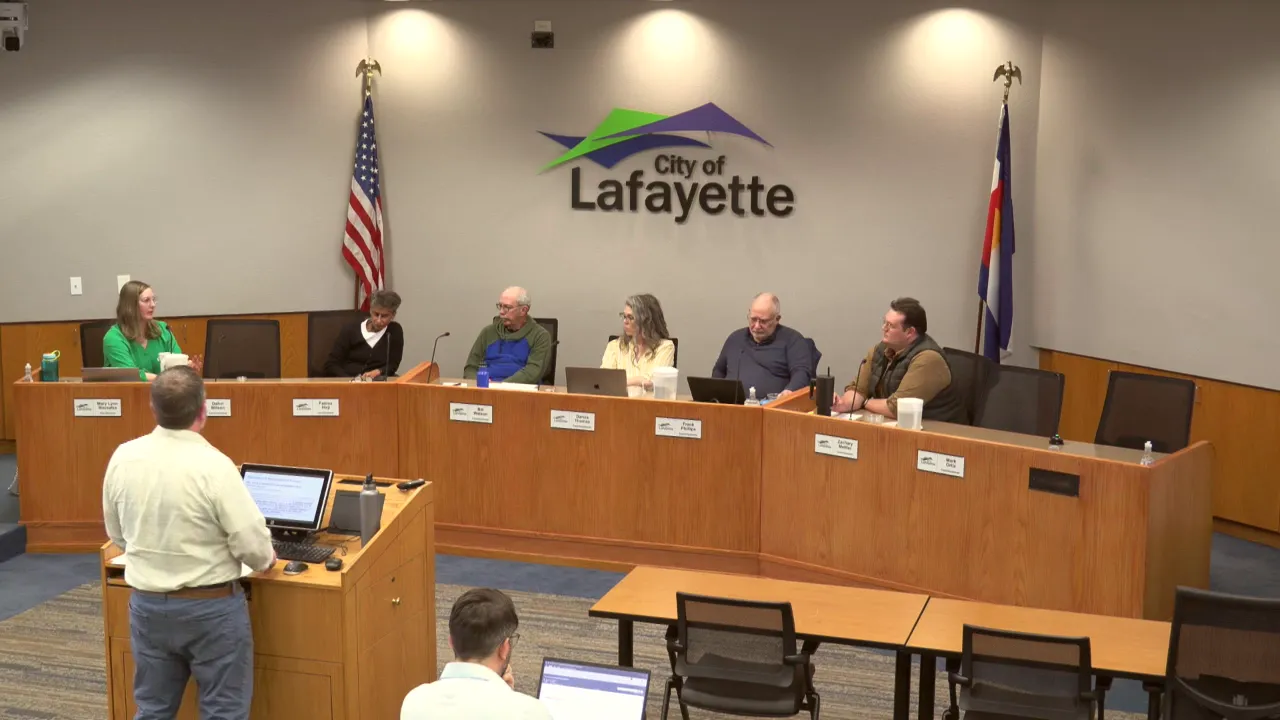
The Lafayette Planning Commission met on March 26, 2025, at 1:00 PM MT to discuss two major agenda items: the proposed Area Planning Framework (APF) for small-area plans, with an initial focus on the South Boulder Road corridor, and an overview of the Sketch and Preliminary Plan process for planned unit developments (PUDs). The commission also approved the minutes from the February 26, 2025, meeting and received updates on staffing and the transition to an in-house city attorney.
Consent Calendar
- Approval of February 26, 2025 Meeting Minutes: Approved by motion (Commissioner Thomas moved, seconded by Vice Chair Phillips) with no opposition.
Public Comments & Testimony
- No public comments were received; the agenda item for public input was closed with no speakers.
Discussion Items
- Area Planning Framework (APF): Staff presented a framework to guide future small-area plans, outlining four plan types (Quick Tactical, Small Area/Neighborhood, Area, Sub-Community) and a proposed public engagement spectrum (inform to empower). The first candidate plan area is South Boulder Road (from 287 to Public Road), cited for synergies with a regional transportation corridor plan, transit-oriented development requirements, and potential bond-funded city hall relocation. The Lafayette Urban Renewal Authority has committed over $1 million in tax increment financing to fund the plan and initial implementation. Commissioners discussed the need for connectivity to adjacent neighborhoods, integration with existing zoning and the comprehensive plan, and the importance of including residential areas and businesses (e.g., the "SoSoBoRo" creative small business coalition). Staff will draft a Request for Proposals (RFP) and return to the commission for further input.
- Sketch and Preliminary Plan Process Overview: Staff reviewed the PUD review process, emphasizing that the sketch plan (≈30% design) is non-binding and intended to identify major issues, while the preliminary plan (≈80% design) is a final decision by the Planning Commission with conditions. Discussion focused on the use of the comprehensive plan at each stage, the role of conditions of approval, and the option for applicants or council to initiate early council review (via council call-up or appeal) to avoid surprises at the final plan stage. Commissioners expressed concerns about relying on aspirational goals and the need for clear language in conditions. Staff noted that upcoming large annexation proposals may benefit from early council involvement to align expectations.
Key Outcomes
- Area Planning Framework: The commission provided feedback that staff will incorporate into the RFP, including emphasizing connectivity, placemaking, and engagement beyond the plan boundary. No formal vote was taken; the item was for discussion and direction.
- Sketch/Preliminary Plan Process: The commission clarified their role in reviewing sketch plans (focus on concept, comprehensive plan consistency, and deviations from zoning) and preliminary plans (detailed compliance, conditions). No vote was taken.
- Commission Liaison Appointment: Commissioner Watson volunteered to serve as liaison to the Open Space Advisory Board; the commission agreed to consider an alternate if needed.
- Staff Updates: Staff noted upcoming challenges with report turnaround due to conferences and vacations but committed to improving communication. The transition to a dedicated in-house city attorney (supporting planning) begins next week, expected to streamline development reviews.
Meeting Transcript
Please rise for the pledge allegiance. Pledge allegiance. And to the republic for which it stands in under God's story. All right, Chair Thomas. Here. Vice Chair Phillips. Here. Commissioner Wilson. Commissioner Watson. Yes. Commissioner Hierjee. Here. Commissioner Ortiz. Commissioner. Commissioner Mettler. Here. Thank you. All right. Are there any items from the public? Not on tonight's agenda. It doesn't appear so. We'll move on to meeting minutes from February 26th, 2025. Approval of the meeting minutes for February 26th. Do we have a motion to approve? Move to approve. Any second? Second. Thank you. All right. We are moving and approved on minutes. Moving on to um regularly scheduled items area planning framework. I do want to give a heads up. I've got to um excuse myself about 10 quarter till eight. Um in case we run that long. Um pick up someone from the airport, so I'll be stepping. This this shouldn't take that long, is that we say that means I don't think so. We have to listen to you too. Um hopefully it'd be a little bit less of me talking. Uh I would like to you know provide this opportunity. We've been developing a staff a document that we included in the packet called an area planning framework. And we were doing that kind of as we were talking about um implementing one of the comprehensive plan items around small area planning. And so what we're hoping to do today is um just go over uh from a staff presentation some of the high points of that. Um kind of uh what we know right now for that um first plan, and then just hear from you all if you want to have discussion and input around that as we're thinking about um drafting what's called a request for proposal that we would develop we would uh hire a consultant team for. So this is kind of the the front end before we know a whole lot about that first effort. Uh but before diving into that, we wanted to just kind of go into like what is the framework itself. And so the comprehensive plan identifies a number of different areas that may benefit from some smaller scale focused planning. Um and we developed the framework in an attempt to just aid decision making and help us as the city identify what are those areas, what's the process we might want to go through at a high level, what are the issues we want to look at it with each of those plans, uh and then identifying those those potential areas. And so the hope with something like this is to just have a more consistent approach, and so we could focus on the work and not have to reinvent the process every time we do a plan, uh, and to try to have some sort of weighing so at least qualitatively we can um have an equitable and fair process in terms of the areas that we focus on throughout the years. The uh what is an area plan? So this is really a hyper local planning effort.
openpublica.com