Las Cruces City Council Work Session – April 27, 2026: NMSU HEST Presentation, Legislative Update, MRA Committee Update
STREAMING COPY IN PREPARATION — RECORDING AVAILABLE FROM THE ORIGINAL SOURCE
Las Cruces City Council Work Session – April 27, 2026
The Las Cruces City Council held a work session on April 27, 2026, beginning at 7:18 PM (ET). The meeting featured three agenda items: a presentation from New Mexico State University’s College of Health, Education and Social Transformation, a legislative update from the city clerk, and an update on the internal Metropolitan Redevelopment Area committee. Council members engaged in discussion, asked questions, and received updates on ongoing projects and partnerships.
Consent Calendar
- No consent calendar items were present.
Public Comments & Testimony
- No public comments were made.
Discussion Items
- Item 1.1 – NMSU College of Health, Education and Social Transformation (HEST)
- Dr. Rick Marlett, Dean of the College of HEST, presented an overview of the college’s mission, programs, and recent accomplishments. Key statistics included: record enrollment of 4,224 students (headcount) and nearly 38,000 student credit hours in fall 2025; the college is NMSU’s second largest, with over 200 faculty and nearly 200 staff. HEST comprises nine academic units, seven of which are accredited at state/national levels and lead to licensure.
- Dr. Marlett highlighted workforce development successes, particularly in teacher education: applications to the professional program increased from 83 in 2019–2020 to 75 in spring 2026 alone. In the Southwest region (south of Socorro), only 35 teacher vacancies exist across all school districts, including Las Cruces Public Schools, indicating strong retention of graduates.
- Council members asked about barriers to retaining graduates and how the city can support partnerships. Dean Marlett identified that higher salaries and state support for paid student teaching have improved retention. Councilor Harris asked about city partnerships beyond salaries; Marlett suggested aligning internships and apprenticeships with city needs. Councilor Matisse inquired about the LIGHT program (social worker co-response) and noted potential employment connections. Councilor Municipal asked about nursing graduation numbers; Marlett stated the BSN program admits 64 per cohort, with the largest graduating classes each semester.
- Council members expressed support for continued collaboration, with Councilor Matisse mentioning the Tell Shore Fund (Memorial Medical Center fund) that could support the college’s clinics. The mayor noted the city has a public health coordinator (Anthony Turner) working with NMSU on a homeless/metal health/substance abuse survey and strategic plan.
- Item 1.2 – 2026 Legislative Update with City Clerk Christine Rivero
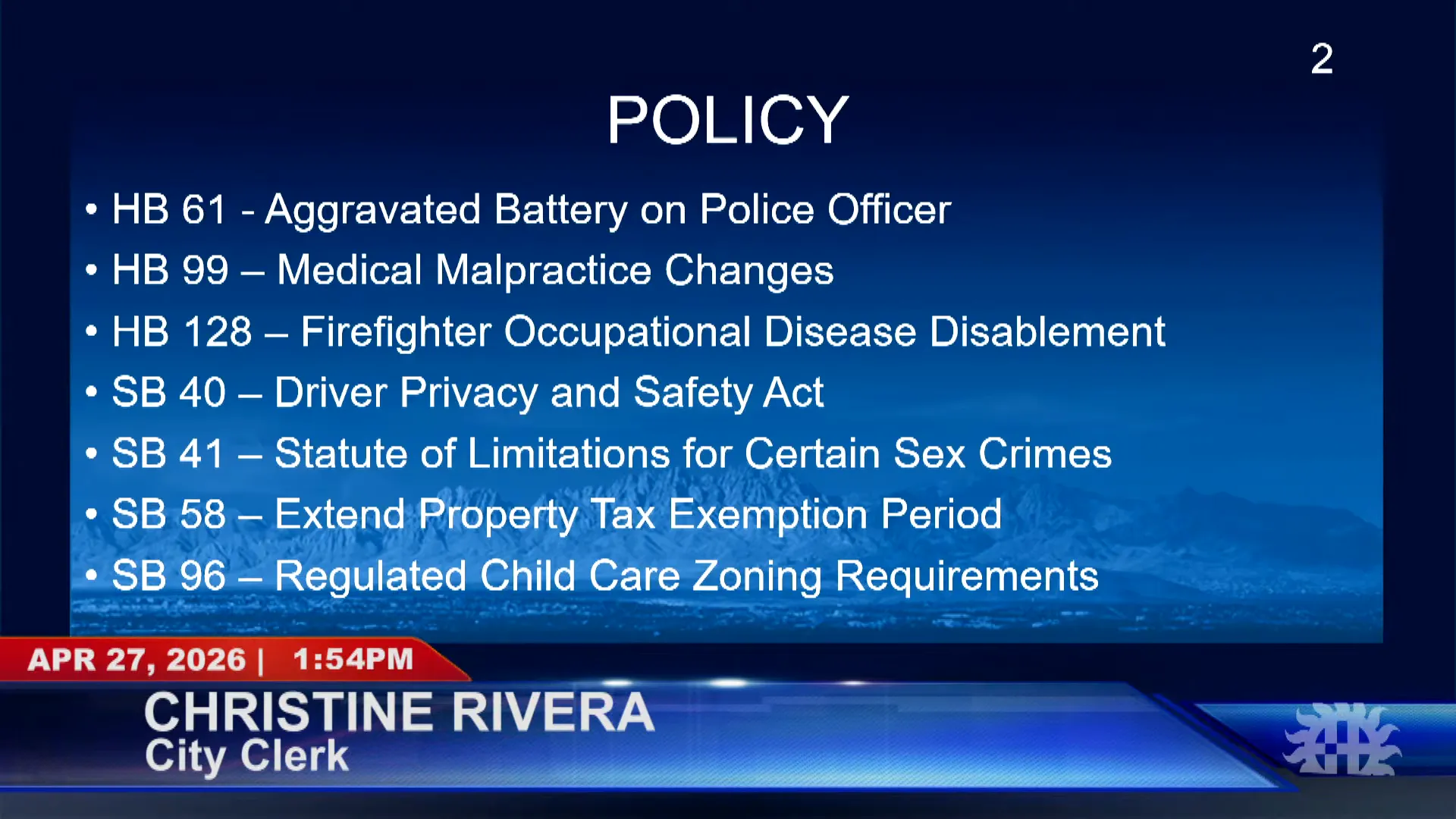
- City Clerk Christine Rivero presented a legislative update on the 2026 30-day session. Key policy bills passed: HB61 (aggravated battery on a police officer – increased penalties), HB99 (medical malpractice changes – restructures damage caps), HB128 (firefighter occupational disease – expands presumption), SB40 (Driver Privacy and Safety Act – restricts personal information access), SB41 (statute of limitations for serious sex crimes – eliminates time limit), SB58 (property tax exemption extension from 7 to 14 years for properties in MRAs), and SB96 (regulated child care zoning – requires home-based daycares be treated as residential).
- Growth funds secured: $150,000 for a youth prevention/intervention coordinator (police department), $180,000 for after-hours youth programming (parks and rec), $180,000 for a sustainability project (sustainability office), and $1 million for the air show (tourism, not growth funds).
- Capital outlay funded projects: Apadaka Park – $3 million; East Mesa Rec Center – $250,000; fire station improvements – $72,000; driving track – $2.09 million; Real-Time Crime Center technology upgrades – $100,000; affordable housing – $470,000; Thomas Branigan Memorial Library – $1.7 million; WIA building – $900,000 (more than requested); East Side Center – $1.025 million (more than requested); Amador Hotel – $4.84 million; nonprofit Kitchens – $2.95 million. Total capital outlay received (excluding Kitchens) was $14.387 million, with an additional $5 million for the Amador Hotel.
- Council members thanked Rivero and staff for coordination and asked about SB96’s impact on zoning (community development director Chris Faber confirmed minimal tweaks needed) and SB58’s property tax impact (no effect on city since county handles). Councilor Curran requested future tracking of all state agency appropriations. Councilor Matisse and the mayor stressed timely execution of projects, especially the WIA building, which has been neglected for years.
- Item 1.3 – Internal Metropolitan Redevelopment Area Committee Update
- Blair Flotis (Economic Development) presented on the internal MRA committee, which is being formalized via city manager policy. The committee includes leadership from key city departments, facilitated by economic development, to set priorities, recommend funding, track progress using Envisio software, and address challenges.
- Accomplishments include: completion of initial training on the Envisio platform, development of an internal MRA SharePoint library, publication of an MRA resource guide (available on the city website), launch of a $100,000 grant pilot (up to $5,000 per property for safety improvements) in the El Paseo MRA (expended $30,000 to date, helping 7 businesses; expansion to West Picacho/Motel MRA in FY27).
- Property tax abatement program (SB58) is being developed with a pre-application process, community benefit matrix, and requirement for council approval. For existing MRAs (El Paseo, West Picacho, Apadaka/Lift-Up), progress updates have been entered into Envisio; web pages and county coordination on TIFFs are ongoing.
- Council members asked about outreach to neighborhood associations (El Paseo area), the need for private–public partnerships (e.g., Boys & Girls Club), and feedback from businesses (safety concerns in El Paseo, motel concerns in West Picacho, illegal dumping in Apadaka). Councilor Curran emphasized including locally owned businesses and employee benefits in the community benefit framework. Councilor Enriquez suggested partnering with Las Cruces Public Schools on potential vacant property (Hernandez Street facility) for youth/vocational uses in the Lift-Up area.
Key Outcomes
- No formal votes were taken during the work session. The session concluded with a motion to adjourn, seconded, and passed unanimously by all council members present (McClure, Matisse, Harris, Bencomo, Curran, Moon, mayor).
- Council members directed staff to keep them posted on WIA building progress and requested updates on all other capital projects.
- The MRA committee will refine implementation processes and bring the tax abatement program framework to a future work session.
- The legislative update website will be updated by end of day; Envisio public dashboards for MRA plans are expected online by end of week.
Meeting Transcript
Your life. Okay, well, welcome back, and we'll start our work session now. We'll start with the agenda items 1.1 NMSU College of Health Education and Social Transformation. That would be you, Dr. Marlett. Thank you, Mr. Mayor. Distinguished members of the council. Thank you so much for the opportunity to be with you this afternoon. Appreciate very much and an honor to have been invited. My name's Rick Marlett. I'm privileged to serve as the Dean of the College of Health Education and Social Transformation at New Mexico State University. We love our acronyms and higher ed, so we're HEST, if you've heard of us. We are driven by a uh by our mission, which is to pursue social change and transformation through education, research, and outreach. Our vision is to be collaborators and leaders in the discovery of innovative solutions in healthcare sciences, allied health, education, and social services, all of which lead to social transformation in New Mexico and beyond. We welcome the opportunity to serve all students and invite all community members in the borderland and beyond to join our academic communities. As a college, we are incredibly proud of who we are, our contributions to NMSU's land grant mission, and our robust engagement with communities and students across the state and region. Our students uh become experts in their fields. They get great jobs right away through hands-on experiential learning opportunities, and they are the benefit beneficiaries of cutting edge scholarship from our faculty and our amazing alumni and donor networks that support our college. Our students graduate, get those great jobs right away, and become strong leaders who are difference makers for their families and change agents in their communities. So just to some brief overview of the college, uh, we did have our highest enrollment on record in fall 2025. HESS served over 4200 students across undergraduate and graduate enrollments. That includes uh all-time high of 4,224 enrolled student headcount, and then an all-time high approaching 38,000 student credit hours, which was very exciting. HEST is NMSU's second largest college. We support over 200 faculty members and nearly 200 staff members. Uh, we're 17.5 million. And uh we've been a the beneficiaries of uh a tremendous amount of support from the state uh in terms of our higher education endowments and uh those have us supported our areas of social work, nursing, and teacher education in particular. Uh we do have several priorities that uh kind of run as a through line through our college and bring together our disciplines, which on paper seem to be somewhat far apart when you think about nursing uh being in the same college as say kinesiology or uh public health. But what really brings us all together is some of those foundational through lines, such as ensuring that providing training and workforce development around mental health and wellness, social emotional working, social and emotional learning, workforce development, and high quality instruction across the board. We have nine academic units in the College of HEST, including three schools and six traditional academic departments. Seven of our nine academic departments are accredited at the state and national level and lead to licensure in a professional program. So I have uh listed our departments and schools here on the next couple of slides, and also added the uh accrediting uh again acronym there for you. Uh, but just just to point out that you know um our our programs are professional licensure leading pathways, whereby students have an apprenticeship and clinical experience out in the field, and most of our students, especially if they're willing to stay in New Mexico, which we highly encourage and incentivize students to do, they're gonna have a job right away in their in their professional field. We have a number of new uh notable academic pathways in the college that just went online this last year. As you can see, we're really attuned to aligning our programming in the college with the needs and the high demands of workforce out in the state. Um, just just briefly want to point out again, the enrollment is pretty much across the board in our uh in our college. So of our nine academic units, nearly all are showing um growth over the last several fall semesters. Um, increases in student enrollment for headcount, as well as uh the total accumulation of student credit hours, which is exciting. Those are the numbers across the college, as you can see, growing on the uh undergraduate side as well as the graduate side. They're in crimson and in silver. You can see we're continuing to serve that mission to expand our capacity and to train more highly qualified, culturally competent professionals for the state of New Mexico. Uh, in addition to our academic arm of the college, we also pride ourselves on providing experiential learning and research and outreach for a huge community engagement mission. A number of our sites across the college are testaments to that, to that public-facing community service aspect. We have the nursing skills and simulations lab for which we did a ribbon cutting in the fall. Very exciting there in the old HSS building. We have a number of clinics on site in the college, including the mental health clinic for clinical psychology and school psychology, the Papin Open Dramos Autism Diagnostic Center, the Edgar R. Garrett Speech and Hearing Center, and the Glass Family Research for Early Childhood Studies. When the O'Donnell Hall expansion is completed, which which I'm told as of this morning is on track and should be ribbon-cutted there in the fall. Um, all of these clinical public serving uh entities will be together on the ground floor in O'Donnell Hall, facing public facing, accessible for uh children and families and clients across the board. So it's very exciting.
openpublica.com