Las Cruces City Council Work Session: OIR Police Audit Report – July 27, 2026
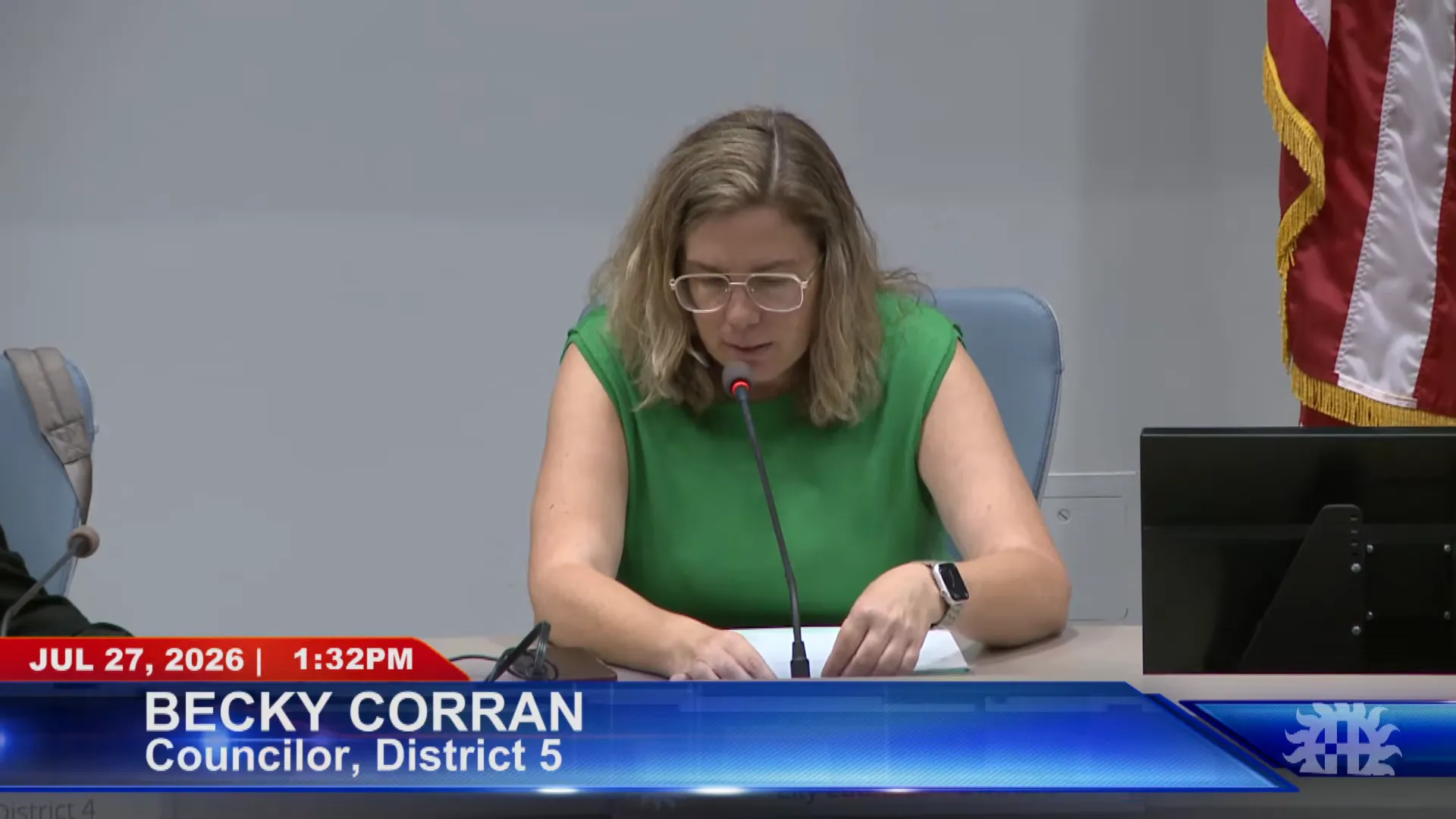
STREAMING COPY IN PREPARATION — RECORDING AVAILABLE FROM THE ORIGINAL SOURCE
Las Cruces City Council Work Session: OIR Police Audit Report – July 27, 2026
On Monday, July 27, 2026, at approximately 1 PM, the Las Cruces City Council held a work session presided over by Mayor Eric Enriquez. The only agenda item was the semi-annual report from the OIR Group on the Las Cruces Police Department's closed administrative investigations, covering cases closed January 1 through June 30, 2026. The meeting included a presentation by OIR Group auditors, council questions, one public comment, and an announcement that LCPD had received CALEA accreditation.
OIR Group Police Audit Report Presentation
- The OIR Group's Teresa and Steve presented the tenth semi-annual report. They explained that their scope is to review closed administrative investigations conducted by LCPD, not to conduct investigations or impose discipline.
- Since March 2026, the contract was expanded to include Category 2 and Category 3 external complaints, so OIR now reviews all public complaints, not just those that become formal investigations. This change was prompted by city council interest, community concern about screening, and Chief Story's preference for full transparency.
- In this reporting period, OIR reviewed 21 cases, up from a historical range of 10 to 16 cases per cycle. These cases involved approximately 30 LCPD employees, mostly officers.
- There were 12 internal investigations, generating 42 unique allegations, primarily involving vehicle pursuits and uses of force, with additional allegations about procedural reporting and evidence handling. OIR stated that LCPD is doing a commendable job identifying its own employees' issues.
- There were 9 external complaints, many concerning officer discretion or communication and customer service. Two external allegations were sustained; the rest were not sustained.
- OIR reported complaint demographics: 73 complainants with identifiable race/ethnicity, and their limited statistical analysis found no evidence that race or ethnicity was a factor in complaints, outcomes, or employee status. Public complaints were evenly distributed among zip codes 88001, 88012, and 88005.
- Sustained cases resulted in formal discipline such as verbal reprimands, suspensions, and one trainee's release from the agency. LCPD also provides debriefs, counseling, or retraining even when allegations are not sustained.
- OIR also noted that a community listening session would take place that evening in the council chambers to gather public feedback.
Findings and Recommendations
- OIR reviewed two officer-involved shootings that completed their process during the cycle. They praised LCPD's review mechanisms, including a force review cadre.
- OIR recommended that all officer-involved shootings be automatically sent to the force review cadre. Chief Story responded that these incidents already receive rigorous multi-level review, the cadre has resource constraints, and he proposed a training and equipment debrief for every officer-involved shooting as a compromise.
- OIR noted some instances where communication could have been better and encouraged LCPD to emphasize customer service as part of departmental culture.
- OIR said LCPD met CALEA accreditation standards; they met with the accreditation team and reported the department was forthcoming with information.
- OIR also mentioned LCPD's participation in a trust-building project using AI to audit thousands of hours of body-worn camera footage, with generally high marks for officers.
- The new contract added a training component; OIR participated in scenario-based training with LCPD the morning before the meeting.
Council Discussion and Q&A
- Councilmember Koran asked about a background check process referenced in the report. Chief Story explained that LCPD had switched from in-house backgrounds to a contractor (which also serves New Mexico State Police). He acknowledged one deficient investigation, stated they had met with the company, and would add redundant checks; he remained comfortable for now but would consider other vendors if problems persist. (Note: The transcript also spells this name as "Counselor Corinth" and "Councilmember Koran.")
- Councilmember Koran asked about Star Chase pursuit-deterrence technology. Chief Story said LCPD has had it since about 2016–2017 and uses it to prevent pursuits, especially given New Mexico's Safe Pursuit Act restrictions.
- Councilmember Bencomo asked about model policies to guard against surveillance overreach from technologies like Flock cameras. OIR described California practices: agencies going line-by-line through vendor contracts to establish data ownership, council-adopted surveillance use policies, retention rules, and audit mechanisms. They offered to share these policies with the council.
- Councilmember Bencomo also asked about recommendations from the National Policing Institute (MPI) report, including monthly body-worn camera reviews and call preparation checklists. Chief Story said monthly reviews already occur through Axon, but he is exploring a system that flags problematic or exemplary interactions. He expressed skepticism about checklists for unpredictable policing situations, preferring training that builds critical-thinking skills.
- Councilmember Harris asked about individual case memos. OIR clarified they no longer produce lengthy memos but continue to review every case. He also asked for more specific geographic data than zip codes; OIR agreed to work with the police department to produce census-tract-level or otherwise more nuanced data.
- Mayor Pro Tem requested demographic analyses beyond race/ethnicity, such as sexual orientation, gender, and age. OIR noted the small sample size but committed to examining trends and flagging any that jump out.
Public Comments & Testimony
- Dan Romero, a Las Cruces resident, made several points: he found it hard to locate the OIR report; he questioned the contract structure and OIR's small shop; he noted duplicate report numbers on OIR's website; he criticized OIR for reporting on employee hotline cases, saying it risks identifying employees; he asked whether OIR uses AI in reviews; and he suggested reporting by neighborhood instead of zip code.
Key Outcomes
- No formal council votes were taken during the work session, except a unanimous motion to adjourn, with council members McClare, Harris, Bencomel, Coran, Munoz, and Mayor Enriquez voting yes.
- City staff (Viola Perea) clarified that the OIR contract is a five-year contract (annual renewals), with a new five-year period beginning March 2026. She stated that all nine previous reports are available on the city's transparency page, and that hotline complaints involving LCPD are automatically forwarded to the police department and then to OIR for review.
- Mayor Enriquez announced that the Las Cruces Police Department has been awarded CALEA accreditation.
- OIR committed to exploring more nuanced demographic and geographic reporting and to sharing model surveillance policies with the council.
- The meeting adjourned.
Note: The agenda and minutes for this meeting were not available; this summary is based solely on the raw transcription.
Meeting Transcript
Well, good afternoon. Welcome to the work session. Today is Monday, July twenty-seventh, two thousand twenty six. It's approximately one PM. I'm Mayor Eric Enriquez. We will start with a moment of silence for the brave men and women of the United States Armed Forces. And also for the Las Cruces Police Department, Las Cruces Fire Department, as I keep our city safe twenty-four seven, three sixty-five. If you join me on the pledge. We are a team of police practice experts. We have about 20 years of experience as independent police auditors throughout various jurisdictions, mainly in California, but of course also here in Las Cruces and a variety of other places throughout the United States. It is important here to note that our scope of work is to review closed administrative investigations that were conducted by the Las Cruces Police Department. So our role is not to investigate those directly. It is also not to issue any kind of findings or discipline related to those. That all lives within the Office of the Chief of Police and his command staff. What we do is we come in after the fact when an investigation has been closed. If there's any discipline, it has been issued. And what we're doing is looking at the systems and the processes that this department has in place to hold its personnel accountable. And so what we're looking for mainly are administrative investigations that are complete, objective, thorough, and fair. So not only are we looking at the investigations themselves, but also the findings, any kind of outcome, whether that's disciplinary or otherwise, and determining whether it fits into those review categories. In order to do that, we have full access to the department's administrative investigations. These are things that might otherwise be confidential, or if they're available to members of the public, they may be redacted. And we have the full file provided to us. Nothing is redacted. We have body worn camera footage, we look at police reports, sometimes there's radio communications, the whole scope of that particular administrative file is made available to us. So in the past, in the past five years or so, we have presented to you on a twice annual basis, and we have provided a review of the cases that were closed within the first half or the second half of the calendar year. And as of March of this year, we were we worked collaboratively both with city leadership as well as with department leadership in crafting a new contract and a relatively similar but expanded scope of work. So this report here is a bit of a hybrid, and so we apologize for the any confusion that that might cause because we have the first half, January to March, in which we were using our previous model that was looking at internal and external investigations that led to a formal investigation. We were providing full memos with respect to each of those cases. So you'll see at the back of the agenda packet, there's four cases that we reviewed in that way. After March, our scope of work expanded. And so we were able to start receiving cases that were submitted by members of the public, external complaints that were classified in two different categories, category two and category three. Okay, so these are complaints that when they came into the department, they were classified as matters that likely would not rise to the level of a formal investigation. What does that look like? It means, for example, someone might be contacting the department with what appears to be a complaint, but upon some form of investigation, it's determined that it's really just a question. We had one of these cases where a member of the public was looking for information about a protest event in the city and what was the sort of right method for LCPD to respond and so on. That question was answered, and that was determined to be a category two external complaint. Category three, we get a little more nuanced and weedsy. I'm going to leave the discussion of that to Steve a little later in the presentation, but suffice to say that it is complaints from members of the Las Cruces community that the department has classified as something that, upon face value, does not have any overt misconduct within the narrative of that complaint. So why a change in the scope of work? Well, this came from a variety of different places. One was from this counsel who was asking, are we actually seeing everything that members of the public are complaining about? Two was from community who was concerned that there was some kind of screening process that was happening that was preventing us as auditors from reviewing everything coming in. And three was from the chief himself who determined that he would like us to see everything, to prevent any concerns that there might be bias or a shielding or screening process of any kind. So we're now receiving all of those. So in this reporting period, we have 21 cases that we reviewed. And just to give some context about where the scope changed a little bit of the of and expanded the scope, in previous cycles, we may have been reviewing anywhere between 10 to 16 cases. And with the inclusion of the new complaint categories that we're now receiving, we're up to 21. As you see, there's a slight difference there, and we are receiving and reviewing more things. Again, I'll remind everyone that these are cases that were closed in the first and second quarters of 2026. So our closing period was June 30th of 26, and we're reporting here to you in late July with that report.
openpublica.com