Lehi City Council Meeting - May 27, 2025: Budget, Annexations, and Code Amendments
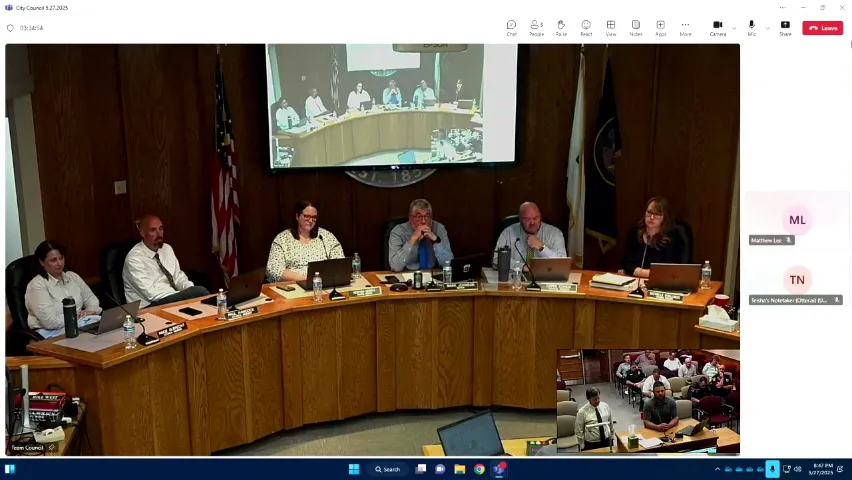
STREAMING COPY IN PREPARATION — RECORDING AVAILABLE FROM THE ORIGINAL SOURCE
Lehi City Council Meeting - May 27, 2025
The Lehi City Council met on May 27, 2025, starting with a pre-council session at 6:00 PM and a regular session at 7:00 PM. The meeting covered a wide range of topics including minimum lot size requirements for detached accessory dwelling units (ADUs), two annexations, reallocation of Community Development Block Grant (CDBG) funds, fiscal year 2026 budget adoption, a development agreement, preliminary subdivision approval, and a development code amendment. The council also briefly adjourned to the Local Building Authority (LBA) and Redevelopment Agency (RDA) meetings to approve their respective budgets.
Consent Calendar
- Approved item 4.3: Nice Healthcare Agreement Renewal (a subscription-based health benefit for city employees at $45 per month per employee).
Public Comments & Testimony
- Jennifer Chamberlain (Lehi Animal Hospital) expressed concerns about the Oz Event Center using their parking lot during daytime events, stating that the event center does not pay for the HOA maintenance and that parking needs were not properly addressed during approval. She urged the city to require adequate parking for event centers.
- Carrie Brighton stated she does not oppose the Salt Spring annexation but wants development done in a good manner that follows the general plan.
- Larry Hadfield (resident near Pioneer Village) expressed appreciation for the developer listening to neighborhood concerns and creating a compatible subdivision, but raised concerns about traffic congestion in the area due to schools and churches.
Discussion Items
- Pre-Council – Minimum Lot Size for Detached ADUs: Staff presented a possible change from the current 15,000 square foot minimum lot size to 14,520 square feet (a true third acre). Councilmember Newell explained that a resident was 200 square feet short of the current requirement. The change would also count toward moderate income housing goals. Discussion included concerns about code consistency and the difficulty of using non-round numbers. Council generally supported the change, with direction to staff to initiate the code amendment process. Additionally, a related issue about reducing setbacks for attached pavilions on corner lots in RA1 zones was discussed, and staff was directed to explore that separately.
- Waterwise Yard of the Month Presentation: The Environmental Sustainability Committee awarded the May Waterwise Landscape of the Month to Shelby and Becky McCoon, noting their use of drought-tolerant plants, strategic turf grass, and low-pressure irrigation. The committee announced a parade of homes on June 12 for award winners.
- CDBG Fund Reallocation: Due to a slight reduction in CDBG funds (from $343,852 to $332,739), the council debated whether to fully fund the Curtis Center subrecipient ($31,864) or put the remainder toward the downtown sidewalk project. Some council members argued that the Curtis Center serves a critical population (adults with special needs) and that the city should complete the sidewalk project with other funds. Others noted the administrative burden of a small grant for the Curtis Center. A motion to fully fund the Curtis Center and reduce the sidewalk allocation passed 4-1.
- Fiscal Year 2026 Budget Adoption: Extensive debate occurred on several proposed uses of excess capital funds and ongoing savings. Items discussed included:
- Ice Rink: Councilmember Condy proposed removing the $800,000 capital cost and $150,000 ongoing cost for the ice rink, citing limited use and proximity to other rinks. He suggested pursuing grant opportunities for a future permanent rink.
- Fragmites Mower: Support for purchasing a mower ($250,000) to address invasive phragmites along Utah Lake, citing fire hazard and liability. Some council members wanted more study, but others noted the need is urgent.
- Code Enforcement Officer: Several council members expressed support for funding a code enforcement officer (half of a proposed position) using ongoing savings from the ice rink, but the motion did not allocate that savings immediately.
- Internal Auditor: Some council members questioned the need for the position, while others noted it would help ensure compliance with state regulations.
- Hutchings Museum: Councilmember Condy proposed increasing city contributions to $15,000 to help fund staff raises, but staff noted that nonprofit organizations should seek funding through the park tax grant.
- Police and Parks Staffing: A debate emerged about whether to prioritize police officers over additional park staff. Councilmember Condy argued the city is falling behind in police staffing compared to Orem, while others noted the city has funded police raises and that parks are understaffed.
- Ultimately, a motion to approve the budget as originally proposed but remove the ice rink (both capital and ongoing costs) and keep the phragmites mower passed 4-1. The ongoing savings from the ice rink were not allocated pending further vetting.
- Clark Meadows Annexation: Resolution and ordinance approving the annexation of 7.2 acres with R-1-22 zoning passed unanimously.
- Salt Spring Annexation: Resolution and ordinance approving the annexation of 13.32 acres with TH-5 zoning passed with an amendment to include DRC comments and direction for staff to work on a development agreement with residents.
- Whitmore Development Agreement: Resolution 2025-33 approved, allowing equipment/vehicle parking, sod transfer, and green waste facilities in a Planned Community zone.
- Pioneer Village Preliminary Subdivision: Approved for a 34-lot single-family residential project with density in lieu considerations, including construction of a road to Dry Creek.
- Development Code Amendment: Ordinance 30-2025 passed, removing side and rear yard setbacks in the Neighborhood Commercial zone except when adjacent to single-family residential, where a 25-foot setback is retained.
Key Outcomes
- Votes:
- Consent agenda approved unanimously.
- Clark Meadows annexation: Resolution 2025-32 (5-0) and Ordinance 35-2025 (5-0) passed.
- Salt Spring annexation: Resolution 2025-31 (5-0) and Ordinance 34-2025 (5-0) passed.
- CDBG reallocation: Motion to fully fund Curtis Center at $31,864 and reduce sidewalk allocation passed 4-1 (Michelle opposed).
- Budget adoption: Motion to approve FY2026 budget as originally proposed but remove the ice rink (both capital and ongoing) and keep the phragmites mower passed 4-1 (Michelle opposed). Ongoing savings from ice rink not allocated pending further consideration.
- Whitmore development agreement: Resolution 2025-33 passed unanimously.
- Pioneer Village preliminary subdivision: Approved unanimously.
- Development code amendment: Ordinance 30-2025 passed unanimously.
- LBA and RDA budgets: Resolutions L2025-02 and R2025-09 passed unanimously.
- Directives: Staff to initiate code amendment for detached ADU minimum lot size (proposed 14,520 sq ft). Staff to explore setbacks for attached pavilions on corner lots. Staff to work with Salt Spring applicant and residents on a development agreement. Budget savings from ice rink to be considered for future allocation (e.g., code enforcement, police, auditor).
Meeting Transcript
Hi there. I'd like to welcome everybody to the Lehigh City Council meeting. Uh the date is May 27th, 2025. It is now 6 p.m. This is actually our pre-council uh version. It's a matter of roll call. All our city council members are here tonight for the meeting. We only have one presentation tonight. That's why we are getting a little later start than usual. But we would before we go to the presentation, we always like to start off with a prayer, and I'll ask Chris if he would take care of that for us. Our dear gracious Heavenly Father, we come before thee this evening with gratitude in our hearts for the blessings that thou's bestowed upon each of us to thank thee, Father, for this opportunity to serve our great community and our great cities, uh Lehi. We're grateful, Father, for her residence as residents and for her businesses and for the prosperity that she has seen. We're thankful, Father, for all those who serve on our behalf. We thank you for our uh first responders for our military for our uh for their families, Father, and for all that they do on our behalf that we uh may be safe and and have the treatment and the safety that we um are deserving of. We thank thee, Father, for this evening to have an opportunity to go through the agenda and pray thy spirit to be with us as we um collaborate and come to decisions and pray that we may do so in a way that is respectful and and to the um and uh pleasing unto thee. We are again grateful for all that we have unless we pray in the name of my son Jesus Christ in our thank you, Chris. Okay, uh item 2.1 is our presentation, the discussion on minimum lot size requirements for detached uh accessory uh dwelling units. Uh Kim. Yeah, I'm gonna just kind of give an intro frame the discussion, and then I'll turn it over to the council to see what direction you want to go. Um this is something that um I know council member Newell reached out, and I think Councilmember Hancock is also interested in just kind of exploring this issue. Um so uh as the agenda states um this is talking about the how you know how large does the lot have to be to qualify to have a detached accessory dwelling unit. To have an attached or an internal one, it just has to be six thousand square feet. But for these detached, uh where it's not part of the primary dwelling. So this is right out of our code. It just says all accessory buildings with an accessory dwelling unit require a minimum 15,000 square foot lot size. So that's where we're at right now. And then that kind of lines up, it might be too small, but this is our table of bulk and intensity in the minimum lot size in the RA1 and the R115 is also that 15,000 square foot lot size. So I think that's why we lined it up with and that's you know, we talk about that zone as kind of being the third acre zone, just like the R122 is our half acre zone, even though a true half acre is slightly below 22,000 square feet. Um so a true third acre, if you just did the raw math, instead of 15,000 square feet, it's 14,520 square feet. So I guess tonight the discussion would be do we would we want to consider uh changing our minimum requirement, the minimum property size from an even 15,000 to the true third acre uh 14520. Um I did I pulled some quick a quick stat and we think we have about 17. There might be a few that came in uh this I got a couple of weeks ago, so we're probably less than 20 actual applications that we've ever received anywhere for a detached ADU. That was that includes going all the way back when we first started allowing them. So it's not an overwhelming desire throughout the city to have these by lowering it. You might open the door, at least we know for a few that you know they're just underneath that threshold. Of course, you always have to pick, you know, you have to draw a line somewhere, right? Uh whether it's on building setbacks or lot size or whatever it might be. Um the one appealing thing that this could do is um if if we entertain this idea, we could actually count it under the moderate income housing goals that the state requires. This goal number five, it just says create or allow for and reduce regulations related to internal or detached. So even if we're, you know, if it's just that 600 square feet or whatever it is, or 400 and some odd. Yeah. We could still say, hey, you know, we're we're making an intercremental change. This allows a little bit more opportunity to have a detached accessory dwelling in it. So anyways, that's kind of where we're at. That's maybe some reasons that we might want to consider it, and with that, I'll just open it up. That's really all I've prepared is the the baseline, and then we'll let you guys decide where you want to go. Yeah, it's this came about because a resident falls in that gray zone and it reached out and said that uh, you know, as we're talking through it, I'm like, well, you have a third of an acre, and this as this amendment came through, it was called you know the third acre. Um, but realizing he's like uh 200 square feet short. So he's like 14, 800, like to build a detached um accessory dwelling unit for his daughter. Um, and but the only other options there can't be an exception, and I I'd be concerned about having any exceptions come through or conditions.
openpublica.com