OPENPUBLICA · PUBLIC MEETING RECORD
Record of Proceedings
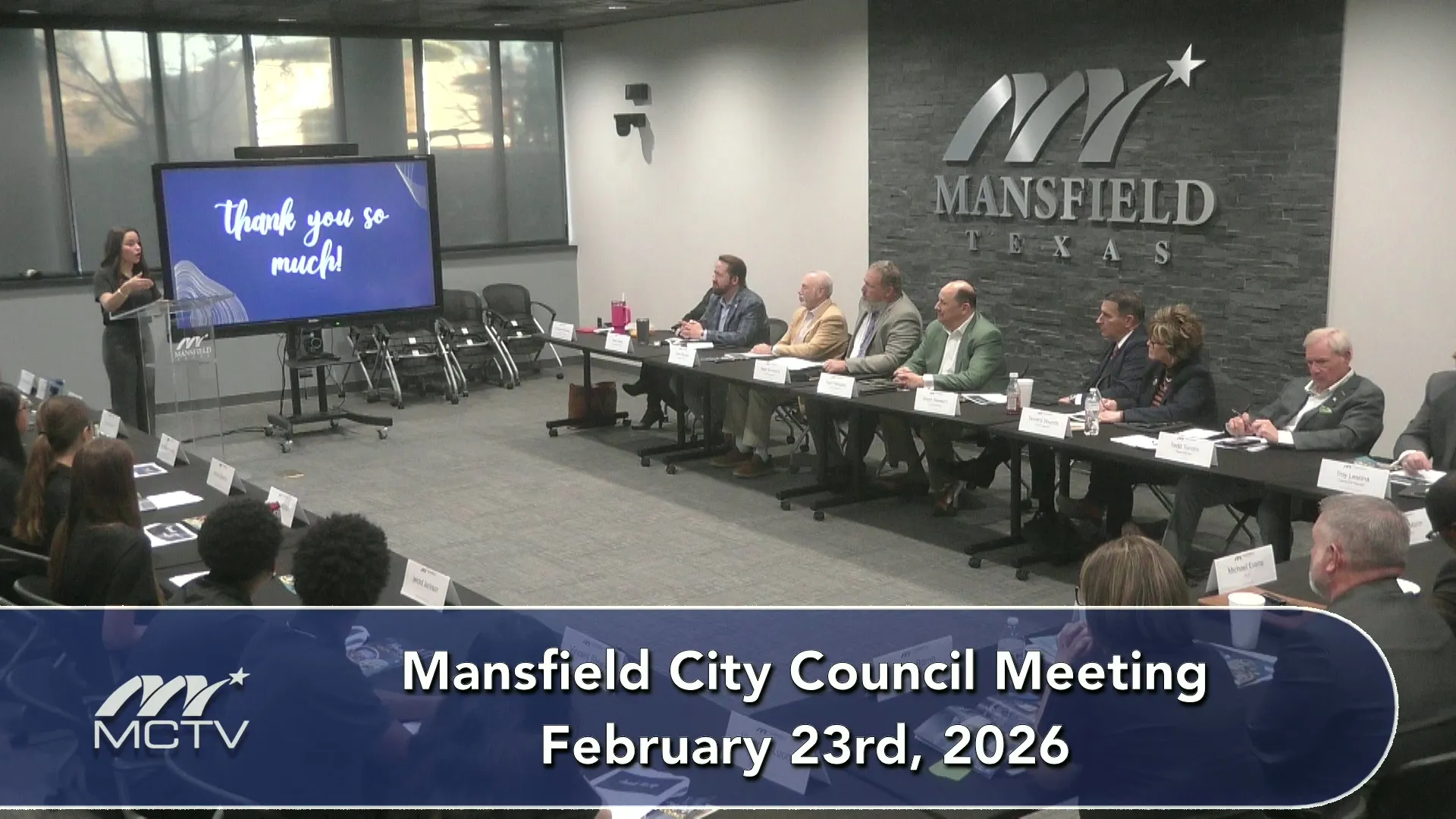
Mansfield City Council Regular Meeting Summary – February 23, 2026
City Council — Monday, February 23, 2026
BodyMansfield, Texas
SessionCity Council
DateMonday, February 23, 2026
StatusFILED
Video Record
STREAMING COPY IN PREPARATION — RECORDING AVAILABLE FROM THE ORIGINAL SOURCE
Transcript — Verbatim
Speaker numbers apply only to this recording. Names come from transcript evidence. “Possibly” marks uncertain attribution.
Discussion Breakdown — Share of Meeting
Engineering And Infrastructure26%
Public Engagement18%
Youth Programs11%
Zoning And Land Use10%
Procedural9%
Transportation Safety8%
Church And State Separation4%
Parks and Recreation4%
Community Engagement4%
Summary of Proceedings
Mansfield City Council Regular Meeting Summary – February 23, 2026
The Mansfield City Council met on February 23, 2026, starting at 1:00 PM in the Council Chambers (1200 E. Broad St.). The meeting included a work session, an executive session (1:59 PM – 5:18 PM), a joint work session with the Mansfield Youth Council, and a regular business session beginning at 6:13 PM. Council Member Brent Newsom was absent initially but arrived at 3:11 PM. All votes were 7-0 unless noted. The meeting adjourned at 7:13 PM.
Work Session: Pavement Condition Index
Jeff Price, Executive Director of Public Works, and Megan Ratliff of Infrastructure Management Services (ICC/IMS) presented the 2026 Pavement Condition Index (PCI) survey. The overall network average PCI is 77 (down from 83 in 2021), with a backlog (PCI ≤40) of 1% (improved from 3% in 2021). The national average PCI is about 65, and typical backlog is 9–12%. The city’s road network is majority concrete. The survey covered all roads and included a pavement markings inventory. Council considered budget scenarios: the current annual maintenance allocation of $3.6 million would cause PCI to decline over five years, while maintaining the current PCI (steady state) would require about $13 million per year (including capital projects). Discussion emphasized that the city’s focus on eliminating the worst roads has reduced the backlog even as overall PCI declined slightly. Council also discussed consent agenda items 26-1936, 26-1942, and 26-1943 with the City Attorney.
Joint Work Session: Mansfield Youth Council
After executive session, the council joined the Mansfield Youth Council for a presentation of the 2025 Youth Survey results. The survey garnered 80 responses from nine schools. Key findings:
- What’s going well: 68% cited nearby friends/family, many mentioned parks/trails (46% restaurants/retail), and described Mansfield as growing, welcoming, and family-oriented.
- Public spaces rating: mean 3.46/5; 78% average or above, but 20% unsatisfied.
- Walkability importance: mean 4.06/5, critical for teens without vehicle access.
- Connectivity: mean 3.17/5.
- Programs: mean 3.09/5; top desired: career/internship resources, volunteering, youth music/art events.
- Priority: 68.4% preferred dedicated teen-specific physical spaces over expanding programs.
- Communication: teens prefer Instagram, short videos, word-of-mouth, and school outreach.
Youth council members answered questions about ideal third spaces (e.g., central gathering areas, Sundance Square model) and outreach strategies. Mayor Evans highlighted future spaces like Guy Commons and the new city hall lawn. The Youth Council plans to start a podcast.
Consent Calendar
The consent agenda included routine items approved unanimously (7-0):
- Resolution 26-1918: Up to $250,000 for right-of-way acquisition and surveying for the Mathis Road Extension project (existing dead end to US 287 frontage road) (TIRZ #1). (Resolution RE-4510-26)
- Resolution 26-1928: Amendments to Keep Mansfield Beautiful Commission Bylaws. (RE-4511-26)
- Resolution 26-1937: Authorization to purchase 800 Highway 287 N #S (MPFDC). (RE-4512-26)
- Resolution 26-1943: Approval of the City’s Employee Speaker Policy. (RE-4513-26)
- Resolution 26-1857: Authorization to contract with Oncor Electric Delivery to relocate utility lines along East and West Broad Street (TIRZ #2, General Fund). (RE-4514-26)
- Minutes 26-1913: Approval of Feb. 5, 2026 joint meeting minutes.
- Minutes 26-1914: Approval of Feb. 9, 2026 regular meeting minutes.
Item withdrawn: Resolution 26-1942 (Political Activities on City Property Policy) was withdrawn by the City Attorney for further council briefing; no action taken.
Item approved separately: Resolution 26-1936 (Surplus Property Authorization) was removed from the consent agenda and approved with a five-year sunset provision (RE-4515-26).
Public Comments & Testimony
- John Pressley (1306 Brittany Lane), representing Mansfield Cares, reported donations totaling $149,886 over the past year: $32,500 to Feed the Kids Summer Program, $58,086 to food banks, $16,500 to MISD multi-scholarship program, $7,800 for back-to-school shoes, and $35,000 for Angel Tree food vouchers. He invited the council to the charity ball on March 7, 2026.
Discussion Items
- Executive Session Actions (Item 13):
- Approved a motion (RE-4509-26) to repeal and replace RE-4480-25 with a new resolution memorializing additional terms in the Third Amendment to the Master Development Agreement for the Qualified Convention Center and Hotel Project, including a requirement for evidence of sufficient funding by April 30, 2026, and construction start extensions.
- Approved a motion to repeal RE-4481-25, a previously authorized professional services contract with the Beck Group for the same project.
- Sub-Committee Minutes (Item 14):
- Local Transportation Issues Sub-Committee minutes (Feb. 9, 2026) approved 3-0 (Tonore, Bounds, Fresquez).
- Tax Increment Reinvestment Zone #4 Board minutes (Feb. 9, 2026) approved 7-0.
- Old Business: RV Parking Ordinance (Item 25-1738):
- Council adopted an ordinance adding Section 72.03 to the Traffic Code, prohibiting recreational vehicles from parking on streets or rights-of-way for more than 72 hours. The 72-hour period begins when a police officer makes first contact with the owner. A citation may be issued after 72 hours, followed by a 48-hour removal notice, after which the city may remove the vehicle at the owner’s cost. A 30-day public education period was recommended.
- Public Hearing: CDBG Grant (Item 26-1912):
- Council held a public hearing (opened and closed at 6:44 PM, no speakers) and approved a resolution endorsing the 2026 (52nd year) Community Development Block Grant project for sidewalk improvements in the southwest quadrant (around Kimball and First through Fourth streets). The project is part of a multi-year program.
- Public Hearing Continuation: Zoning Change (Item 25-1514):
- Council approved second reading of an ordinance changing 5.866 acres at 2445 FM 157 from C-2 to Planned Development (PD) for a mixed-use development: 21,000 sq ft commercial and 42 townhomes (density 11.5 du/ac). Conditions added:
- No more than 10% of units may be sold to any single entity.
- Retaining walls over three feet above existing grade to the west require City Council approval prior to site work permit.
- Elevations must follow Development Review Committee anti-monotony standards for architectural variety.
- The applicant presented updated renderings showing pocket parks and enhanced landscaping.
- Council approved second reading of an ordinance changing 5.866 acres at 2445 FM 157 from C-2 to Planned Development (PD) for a mixed-use development: 21,000 sq ft commercial and 42 townhomes (density 11.5 du/ac). Conditions added:
- New Business: Board Appointment (Item 25-1916):
- Council appointed Germaine Croom to fill an unexpired term on the Keep Mansfield Beautiful Commission, ending September 30, 2027. Approved 7-0.
Key Outcomes
- All votes were unanimous (7-0) on consent and regular agenda actions; only the Transportation Sub-Committee vote was 3-0.
- Consent calendar: 7 items approved, 1 withdrawn, 1 approved with sunset.
- RV ordinance adopted with modified enforcement timeline.
- CDBG project endorsed for 2026 sidewalk improvements.
- Zoning change approved with conditions on bulk sales, retaining walls, and architectural diversity.
- Board appointment made to Keep Mansfield Beautiful Commission.
- Executive session actions updated convention center/hotel agreement and rescinded prior professional services contract.
- Youth Council survey results to inform future city planning; city will consider teen spaces, improved Instagram communication, and other initiatives.
- Next steps: The Mathis Road extension and utility relocation projects will proceed; the CDBG application will be submitted; the RV ordinance will take effect after 30-day education period.
Meeting Transcript
afternoon everybody I want to call to order our meeting for Monday February twenty-third, twenty twenty six to order at one PM. We will begin with our work session, presentation of the pavement condition index. And I'll turn it over to the hands of the buddy. Thank you, Mayor. Um council I we appreciate the the opportunity to to present this to you today. This this has been an important project for us is it helps us so it'll help us over the next five years develop our road maintenance program. And on top of that it also helps us inform um as a as a piece as a data point within our capital improvement program in which which projects should make the the capital program as opposed to being funded through the through the maintenance budget. One of the other things I would I would point to this is done every five years where we create we go back and look at where we were how we how we've adjusted the the projects we've done so you'll see a little bit of where we were and where we are um recognizing that in the last five years you all really committed to to increasing some of the the maintenance funding within that within our budget each year. So um and and I think we'll be able to show you between the two where that has been successful. So um I want to jump right into the presentation and and introduce um Megan Ratliff to you. She's with the infant infrastructure management services which is also the international cybernetics company so IMS ICC bunch of uh letters but um we we very capable so I'll I'll let Megan take over the presentation from here. All right welcome Megan uh thank you so much for having me here today so I'm an engineer at ICC IMS yes tons of letters I didn't pick the name I apologize for that terrible name but uh yeah so I'm here to present the the findings of this pavement management project we've done with Mansfield um and you know this is meant to be interactive so if you have any questions at any time please stop me and we can address it then in there or say it to the end uh and we can have a more in depth discussion, but uh yeah, so uh I hope you enjoy it um first things first. I I want to go through what it means to manage your pavements, you know, what is the process, why do we do it a certain way? Um, and then I'll get into how we did this for Mansfield, what the payment condition survey actually looks like, what it is we're looking for. Um, and then I'll go through some of the representative conditions that we found in Mansfield to kind of gauge uh what those numbers mean for your network. So to just put them into perspective, if you will. Um, and then I'll go through some of the results of the conditions that we found, and finally go through the analysis looking forward five years into the future, and how that looks from a planning perspective. So, first, as I mentioned, we'll talk about the pavement management process. So, you know, as a city, this is very common uh to have certain objectives, goals, policies that you're trying to meet or or plan for or accomplish, any anything like that. Um you come to us, we go out and we survey your pavements and we report back the conditions, and then we work with these cities to come up with plans, five year plans, sometimes ten years, uh, whatever it is the goals that you want to accomplish. And then you go out and you implement that plan, you make it happen over those five years, and then we repeat over and over again every five years as was previously previously mentioned. So this is very common. We do this a lot. Um I myself have done uh have been a part of many of these projects, probably 50 over my short lifetime. Um, and now we'll talk about actual pavement management. This is a very um well-known process that uh lots of agencies to cities, towns do on a daily basis. So we have what's called the pavement condition index, the PCI, and keep that in mind. We'll talk about that later. Um, it goes from zero to 100, as you can see on the left there. 100 being excellent. It's a brand new road that has no deficiencies whatsoever. And zero being as poor as you can get, it has cracks, potholes, basically a gravel road, potentially. Um, so over the course of that pavement's lifetime, it deteriorates due to traffic, the environment, uh basically anything that happens, it experiences and it causes it to deteriorate. So we have this kind of a range from zero to 70, where it's a lot cheaper to fix those pavements. You know, you're just doing some basic maintenance or doing a much cheaper treatment type, and we'll talk about that in a little bit. But as you let it deteriorate, um, it becomes much more expensive to fix. We're talking full reconstruction or on an asphalt pavement, a very thick uh mill and overlay, just much more expensive to fix. So ideally, we want to try to go ahead. So could you say again the pavement age is 70 years that y'all looked at? Uh so the zero to one hundred in the condition, so it's a score basically from zero to 100. That range from zero to 100 is what we consider the range to do like cheaper treatments on. So not necessarily the age, but the condition. Does that pavement age is typically that? Uh so the age is along the bottom, and then the condition is on the y-axis. How long is the age? So it depends on the type of pavement, but for concrete pavements, they typically last like 50 years, asphalt pavements about half that, so 20, 25 years. Uh, does that answer your question? Yes.
SUMMARIZED BY OPENPUBLICA AI
TRANSCRIPT VIA PUBLIC VIDEO
openpublica.com
openpublica.com