OPENPUBLICA · PUBLIC MEETING RECORD
Record of Proceedings
Mansfield City Council Regular Meeting - March 9, 2026
City Council — Monday, March 9, 2026
BodyMansfield, Texas
SessionCity Council
DateMonday, March 9, 2026
StatusFILED
Video Record
STREAMING COPY IN PREPARATION — RECORDING AVAILABLE FROM THE ORIGINAL SOURCE
Transcript — Verbatim
Speaker numbers apply only to this recording.
Discussion Breakdown — Share of Meeting
Public Safety42%
Procedural13%
Fiscal Sustainability6%
Fire Prevention And Code Enforcement5%
Transportation Safety5%
Public Engagement4%
Engineering And Infrastructure3%
Public Transportation3%
Citizen Engagement3%
Summary of Proceedings
Mansfield City Council Regular Meeting - March 9, 2026
The Mansfield City Council held a regular meeting on March 9, 2026, at 3:00 PM in the Council Chambers. The meeting included a work session, executive session, and regular business session. Key topics included a standards of cover and community risk assessment for the Fire Department, discussion on speed limit and school zone changes on Cannon Drive, citizen comments on political atmosphere and Geyer Commons, approval of the consent agenda (with one item withdrawn), and public hearings continued to March 23, 2026.
Work Session
- Presentation of Standards of Cover and Community Risk Assessment: Peter Finley (Center for Public Safety Management) presented key findings and recommendations, including: current response time benchmarks (e.g., travel time at 90th percentile is 7.6 minutes; 41.5% of city meets the 240-second travel time standard); a recommendation to increase minimum staffing on fire suppression units from three to four personnel; proposed relocation of Station 3 and addition of Station 6 (which would increase 240-second coverage from 41.5% to 54.7%); and enhancing automatic aid with Arlington and Grand Prairie. Council members expressed support for the Fire Department and its leadership.
- Discussion on Speed Limit and School Zone Changes on Cannon Drive: James Rogge (Assistant Director of Public Works - Transportation) presented possible interim solutions for a crosswalk connecting Arbors of Creekwood to Mansfield High School: (1) creating a school zone with a crossing guard (requires speed limit reduction; MISD agreed to provide a guard only if school zone is established); (2) installing a Rectangular Rapid Flashing Beacon (RRFB, 24/7 on-demand, but no guard); (3) potentially a full corridor enhancement as a CIP project. Council directed staff to bring back cost estimates for two interim solutions: a school zone option and the RRFB.
- Discussion Regarding Consent Agenda: City Attorney Victor Flores requested withdrawal of item 26-1966 (Cost Reimbursement Agreement for Water Improvements with NIOS Mansfield, LLC) for further review. Council agreed to withdraw the item.
Public Comments & Testimony
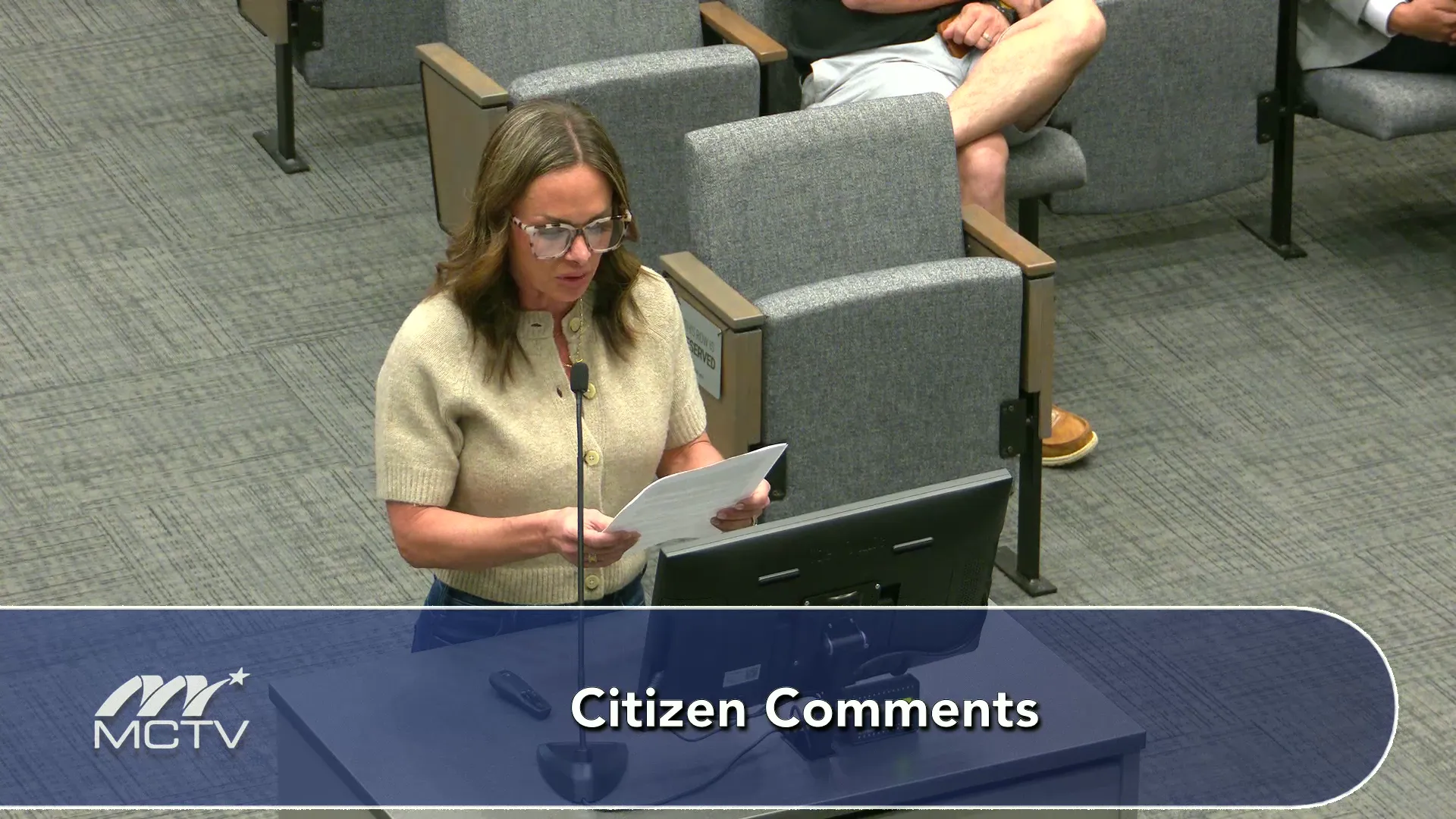
- Melisa Perez (111 Van Worth Street) expressed concerns about political intimidation and retaliation in Mansfield, alleging that Mayor Evans and Council Member Tonore (not present) pressured her small business and threatened her husband's job due to her political activities. She stated that the atmosphere has created a climate of intimidation and that citizens should not fear retaliation for participating in democracy.
- Keziah Farrar (2080 Cannon Drive) spoke regarding Geyer Commons, expressing support for the concept but concern that the city is becoming a landlord to small businesses at a rate of $250 per month, which she argued is below market value and competes with private property owners. She requested that the city (1) prohibit tenants who have had a storefront in Mansfield within the past six months from leasing at Geyer Commons, and (2) adjust lease rates closer to fair market value.
Discussion Items
- Geyer Commons Update: Matt Young (Executive Director of Community Services) reported on the opening weekend (February 27–March 1, 2026): over 8,000 visitors, 12 vendors with over $60,000 in sales, food trucks with nearly $15,000 in revenue. Announced a new spring concert series (Fourth Fridays) and weekly programs (yoga, pickleball, story time).
- Community Engagement Spring Events Update: Tim Roberts (Tourism Manager) highlighted upcoming events, including Arts Week, Pickle Parade, and the city being selected as a base camp team for the 2026 FIFA World Cup, with a match on March 31, 2026.
- Presentation of the 2025 Annual Traffic Contact Report: Police Chief Tracy Aaron presented the report, noting no complaints this year.
- Presentation of the Fiscal Year 2025 Annual Comprehensive Financial Report: Roger Tovar (Whitley Penn) presented the audit, stating an unmodified opinion, no material weaknesses or deficiencies, and a single audit with no findings. The City's net position increased by $25.3 million over FY2024. Council acknowledged acceptance of the report.
Key Outcomes
- Approved Consent Agenda Items (all votes 5-0):
- Ordinance OR-2436-26: Accepting certification of unopposed candidates for Council Places 6 and 7; canceling May 2, 2026 election.
- Resolution RE-4518-26: Authorizing funding up to $261,868.20 for 50th Year Community Development Block Grant; recommending contract to JR West Texas Concrete, LLC for sidewalk improvements ($223,062.00).
- Resolution RE-4519-26: Approving purchase of a Roll-Off Mount Grapple Loader from Doggett Freightliner for up to $436,953.
- Resolution RE-4520-26: Awarding construction contract for 2026 asphalt and concrete crack and joint sealing with Curtco Inc. for up to $350,000.
- Resolution RE-4521-26: Approving construction contract with Pavecon, Ltd. for sidewalk on E. Broad Street near Julian Feild Park for up to $135,590.80.
- Resolution RE-4522-26: Authorizing purchase of 205 W. Broad St.
- Adoption of amendments to Planning and Zoning Commission Rules of Procedure.
- Approval of February 23, 2026 meeting minutes.
- Item 26-1966 Withdrawn: Council voted 5-0 to withdraw the item per staff request.
- Action Pursuant to Executive Session: Council voted 5-0 to authorize the City Attorney to file suit to obtain a Right of Entry to property at 700 West Broad Street against Ragan, LLC, Wildcat Management, and others.
- Public Hearing (SUP25-004): Continued to March 23, 2026 (applicant request). Vote 5-0.
- Public Hearing (SUP25-006): Continued to March 23, 2026 (applicant request). One non-speaker card filed in opposition (Gary Cardinale). Vote 5-0.
Proclamation
- March 2026 proclaimed as "Theatre in Our Schools Month" in Mansfield. MISD administrators and theater students received the proclamation.
Meeting Transcript
Do you have the agenda? I just want to make sure that that's the right one. Thanks my watch. Good afternoon, ladies and gentlemen. I want to call the meeting of Monday, March 9th, 2026 to order at three PM. We'll begin with our work session presentation of standards of cover and community risk assessment by the Center for Public Safety Management. Chief Ross. Thank you very much for including us in your three o'clock session. I'd like to introduce uh, well, as you're as you're aware of several months ago, we commissioned a standards of cover and community risk assessment. Uh that finally has uh reached completion, and Pete Finley, uh associate of the Center for Public Safety Management is here to go over that report with you, and then we're available to answer any questions that council may have after. Sounds good. Pete. Thank you, Chief. Good afternoon. Welcome. Um Mayor Evans. Yes, sir, Mr. Smolinsky, members of council, Chief Ross, Chief Holland, Chief Sullivan. Did I get it right? Close enough. Um thank you for the opportunity uh to do this presentation for you. But even before that, thank you for the opportunity uh on behalf of CPSM, um, Tom Wazurick and Dove Chelst are uh our principal uh stakeholders, Joe Pozo, who heads up the uh fire and EMS division. Uh thank you for the opportunity to do this study and this analysis for the city, and um, you know, present you with this standards uh of cover. So just a little bit of information. Um ICMA uh or CPSM was a division of ICMA, the international city county uh management association. Um it was launched to provide support to public safety entities, police, fire, uh, EMS, uh, emergency management nine one-one centers. Um CPSM can do these types of studies, uh, we can provide training and research to ICMA members, uh, and we represent ICMA in dealings with public safety professional organizations such as the International Association of Fire Chiefs, the National Fire Protection Association, and also on the law enforcement side, a number of organizations that we represent uh ICMA on. Uh in 20 that 2014, um ICMA spun CPSM off uh into a separate company, and we are now the exclusive provider of public safety consulting services for the ICMA. Let's see. And one of the key components of a standards of cover is the community risk assessment piece. Okay. So those two items together basically are analysis tools that are used by fire departments to evaluate and formulate planning initiatives, mitigate risk within the community. Two communities could be very similar in size and population, but they may have two very different risk profiles or risk characteristics because of the nature of those communities. In fact, I was talking to the Chiefs this morning. They had a very interesting and challenging incident earlier today. That's you know something I had never seen before in almost 50 years in the fire and the emergency services. So together, what they do is they align resources, strategies, and performance objectives with those unique risks. We'll see if I can get through it without knocking this off here. Without with the unique risks and needs of the community. So an integrated response management plan basically links the community's identified risk to a safe and effective fire department response force for fire suppression, EMS, and then specialty type of responses. Hazardous materials responses, uh, technical rescue responses, um, if you're in a port community, perhaps shipboard firefighting, all of those things that are necessary to form a comprehensive fire protection and EMS delivery system. So a key component of a standards of cover evaluation is that comprehensive community uh risk assessment. And the community risk factors have an impact on all fire department responses that includes fires, non-fire related EMS responses, and the analysis of that community risk assessment includes components such as the community demographics, community growth, and future development. So we're looking not only at what we have today, but we're looking ahead and trying to stay preferably ahead of the curve of development, but certainly at the very least, to keep up with that development. Natural hazards, uh, transportation networks and hazards, fire management zones, uh, analysis for the types of calls, the demand for those calls, uh, building risks and hazards, um, and hazards that are specific to that particular community. Um the the community risk assessment and standards of cover primary objectives help to ensure that the emergency services are pre-act proactive as opposed to reactive, that they're data-driven, and that they are community focused. All right.
SUMMARIZED BY OPENPUBLICA AI
TRANSCRIPT VIA PUBLIC VIDEO
openpublica.com
openpublica.com