Monroe City Plan Commission Meeting - TID Workshop and Zoning Updates - August 12, 2026
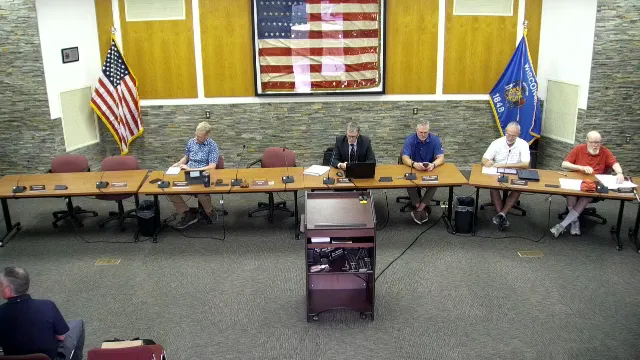
STREAMING COPY IN PREPARATION — RECORDING AVAILABLE FROM THE ORIGINAL SOURCE
Monroe City Plan Commission Meeting - TID Workshop and Zoning Updates - August 12, 2026
The Monroe City Plan Commission met on August 12, 2026, at 5:00 PM at City Hall Council Chambers. The meeting included a TID 101 workshop presented by Ehler's, followed by discussions and recommendations on a certified survey map for Cheese Louise, an ordinance update for in-home daycare, and the adoption of a public participation plan for a comprehensive plan amendment. All three business items received unanimous recommendations to the Common Council.
Discussion Items
-
TID 101 Workshop: Greg Johnson from Ehler's presented a comprehensive overview of Tax Increment Financing (TIF) and Tax Increment Districts (TIDs). Key points included: the city is currently at 6.21% of the 12% statutory value limitation, allowing room for new districts; the mechanics of TIDs including base value, incremental value, and the "but for" test; the roles of the Plan Commission, Common Council, and Joint Review Board; and recent legislative changes effective October 1, 2026, creating a new Residential TID for owner-occupied single-family and duplex units with strict lot size and setback requirements, prohibiting TIF funding for land acquisition or home construction. The affordable housing extension was also increased from one to two years. The presentation served as a reference for future TID proposals.
-
Certified Survey Map (CSM) for Cheese Louise: The city's DPW presented a CSM to combine four lots on the north side of 30th Street between 9th and 11th Avenue into one parcel for future development, leaving the Mineral Engraving site as a separate lot. The zoning is compatible. A motion to approve was made and seconded.
-
Ordinance Repealing and Recreating Zoning Code 5-2 Regarding In-Home Daycare: Administrator Rindy explained that state licensing now allows up to 12 children (previously 8) subject to space requirements. The proposed ordinance updates the definition and allowed number from 4–8 to 4–12 children, and changes the CMU district from a conditional use to a permitted use to align with state law and avoid potential conflicts. A motion to recommend approval to the Common Council was made and seconded.
-
Comprehensive Plan Amendment Public Participation Plan: Shannon Hayden from Vandewalle & Associates stated that a rezoning request requiring a future land use map amendment initiated this step. The public participation plan outlines how public testimony will be taken and allows for future amendments without repeating this step. The resolution to adopt the plan and recommend it to the Common Council was moved and seconded.
Key Outcomes
- C.2 Certified Survey Map for Cheese Louise: Motion to approve passed unanimously (Voice vote: Ayes – Schaefer, Spielman, Wartenweiler, Duff, Markham). The recommendation will move to the Common Council.
- C.3 In-Home Daycare Ordinance: Motion to recommend the ordinance to the Common Council passed unanimously (Roll call: Spielman – aye, Wartenweiler – aye, Duff – aye, Markham – aye, Schaefer – aye). The Council will set a public hearing.
- C.4 Comprehensive Plan Amendment Public Participation Plan: Motion to approve the resolution and recommend to the Common Council passed unanimously (Roll call: Wartenweiler – aye, Duff – aye, Markham – aye, Schaefer – aye, Spielman – aye). The public hearing on the amendment is scheduled for September.
- The TID 101 workshop was informational; no vote was taken.
Business Presented by Members
No additional business was presented. The meeting adjourned with a motion and second.
Meeting Transcript
It's uh five o'clock. I'd like to call the Monero City Planning Commission to order if the administrator would call a role, please. Yes, Mayor Miller. Alder Schaefer. Here. Ron Spielman. Dave Hortonweiler. Here. Jesse Duff. Here. Louis Armstrong. And Ron Markham. Here. Okay, we have quorum. Any correction of the minutes from July 8th, 2026. Hearing none, we'll move on to the business. C1 TID 101 workshop by Ailers. Planning Commission and Common Council members. Yes, so we have Greg Johnson here with others to kind of give uh an overview of TIDS for everyone. Good afternoon. Included in the packet was our TID presentation. Just want to say there's a lot of content in there. This is really intended to be a reference guide for future as you need it. TIFFs, there's a lot of detail involved with TIFF district, so we just wanted to provide some a comprehensive resource, but I I'm not gonna dwell on on all the content. We'll just kind of give it an overview. But appreciate the opportunity to be here this afternoon. So we'll kind of start with what uh taxicramal financing districts is and how the tool is used. So you'll hear two terms used kind of interchangeably. So first is TIFF, which is taxicromal financing. That refers to the term and the tool that is defined in statute, which I'll talk about this afternoon. And then you'll refer to a TID, which is a tax accrement district. That's specifically where the tool is deployed in a particular community. So a taxicremel finance district is is it's really an economic development tool that is used by municipalities to help promote development or redevelopment within a defined geographic area. And how a TIF district works financially is when a TIFF district is created, you'll identify a an area where you want to uh use taxocromal financing that is called the TID district. And all the properties within that TIF district have a taxable value at the time the district is created. That is called the base value of the district. So all the taxing jurisdictions, the city, the county, the school district, the technical college, all continue to clear cluck their share of tax revenue on that existing value, just like they would do prior to a TID district being created. And so that that base value, there's no loss of tax revenue from what was collected at the time the district was created. The financial benefit of a TIF district occurs when that value within the district's boundary increases, whether that's due to new construction, a redevelopment project, appreciation, or a combination of a multiple multiple of those factors. That increase in value is called the incremental value, and the city retains the taxes collected on all of that incremental value. And when the TIF district remains open either for its maximum life or recovers and enough revenue to pay for all of its project costs, the TID district closes, and all that value returns to the tax rolls. So really what the TIFF district is it's a financial partnership uh between the city and the other taxing jurisdictions because the county, the school district, and the technical college, when a TIFF district is TIFF district is created, they are agreeing to forego their share of tax revenue on that increase in value, that incremental value with the expectation that that investment of those tax dollars is gonna result in valuation increases that would not occur but for the use of the TIFF district. So it's really that long-term partnership that at the end when the district closes or reaches the end of its maximum life, there's going to be more taxable value there than there would have been if the TID had not been utilized. And then when the district closes, all the taxi jurisdictions benefit is all that uh taxable value returns to the tax rolls. So a SICBO example, if you had four parcels, the cumulative value of those parcels was five million dollars. That's the base value. Over time, that value increases to 15 million. So the incremental value is 10 million dollars, the difference between the increase and the base, the uh 10 million of incremental value gets returned to the tax rolls, and the TID closes, all the tax insurance sections go back to collecting their share of tax revenue. So, really the financial benefit of a TIFF district is you can capture tax revenue from a defined geographic area, take revenue from development and redevelopment projects, and use that tax revenue directly, invest back into infrastructure or other projects necessary for that development to materialize. Before I keep going on, those are kind of the financial fundamentals of a TID.
openpublica.com