Transportation and Environment Committee Meeting on Bill 2-26 – March 9, 2026
STREAMING COPY IN PREPARATION — RECORDING AVAILABLE FROM THE ORIGINAL SOURCE
Transportation and Environment Committee Meeting - March 9, 2026
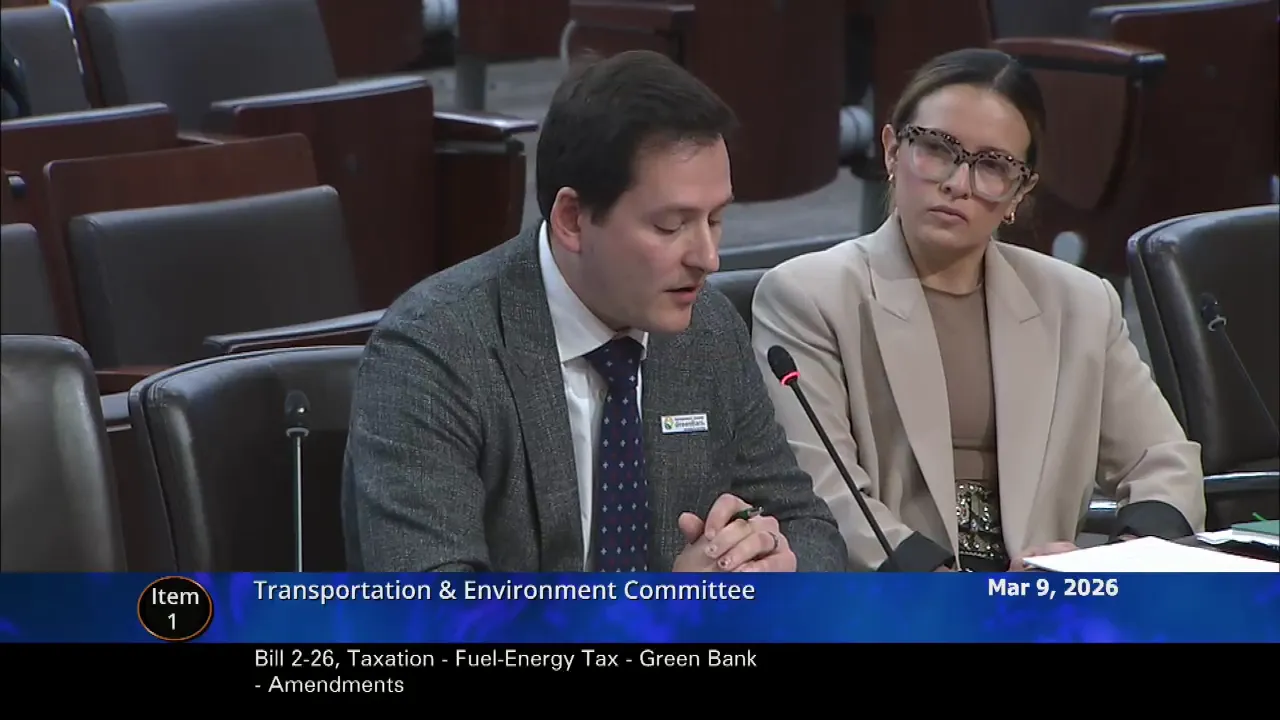
The Montgomery County Council's Transportation and Environment Committee met on March 9, 2026, from 10:00 a.m. to 10:13 a.m. to consider Bill 2-26, Taxation - Fuel-Energy Tax - Green Bank - Amendments. The committee unanimously recommended enactment of the bill, which would allow the Montgomery County Green Bank (MCGB) to use fuel-energy tax revenue for climate resilience activities, in addition to its current uses of promoting investment and financing clean energy technologies.
Public Comments & Testimony
- At the prior public hearing, testimony was largely in favor of the bill, though not numerous.
- The Sierra Club questioned the cost-benefit analyses that might flow from the legislation.
- Councilmember Luedtke noted that some testimony suggested the bill should only support one type of project, but she emphasized that both resilience and green energy projects must move forward simultaneously.
Discussion Items
- Councilmember Dawn Luedtke, lead sponsor, described the bill as a continuation of the work establishing the Green Bank and its fund, enabling projects such as replacing cooling equipment, adding battery backups, installing flood mitigation, rain gardens, green roofs, and permeable pavement. She noted existing MCGB partnerships with multifamily buildings, faith institutions, and Habitat for Humanity.
- Legislative Attorney Ogorzalek summarized the staff report: the bill removes a statutory restriction on fuel-energy tax revenue use, allowing it for resilience activities. The fiscal impact is none because the county appropriation to MCGB is unaffected; the climate assessment is net positive; the racial equity and social justice statement is indeterminate; and the economic impact is likely neutral in the short term with potential net positive long-term impact.
- MCGB CEO Mr. Morel described the Green Bank's "Protecting the Path to Net Zero" resilience and adaptation strategy, which includes physical and energy resilience tracks and four implementation pathways: packaging solutions, piloting programs, organizing frameworks, and long-term implementation channels. He cited examples such as high-performance new construction, condo retrofits (sewer lines, exterior hardening, EV readiness, cooling towers, new HVAC, flood mitigation, battery backup), and a climate-smart agriculture pilot. He also highlighted a resilience dedicated fund for affordable multifamily housing using an innovative corporate line-of-credit structure.
- Chair Evan Glass noted the importance of local action given diminished federal leadership on green infrastructure, stating "our climate resilience is in our own hands these days."
- Councilmember Marilyn Balcombe expressed appreciation for the agricultural projects she saw on a bus tour, saying the bill would allow that work to move forward in a bigger way.
Key Outcomes
- The committee voted unanimously to recommend enactment of Bill 2-26 as introduced.
- The bill will proceed to full Council action, tentatively scheduled for March 17, 2026.
Meeting Transcript
Good morning, everybody. Welcome back to the Transportation and Environment Committee. We have one item on the agenda today, and that is Bill 226 Taxation Fuel Energy Tax Green Bank amendments, which was introduced on January 20th by Councilmembers Don Ludke, Andrew Friedson, and myself. This bill would allow the Montgomery County Green Bank to use revenue received from the fuel energy tax resilience activities, in addition to currently allowed uses of promoting investment and providing financing for clean energy technologies. This means that more investments to help our communities prepare and adapt for the impacts of climate change and extreme weather, which we are seeing on a daily basis. And it also could include projects that strengthen energy reliability during outages, support community resilience hubs, and help buildings better withstand flooding or extreme heat. The goal here is to give the green bank the flexibility to finance projects that not only reduce emissions, but also help residents infrastructure and our local economy. And with that, I'll turn it over to the lead bill sponsor, Councilmember Ludke for a few more words. Thank you, Chair Glass, and thank you for your co-sponsorship of this, along with Councilmember Friedson. And this is, I view just as a continuation of the solid work that has already been done in getting the green banks set up and getting things moving along and creating this fund in the first place. And now allowing it with the passage of this bill. Can we get it across the finish line? So that we can allow the green bank to do the work that it already has a strategy for, because I want to be clear. They already have a thorough and comprehensive resilience and adaptation implementation strategy that targets exactly these types of products, how they can finance and fund resiliency project projects like replacing cooling equipment, adding battery backups, um, installing flood mitigation, rain gardens, green roofs, permeable pavement. And all of these things, too. I want to I want to emphasize, because there was some testimony at the public hearing that we should only do X and not X and Y, right? We must do both at the same time. And in doing resiliency projects, you can also do them in green ways, which again reduce energy consumption, focus on renewable energy sources, and do them strategically and methodically while dealing with the present crises our residents are currently facing. And I know that the Green Bank has already been doing some of these projects with multifamily buildings, faith institutions in partnership with Habitat for Humanity. Um this just allows us to have some more flexibility in the types of things that people can go to the Green Bank in order to bring to life, and it will be to the benefit of our community as a whole. With that, I turn it back to the chair. Thank you very much, Councilmember Ludke. Uh, I'd like to invite Mr. Morel up as well. But and as you're approaching um Mr. Gorazalek, uh any additional comments on your end? Uh no, it's I'll just note that the staff packet itself sets forth the the history that got us from the formation of the green bank in 2015 to where we are presently prior to enactment uh or prior to consideration, introduction consideration of this bill that that Councilmember Ludke alluded to, that the path to where we got where the fuel energy tax 10% is being provided through uh annual appropriations as codified um in law and and that there was an in a an expansion of the green bank's uh activities to include resilience, and that when that occurred, there there was a restriction. So the bill itself is very, very brief. It really just removes a restriction on the use of those funds as Chair Glass indicated and and allows, makes an express uh allow um allowance for the green bank to use the fuel energy tax revenues for resilience activities. Um I'll also just briefly touch on the public statements. Um, the uh climate, uh sorry, the fiscal impact indicated no um impact. That is because the amount that is going from the county to the green bank is completely unaffected by this bill. It only allowed it only touches on the ability of the green bank and its uses of those funds. Uh the climate assessment uh indicated a net positive for the county in reaching its uh climate objectives. The racial equity and social justice statement was indeterminate, and the economic impact noted probably a neutral impact in the short term, but a possibility for a net positive economic impact in the long term. The public hearing, there were not a significant number of speakers. Those who testified were largely in favor, as Councilmember Lukey indicated, there was one set of testimony from the Sierra Club wondering about some of the cost-benefit analyses that may flow from this legislation. Appreciate that and the straightforward nature of the legislation and want to extend my appreciation, our appreciation to the green bank and the leadership of the green bank, recognizing that there were funding challenges in the current budget as proposed by uh and drafted by the county executive. Uh and then also there are macro funding challenges with the green greenhouse gas reduction fund expectations, um national leadership, which has completely dissipated. Uh I mean, we are literally invading other countries to take their oil, and they are not investing in green infrastructure and uh helping us make those investments, which is why it's important for us uh to take everything into our own hands and to be creative. And I know the green bank and the board of directors and and staff have been very creative. Uh and while this is one policy solution, there are others that many of us are pursuing to figure out how do we make that happen. Um those are a little more challenging. Uh but uh this one uh is uh right in front of us. And uh I'll turn it over to Mr. Morel if you want to introduce yourself and just share how you plan to deploy these newly uh received funds that you will expect to get. I'll certainly. Well, thank you very much, Chair Glass. I appreciate the opportunity to join this morning. Uh I'm joined by my colleague uh Laura Mondragon, who's our senior director for climate resilience, uh, who we brought on when we brought on the strategy, as uh Councilmember Ludke alluded to.
openpublica.com