Browse by city
Date range
Search help

Search titles, summaries, topics and stored transcripts together. Keywords may match separately; put the whole query in double quotes for a phrase. Matching follows word analysis, so punctuation is not exact. Both dates are included. Documents are not searched.

SHOWING 1–10 ENTRIES
01
NEWOCT 29, 2026 · MONTGOMERY COUNTY, MARYLAND · COUNTY COUNCIL & COMMITTEES
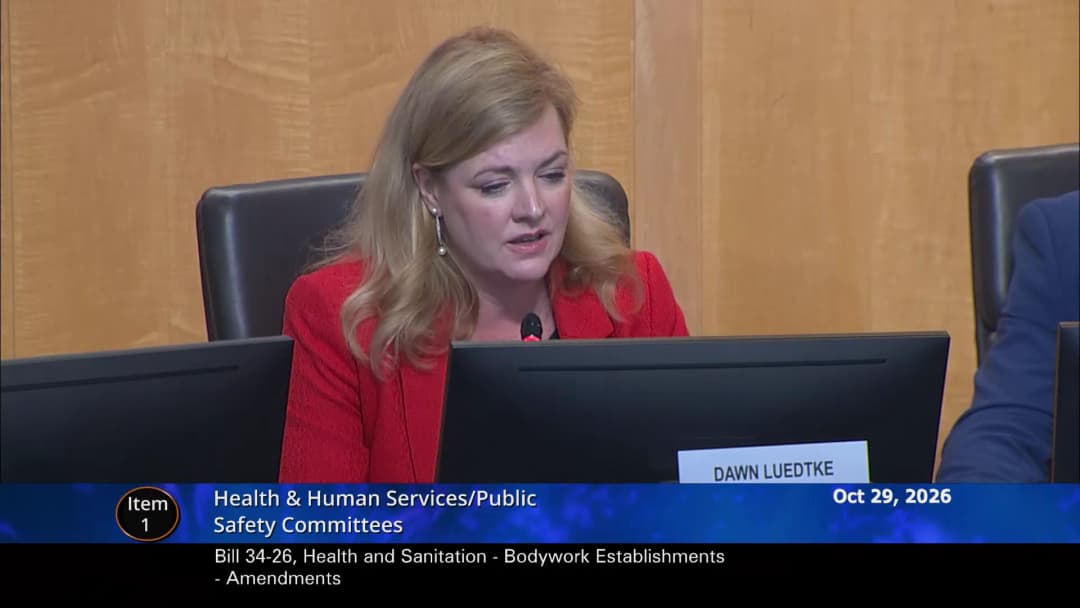
Joint HHS/PS Committee Work Session on Bill 34-26 (Bodywork Establishments) - October 29, 2026

The Health and Human Services (HHS) and Public Safety (PS) Committees met jointly on Thursday, October 29, 2026, to discuss Bill 34-26, which amends regulations for bodywork establishments to close loopholes that allow individuals affiliated with problematic establishments to open new ones. The meeting included a staff presentation, discussion of amendments, and a final vote. Discussion Items - Bill Overview: Mr. Ogorzalek presented Bill 34-26, which defines corporate officer and business manager roles, prohibits issuance of a license to establishments where such individuals have pending adjudication or prior violations, and requires reporting to cross-check applicants. The bill aims to prevent individuals who have faced enforcement at one bodywork establishment from opening another in the county. - Amendment 1 (Probation Before Judgment): Offered by Councilmember Luedtke, this amendment adds probation before judgment (PBJ) as an adjudicatory posture that would disqualify an individual. The committee approved this amendment by acclamation after a technical correction to reference the Criminal Procedure Article. - Discussion on Prostitution-Related Offenses: The committee debated three options to modify the list of disqualifying crimes: - Option A: Remove the STET docket from disqualifying adjudicatory postures. - Option B: Remove the specific crime of prostitution/assignation (Md. Crim. Law §11-303) from the disqualifying crimes. - Option C: Remove all prostitution and related crimes from the disqualifying list. - Option D: Leave the bill as currently drafted (including prostitution-related crimes). Councilmember Mink argued that sex workers are often victims and should not be further penalized, especially since many would be on the STET docket and could face barriers to economic advancement. Councilmember Luedtke and Councilmember Sayles countered that the bill targets ownership/management, not employment, and that the nexus between prostitution offenses and bodywork establishments justifies inclusion. Detective Dizinkowski from the Vice and Intelligence Unit provided an example of a manager charged with prostitution-related offenses in a trafficking case. Councilmember Luedtke also noted that once a STET docket expires, the charge no longer applies, so the prohibition is temporary. - Amendment to Clarify STET Docket Language: Councilmember Luedtke moved to amend the bill to clarify that the prohibition applies only while a charge is currently under disposition on the STET docket, not after it expires. The committee approved this amendment unanimously. - Vote on Option B: A motion to adopt Option B (remove prostitution from disqualifying crimes) failed 2-3. - Final Vote on Bill 34-26 as Amended: The committee voted 3-2 to approve the bill with the amendments (including the STET clarification). Key Outcomes - Amendment 1 (Adding PBJ): Approved by acclamation. - Amendment on STET Docket: Approved unanimously (5-0) to change language to apply only during the pendency of the STET. - Motion to Remove Prostitution (Option B): Defeated (2-3). - Final Bill Vote: Bill 34-26 as amended passed 3-2. The bill will now move to the full County Council for consideration. - Next Steps: Councilmember Sayles noted that the Department of Permitting Services has raised related issues for future consideration. Staff will provide data on the 46 currently licensed establishments and communication plans for affected businesses.

HUMAN TRAFFICKING PREVENTION 83% · LEGAL AFFAIRS 13% · PROCEDURAL 4%
02
NEWOCT 29, 2026 · MONTGOMERY COUNTY, MARYLAND · COUNTY COUNCIL & COMMITTEES
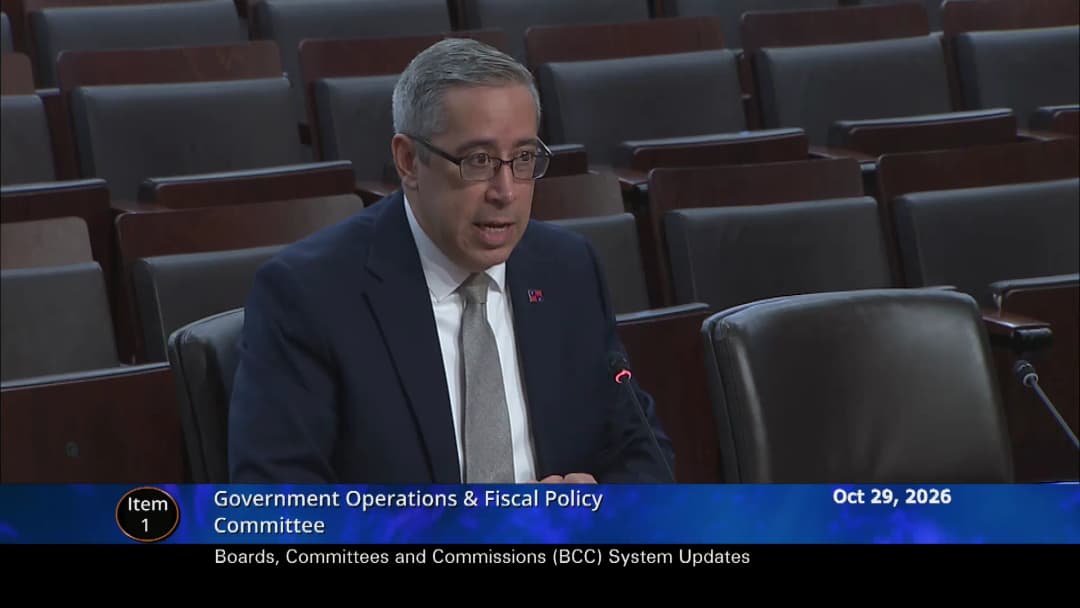
Montgomery County GO Committee: BCC Update and Tax Credit Bills, October 29, 2026

The Montgomery County Council's Government Operations and Fiscal Policy (GO) Committee met on October 29, 2026, in a scheduled 9:30 a.m. – 12:30 p.m. work session in Room 3CHR at the Council Hearing Room, Rockville, Maryland. Committee members present were Chair Kate Stewart, Councilmember Sidney Katz, and Councilmember Shebra Evans. The committee reviewed the county's boards, committees, and commissions (BCC) system and considered amendments to three tax-credit bills. All three bills were recommended unanimously to the full Council, each with amendments. Boards, Committees, and Commissions (BCC) System Updates - Assistant Chief Administrative Officer Ken Hartman Espada and BCC staff briefed the committee on progress since the February 2026 Committee Evaluation and Review Board (CERB) report, including a new draft BCC manual that had just completed County Attorney review. - The administration highlighted successful recruitment changes, including evergreen vacancy advertisements, and noted the system supports roughly 1,400 volunteer BCC members. It proposed a stronger community-engagement strategy, clearer reporting pathways, annual reports, more equitable recruiting, possible stipends or other participation incentives, standardized department support and training, performance metrics, and annual feedback questionnaires. - The Conflict Resolution Center of Montgomery County has agreed to pilot facilitation and evaluation work with several boards. - Chair Stewart recommended that staff prepare a next-steps and timeline memo for the incoming county administration so the work is not lost during transition. Councilmember Katz urged flexibility in advertising while warning against public perceptions that the county is hiding something. Councilmember Evans asked how board feedback is acknowledged; Mr. Hartman Espada described the reply process and noted boards, committees, and commissions cannot lobby in Annapolis. No vote was taken. Bill 46-26: Taxation – Child Tax Credit – Supplemental Grant - Co-led by Chair Stewart and Councilmember Evans, this bill would create a county child tax credit supplement of up to $500 per qualified child, enabled by state legislation. A qualified child is a dependent under age 6, or under age 17 with a disability. - The credit would be full for taxpayers with federal adjusted gross income below $15,000 and then phased out. The committee accepted two clarifying amendments: one specifying the phase-down amount as $50 per additional $1,000 of income, and another cross-referencing state definitions for “resident” and “place of abode.” - Councilmember Katz voiced support, citing workforce participation and the local economic multiplier effect. The committee voted unanimously to recommend the bill, as amended, to the full Council. Bill 47-26: Homeowners Property Tax Credit – County Supplement – Amendments - The bill would expand the county’s homeowners property tax credit supplement by raising gross income eligibility from $75,000 to $106,800 and, under the adopted amendments, increasing the maximum assessed home value considered in the calculation. - Council staff explained that the bill as introduced would have produced almost no benefit for newly eligible households. The committee adopted amendments replacing the new tranche percentages with 7.5% and 8%, adjusting the existing top tranche to 7%, and increasing the maximum assessed value from $375,000 to $500,000. Because of the credit’s counterintuitive calculation, these lower percentages produce a larger benefit. - A second amendment made CPI-related technical adjustments, including updating the combined net-worth limit to $255,400. A third amendment provided a transition clause applying the revised credit to the tax year beginning July 1, 2027, while preserving required annual CPI adjustments. - The Department of Finance estimated that, if all eligible households take advantage of the credit, the amendments could cost the county between $5 million and $8 million per year: about $2.5 million to $3 million for existing recipients and $2.5 million to $5 million for new recipients, with about 2,600 potential new households. The committee voted unanimously to recommend the bill, as amended. Bill 48-26: Property Tax Credit – Public School Employees - The bill would establish a $2,500 county property tax credit for full-time Montgomery County public school employees, modeled on the existing credit for public safety employees, to help educators, bus drivers, cafeteria workers, and other school staff own homes and live in the county. - Council staff recommended, and the committee accepted, an amendment clarifying that employees must be full-time. The committee also agreed to prepare a later amendment adding a small group (likely under 30 employees) who are not in either of the two main bargaining units, based on Board of Education feedback. - A technical amendment was adopted to remove language allowing eligibility based on an intent to occupy the home, requiring the employee to actually occupy the qualifying property for at least nine months during the taxable year. Finance clarified that the school employee must be listed on the title; joint ownership with a non-school employee does not disqualify the credit; and only one credit is available per property. - The Department of Finance testified that, using MCPS address data and limiting the analysis to full-time employees, the estimated fiscal impact falls to roughly $20 million to $23 million, compared with $25 million to $30 million originally; the data identified roughly 8,000–9,000 full-time teacher-owned properties. Chair Stewart noted that the parallel public-safety credit has had about 80–85 percent uptake, so actual costs may be lower. Councilmember Evans emphasized that the intent is to improve homeownership opportunities for Black and Latino educators, despite the racial equity impact statement indicating a potential negative effect. The committee voted unanimously to recommend the bill, as amended. Public Comments & Testimony - No oral public testimony appears in the work session transcript. Staff referenced testimony from earlier public hearings: the Bill 46-26 staff memorandum included a summary of public testimony; Bill 47-26 testimony was broadly in support with some opposition; and Bill 48-26 public testimony informed the technical amendment requiring actual occupancy. Key Outcomes - BCC update: No vote. The committee asked the executive team to prepare a transition memo with next steps and a timeline for the incoming administration. - Bill 46-26: Two clarifying amendments adopted; unanimous recommendation to the full Council. - Bill 47-26: Three amendments adopted; unanimous recommendation to the full Council; estimated annual cost of $5 million–$8 million if all eligible households participate. - Bill 48-26: Full-time and occupancy amendments adopted; an additional bargaining-unit amendment to be drafted; unanimous recommendation to the full Council; updated fiscal estimate of $20 million–$23 million.

TAXATION 33% · COMMUNITY ENGAGEMENT 27% · PUBLIC EDUCATION 18% · PERSONNEL MATTERS 7%
03
NEWOCT 29, 2026 · MONTGOMERY COUNTY, MARYLAND · COUNTY COUNCIL & COMMITTEES
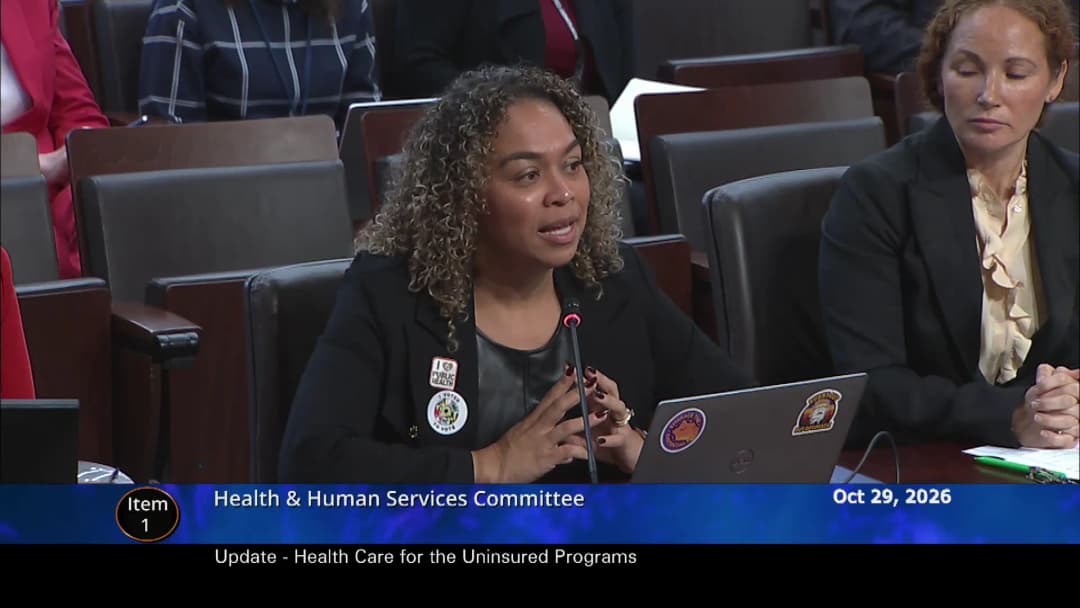
Montgomery County HHS Committee Reviews Uninsured Care and H.R.1 Impacts on Oct 29, 2026

The Health and Human Services (HHS) Committee of the Montgomery County Council met on October 29, 2026, from 2:00 p.m. to 4:30 p.m. to review updates on health care programs for the uninsured and the implementation of H.R.1, focusing on October Medicaid eligibility changes. Chair Laurie-Anne Sayles led the session, with Councilmembers Andrew Friedson and Dawn Luedtke participating. Staff from the Department of Health and Human Services (DHHS) and the Primary Care Coalition (PCC) presented data and fielded questions. No formal votes were taken; the committee instead identified follow-up actions and priorities. Health Care for the Uninsured Programs - Dr. Nina Ashford, Chief of Public Health Services, presented an overview of three programs: Montgomery Cares (adults), Care for Kids (children), and the Montgomery Perinatal Program (formerly Maternity Partnership). The programs are funded by Montgomery County and administered by PCC, except the perinatal program, which is county-run. - Dr. Veronica Vella, Senior Director of Healthcare Access at PCC, provided utilization data: - Montgomery Cares encounters increased from 61,000 in FY23 to 82,000 in FY26. The county pays a rate of $130.82 per encounter in FY27. - Care for Kids enrollment declined from 3,928 to approximately 3,000 between 2025 and 2026. Dr. Vella attributed this to parents' fear of visiting government offices due to the political climate and the loss of a community health worker program (Point of Entry) that helped enroll children during school registration. - Average appointment wait time across the network is 10.5 days, ranging from 1 to 21 days; the longest waits are at Federally Qualified Health Centers (FQHCs). Wait times have been consistent over the past few years. - Quality metrics show high performance in hypertension control (99.7%) and diabetes A1C testing (90.4%), but lower rates for breast cancer screening (only women 45+ are covered) and diabetic retinal exams. PCC recently added retinopathy screening at two practices. - Behavioral health services, funded by a supplemental appropriation, served over 2,000 patients, including case consultations for 475 and social needs support for over 400. - The Montgomery Perinatal Program served 1,870 clients in FY26, a 20% increase from 1,500 in FY25. The first quarter of FY27 was strong with 480 clients. The program is transitioning to an integrated “One MCH” model to align with the 2025 OLO report on racial disparities. - Councilmembers raised concerns about declining enrollment in Care for Kids and the impact of clinic access barriers. Dr. Vella noted clinics have adapted by rearranging wait areas and increasing telehealth use. Councilmember Friedson requested comparison data on FQHC wait times versus national standards, and asked whether wait times are business or calendar days. - Councilmember Sayles asked about outreach and coordination with community partners such as VITA and libraries. Staff committed to sharing the new client guide and to reach out to VITA. H.R.1 Implementation - Tara Clemons Johnson, Council staff, reviewed the policy changes. State data indicates 1,082 Montgomery County residents have lost Medicaid eligibility due to H.R.1 changes, down from earlier estimates of 4,000. The county estimates 700–1,200 may be affected. County-wide, an estimated 33,000 Temporary Protected Status (TPS) holders will lose ACA subsidy eligibility beginning January 2027, with most residing in Montgomery and Prince George's counties. - Sean Gibson, Health Insurance Manager at OESS, described mitigation efforts: referral to Montgomery Cares, Care for Kids, and Qualified Health Plans (QHP) during open enrollment (November 1 through January 15). He highlighted the new rule eliminating the cap on advanced premium tax credit repayments, which could cause large tax bills. Refugee medical assistance will expand from 8 to 12 months in January. SSI recipients will face new immigration-related eligibility requirements starting January. - Dr. Patrice McGee, Chief of Aging and Disability Services, reported nine county residents lost Medicaid waiver services (emergency Medicaid waivers) as of October 1, affecting their home-based care and residential support. She noted DDA has not provided continuity plans or funding; county providers are trying to fill gaps, but a supplemental appropriation is being requested. - Yvonne Iskandry of OESS discussed SNAP changes: work requirement age range expanded from 18–54 to 18–64, and veterans and foster youth under 24 are no longer automatically exempt. The county is helping recipients comply, and so far few have lost benefits in October. - Councilmember Luedtke expressed concern about the lack of proactive planning by DDA, and questioned the adequacy of work requirement exemptions for people with disabilities. Staff affirmed that individuals with disabilities may be exempt if they provide medical documentation. Key Outcomes - Staff agreed to provide follow-up data comparing the county's 10.5-day average appointment wait time with state and national benchmarks for FQHCs and other systems, and to clarify whether the wait time is in business or calendar days. - The committee will receive updates on the supplemental appropriation requests, including those for the Montgomery Perinatal Program (nurse and health educator positions) and support for individuals who lost waiver services. These supplementals are scheduled for committee consideration on November 18. - Councilmembers requested continued coordination with community partners, including VITA and libraries, to disseminate information about coverage options and safety net programs. - Future reports will include outcomes of the new reproductive health services program and further analysis of Care for Kids enrollment trends.

HEALTHCARE ACCESS 52% · PUBLIC HEALTH 35% · FOOD SECURITY 11% · YOUTH PROGRAMS 1%
04
OCT 27, 2026 · MONTGOMERY COUNTY, MARYLAND · COUNTY COUNCIL & COMMITTEES
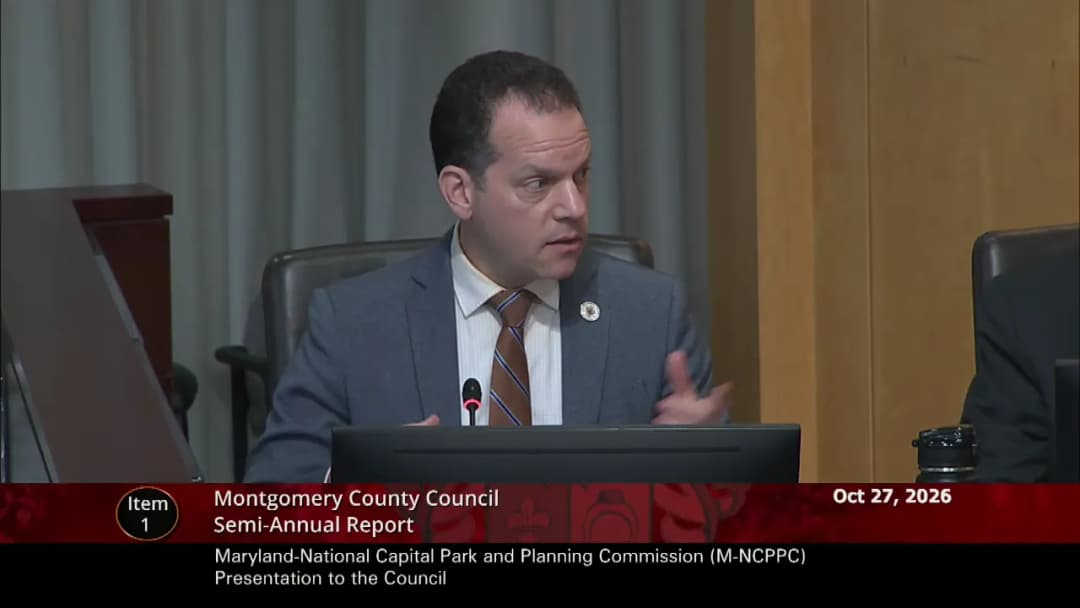
Montgomery County Council Session: Proclamations, Census Resolution, Solid Waste Worksession - October 27, 2026

The Montgomery County Council met on Tuesday, October 27, 2026, in Rockville for a full-day session that opened with proclamations and included the M-NCPPC semi-annual report, a resolution opposing proposed federal census changes, multiple public hearings and supplemental appropriations, the District Council's final zoning actions of the term, worksessions on state priorities and long-term solid waste disposal, and an 11-item consent calendar. Proclamations - Presented a proclamation celebrating Hindu American Heritage Month; speakers highlighted the county's Hindu community and called for continued inclusion, including recognition of Diwali as an MCPS school holiday. - Presented a Domestic Violence Awareness Month proclamation with County Executive Elrich and Councilmember Katz; speakers cited domestic violence statistics and services at the Family Justice Center and Trauma Services. - Presented a National Bullying Prevention Month proclamation led by Councilmember Evans and MCPS students; MCPS staff emphasized prevention, reporting, and support systems. - Presented a National HealthCare Quality Week proclamation honoring Casa Rubén Foundation and American Diversity Group for expanding culturally responsive care to underserved residents. M-NCPPC Semi-Annual Report - Commission Chair Artie Harris, Parks Director, and Planning Director presented the fall 2026 semi-annual report of the Maryland-National Capital Park and Planning Commission. - Parks survey results: 84% of residents regularly use parks, 62% visit weekly, and 72% are satisfied; parks ranked second only to public safety as a community priority. - Planning reported on master plan support funding, implementation of its strategic plan with 12 actions complete and 100 currently underway, and staff awards. - Council members thanked staff, raised planning academy and OZAH inclusion, trail lighting, accessibility, and coordination/efficiency concerns. General Business and Census Resolution - Announcements: two consent items were postponed: MCPS Bus Depot and Maintenance Relocation and Fenton Street Cycletrack. - The Council suspended Rule 7(d) and adopted a resolution opposing proposed federal changes to the 2030 Decennial Census, voting 11-0. The resolution cites constitutional apportionment concerns, impacts on foreign-born residents, and the removal of demographic questions; comments were due November 2, 2026. Public Comments & Testimony - Debbie Spielberg, special assistant to the County Executive, supported Expedited Bills 49-26 and 50-26, saying additional assistant chief administrative officers and appointed deputy/executive directors would improve accountability. - Fire Chief Corey Smedley supported Bill 50-26 for clearer leadership accountability and public safety. - Former Deputy County Attorney Edward Lattner proposed an amendment to retain a dual executive-council removal check for the deputy county attorney, paralleling the county attorney charter protection. - Cheryl Gannon and Linda Nemick supported Bill 50-26 as good-government improvements with council confirmation. - Michina Foster, chair of the Commission for Women, supported Bill 50-26 with an amendment to keep the commission's executive director in the merit system. - Monty Gingery urged rejection of both bills, warning that converting merit positions to political appointments would reduce accountability and invited comparisons to past corruption cases. - Esther Wells strongly opposed both bills, citing missing fiscal and racial equity impact statements, lack of constituent engagement, and concerns about expedited procedures. - A former congressional candidate, JD Kumar, gave disorderly and unrelated testimony and was cut off; Councilmember Mink later condemned the hate speech and expressed support for Council President Fani-González. Public Hearings and Supplemental Appropriations - Supplemental Appropriation 27-8 ($4,530,830 state grant, Utilities Non-Departmental Account) was adopted 11-0 after a closed hearing. - Supplemental Appropriation 27-17 ($623,094 DGS Energy Conservation; $210,182 Silver Spring, $45,455 Wheaton, and $496,308 Bethesda parking facility renovations) was adopted 11-0. - Public hearing held on Supplemental Appropriation 27-7 ($100,000, Labor Management Relations Committee); record remains open until November 12, 2026. - Public hearings held on Expedited Bill 49-26 (County Executive non-merit positions) and Expedited Bill 50-26 (non-merit deputy/executive directors); records remain open until November 6, 2026, with GO Committee worksessions scheduled for November 13, 2026. Other Actions and District Council Session - WSSC Water FY28 spending control limits were approved 11-0; the Transportation, Environment Committee recommended a 7% rate increase scenario, compared with Prince George's County's 5% action. - Acting as the District Council, the Council enacted Zoning Text Amendment 26-10, Subdivision Regulation Amendment 26-02, and Zoning Text Amendment 26-11, each by 11-0. ZTA 26-11 includes amendments adding public safety agency notice and a minimum seven-day notice requirement. Worksession: State Priorities Letter - The Council reviewed the draft 2027 state priorities letter with county executive recommendations. - Members requested revisions, including changing "could affect" to "will affect" for demographic questions, adding permanent housing, health impacts, child care workforce and affordability language, DDA functionality, and ADA-accessible transportation infrastructure. - An updated draft is expected by Monday, with action scheduled for November 10, 2026. Worksession: Long-Term Solid Waste Disposal Alternatives - Council staff presented environmental, environmental justice, community impact, waste diversion, and cost analyses for the binary choice: keeping the Resource Recovery Facility (RRF) open long-term or closing it and long-hauling waste to out-of-county landfills. - The County Executive's proposal assumes long-haul with advanced waste processing; cost estimates depend on many unknowns, including RRF capital costs, landfill contracts, AWP feasibility, and future waste volumes. - Staff projected average annual base system benefit charge increases of 4.3 to 4.8% for single-family homes under the options considered. - Two resolutions were introduced on the consent calendar for consideration on November 10th; Council President stated the resolutions would be revised with stronger language prioritizing racial equity and minimizing environmental and health impacts. Consent Calendar - The consent calendar was approved; the unofficial session summary records 10 yes votes. - Items included introduction of a resolution on long-term solid waste disposal, introduction of MCPS categorical transfers ($12,600,000), confirmation of Acting Directors Thomas Dant and Naddia Clute, approval of the 2026-2035 Comprehensive Water Supply and Sewerage Systems Plan, and confirmation of appointments Darniel Dorsey and Shakirra Haynes. - Two postponed consent items were not acted on: MCPS Bus Depot and Maintenance Relocation and Fenton Street Cycletrack. Key Outcomes - 11-0 votes: census opposition resolution, Supplemental Appropriations 27-8 and 27-17, WSSC spending control limits, and ZTA 26-10, SRA 26-02, and ZTA 26-11. - Public hearing records remain open for 27-7 until November 12, 2026, and for Bills 49-26 and 50-26 until November 6, 2026. - Action on the State Priorities Letter and the solid waste disposal position is tentatively scheduled for November 10, 2026. - No final solid waste decision was made at this meeting.

WASTE MANAGEMENT 19% · PARKS AND RECREATION 9% · URBAN PLANNING 8% · ENVIRONMENTAL PROTECTION 7%
05
OCT 26, 2026 · MONTGOMERY COUNTY, MARYLAND · COUNTY COUNCIL & COMMITTEES
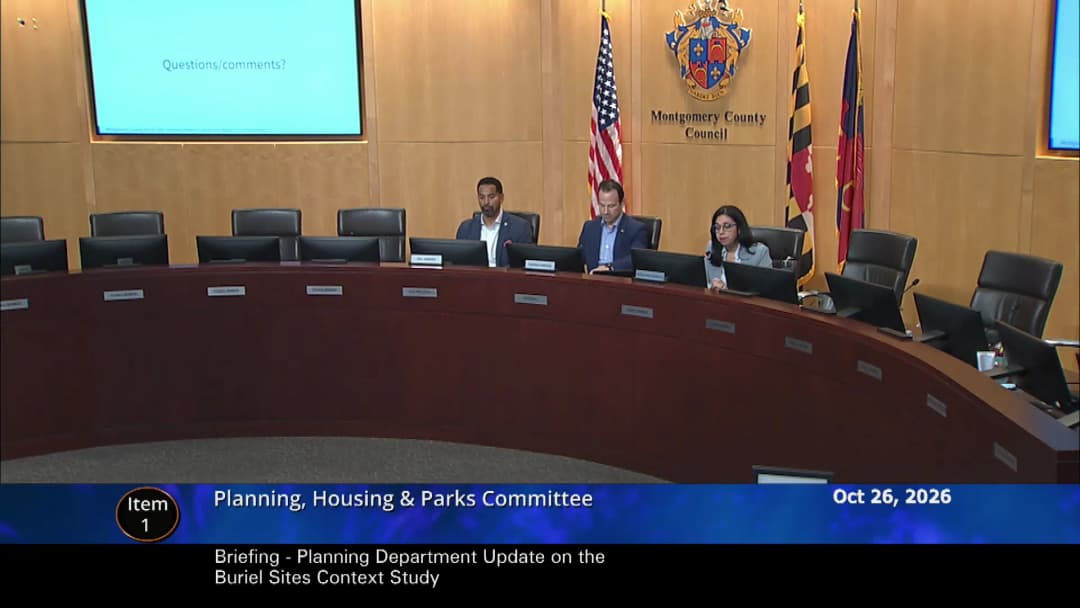
Montgomery County PHP Committee Work Session - 2026-10-26

The Planning, Housing, and Parks (PHP) Committee of the Montgomery County Council met on 2026-10-26 at 1:30 PM. The committee received a briefing on the Burial Sites Context Study and voted unanimously on three bills: Bill 40-26 (landlord payment methods), Bill 41-26 (ADU licensing and fees), and Bill 42-26 (short-term rental platform compliance). Burial Sites Context Study Briefing - Planning Department staff (Rebecca Ballow and Dr. Brian Crane) presented a countywide, thematic master plan amendment for burial sites. The work is built on a consultant-led historic context study. - The county inventory comprises 347 burial sites: 261 known locations and 86 approximate sites. Staff discussed historical themes including enslaved persons' grounds, post-Civil War community cemeteries, and 18th-century family plots. - Councilmember Friedson stressed the real-world equity implications, citing the Wesleyan Cemetery case where a property was unknowingly sold at tax sale. He emphasized the need for plans addressing public, private, and right-of-way sites, as well as funding for fencing and markers. - Council President Fani-González urged outreach to Montgomery College to involve younger people. Councilmember Jawando asked about sites destroyed by development (over 30 are under pavement) and recommended partnering with Montgomery History for oral histories and consulting legacy funeral homes such as Snowden's. - Key Outcome: This was an information briefing. Staff will develop a scope of work and communications plan in early 2027, with master plan amendment work beginning in spring 2027. Bill 40-26: Landlord-Tenant Relations - Accepted Forms of Payment - Sponsor Council President Fani-González proposed requiring landlords to accept certified checks and money orders and prohibiting the termination of tenant access to online payment portals. - Discussion: Councilmember Jawando suggested adding personal checks with protections against bounced checks, which the sponsor was open to exploring at full council. The committee adopted a DHCA amendment requiring written receipts within 5 business days for rent redemption and 15 days for other payments. A DHCA proposal for local payment offices was deferred to full council for further discussion. - Key Outcome: The bill passed unanimously (3-0) as amended on the receipt requirements. Bill 41-26: Landlord-Tenant Relations - Licensing Procedures and Fees (Accessory Dwelling Units) - Sponsored by Councilmembers Friedson and Fani-González, the bill removes the owner-occupancy requirement for ADUs and waives licensing and permitting fees for units affordable to households earning 65% or less of Area Median Income for at least 10 years. - Discussion: An amendment by Councilmembers Jawando and Mink passed (3-0) limiting ADU licenses to two per owner (including affiliated entities to prevent circumvention) and requiring a County Executive report by December 2028. An amendment by Councilmember Sales to retain the owner-occupancy requirement was not moved. - Key Outcome: The bill passed unanimously (3-0) as amended. Bill 42-26: Transient Lodging Facilities - Short-Term Residential Rental - Online Platform Compliance - Councilmember Evans presented her first authored bill to strengthen compliance for short-term rentals by regulating online platforms. - Discussion: The bill requires platforms to verify operator licenses before listing, prohibits transaction fees for unlicensed rentals, and mandates annual reporting to DHCA. An OIG report found approximately 85% of short-term rentals were unlicensed. The committee adopted an amendment to make the verification database publicly available. DHCA requested and was granted an effective date of July 1, 2027, for technical implementation. - Key Outcome: The bill passed unanimously (3-0) as amended.

HISTORIC PRESERVATION 29% · SHORT TERM RENTAL REGULATION 16% · HOUSING 14% · ZONING REGULATION 12%
06
OCT 26, 2026 · MONTGOMERY COUNTY, MARYLAND · COUNTY COUNCIL & COMMITTEES
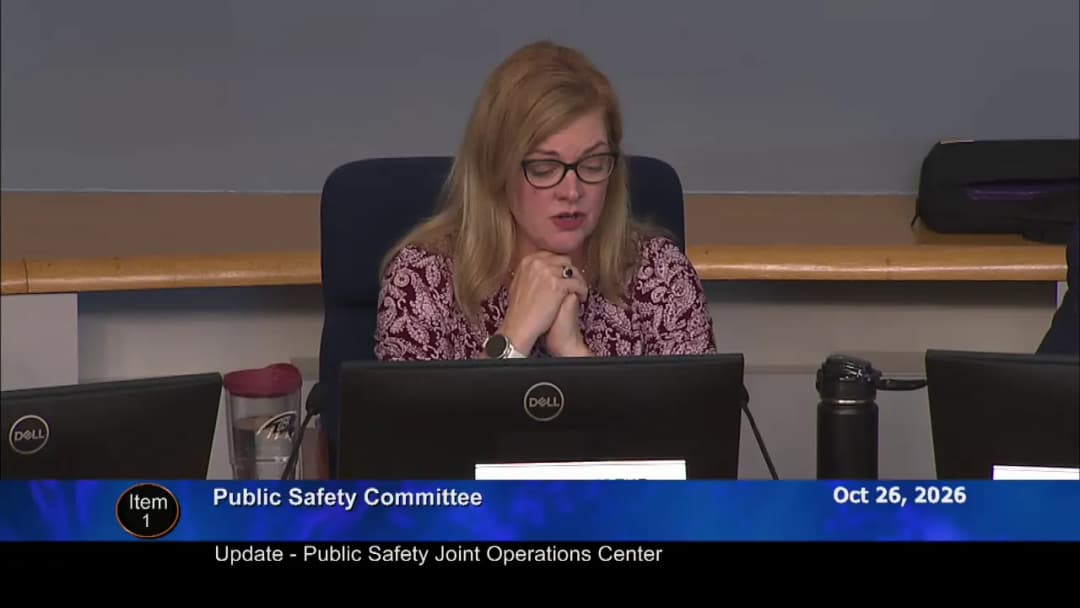
Public Safety Committee Work Session on Joint Operations Center - October 26, 2026

The Montgomery County Public Safety Committee, chaired by Sidney Katz, convened on October 26, 2026, to receive an update on the Public Safety Joint Operations Center (JOC). The work session featured presentations from Assistant Chiefs Dominic Colletti (Fire Rescue) and Dave McBain (Police), Mark Becklin (Talent Chief, Fire Rescue), Luke Hodgson and Nicole Markuski (OEMHS), Derek Erigan (OMB), Acting Police Chief Frank, and Fire Chief Corey Smith. Background and Funding - The JOC was initially funded at $2.4 million, later adjusted to $1.2 million during the FY27-32 CIP process for affordability. - Total investment to date is $2.367 million, leveraging $1.2 million in CIP funds, $452,000 in General Fund savings, $614,000 in Homeland Security Grant Program funds, and $100,000 in COVID relief funding. - 75% of capital work is complete; remaining antenna and radio installations are expected to be finished by the end of the calendar year. Operations and Impact Statistics - The JOC facilitates co-located operations for Police (Drone as First Responder - DFR, Real-Time Intelligence Center - RTIC/Arctic, and analytical units), Fire & Rescue, and OEMHS. - Fire Rescue and OEMHS functions currently lack dedicated FTEs. - On average, 20 to 25 weekly incidents requiring multi-agency coordination are managed in the JOC. - DFR Performance (Year to Date 2026): - Responded to 2,987 total calls. - Avoided dispatching police officers 440 times (estimated 2 officers per call). - First on scene 1,868 times with an average 52.3-second response time. - Average overall DFR response time: 77 seconds. - Notable Events: - Two missing autistic children in Silver Spring were located in 8-10 minutes via DFR, avoiding the need for 25-30 officers. - Over the preceding weekend, DFR responded to 38 calls on Friday and 45 on Saturday. - Future Operations: Police plan to run a duty commander from the JOC for county-wide resource coordination. Key Discussion and Testimony - OEMHS Director Luke Hodgson detailed the JOC's pivotal role during a major WSSC water outage, calling it "one of the worst emergencies we could have." With only 2-3 hours' notice, the co-located teams coordinated resources, deploying water trucks within the hour, while maintaining normal county operations. This was described as "night and day" compared to the typical EOC ramp-up. - Assistant Chief Dominic Colletti (Fire Rescue) noted the Fire Rescue program is only six months old. The co-location allows data and intelligence from Police DFR and RTIC to be relayed immediately to responding crews, improving efficiency and shortening the emergency-to-recovery timeline. - Assistant Chief Dave McBain (Police) emphasized the JOC is a force multiplier. He cited real-time information sharing, including body-worn camera feeds to assist Fire Rescue with patient statuses, as a key benefit. - Luke Hodgson noted that transition between steady-state JOC operations and a full EOC activation was seamless, allowing the JOC to handle routine incidents while the EOC focused on the major event. Council Comments - Chair Sidney Katz praised the JOC for enabling simultaneous communication and efficiency. He acknowledged that additional capital expenses are likely as the operation evolves and expressed appreciation for the collaboration. - Councilmember Kristin Mink expressed personal gratitude regarding the WSSC response, stating she has loved ones whose lives depend on a water supply. She noted the high level of public trust demonstrated during the incident. - Councilmember Andrew Friedson called the JOC investment a "low number" relative to the county's $700 million annual public safety budget. He praised the pooling of funding sources and highlighted the power of collaboration in high-pressure situations, noting that Fire Rescue and OEMHS have integrated effectively without pre-existing programs like DFR. Key Outcomes and Next Steps - The committee received the update with strong praise for the departments. - No formal votes were taken during the work session. - Future capital and operational budgetary needs were acknowledged by staff and committee members. - The departments will continue operating and expanding JOC capabilities, including the planned addition of a police duty commander.

PUBLIC SAFETY 67% · EMERGENCY MANAGEMENT 16% · TECHNOLOGY AND INNOVATION 11% · FISCAL SUSTAINABILITY 6%
07
OCT 26, 2026 · MONTGOMERY COUNTY, MARYLAND · COUNTY COUNCIL & COMMITTEES
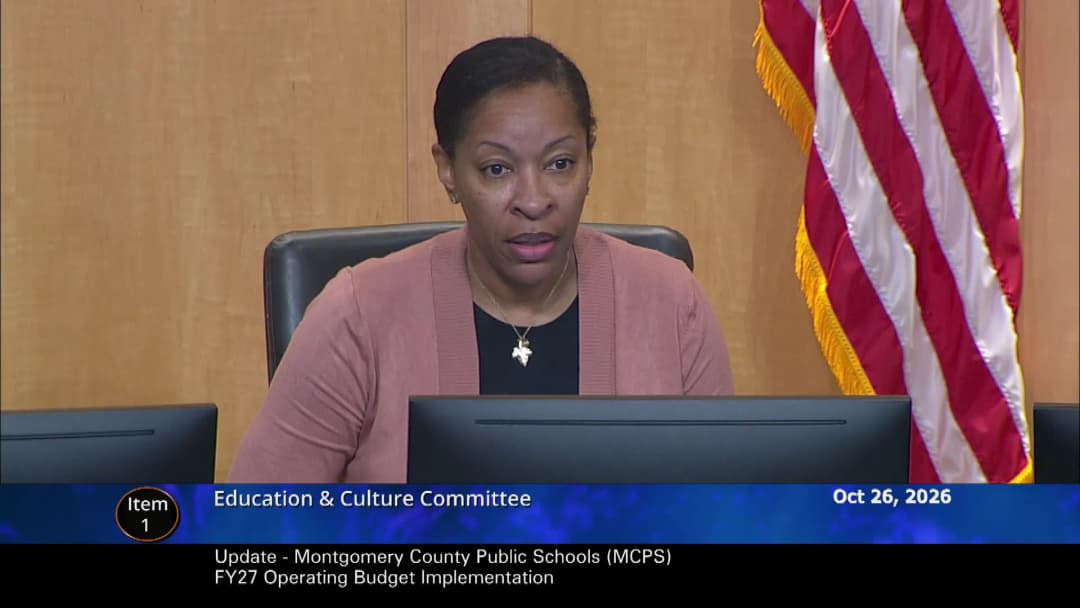
MCPS FY27 Budget Implementation Update - October 26, 2026

The Education and Culture Committee (EC) of the Montgomery County Council met on October 26, 2026, at 9:30 a.m. to receive an update from Montgomery County Public Schools (MCPS) on the implementation of the FY27 operating budget. The meeting focused on the impacts of $61 million in unfunded requests from the Board of Education, which resulted in 415 full-time equivalent (FTE) position reductions, 47 reductions in force (RIFs), and 162 involuntary transfers. Committee Chair Will Jawando and members Kate Stewart, Shebra Evans, and Kristin Mink participated. MCPS representatives included Superintendent of Schools, Chief Human Resources Officer Dr. Renee McCall, and Chief Financial Officer Ivan Alfonso Windsor. Discussion Items - Budget Overview: The final appropriation funded 98.4% of the Board's request, a 3.6% increase over the prior year, but left $61 million unfunded. Local funds increased by 5.1%. Declining enrollment (projected 4,800 fewer students K–12, actual 3,200 more than that projection) was a key factor. - Position Reductions: Of 415 FTEs cut, 196.5 were new/unfilled positions (no job loss), 20 employees retired, 162 were involuntarily transferred, and 47 (later corrected to 47) were RIF'd. Across all unions, over 1,200 involuntary transfers occurred due to enrollment shifts and staffing standard changes. The majority of reductions affected the SEIU Local 500 (support staff). - Retirement Incentive Program: A $10,000–$12,000 incentive (for 10-month/12-month employees) was offered after May 23, resulting in 577 retirees. Sick leave payouts were at 35%. Total incentive pay was $5.934 million, higher than initially estimated. The program helped reduce the need for RIFs, but the exact number of avoided RIFs could not be quantified. - New Hires: As of August 25, 853 new hires were made, mostly in MCEA (teachers), with concentrations in elementary, special education, and English language learner areas. The planned expansion of elementary security assistants was not implemented due to cuts. - Dual Enrollment: 2,234 students had courses paid for by MCPS at Montgomery College. Of 289 students not meeting College and Career Readiness (CCR) standards in 10th grade, 100 were covered by a grant or paid themselves, 102 discontinued the program, 31 achieved CCR over the summer, and 56 P-Tech students had enrollment delayed. Committee members requested further demographic and school-level data on these students. - Pupil Personnel Worker (PPW) and Social Worker Reductions: 27 PPW positions were cut (26 involuntary transfers, 1 retirement). PPWs will remain in schools but will no longer lead student well-being teams (coordination varies by school) and will not conduct routine residency verification or evaluate homeschooling portfolios (other staff will handle). 40 social worker positions were RIF'd, with 1 retirement, 1 called back, and 1 reassigned. MCPS is partnering with the Department of Health and Human Services (DHHS) and using a $12 million CHRC grant (increase of $2 million) to provide mental health services, but acknowledged potential increases in waitlists. The transition from school-based to county-based services was described as a "band-aid rip-off moment." - CTE Program Changes: The Career and Technical Education (CTE) program is now managed under the Office of Career and Postsecondary Partnerships. New MOUs with foundation partners are being negotiated; the timeline for signing was not specified. Construction and automotive programs continue using Perkins grants and existing car inventory, but house-building project land has not been acquired. Committee members emphasized the importance of maintaining industry partnerships. - Other Reductions: Cuts were made to bus leases, project management, mental health contractual services, air conditioning filters, higher education partnerships, equity add-on funding, professional development, and temporary part-time salaries. MCPS noted these are not anticipated to have significant impact this year. Key Outcomes - No formal votes were taken. The committee received the update and discussed ongoing monitoring needs. - Requests for additional data: MCPS agreed to provide: - Demographic and school-level breakdown of the 102 students who discontinued dual enrollment. - Impact analysis (not audit) of reductions on student achievement, disaggregated by student groups, at end of school year. - Information on who leads student well-being teams at each school after PPW role changes. - Data on enrollment withdrawals, particularly "unknown" reasons, and comparisons to prior years. - Waitlist numbers for Tier 3 mental health services and current capacity. - Update on CTE foundation MOU signing. - Monitoring: The committee will continue to track the effects of reductions as FY28 budget development begins. MCPS is conducting an initiative inventory to assess resource allocation and outcomes. - Next Steps: MCPS plans to present enrollment data to the Board of Education during a CIP work session the following week. The superintendent's budget proposal is expected in December.

PUBLIC EDUCATION 47% · EDUCATION 19% · BUDGET EQUITY ANALYSIS 12% · PUBLIC HEALTH 9%
08
OCT 26, 2026 · MONTGOMERY COUNTY, MARYLAND · COUNTY COUNCIL & COMMITTEES
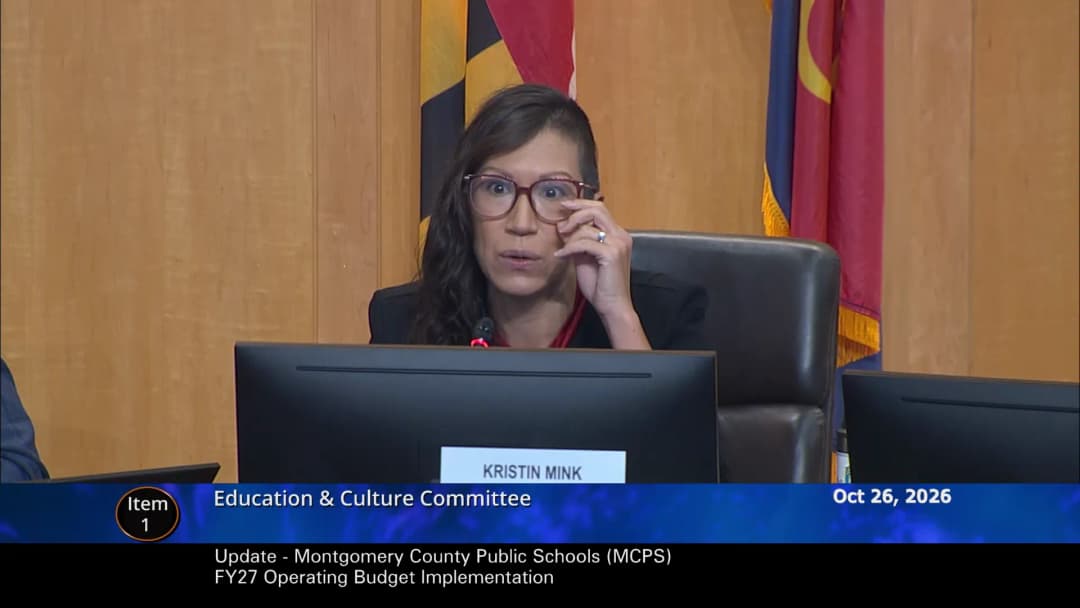
Montgomery County Education & Culture Committee Receives MCPS FY27 Budget Implementation Update on Oct. 26, 2026

The Montgomery County Council Education and Culture (EC) Committee met on Oct. 26, 2026, at 9:30 a.m. in Rockville to review implementation of the MCPS FY27 operating budget. The sole agenda item was an update from MCPS staff on position reductions, retirements, new hires, dual enrollment, student well-being staffing, and CTE program changes. Chair Will Jawando opened by noting that the Council funded MCPS below the Board's request but above earlier expectations, and that the budget required MCPS to eliminate 415 full-time equivalent positions, with 46 reductions in force (RIFs) and 162 involuntary transfers. He stressed that behind these numbers were real employees and classroom impacts. Discussion Items - Budget and position reduction overview: Staff reported the final appropriation was 98.4% of the Board's request, a 3.6% increase over the prior year, with local funds up 5.1%; however, $61 million of the Board's request remained unfunded. The $128 million total appropriation increase still left a $61 million gap. MCPS reduced 415 FTEs, totaling $35 million in cuts. Of those, 196.5 positions were new positions not implemented; 20 employees in targeted positions retired; 162 were involuntarily transferred; and MCPS later corrected the RIF number to 47. Dr. Renee McCall noted there were over 1,200 involuntary transfers across all employee associations, most in MCEA, making the year atypical. MCPS projected a K-12 enrollment decline of 4,800 students and said staffing standards lessened the impact. - Retirement incentive and sick leave payouts: MCPS offered a retirement incentive for retirements filed between May 23 and June 5: $10,000 for 10-month employees and $12,000 for 12-month employees, in addition to the 35% sick leave payout. The incentive resulted in increased retirements after the May 22 Board vote; total incentive pay was about $934,000, slightly more than originally projected. The discussion referenced 577 retirees. MCPS said the state retirement deadline limited how much additional time employees could be given to decide. - New hires: As of Aug. 25, MCPS had 853 new hires, mostly in the MCEA unit. More hires were in elementary than middle/high school, with notable numbers in special education, English learner instruction, and speech pathology. A planned expansion of elementary school security assistants was not implemented. - Dual enrollment: MCPS pays for 2,234 students to take Montgomery College courses this year. Of 289 students who were not college and career ready as of 10th grade, 100 were covered by a Montgomery College high school grant or paid themselves, 102 discontinued the program, 31 achieved CCR status over the summer and are being paid for by MCPS, and 56 PTEC students at Clarksburg High School had enrollment delayed a year or two. Councilmember Evan Glass said the dual enrollment program should return to its original equitable-access purpose. Other councilmembers argued there is an inherent tension because MCPS is mandated to prioritize K-12, and the state Blueprint covers only about 25% of program costs in Montgomery County, leaving most funding to local government. Councilmembers requested more demographic and school-level breakdowns, including for the 102 students who left the program. - Pupil personnel workers (PPWs): MCPS cut 27 PPWs. They will continue reducing barriers to education and remain present in assigned schools, but they will no longer coordinate student well-being teams, conduct routine residency verification home visits (with exceptions for foster care and McKinney-Vento cases), or evaluate homeschooling portfolios. MCPS said it aligned PPWs and family engagement specialists into cross-functional teams organized around about four school clusters, with staff expected in schools 80% of the time. Chair Jawando asked about attendance and chronic absenteeism; MCPS acknowledged an impact but said attendance numbers were so far doing reasonably well. - Mental health and social workers: MCPS reported 40 social worker RIFs, one retirement, one call-back, and one employee who found another position. MCPS is working with the Department of Health and Human Services and external providers, and plans to use Community Health Resources Grant funding to maintain a mental health presence in all schools. MCPS acknowledged there could be an increased waitlist for services. Councilmember Kristin Mink cited significant recent losses in therapeutic service contracts, extended-term contract capacity, and social worker capacity, and said the abrupt shift of responsibility from MCPS to HHS was difficult for vulnerable students. She asked MCPS to be candid about gaps and to build sustainable supports. Councilmember Shebra Evans called for an impact analysis, not necessarily an audit, disaggregated by student groups, as the year progresses. - Enrollment trends: MCPS reported that enrollment is 3,200 below projections, on top of the projected 4,800-student decline, for nearly 8,000 fewer students compared with the prior year. There were about 600 fewer kindergarten students than expected. The declines are concentrated in elementary and high school, with middle school more stable. High school withdrawal codes show movement to other Maryland districts, other states, and outside the U.S., with a substantial number of unknown withdrawals; MCPS is not seeing a spike in private school enrollment. MCPS emphasized it is making no mid-year staffing cuts, but lower enrollment will affect future allocations and likely mean more involuntary transfers. - CTE programs: Career and technical education programs are now managed by the Office of Career and Postsecondary Partnerships. MCPS is developing new MOUs with foundation partners to continue construction and automotive programs. Materials continue to be purchased with federal Perkins grants, existing cars remain available for automotive classes, but the house-building project has not yet secured land. MCPS said most student experiences in CTE are continuing, but it is re-envisioning the foundation relationship. Councilmember Evans stressed that the public should know the program was changed, not eliminated. - Other reductions: Staff also noted cuts or deferrals across bus leases, project management certification, mental health contractual services, air conditioning filters, higher education partnerships, equity and organizational development, Operational Understanding DC, technology services, the equity add-on program, professional development, and temporary part-time salaries. Key Outcomes - No formal votes were taken; the committee received the update as part of budget monitoring. - Councilmembers requested follow-up data on dual enrollment discontinuation by program and demographics, MC2 participation, enrollment withdrawal reasons, student well-being team leadership at each school, tier-three mental health service waitlists, and referral/contingency plans if HHS reaches capacity. - MCPS said a deeper enrollment presentation would be provided to the Board as part of the CIP work session the following week. - MCPS is conducting an initiative inventory to assess how resources are allocated and will use it to inform the superintendent's and Board's upcoming budgets. - The committee adjourned after directing MCPS to continue monitoring implementation and reporting impacts as the FY28 budget process moves forward.

PUBLIC EDUCATION 63% · BUDGET EQUITY ANALYSIS 16% · MENTAL HEALTH AWARENESS 10% · EDUCATION 4%
09
OCT 26, 2026 · MONTGOMERY COUNTY, MARYLAND · COUNTY COUNCIL & COMMITTEES
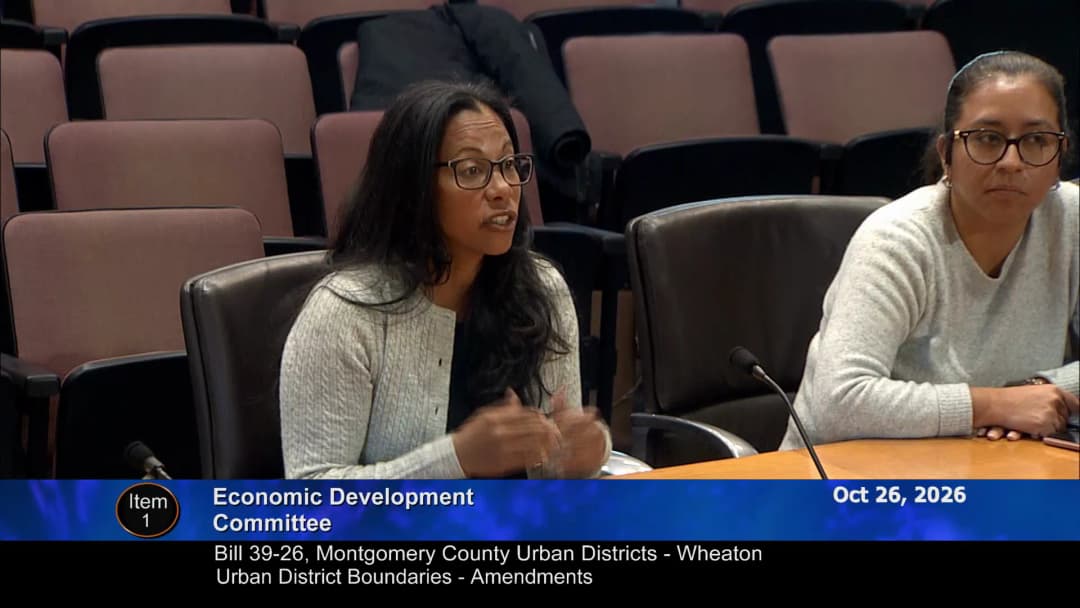
Montgomery County Economic Development Committee Work Session on Bill 39-26, Wheaton Urban District Boundaries – October 26, 2026

The Montgomery County Council Economic Development (ECON) Committee met on October 26, 2026, for a work session on Bill 39-26, which would amend the Wheaton Urban District boundaries. The meeting was chaired by Councilmember Natali Fani-González, with Council Vice President Marilyn Balcombe present and Councilmember Evan Glass participating online. The committee considered the bill, heard from invited staff and district officials, and voted to advance the measure to the full council. Public Comments & Testimony - Staff reported that public testimony on the bill was uniformly in support. - No public witnesses appeared during the work session. Discussion Items - Staff explained that Bill 39-26 would expand the geographic scope of the Wheaton Urban District to include the Wheaton Library and Community Recreation Center, Wheaton Local Park, and the Georgia Avenue right-of-way connecting those spaces to the current district. - The staff impact assessment found little to no impact on climate, a positive impact on racial equity and social justice, a one-time $70,000 fiscal impact in FY27 for a vehicle purchase, and a $10,000 annual fiscal impact in subsequent years. - Staff reported there were no amendments to the bill. - The Mid-County Regional Service Center Director and the Wheaton Urban District Manager expressed support for the expansion, noting that the district’s clean and safe team already services the library and that the boundary change would make that work official. They also connected the expansion to the future art center and the goal of enhancing public spaces. - The Urban District Manager explained the need for the one-time vehicle purchase: the team’s current vehicles are aging, between 12 and 15 years old, and the warehouse is not within walking distance of the expanded service area with equipment and tools. - Council Vice President Balcombe expressed support for the expansion but questioned whether the truck should be attributed to this boundary expansion, noting the truck seemed necessary regardless and that the district would now be one unified urban district. - Councilmember Glass supported the bill and encouraged the next council to undertake a broader evaluation of urban districts and regional service centers, whose boundaries have not changed much even as their communities have evolved. - The Chair noted the relevance of the county executive transition to broader regional district and service center conversations. Key Outcomes - The committee voted unanimously to support the staff recommendation on Bill 39-26. - The motion was made by Council Vice President Balcombe and seconded by Councilmember Glass; all members present voted in favor, with no passes. - The bill will be forwarded to the full council for consideration.

URBAN PLANNING 53% · PROCEDURAL 24% · ECONOMIC DEVELOPMENT 23%
10
OCT 23, 2026 · MONTGOMERY COUNTY, MARYLAND · COUNTY COUNCIL & COMMITTEES
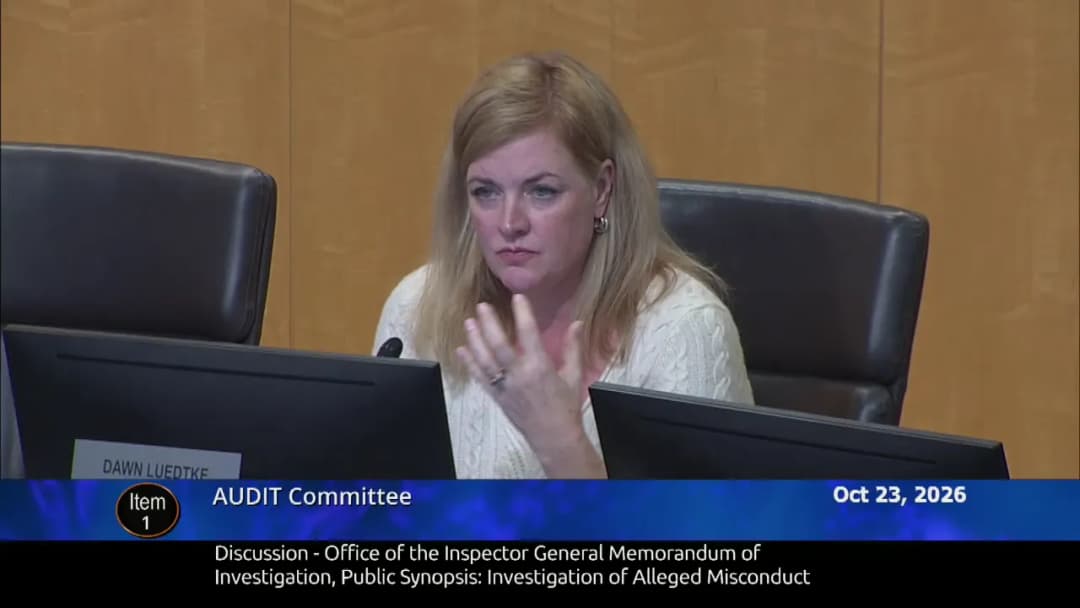
Audit Committee Meeting on OIG Misconduct Investigations - October 23, 2026

The Montgomery County Council Audit Committee met on October 23, 2026, from 2:30 p.m. to 4:30 p.m. to review two reports from the Office of the Inspector General (OIG) regarding alleged misconduct by a Montgomery County Police Department (MCPD) executive and an employee of the Office of the County Attorney. The committee heard presentations from OIG Inspector General Megan Lamarzy, Deputy Chief Administrative Officer Faribaksiri, Acting Police Chief Darren Frank, and County Attorney Marcos, followed by discussion and questions from councilmembers. Office of the Inspector General Report on MCPD Executive - Inspector General Lamarzy presented findings on a high-level MCPD executive. The investigation substantiated that the executive failed to record leave for at least 40 hours of absences (including attending a golf tournament while on duty and consuming alcohol), falsely told investigators that they were not involved in selecting a family member for an out-of-state conference assignment (violating county code), and directed a county vehicle be provided to the County Attorney employee without proper authorization. - The report also noted that many high-level appointees are exempt from HR regulations, creating confusion about time and attendance requirements, and that MCPD policy on timesheet approval does not align with county policy. Office of the Inspector General Report on County Attorney Employee - Inspector General Lamarzy reported on allegations against an Office of the County Attorney employee, including improper travel, use of a secure messaging app to avoid public information requests, and involvement in a motor vehicle accident while potentially under the influence. The investigation did not substantiate the MPIA or impairment allegations, but found that the employee used a county vehicle without required director approval, had not been approved for a take-home vehicle, and failed to report an accident. The employee resigned during the investigation. Discussion Items - Council President Natali Fani-González praised the OIG hotline and Inspector General for effective oversight, emphasized that the misconduct does not reflect on the majority of MCPD staff, and stressed the need for clarifying time and attendance expectations for exempt employees. - Councilmember Katz noted the importance of respecting the Inspector General's role and urged that the focus remain on correction rather than dwelling on negative aspects of long-serving employees' careers. - Councilmember Balcombe expressed concern about complacency at the highest levels and asked how to ensure ongoing compliance. - Councilmember Evans highlighted the need for oversight and accountability for all employees regardless of exempt status, and supported cross-departmental checks. - Councilmember Luedtke questioned how problems could be identified and resolved earlier before escalating to the OIG, and stressed the importance of internal mechanisms for compliance and corrective action. - Acting Chief Frank described actions taken: an audit of admin vehicles, direct orders to fleet manager, issuance of a headquarters memorandum on leave recording, a new policy for attending social events during work hours, and mandatory ethics training for executives. The County Attorney stated the former employee is no longer with the office and clarified that he was unaware of the vehicle assignment. - Deputy CAO Faribaksiri reported that a policy reminder on time and attendance was issued to all managers, and that the CAO's office is updating administrative procedures on vehicle assignments and developing improved tracking. Key Outcomes - The committee acknowledged the OIG findings and the corrective actions already initiated by the county executive's office, MCPD, and the County Attorney's office. - Recommendations from the OIG include: recovering compensation for at least 40 hours of unrecorded leave, clarifying expectations for exempt employees, updating MCPD timesheet policy, implementing a policy on attendance at social events during work hours, and reviewing civilian vehicle assignments. - All recommendations were accepted by the Chief Administrative Officer, with responses included in the public report. - Councilmembers emphasized the need for ongoing vigilance, cross-departmental learning, and additional resources for the OIG to conduct proactive audits. - Meeting adjourned at approximately 4:30 p.m.

ETHICS 35% · PERSONNEL MATTERS 22% · PUBLIC INFORMATION ACT 20% · PUBLIC SAFETY 19%
0102
NEXT →
OPENPUBLICA · PUBLIC MEETING INDEXUPDATED DAILY · openpublica.com