Montgomery County GO Committee Discusses Grant Workgroup Recommendations on March 19, 2026
STREAMING COPY IN PREPARATION — RECORDING AVAILABLE FROM THE ORIGINAL SOURCE
Montgomery County GO Committee Discusses Grant Workgroup Recommendations on March 19, 2026
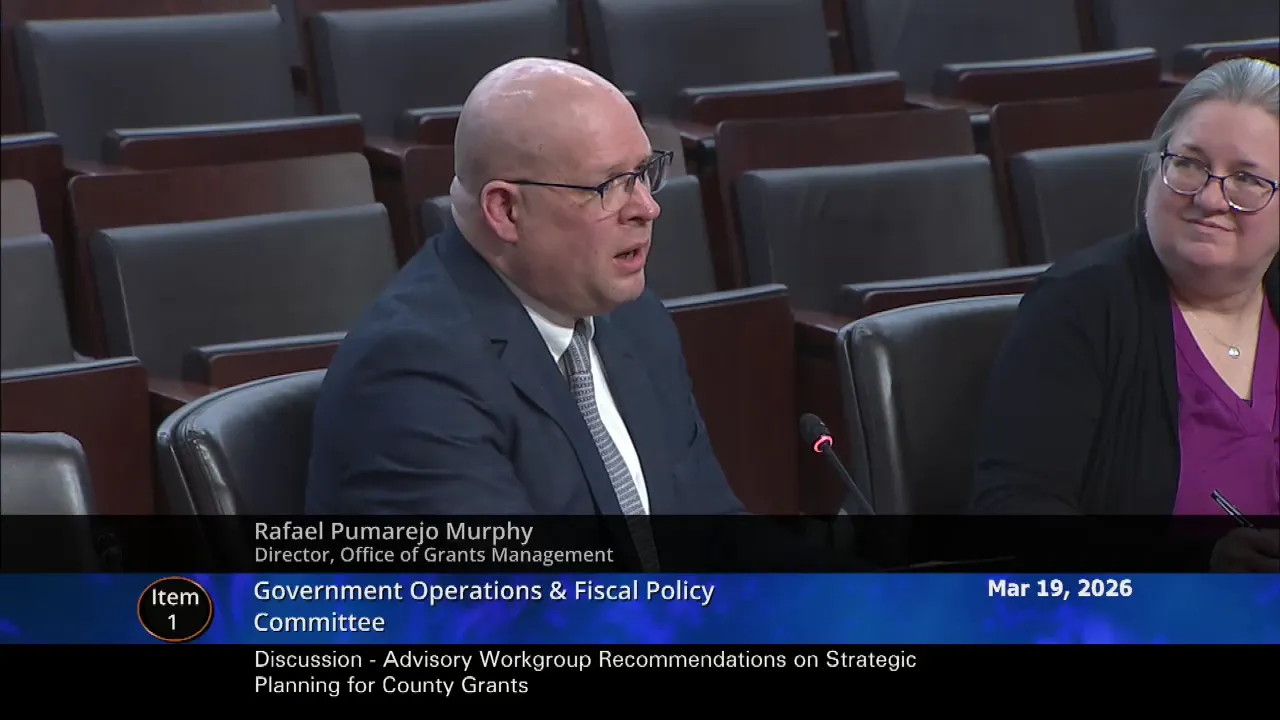
The Montgomery County Council's Government Operations and Fiscal Policy (GO) Committee met on Thursday, March 19, 2026, in the 3rd Floor Council Hearing Room in Rockville, Maryland, for a discussion-only session on the Advisory Workgroup Recommendations on Strategic Planning for County Grants. The agenda listed an 11:30 a.m. - 12:30 p.m. time slot, while the approved minutes record the meeting running from 10:32 a.m. to 11:40 a.m. Present were Chair Kate Stewart, Councilmember Shebra Evans, and Councilmember Sidney Katz. Participants included Bridget Howe (Nonprofit Montgomery), Kim Jones (Montgomery County Black Collective), Gabriel Albanos (Director, Department of Recreation), and Raphael Murphy (Director, Office of Grants Management), with Legislative Analyst Clemons Johnson. No formal votes were taken.
Discussion Items
- Background: Clemons Johnson explained that the workgroup was created by Resolution 20-780 in April 2025 after years of GO committee discussions about the transition to a new grant-making system, the community grants Non-Departmental Account (NDA), and legacy grants. The group met six times over seven to eight months. Its charge covered strategic plans for the community grants award process, legacy awards, and cost-sharing capital improvement grants.
- Funding context: Johnson reported FY26 community grants NDA funding of $13.3 million, including $6.2 million for community grants, $4.7 million for legacy grants, $1 million for nonprofit technical assistance grants, $1 million for nonprofit resiliency centers (formerly incubator grants), and $389,000 for inflationary funds. The FY27 recommended budget is largely similar and will be discussed in April.
- Community Grants Board: Bridget Howe recommended creating a board to identify funding priorities, contribute to the review process, and serve as an advisory body to the Office of Grants Management (OGM) to bring in community perspective.
- Nonprofit Liaison: Kim Jones recommended creating a position in the County Executive's office to be a consistent, knowledgeable contact for the nonprofit sector, especially to help small, new, and underserved organizations navigate county processes.
- Preserve the NDA: The workgroup recommended maintaining the community grants NDA as a flexible general fund to remain nimble and responsive to community needs, rather than moving funding into department base budgets.
- Cost-sharing CIP: The group suggested restricting capital requests so they align with community needs and budget realities, and favor 'shovel-ready' projects.
- Legacy grants: Jones said the workgroup recommended discontinuing legacy grants after a transition and rolling those funds into the broader community grants program. The recommendation was to notify grantees and provide a six-month allocation in FY27; Jones noted the county executive included a 12-month allocation in his proposed budget. The workgroup acknowledged the history and good intentions behind legacy grants, but favored regularly reviewed, competitive grants.
- Equity and capacity building: The workgroup recommended improving access for smaller and underserved organizations, providing more technical assistance, and using a tiered structure so small and emerging nonprofits are not competing against larger, well-resourced organizations.
- Staggered grant process: The recommendation is to stagger competitions so one-third of the pool competes each year, with three-year grants; the first new three-year cycle would begin July 2027 with a Notice of Funding Opportunity (NOFO) in November or December 2026. Priorities would be set by the community grants board, potentially by income/socioeconomic status, geography, or historically disenfranchised communities. The group also urged a clear distinction between programmatic funding and general operating support.
- Capacity concerns: Howe and Albanos noted OGM and county departments are thinly staffed. Albanos said the Department of Recreation administers over 588 contracts and 24 grants with two full-time staff, limiting outcomes monitoring. Howe said OGM needs more resources and that departments are stretched.
- Murphy's perspective: OGM Director Murphy said funding through the community grants NDA is less than 10% of county money that goes to the nonprofit community; most flows through department-based procurement contracts. He cautioned that setting separate priorities could duplicate or contradict department strategies, and cited the community reinvestment and repair fund as a pilot that illustrates the difficulty of priority-setting. He supported the tiered approach and stressed that OGM can move quickly once priorities and criteria are set; the main delays are program design and application review. He warned against repeating the FY24 open competition, which drew 311 applications and had 10 to 20 dollars requested for every dollar available.
- Timeline concerns: Chair Stewart questioned whether a newly created community grants board could be stood up before the next NOFO, which is expected around October or November. Councilmember Evans asked about the infrastructure needed to support expansion. Councilmember Katz stressed the importance of providing resources and praised the workgroup's approach. Evans asked the advisory workgroup to continue if possible to help with outreach and smooth transitions.
- Transition and outreach: Albanos suggested the recommendations could be advanced through the next county executive's transition team. Howe said Nonprofit Montgomery will host an 'ask me anything' session for members to explain the recommendations. Clemons Johnson noted the workgroup could continue because the enabling resolution has no sunset date; the council could revise or clarify its membership and scope.
Key Outcomes
- No formal votes or binding decisions were taken; the item was a discussion.
- Chair Stewart indicated she was not inclined to end legacy grants before fully working out next steps, and that the county executive's proposed one-year extension would likely be continued during FY27 budget deliberations.
- Staff and executive branch participants, including Director Albanos, were asked to work with council staff to identify next steps and possible partnership approaches.
- The committee will revisit grant funding during FY27 budget discussions, specifically the community grants NDA and legacy grants.
- Clemons Johnson will prepare options for the council regarding possible modification or extension of the advisory workgroup resolution.
Meeting Transcript
Welcome everyone to uh this session of the government operations and fiscal policy committee. Today we have one item in front of us, which is a discussion of the advisory work group recommendations on strategic planning for county grants. Um before I turn it over to Ms. Clemens Johnson, I just want to um kind of give uh first a thanks to the working group for meeting, um discussing and looking at ways that we can um address our grant system. Um as many of you know, this has been an issue that we've discussed um uh at this committee for a number of years now. Um we know that transitions are hard. And given the number of nonprofits we have in our community, um setting up a new office of grants management and shifting to a new way of doing community grants um has has been hard, honestly. Um and I want to just say thank you to Mr. Murphy for all of his work on this, because I think when um you've probably started to undertake um this work, understanding the challenges that were ahead and how long certain things were gonna take and other obstacles uh that presented themselves. You have uh been very honest with this committee. Um, and I know you've been uh and your team uh have been trying to work through uh many of the um the issues. And um we are gonna discuss um some of the uh the community grants, our legacy grants, and our cost sharing. Uh, but I don't want that to um cloud with the things we have to work on, the overall great work of our Office of Grants Management and our county government in working together with our community partners, with our departments to get money and um funding and support out to our nonprofits, particularly when it is a targeted um grant program. And I know we've had huge success with our Office of Grants Management, our Office of Excuse me, Food System Resilience. Um yesterday the county executive just um talked about increasing the amount of money we have in our security grants given world events to make sure that our people are safe in our community when they go to our houses of worship and in other places. So I I just want to say thank before we get into the details and talk about all the things we got to fix. I do want to just highlight the incredible work that is being done uh to make sure that needs are being met in our community. Um so I know we still have some things that we need to address, and I appreciate the working group for rolling up their sleeves and providing these recommendations to that. So why don't we get started? Ms. Clemens Johnson, you want to walk us through? Uh we'll do, yes. And I will give uh more background than anything, and while we'll let the committee talk about their recommendations. I was um glad to staff of the committee and um the members were all involved. There were six meetings over the course of um of seven months, I guess we'll say seven to eight months. Um the council uh initially approved the resolution 2077 20-780, establishing um the advisory work group in April 2025. And this was pretty much the culmination of discussions, really deep discussions that the GO committee had during 2024. Um there was a lot of transition that was happening. There was the legacy grants that I think was a sticking point for the county council because they were approved after the fact by the executive using his own uh funds without the involvement of council who had really intense discussions about the legacy grants, the community grants, and what that looked for, what that looked like moving forward. Um so there was a meeting in November of 2024 where there was discussion about the community grants, the new community grants, and the legacy grants, and there was um renewals and extensions, bridge grants that were provided for the legacy partners so that they we didn't just drop them off. And after a memo was sent to the county executive, he provided a response February 2025, and at that time the GO committee met around a week later to discuss his recommendations that really did not address the concerns that the committee addressed at that time, which had been ongoing in the same for like the past year and a half. So I think that resulted in the culmination and uh creation of this advisory work group on a strategic plan for the grants so that there was um specific response from community individuals, organizations who are familiar, some are familiar with the grants process, have been involved in grant making, um receive grants from the county and could talk in detail about their um their recommendations, their experience and their recommendations moving forward. So we did have an ambitious timeline for for work groups, uh, if you feel an essay with them starting in April, and then um I think our initial plan was to bring forward the final report in November, but they were able to complete their final report um in the past month to provide the recommendations that are included in the packet. So um so I will just highlight the focus of the strategic work group, which is listed on the uh page one, um includes the three buckets that are are that are here, um a strategic plan for the community grants award process, uh strategic plan for the community grants legacy awards, and a consistent criteria and process for the cost-sharing capital improvement grant. Uh so this work group was really charged with focusing on funding that is appropriated within the community grants in DA that is administered by the Office of Grants Management. So there is a number of grants that the Office of Grants Management puts out in coordination with the departments, meaning that they may choose to use their funding in a within a certain year to support different efforts. Um there's DIMBIN, I I can think of an example of the Lighthouse Initiative within DHHS, where they have switched to a grant-making model instead of doing things um just um by contracts, if you want to say. So the community grants NDA is the largest portion of money that we're truly talking about when it comes to this work group, which for FY26 it was 13.3 million dollars. Um the biggest programs that they talked about were the community grants, as mentioned, which is uh 6.2 million in last in the FY26 budget, and the legacy grants were 4.7 million in the FY26 budget. And then there is one million for the nonprofit technical assistance grants, one million for the nonprofit and incubator grants, they're now called nonprofits resiliency centers, and then um 389,000 for inflationary funds. So we have uh received the FY27 recommended uh budget from the CE. It largely mirrors um the FY26 funding with some slight changes, but basically the same. Um so we will talk about that at a later date in April. Um so with that I will yield back to the chair. Great. Thank you so much. Uh and I think with that, I'm gonna turn it over to some of the uh work group participants to help us uh walk through your recommendations and your process. Um Ms. Howe, am I turning it over to you or right? All right.
openpublica.com