Economic Development Committee Meeting - Bill 7-26 Agricultural Building Exemptions - March 23, 2026
STREAMING COPY IN PREPARATION — RECORDING AVAILABLE FROM THE ORIGINAL SOURCE
Economic Development Committee Meeting - Bill 7-26 Agricultural Building Exemptions - March 23, 2026
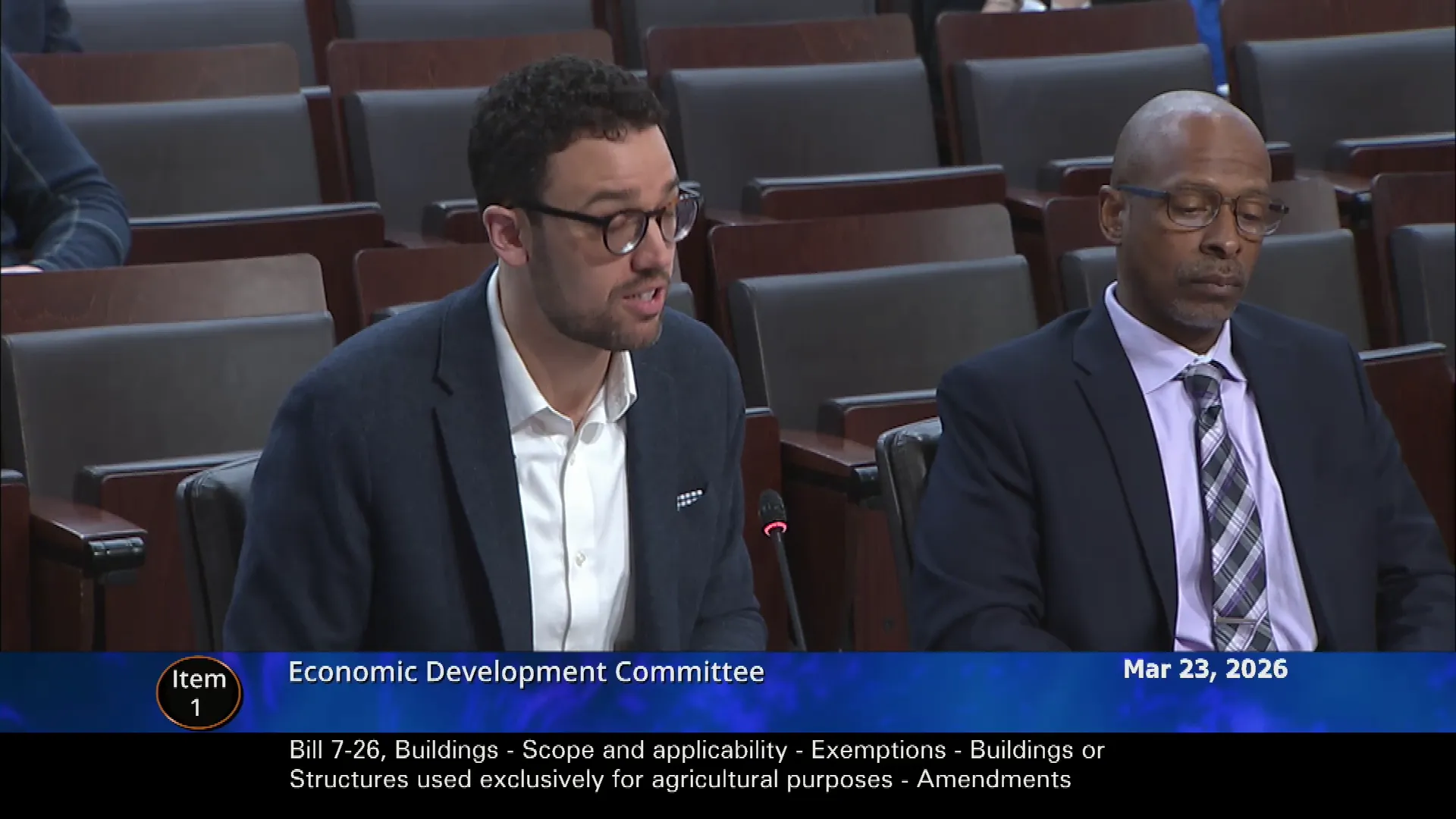
The Economic Development (ECON) Committee met on March 23, 2026, from 9:30 a.m. to 9:53 a.m. to consider Bill 7-26, which clarifies exemptions from county building code requirements for buildings or structures used exclusively for agricultural purposes. The bill was sponsored by Council President Fani-González, Council Vice President Balcombe, and Councilmember Luedtke. The committee heard from Legislative Attorney Ogorzalek, Director Scheffel of the Office of Agricultural Services, and Director Sabbakhan of the Department of Permitting Services (DPS). The committee recommended approval of the bill with a clarifying amendment, and the bill is tentatively scheduled for full Council action on April 7, 2026.
Public Comments & Testimony
- All public testimony received, both in person and written, was supportive of the bill. No specific speakers or organizations were named.
Discussion Items
- Definition of "agricultural purpose": The bill adds a definition taken from county zoning and agricultural easement codes, including business administration/management of agriculture and processing of agricultural products to prepare for market.
- Exception to exemption: The bill adds an exception requiring a building permit for structures where customers or members of the public consume food or beverage, to ensure public safety.
- Clarifying amendment: Staff proposed an amendment to ensure the bill does not conflict with Maryland Public Safety Article Section 12-508, which exempts certain agritourism structures (e.g., barns, stables) from occupancy permits. The amendment states that the new county permit requirement does not apply to structures already exempted under state law.
- Dual-purpose buildings: Councilmember Balcombe raised concern about buildings with both production and tasting rooms. Staff and directors explained that separate uses within a structure may be treated as separate structures for permitting, depending on fire separation and design. The agricultural production side would not require a permit, but public consumption areas would. DPS coordinates with the Office of Agricultural Services on a case-by-case basis.
- Residential use by farmers: Councilmember Luedtke asked whether a farmer's residence on agricultural land removes the property from exemption. Directors confirmed that a residence does not disqualify the property, as long as other thresholds (e.g., occupancy for agritourism) do not trigger a permit.
- Controlled environment agriculture: Councilmember Sayles asked whether innovative practices like controlled environment agriculture qualify. Director Scheffel said they generally would, but it is case-specific.
Key Outcomes
- The committee unanimously approved Bill 7-26 as amended (motion by Councilmember Balcombe, second by Councilmember Sayles).
- Next step: Full Council action tentatively scheduled for April 7, 2026.
Meeting Transcript
Good morning, everyone. This is the economic development committee uh session for March 23rd, already March 23rd. Um we only have one item is Bill 7-26, building scope and applicability exemptions, buildings or structures used exclusively for agricultural purposes, amendments. Um this bill sponsored by myself, Council President Naralifani Gonzalez, Council Vice President Balcon, and Councilmember Luki, who's here joining the econ uh work session. With that, I'm gonna turn it to Council Staff to walk us to into this packet, and I'm very happy to see uh both uh DPS director uh Rabbi Savakan and the Office of Agricultural Services, Director Mike Shaffle. Thank you for being here with us and all the partnership and work because um every time you introduce a bill, people have no idea all the work that goes behind the scenes, and you two as well as planning staff, they're sitting in the back have been wonderful. So thank you for that. With that, I turn it to staff. Thank you, Council President. Um Bill 726 is in intended to be a fair fairly narrow bill that clarifies the interpretation and enforce enforcement and implementation of chapter eight of the county code, which is the building code. Chapter 8 specifies that all buildings generally uh constructed within the county are subject to chapter 8. There is an exemption in existing county law, there is an exemption for a building or structure used exclusively for agricultural purposes on land used exclusively for agriculture. Uh that does flow down generally from the land use article of the Maryland Code and conforms to that. The term agricultural purposes, however, is not defined. The intent of this bill is to uh shed some light so that there is less gray area, both for the benefit of the regulating body, Department of Permitting Services, and um with the assistance of the Office of Agricultural Services, as well as for the property owners, the stakeholders, um, so that they can better understand when a permit is required. Um the bill was introduced on uh February 10th of 2026, um, and a public hearing was held on March 10th. The all of the public testimony that was received, both in person and written, was supportive. Um very quickly, the um impact statements, uh the climate assessment, no impact, fiscal impact, uh no impact, racial and equity minimal impact, and the economic impact is generally viewed to have a positive impact on economic conditions because of reduced fees as well as requirements placed upon the property owners. Um the bill itself is relatively brief. Um it sort of has two turns. Um I'll address them in sort of reverse order from the way they appear in the code. The first is that it provides a definition of agricultural purpose. This definition is is broadly taken uh to uh mimic that set forth in chapter 59, which is the zoning ordinance, uh, as well as in chapter two B, uh, which relates to agricultural uh land easements. Um the definition set forth uh in the bill would define agricultural purpose as a use or function in performance of the work or storage of the instruments of products or of agriculture uh as defined in section 1.4.2 of chapter 59, again of the county code, and agricultural purpose includes the business administration or management of agriculture and the processing of an agricultural product to prepare the product for market. And that really is sort of the the crux of the intent of the bill to shed light to make sure all both the regulate regulating bodies and the landowners are clear that things like the the business of doing farming is included when we refer to an agricultural purpose, as well as that uh processing of items to make them ready for market. The second turn um is if you look at uh page two, sorry, of the yeah, circle letter two of the packet um in the exemptions section. Um we deleted that paragraph A, which was sort of it referred to conditional uses, but was largely duplicative of what was already set forth above and and really didn't serve uh a statutory purpose and could potentially confuse. And and in its place, uh there was a lawyer's dream, an exception to an exemption um for a building or structure in which customers or other members of the public consume form foam or beverage. This was to make sure that if the agricultural processing facility included an element in which individuals were staying to drink and eat for a while, that that those structures would still be subject to chapter eight of the building code. There is an amendment that we can we can get to that the staff propose the clarifying amendment that is related to that section. Can you go over to the amendments? Yeah, absolutely. So there's one amendment in the packet, and you can find it on page three of the staff report. Um so ch chapter uh section sorry, section 12508 of the public safety article of the Maryland Code includes a provision already that certain agricultural buildings, and it's pretty fair fair fairly narrowly defined by the state, and it really is sort of what you might think of as a barn or a stable or a silo, sort of that sort of prototypical agricultural structure does not require a change in occupancy permit when it is used for agritourism activities. Now, agritourism activities itself is defined in Maryland state regulation and again has sort of an unclear definition, frankly. It refers to entertainment and recreation. It has a non-exhaustive illustrative list that largely relates to viewing agricultural activities. So it's it's sort of unclear, but to the extent the the sponsor's goal in this bill was not in any way to increase the permitting uh requirements upon these business owners, these business owners, these uh these property owners. And so to the extent there's some overlap between 12508 and where what that would exempt a pr a building from uh from a permitting process and the new language in chapter eight of the county code. This is intended to make very clear this amendment that this was not intended to impose a new amendment on that which had been exempted under 12508. So it simply states uh that that requirement for a pill uh for a permit for a building or structure in which customers or other members of the public consume from a beverage, unless it is exempted under Maryland Code 12508 of the pay public safety article as amended. I'll I'll note that it's not a clear preemption issue to be very clear because Section 12504 of the Maryland Code actually allows the county to increase the floor of permitting requirements. Um so I think that this is an important one to reach that intent to make sure that the council's intent was clear here. Great. Thank you so much for all the work. Before I turn it to Colleys, uh the any of the directors would like to uh comment, especially with this, I'm gonna say technical amendment from staff. Um any flags that you may see. Thank you. Good morning. Thank you, uh members of the committee.
openpublica.com