Government Operations and Fiscal Policy Committee FY27 Operating Budget Review - April 10, 2026
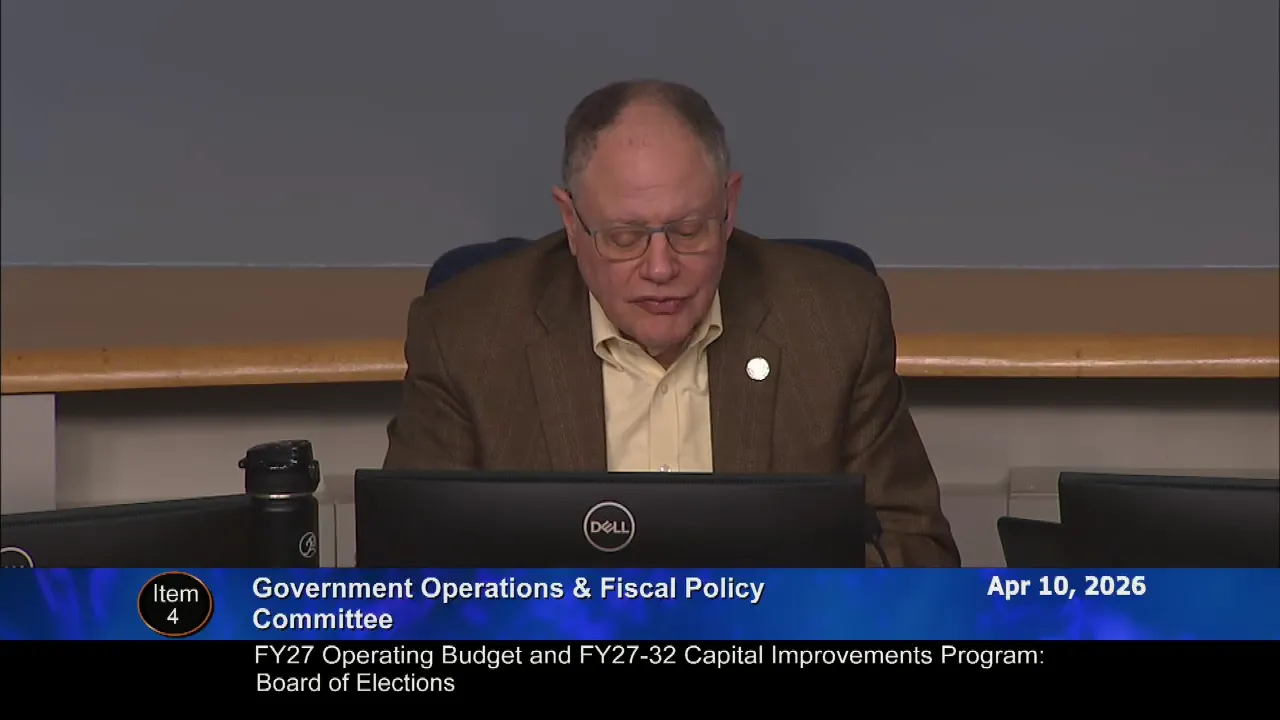
STREAMING COPY IN PREPARATION — RECORDING AVAILABLE FROM THE ORIGINAL SOURCE
Government Operations and Fiscal Policy Committee FY27 Operating Budget Review - April 10, 2026
The Government Operations and Fiscal Policy (GO) Committee, chaired by Councilmember Kate Stewart, met on April 10, 2026 from 9:30 a.m. to 11:00 a.m. (agenda indicated 9:30 a.m. – 12:30 p.m., but minutes reflect an earlier adjournment) to review six FY27 operating budgets. The committee heard presentations from department heads and analysts, discussed racial equity and operational challenges, and made recommendations for full Council consideration in May 2026.
Ethics Commission
- Proposed budget: $312,274 increase (+85.36% from FY26), driven largely by a one-time $273,000 line item for upgrading three IT systems (financial disclosures, outside employment, lobbying). The systems are at least 10 years old (last updated in 2015) and the electronic financial disclosure system is required by law. $10,000 of the upgrade cost becomes ongoing licensing.
- Racial equity: Received an ORESJ commitment rating of 5 out of 11 (emergent commitment). The small two-person office (currently one person) is working with the Office of Racial Equity and Social Justice on trainings.
- Recommendation: Council staff recommended placing the $273,000 IT upgrade on the Council President’s Reconciliation List. The committee concurred.
- Speakers: Chief Counsel O’Connor, Chair Kellar, Councilmembers Stewart, Evans, and Katz praised the commission’s work and noted the need for resources.
- Key outcome: Recommended approval of the FY27 Operating Budget for the Ethics Commission as amended with the reconciliation line item.
Merit System Protection Board (MSPB)
- Proposed budget: $18,622 increase (+4.99% from FY26), covering compensation adjustments and operational increases. No reconciliation items.
- Racial equity: Received an ORESJ rating of 7 (sustained commitment). The board recently published a racial equity action plan on its website and incorporates implicit bias training and equity components in its mandatory five-year audits.
- Staff size: Three board members and two staff (executive director and part-time coordinator).
- Context: An independent classification and compensation audit (required every five years) was conducted in CY2024; recommendations are still being implemented. The committee noted future councils may consider postponing the next audit to allow full implementation.
- Speakers: Executive Director Haentfling, Chair Hopkins-Laboy, Councilmember Evans emphasized the importance of interpreting the equity rating in context of a small quasi-judicial body.
- Key outcome: Recommended approval as submitted by the County Executive.
Charter Review Commission Non-Departmental Account (NDA)
- Proposed budget: $1,000 decrease from FY26, maintaining $150 level funding for odd-numbered years after the biennial report is published.
- Overview: The commission is appointed every four years per §509 of the county charter; reports are due by May 1 of even-numbered years.
- Key outcome: Recommended approval as submitted.
Office of Public Information (PIO)
- Proposed budget: Net decrease of $21,555 (including $128,724 in compensation and other cost increases). A same-services budget with no new initiatives.
- Racial equity: Received an ORESJ rating of 4 (emergent commitment). PIO intends to partner with other small departments to combine RESJ activities. The director noted a focus on completing required trainings and reaching underserved communities through alternative media (neighborhood newsletters, faith-based outlets, diverse media) and collaboration with the Office of Community Partnerships.
- Staff size: Approximately 17.5 FTEs.
- Speakers: Director Anderson, Councilmembers Stewart, Evans, and Katz discussed the importance of equitable outreach given PIO’s external-facing role.
- Key outcome: Recommended approval as submitted.
Board of Elections (BOE)
- Proposed budget: $809,341 increase from FY26, including six specific changes:
- $200,000 for election judge stipends (anticipated higher turnout and more equipment).
- $167,319 for 69 seasonal temporary staff.
- $112,400 for license/software of a new election worker management system (replaces an outdated unsupported system; went live March 2026).
- $24,453 for maintenance/support of that system.
- $59,860 for overtime expenses (certification, statewide audit, election year demands).
- $292 for 2.5% inflationary adjustment to nonprofit contracts (to be reviewed council-wide).
- Racial equity: Received the highest ORESJ rating of 11 (proactive and strategic commitment). BOE produces voter guides in five languages (English, Spanish, Chinese, Vietnamese, plus French and Korean via waiver), conducts about 300 outreach events per year, and pilots a new equity checklist for outreach.
- Election preparedness: Director Brajkovic and Board President Naiman provided an extensive update. Key points:
- Primary election: June 23, 2026.
- Early voting: 14 sites, same hours as 2024; election day polling places nearly all same (7 changed due to construction).
- Mail-in ballots: Voters can receive ballots by mail or print online; return via 58 drop boxes (same locations as 2024), USPS, or in person. Drop boxes will have redesigns to avoid lock confusion.
- New state legislation: Voter guide translations for Chinese and Vietnamese; BOE added French and Korean via waiver.
- Lawsuit and executive orders: RNC lawsuit challenged list maintenance (BOE dismissed); Supreme Court case on Mississippi mail ballot receipt deadline (decision expected late June/early July); new executive order attempting to restrict mail balloting (challenged in five lawsuits, including by Maryland).
- Election judge recruitment: Ongoing; challenges include finding enough Republican volunteers to meet state parity requirements. BOE uses targeted advertising and has a new training center. Future Vote program starts in 6th grade, and 16- and 17-year-old registered voters can serve as paid election judges.
- Provisional ballot concerns: Voters who go to the wrong polling place or who requested a mail ballot but vote in person must use provisional ballots. BOE encourages early voting and use of sample ballots and text-to-check services (text CHECK to 77788).
- Speakers: Director Brajkovic, President Naiman, Administrative Specialist Merino, Councilmembers Stewart, Katz, Evans. Multiple councilmembers thanked BOE for high equity rating and responsiveness.
- Key outcome: Recommended approval as submitted (no reconciliation items).
Public Elections Fund (PEF) Non-Departmental Account
- Proposed budget: $110,812 increase for the fund, allocated as $50,000 to meet State Board of Elections billing for campaign finance/PEF liaison support and $60,812 to support the state-employed liaison through the election cycle. Base level funding of $333,000 maintained to reach $5 million target.
- Fund balance: $2,679,108 as of March 2026 ($77,817 from interest income).
- Key outcome: Recommended approval as submitted.
Key Outcomes
- All six FY27 operating budgets were recommended for approval by the GO Committee, with the Ethics Commission budget amended to include the $273,000 IT upgrade on the Reconciliation List.
- The committee did not place any other items on the Reconciliation List.
- Full Council consideration for all budgets is scheduled for May 2026.
- The committee emphasized the importance of racial equity efforts, particularly for small departments and those with public-facing roles, and encouraged collaboration among small agencies to advance RESJ goals.
Meeting Transcript
Good morning, everyone, and welcome to this session of government operations and fiscal policy. We are beginning our review of the FY27 operating budget. We have uh six um department budgets to go through this morning, so I'm very excited. I'm thank you uh already to our staff for excellent packets and doing a great deal of work. Uh we're gonna kick it off this morning with our ethics commission. If folks wanna come on down. Um yeah, our first uh review of the FY27 operating budget is our ethics commission. Thank you, Ms. O'Connor, for joining us. And I'm just gonna turn it over to our team to walk us through the packet and what's recommended by the county executive. Thank you. Good morning. The executive recommends an increase for the ethics commission of 312,274, which is 85.36% from the FY26 approved operating budget. Uh that's a large increase, but the vast, vast majority is a one-time expense for the upgrade of the ethics program IT systems. Uh, there are three of those systems. So jumping to page three on your packet where that's broken out in a little more detail. This 273,000 item provides for upgrades to three different different systems, one for financial disclosures, one for outside employment, and one for lobbying. Um this was previewed for the committee last year in terms of the needs of the the um upgrades of the systems. They're old with the most recent having uh last bit having been implemented in 2015, so they're all at least 10 years old. And as they age, they begin to show challenges that affect filers and make it more difficult for them to file with these three systems. Um the commission has indicated that it's most cost effective to upgrade all three of these systems at once instead of considering them in tranches or breaking them out over three, and again, of the total cost of the item, 263,000 is one-time funding to implement the upgrades. The remaining 10,000 dollars of this item will be built into the budget as an ongoing expense for licensing. So council staff recommends placing that item on the reconciliation list for the council president's budget approach. The only other thing that I will highlight, jumping back to page two of the packet is the operating budget equity tool analysis. As the committee is aware, the Office of Racial Equity and Social Justice has issued each department an analysis to highlight how its proposed budget and resource allocations support the goal of eliminating or reducing racial inequities and social injustices in the county. ORESJ issued the Ethics Commission a commitment level rating of five on an 11-point scale, which indicates that the department demonstrates an emergent commitment to advancing racial equity and social justice. ORESJ's analysis is provided for the committee's review in the packet and centers uh in large part around the capacity issues due to the ethics commission being such a small office and the challenges with implementing um the additional programs. Um however, the office notes that the ethics commission does have uh has demonstrated a willingness to collaborate with ORESJ on training and um had active participation uh in various ORESJ initiatives. So with that, and with the recommendation to add this single line item to the reconciliation list, I'll turn it over to the committee for questions or to the commission for comment. Great. Thank you very much. Um Director Conner, do you want to walk us through anything or add? I just want to thank everyone for uh speaking with us today and for your continued support of the ethics programs. I will reiterate what I said last year that the systems are definitely showing the wear and tear of the ancient nature of the platforms that they're on. We are experiencing increased issues from users and increased complaints, sadly. And with uh most of us in the room having to use these systems, it is a benefit to all of us to uh maintain them. And not to not to mention the fact that the electronic system for the financial disclosure is required by law. And for it to fail would be uh hazardous for the entire county. Thank you. Thank you for making that point. Um I know um we looked at the um excuse me, the racial equity budget tool analysis and um and we've talked about this in the past as well, um, given the size of the staff and appreciate the efforts that are being made. Um one of the things I just want to lift up is I think from the um analysis was that um the racial equity um department feels like the uh the department's um efforts in this area are stagnant due to time constraints. Um, and are there ways that we can think about in the upcoming year to really move from stagnant to moving? It's a wonderful question. I will tell you that the the full breadth of RESJ's blurb in our uh budget uh packet notes that while we are a two-person operation, currently one I'm hiring for the second. We are both in past iterations and in future iterations, we are both going to be equity leads. We both uh will be uh facilitators for RESJ. I have offered to create trainings for RESJ. Uh we are a small engine, but we are uh doing our level best, and that has been recognized by RESJ. There are some issues that we are in continued talks with RESJ and how to strengthen our performance with their mission.
openpublica.com