Montgomery County Public Safety Committee FY27 Budget Review - April 15, 2026
STREAMING COPY IN PREPARATION — RECORDING AVAILABLE FROM THE ORIGINAL SOURCE
Montgomery County Public Safety Committee Meeting Summary – April 15, 2026
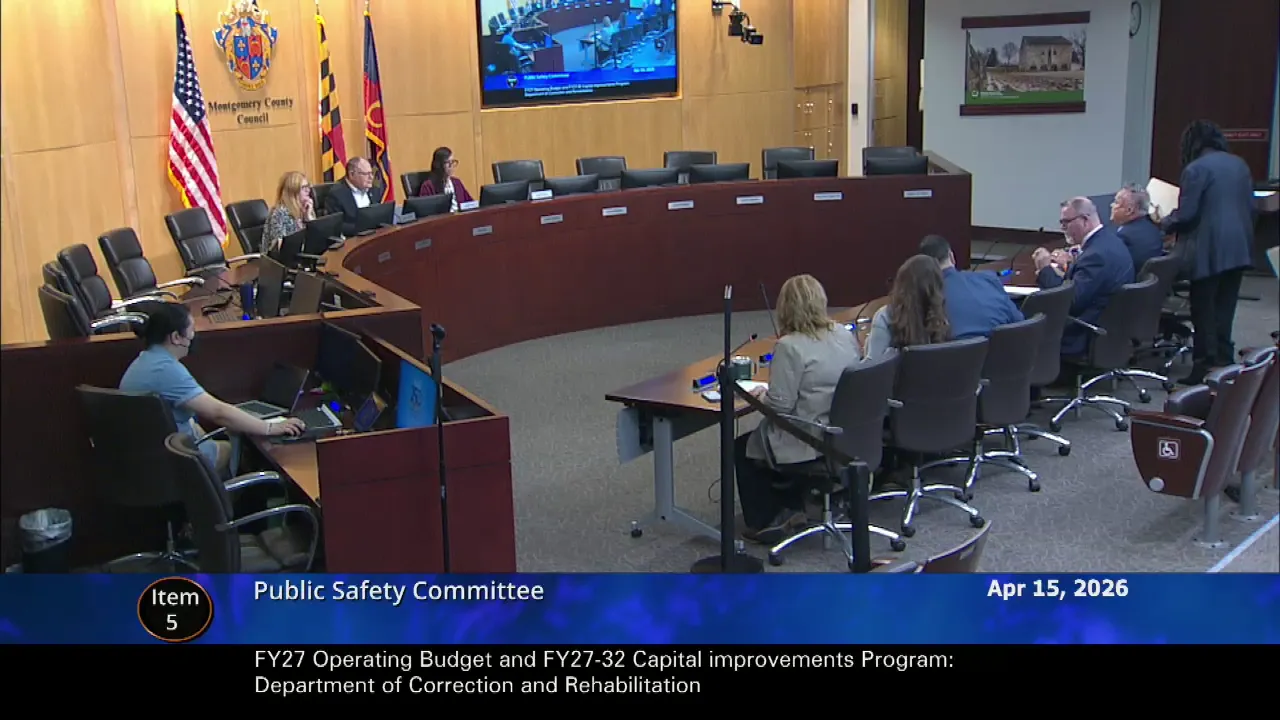
On April 15, 2026, the Montgomery County Public Safety Committee (Chair Sidney Katz, Councilmembers Dawn Luedtke and Kristin Mink) met from 9:30 a.m. to 11:03 a.m. to review the County Executive's recommended FY27 Operating Budget for five agencies: Office of Animal Services, Sheriff’s Office, State’s Attorney’s Office, Circuit Court, and the Department of Correction and Rehabilitation. The committee voted unanimously (3-0) on all items, placing several funding requests on the Reconciliation List and approving each budget as amended.
Circuit Court
- Discussion: Administrative Judge Carla Smith and staff presented a $1.2 million (6%) increase request for FY27, totaling $21.8 million. A key item was $391,877 to address a funding gap for 29 grant-funded positions (e.g., problem-solving court staff, self-help attorneys, custody evaluators, data analysts) whose state grant reimbursements have not kept pace with county pay raises, threatening pay equity and leverage of state funds. Judge Smith emphasized that losing these positions would reduce access to justice for low-income residents. Chair Katz noted that 87–88% of the court's budget is personnel.
- Outcome: The committee unanimously placed the $391,877 on the Reconciliation List and approved the Circuit Court budget as amended. Staff will investigate whether this item can be categorized as a “known commitment” rather than a new expenditure.
Office of Animal Services (OAS)
- Discussion: Director Caroline Hairfield reported that OAS starts each day at 125% over capacity; surrender rates have risen to 41% (from 38%) driven by housing instability and financial hardship. The shelter is authorized for 15 Animal Care Attendants (ACAs) versus a best-practice recommendation of 24. Animals routinely spend 23 hours a day in cages due to understaffing. Director Hairfield described a “mass casualty incident” environment causing moral injury among staff. The executive’s recommended budget included no new staffing; Chair Katz proposed adding five ACA positions ($437,410) in two tranches (three and two) on the Reconciliation List.
- Outcome: The committee (3-0) approved placing two tranches of ACA positions (three positions and two positions) on the Reconciliation List, with the understanding that splitting the request could maximize funding chances. The rest of the OAS budget was approved as recommended.
Sheriff’s Office
- Discussion: Sheriff Uy reported improving hiring (nine deputies in current academy class, shrinking vacancy rate). The executive recommended a $51,660 increase (0.16%). The only Reconciliation List item was $178,043 (1.31 FTEs) to rebalance workloads previously grant-funded for judicial security—these are filled positions, not new hires. Overtime expenditures have historically exceeded budget; FY26 shows projected decline. A potential reduction of $10,483 in the Taser/body-worn camera contract was noted (invoice came in lower than budgeted).
- Outcome: The committee (3-0) placed the $178,043 on the Reconciliation List and voted to reduce the Taser/body-worn camera line item by $10,483 (from $246,929 to $236,446). The Sheriff’s Office FY27 budget was approved as amended.
State’s Attorney’s Office
- Discussion: State’s Attorney John McCarthy and staff requested a 4.8% increase ($1.3 million, total $28.7 million). Two Reconciliation List items: (1) $314,118 to replace lost federal grant funding for four legal assistant positions in the evidence review unit (filled positions); (2) $225,383 for Axon Justice Premier licenses to improve digital evidence review, redaction, and transparency. State’s Attorney McCarthy noted the licenses are necessary for constitutional discovery obligations and that procurement constraints prevented piggybacking on the police contract. Councilmember Mink flagged the need for enterprise-wide procurement efficiencies.
- Outcome: The committee (3-0) placed both items on the Reconciliation List and approved the State’s Attorney’s Office budget as amended.
Department of Correction and Rehabilitation (DOCR)
- Discussion: Director Ben Stevenson presented a $4 million increase (4.2%, total $99.4 million). Four Reconciliation List items: (1) $182,609 for a dedicated K9 contraband detection unit (no new positions); (2) $131,439 for CPI-driven contract increases (later moved off the Reconciliation List as contractually obligated); (3) $47,422 for full-time instructors to sustain education programs (partially off-ramped if legally required for IEP services); (4) $18,000 to replace obsolete taser units for the emergency response team. The executive also recommended abolishing seven vacant positions in pretrial services and pre-release/re-entry, saving $1.1 million, due to declining program participation and lower average daily population at the pre-release center (currently ~60 residents vs. 80 pre-COVID). DOCR’s average daily population is down by about 70–80. Juvenile population has declined to 13.
- Outcome: The committee (3-0) placed all four items on the Reconciliation List (with budget change #2 removed per staff recommendation) and approved DOCR’s budget as amended. Staff will follow up on whether part of the education funding is legally obligated and provide an update on pre-release center population in 4–6 months.
Key Outcomes
- All five agency budgets were approved unanimously (3-0) with the amendments described above.
- Several items were placed on the Reconciliation List, including: $391,877 (Circuit Court), $437,410 for ACAs (OAS, split into two tranches), $178,043 (Sheriff’s Office), $314,118 and $225,383 (State’s Attorney’s Office), and $182,609, $131,439 (later removed), $47,422, $18,000 (DOCR).
- The committee emphasized distinguishing between ongoing filled positions (needing an “asterisk”) and new expenditures.
- Staff will provide additional information to the full Council on the Circuit Court funding gap classification and the DOCR education funding obligation.
Meeting Transcript
Corrections and rehabilitation. As we begin, I'd like to thank Ms. Farag and Mr. Onbinder for preparing the staff reports for the topics today and for once again and always assembling a most informative package for us. And unless the other committee members have any opening comments, and I'm seeing two shaking of heads, no. I'm going to ask the first panel to please uh introduce themselves and if yes, if they have any opening comments. And then I'm going to ask Ms. Farag to please walk us through the panel. Good morning. Good morning, Your Honor. Judge Carla Smith from the circuit court. Good morning, Tim Sheridan, Court Administrator. Carol Hawkins, Deputy Court Administrator. Good morning. Do you have any opening comments? If not, we'll just make this opening comment. You know we're here. Your Honor, could you move? There you go. You know, we're here to uh discuss a funding gap that we have uh this year. And uh I just want you to know I just left the courthouse, was in the middle of a plea uh with the individual dealing with the DUI per se and a high blood alcohol level, a lot of trauma, need for therapy, et cetera. And I recommended that he apply for our drug court. And that is one of the you know grant positions that we are looking to uh supplement. So I just want you to understand how impactful it is in our community. And I appreciate that. I know that many of us have gone to to see the graduations, if that's what they're calling it, drug court and and and uh mental health court, the problem solving courts, and how they how they change lives for the better. Sometimes it takes a while for someone to get themselves to the better, but how they change lives for the better. So it's certainly there's certain things we can't afford not to do. Absolutely. And with that, sure. Good morning, everyone. Um for the circuit court this year, the recommended increase is about 1.2 million. That's about a 6% increase from the approved budget from last year. If fully approved, the circuit court's budget would be about $21.8 million dollars. The executive's recommendation, which Judge Smith just alluded to, includes about $392,000 in some staff, programmatic and staffing additions, enhancements, and other cost increases that must be placed on the reconciliation list. This year, the council president's approach is to place all new or additional tax supported funding on the reconciliation list. There are some limited exceptions to that, and we can get go through that as we go through the uh staff report. Um the executive's recommended budget also has about $718,000 increase for compensation adjustments, and there's an additional $200,000 for other net cost increases that are not required to be placed on the reconciliation list. The circuit court is not required to submit an operating budget equity tool analysis. It has, however, provided information on its racial equity and social justice efforts over the past year. I have also not identified any potential reductions for committee consideration that were not included in the executive's recommended budget. For the first item, which is described on page three. Um this general fund increase of $391,000 would ensure pay equity between state-funded, which are grant funded, and county funded staff positions who often perform the same work. The Circuit Court advises that they their staff consists of 24 judges, uh six magistrates, 225 employees, clerks of the court, and then they also have 129 employees that are on the county payroll. And it's those employees that we're looking at in this universe. Um the judges and magistrates are all funded by the state, but of the 129 employees on the county payroll, 29 are funded by 4.4 million dollars in state grant funding that the court receives each year. And these state grants reimburse the county for a little more than 90 percent of actual pay and benefits paid for these employees. And since state grants increase annually based on state merit and general wage increases, which historically have been less than those given to county employees, this has created a funding gap that just gets bigger and bigger every year. Um they have not kept pace sufficiently to maintain pay equity among similarly functioning county positions. And again, it impacts 29 of the 129 employees on the county payroll.
openpublica.com