Transportation and Environment Committee Meeting – April 16, 2026
STREAMING COPY IN PREPARATION — RECORDING AVAILABLE FROM THE ORIGINAL SOURCE
Transportation and Environment Committee Meeting – April 16, 2026
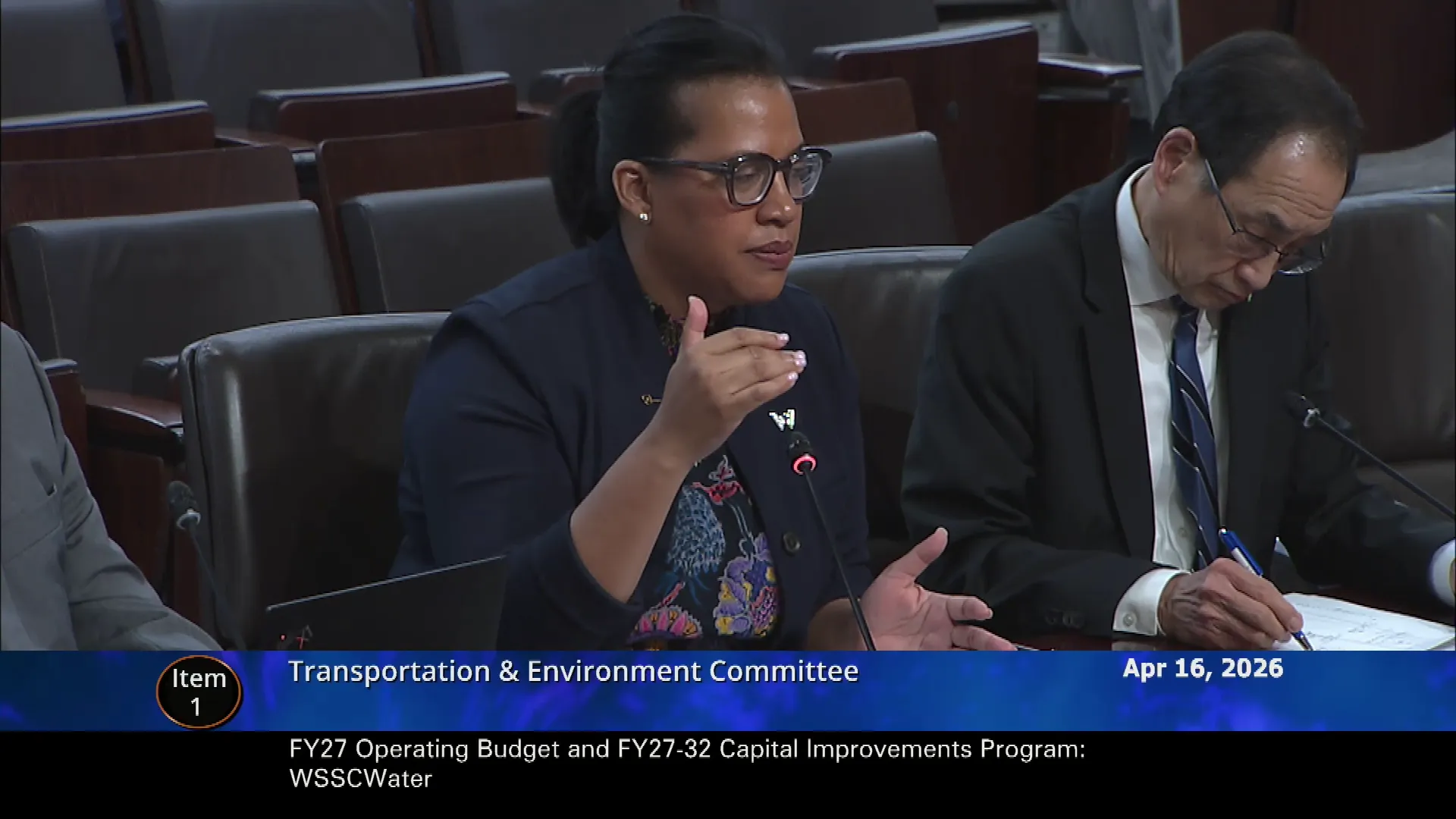
The Transportation and Environment (T&E) Committee met on Thursday, April 16, 2026, from 1:35 p.m. to 3:30 p.m. to review the FY27 Operating Budget and FY27-32 Capital Improvements Program (CIP) for WSSCWater, Utilities Non-Departmental Account (NDA), Department of General Services (DGS) Fleet Internal Service Fund, Motor Pool NDA, Montgomery County Department of Transportation (MCDOT) Parking Lot Districts, and a resolution to adopt FY27 Transportation Fees, Charges, and Fares. The committee heard presentations from agency staff and council analysts, discussed fiscal challenges and service needs, and recommended approval of several items, with additions placed on the reconciliation list for full council consideration.
Discussion Items
WSSCWater FY27 Operating Budget and CIP
- WSSCWater presented a proposed 5.0% volumetric and fixed-fee increase, down from earlier projections due to internal cost-cutting. The budget includes no new FTEs and relies on a 6% revenue enhancement (5% from rates, 1% from non-rate revenue and fund balance).
- Key cost drivers: increased debt service (4%), regional sewage disposal (7%), heat, light, and power (9%), health insurance (10%), and rising costs from chemicals, fuel, and tariffs. Federal funding for water assistance is declining; a pilot low-income program was sunset.
- The Potomac Interceptor emergency repair costs increased: DC Water’s estimate rose to $59 million, with WSSCWater’s 30.9% share impacting future rates (estimated at 0.6% of a future rate increase). Planned projects for the interceptor are also costing more; these will be incorporated in a future CIP amendment.
- The committee supported the proposed 5% rate increase and the 2.4% increase in the System Development Charge, but noted that long-term rate projections (e.g., 8.2% in FY28) are uncertain and subject to bi-county agreement with Prince George’s County.
- Councilmember Balcombe expressed concern about future rate increases and the need to avoid capital deferrals. Councilmember Stewart emphasized the importance of regional advocacy for federal assistance and avoiding deferred maintenance.
Utilities NDA (Non-Departmental Account)
- The County Executive recommended a $633,618 increase (1.5%) for utilities. Key changes: $2.1 million increase for resiliency hub and microgrid lease payments, $840,000 for higher commodity costs, and $61,000 for utility charges at the new MCPS bus depot lease site (true cost ~$100,000). A $2.1 million shift of electric bus fuel costs to the Fleet Internal Service Fund reduces the NDA.
- The committee discussed that the microgrid payments are contractually obligated and should not be treated as discretionary. An asterisk was noted for such items on the reconciliation list.
- DGS Director Dice described progress on the MCPS bus depot relocation to the GUTI site, with lease executed November 2025, design nearly complete, and construction expected to finish by August 2027.
DGS Fleet Internal Service Fund
- The County Executive recommended a 1.33% decrease in the fleet budget. Notable: a $742,000 addition for hydrogen fuel for new Ride On hydrogen fuel-cell buses on the Viers Mill corridor, to be placed on the reconciliation list. Without funding, the 13 buses (arriving by September 2026) would be idle until fueling infrastructure is complete.
- The committee agreed that hydrogen fueling should be funded to avoid stranding capital investments. Director Dice noted that without fuel, the buses become “very expensive paperweights.” Councilmember Balcombe highlighted the importance of workforce development programs like the fleet apprenticeship program.
Motor Pool Fund Contribution NDA
- The County Executive proposed a 97% decrease ($41,200 for one vehicle) for the Mobile Crisis Outreach Team under HHS. This vehicle is tied to an expanded HHS service. The committee stressed that if the HHS service is funded, the vehicle must be as well—an asterisk noted.
MCDOT Parking Lot Districts (PLDs)
- The committee recommended a $149,998 addition for one Transportation Contract Compliance Inspector (split across Bethesda, Silver Spring, Wheaton PLDs) to cover expanded collection hours (Saturdays and until 10 p.m.). Revenue from the hours expansion is estimated at 20-25% increase per PLD (total PLD revenue ~$30 million). Councilmember Stewart requested data on compliance issues to justify the FTE.
- A $42,000 addition for a new fleet vehicle for maintenance was also supported; it reduces rental costs.
- The committee noted the elimination of urban district transfers (Bethesda: $1.6M, Silver Spring: $150K, Wheaton: $225K) and three FTEs from Silver Spring PLD, continuing a trend to sever PLD subsidies to urban districts. General fund dollars will replace these transfers for urban districts. Fund balances vary: Bethesda ~11%, Silver Spring ~0.4% (negative by FY28), Wheaton ~124% (due to planned fare structure changes).
- CIP adjustments: $895K increase for Gate 31 payment system upgrades in Bethesda; a $276K decrease in Silver Spring facility renovations (affordability deferral); $400K increase for elevator tower renovations in Wheaton Garage 45.
Resolution for FY27 Transportation Fees, Charges, and Fares
- The committee recommended approval of new and modified fees:
- $75 fine for driving/standing/parking in bus lanes (codifying a pilot with manual enforcement; automated enforcement pending privacy compliance).
- New Controlled Zone (CZ) permit: $205/month per space in Bethesda, $140 in Silver Spring/Wheaton, for employers reserving 75+ spaces. Overselling at 80% occupancy typical; will monitor and adjust. Councilmember Balcombe requested not to oversell to ensure availability. Councilmember Stewart asked for outreach to small businesses; MCDOT agreed.
- Electric vehicle charging fees: 50¢/kWh for fast chargers, 35¢/kWh for Level 2 (up from 17¢, reflecting maintenance costs).
- Wheaton PLD fee changes: end collection at 6 p.m. weekdays and on Saturdays, offset by doubling hourly street parking from $1.25 to $2.50, surface lots $1 to $2, garages $1 to $1.75. Revenue neutral per WUDAC request.
- $60 fine for stopping in bikeways (Bill 28-25).
- Residential permit parking hearing fee moved to code.
- Elimination of Transportation Demand Management fees (per Bill 24-25).
- Councilmember Stewart requested MCDOT work with Silver Spring on similar adjustments given Wheaton’s changes; Director Conklin expressed openness to parallel discussions if revenue neutral.
Key Outcomes
- WSSCWater: Committee recommended approval of FY27 Operating Budget with 5% rate increase and 2.4% System Development Charge increase. Next steps: Council worksession May 4, 2026; bi-county meeting with Prince George’s Council on May 14, 2026.
- Utilities NDA: Recommended approval as amended, with microgrid payments, energy benchmarking, bus depot utilities, hydrogen fueling, and HHS crisis vehicle placed on reconciliation list (non-tax-supported).
- Fleet Internal Service Fund: Recommended approval, with hydrogen fueling on reconciliation list.
- Motor Pool NDA: Recommended approval, with one vehicle tied to HHS service on reconciliation list.
- Parking Lot Districts: Recommended approval of FY27 Operating Budget and CIP amendments, with one contract compliance inspector and one fleet vehicle placed on non-tax-supported reconciliation list.
- Transportation Fees Resolution: Recommended approval of all new and modified fees as submitted by the County Executive.
- All items were supported without objection by the committee.
Meeting Transcript
Good afternoon, everybody. It is Thursday, April 16th. Welcome to the Transportation and Environment Committee. We are picking up work on the FY26 budget. And there are six items on the agenda today. WSOC water, Utilities, DGS fleet, the motor pool contribution and NDA, the Department of Transportation parking lot districts, and a resolution to adopt the FY27 transportation fees charges and fares. But we will start with WSSC water, which provides two million residents with water every single day. And in response to that, WSSC is requesting a 5% volumetric and fixed fee increase, which we will learn more about. And I'll start with Mr. Lopchenko. Good afternoon. WCC Water does have a slide deck, which we can go through, and then after that, items that I have in my packet that were not covered in the slide deck, we can get back to to make sure we cover them. But I think that might be the most efficient way to get through this in a timely manner. So I'll turn it over to Ms. Powell to introduce the folks at the table. Fantastic. Good afternoon, Chair Glass and Councilmember Stewart and Balcom. Thank you for having us here today. I'm joined by our CFO, Minetsi Masara, as well as Chief Engineer Alan Wong. I'm Keisha Powell, General Manager and CEO for WSSC Water. We also have other members of our finance team in the audience, and I'm here on behalf of our commissioners as well. As we've said previously, we uh transition about three years ago to really developing our budget around specific outcomes and the vision for the utility, which is we've said sustained and transformative change. We're focused on primarily four pillars across our eight strategic priorities, with uh infrastructure being one, our workplaces, the workforce, innovation and technology, as well as uh improving service delivery. Next. WSSC Water is an anchor institution for our communities, uh, meaning that we through the work that we are doing, the work that we control, meeting permits for our facilities, uh, fixing water mains, uh, investing in infrastructure, protecting 9 billion in infrastructure assets on behalf of our customers. Uh we are in um many respects protecting the economic output of the two counties. And uh we have funding in our budget to support customer assistance as well. And I have to just say that um that is extremely important. Uh just this week we were uh in Washington, D.C. for the water policy fly-in, and um on discussions around the low-income household water assistance program, uh, which was a federal pilot out of uh during the COVID time period, uh that sunset last year. Um we've been told that that will not uh make it into the bill for re for an authorization for a permanent program. So that means there is no federal level assistance program. We do not have any state level assistance for water bills to help customers with water bills. So our customers will be solely reliant on the funding and programs that we can provide in partnership with others like Habitat for Humanity to provide the assistance necessary. Just the bottom line up front where our budget formulation is concerned. WSSC water targeted a cut of uh 5% cut below fiscal year 26 budget levels, uh approved budget levels. The fiscal year 2027 proposed budget was an 8% reduction. We were able to cut 27 million from what you know we would call the discretionary portion of the department budgets, discretionary in this sense is costs that are not required of us from others, though many of those costs are costs that we cannot cut, like chemicals and other things, fuel, other things that are necessary for operations. We also focused on cost containment and saw efficiencies within our existing programs. We have no new programs that are included in the budget, and we did not include any new head count requests. Next. Most of the funding for our budget, I believe it's about 93% comes from our customers. And we don't, you know, that's not something that we want to be the case, but it is something that is the case because there is not a lot of federal funding for capital. And I made the point this week to uh stakeholders in Washington, our uh congressional delegation in Washington that even though we are focused on reauthorizing uh state revolving funds to support the capital program, there is nothing that supports our operating, the operating side of the budget, which is why uh the low-income household water assistance program is so important. Um we've also included here the operating uses of funds, um, the operating expenses. We also include debt service in the operating budget and uh pay as you go funding for the capital program. And you can see on the the uh blue side of the of the budget is is our capital uh side, the debt, this uh state funding, pay as you go for the capital sources of funds, um, the system development credits and other contributions, and then the specific uses. The lion's share of the funding goes towards WSSC waters infrastructure capital projects. We do have some interjurisdictional investments that were required to make that includes funding that we pay toward DC Waters capital program for Blue Plains and the adjustments for developer funded projects. On the next slide, you'll see the specific budget drivers.
openpublica.com