Health and Human Services Committee FY27 Budget Review - April 16, 2026
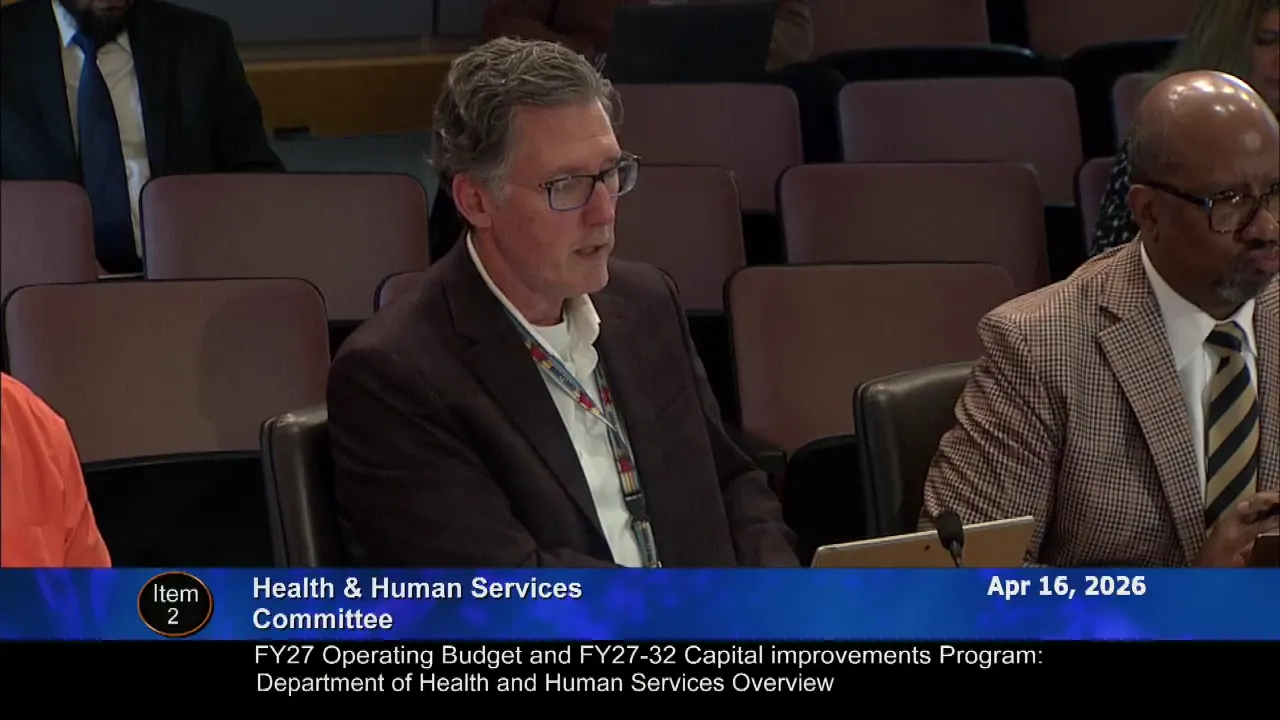
STREAMING COPY IN PREPARATION — RECORDING AVAILABLE FROM THE ORIGINAL SOURCE
Health and Human Services Committee FY27 Budget Review - April 16, 2026
The Montgomery County Health and Human Services (HHS) Committee, chaired by Councilmember Laurie-Anne Sayles, met on April 16, 2026, from 1:31 p.m. to 4:39 p.m. to review the FY27 Operating Budget and FY27-32 Capital Improvements Program for the Office of Food Systems Resilience (OFSR), the Department of Health and Human Services (DHHS) overview, and DHHS Administration and Support. The discussion took place amid a challenging fiscal year with significant federal and state funding uncertainties. Key decisions included recommending approval of the County Executive's proposed budgets, with specific votes on program enhancements and reductions, and directing follow-up on contract details and vacancy analyses.
Public Comments & Testimony
- Multiple nonprofits testified during public hearings held April 7–9, 2026, urging support for food system programs. The Commission on Health submitted a formal request for additional OFSR grant enhancements.
- Significant public testimony supported HHS budget items, which will be discussed in service-area reviews.
Discussion Items
Office of Food Systems Resilience (OFSR)
- Director Heather Bruskin presented OFSR's evolution over three years from non-strategic funding to competitive, tailored grant programs, emphasizing a layered approach to building a resilient food system: protecting federal assets (SNAP), adaptable infrastructure, community food access, and education.
- The committee reviewed the FY27 recommended budget of approximately $13.8 million (less than 1% increase from FY26). Key changes included:
- Enhancement: $150,000 for a new Food Systems Education Grant Program to mitigate the loss of federal SNAP-Ed funding (formerly $700,000 across 46 sites).
- Reduction: $150,000 from the Retail Food Access Program (MC Groceries and nutrition benefits outreach) reflecting stable enrollment.
- Reduction: $230,779 from the Food as Medicine Grant Program (31% decrease) due to overlapping services and growth in external funding opportunities.
- Councilmember Friedson and Luedtke questioned regional coordination, the impact of federal cuts (e.g., SNAP-Ed, refugee support), and the Ag Reserve. OFSR reported $3.5 million in special appropriations were fully expended via 53 nonprofits, including $1.85 million for community food assistance grants and $750,000 to Capital Area Food Bank.
- OFSR received the highest possible score (11) on the operating budget equity tool.
DHHS Overview
- Dr. James Bridgers, DHHS Director, highlighted a $576 million recommended budget (3.39% increase, $18.9 million) with 50.15 new FTEs (2.4% increase). He stressed federal funding threats (HR1), showing a "hole" in the safety net.
- Vacancies reduced from 375 three years ago to 159 currently (six to seven percent vacancy rate). The largest gaps are in social workers, school health nurses, and community service aides. Contractor costs for backfilling were approximately $6 million in the second quarter, covering about 100 contractors.
- The committee discussed the DHHS reorganization (cost-neutral realignment) eliminating the Office of Community Affairs, moving programs to better align with service areas (behavioral health, children/youth/families). Equity and language access moved to the Director's Office.
- Councilmember Luedtke raised concerns about state underfunding of senior living facility inspections, now borne by the county.
- The Office of Racial Equity gave DHHS a score of 6 out of 11, noting opportunities for intentional application of racial equity.
DHHS Administration and Support
- The recommended budget decrease of $19.8 million largely reflects reorganization transfers. A $2.5 million enhancement for the Community Connect portal (to continue IT development, mobile app, AI features) was debated. The portal currently supports Working Parents Assistance (WPA) and rental assistance; FY27 would be the final phase of a five-year plan.
- Council staff suggested splitting the item: $1.5 million for maintenance and $1 million for enhancements, pending further documentation on contract scope and costs.
- A net-zero conversion of three contractual IT positions to merit positions (three FTEs) was approved.
- Technical adjustments included shifting $65,000 from DHHS to OFSR for inflationary corrections.
Key Outcomes
- OFSR Budget: The committee recommended approval of the County Executive's recommended FY27 budget, including:
- Concur with $150,000 enhancement for Food Systems Education Grant (approved without objection).
- Concur with $150,000 reduction to Retail Food Access Program (approved without objection).
- Concur with $230,779 reduction to Food as Medicine Grant Program (approved without objection).
- DHHS Overview: No formal vote; the overview was informational. The committee noted the reorganization and requested a visual chart.
- DHHS Administration and Support:
- The Community Connect portal request ($2.5 million) was added to the reconciliation list with two markers: $1.5 million for maintenance and $1.0 million for enhancements, pending further documentation from DHHS on the contract history and scope.
- The conversion of three contractual IT positions to merit positions was approved (net-zero increase, three FTEs).
- Next Steps: Council action on the FY27 budget is tentatively scheduled for May 2026. Follow-up reports on vacancy filing progress and contractor costs were requested before full council consideration.
Note: The meeting agenda and minutes did not include a Consent Calendar; all items were discussed in detail.
Meeting Transcript
So good afternoon, everyone. Thank you all for joining us for our first operating budget discussion for FY27. I want to thank my colleagues, Councilmember Ludke and Councilmember Friedson for joining us for this discussion. This meeting is being televised live on County Cable, Montgomery and streamed online. A recording will be available within 24 hours for those listening by phone. The number for meetings is 7CHR 240 7737. I also want to thank our council staff, uh Miss Tara Clemens Johnson, Miss Nicole Rodriguez Hernandez, and Miss Monsi Guns Gosalia for their hard work preparing today's agenda as we begin our in-depth review of the Department of Health and Human Services. FY27 recommended operating budget. Today's discussion takes place in the context of a challenging fiscal year. Requiring careful and deliberate decision making. We will start with the Office of Food Systems Resilience, which plays a crucial role in addressing the significant challenges faced by residents who have lost their jobs unexpectedly. It helps those navigating the complex process of determining their eligibility for SNAP benefits and ensures that residents throughout the county have access to healthy fresh foods. Additionally, this office supports our growers in the Ag Reserve and beyond. Next, we will hear an overview of the Department of Health and Human Services overall funding and staff from the director and OMB. And then finally, we'll take a deeper look into the department's administrative and support services. As we consider these items, it's important to recognize that every line in this budget represents real services and real people. And so with that, I will turn things over to our council staff to introduce our first item. Good afternoon, and thank you so much, Chair Sales. The FY27 recommended budget is 13.8 million approximately not approximately 1,000 $691 increase from the FY26 approved budget. And so the uh one item of change that is recommended for increase is a $150,000 for the food system food systems educated grant education grant program. There is also uh $380,000 in recommended programmatic reductions. That is for um $230,000 for the food as medicine program and $150,000 for the retail food access program. Uh we so council staff will go through each of these reductions for the committee to weigh in on and well we'll vote to approve or disapprove or make other recommendations as it is related to those items. Um the recommended the executive's recommendation also includes a 130 uh thousand dollar increase for compensation and we will highlight the um other items after the OFSR has done their uh brief presentation on the FY27 budget. So with that, I will stop and we will revisit the budget items after the presentation. Uh good afternoon. I'm Heather Bruskin, the director of the Office of Food Systems Resilience. Thank you very much, Madam Chair, and your fellow council and committee members uh today for the opportunity to get to discuss uh the OFSR budget proposed for FY27. Um, and appreciation to Miss Clemens Johnson for her uh valuable partnership in uh in this process. And I'm joined today by our team, Catherine Nardy, Juan Cruz, uh Kaylin Sok, Kira O'Brien, uh Yeti Uragba, um, and two folks who are not able to be with us today. So we have a small but uh very dedicated uh team, and um grateful to have them here with me. Uh so uh oh, I'm in church. I forgot about this. I think yeah. Thank you. Um so before we uh talk about the FY27 proposal, wanted to just take a brief moment to recap uh our journey in getting to this moment. Uh building a brand new agency over the past three years, it takes time, and we've been intentionally crafting our approach and our strategy so that we can get to this moment. Um, you've seen this slide before. This is uh a capture of our initial four year strategy uh where we were beginning with a very um large couple pots of money uh in non-strategic funding buckets and have slowly over time shifted them into distinct programs. Uh and there are in particular you can see our grant programs here as well as our contracts, which have been shifting from non-competes to competitive uh programs over time. Um as well, some of these uh bigger buckets, like our community food assistance grant program actually is broken down into smaller uh sections through an iterative process that allow these uh these grant programs to also be tailored to the unique approaches of the more than 60 partners that we work with. And so our first few years were really focused on uh really identifying where we are, where we were as a county, what we were already doing, and what was being funded, uh, while establishing a variety of flexible competitive processes and really focusing and implementing and data collection and reporting requirements, not just internally, but getting our partners up to speed and creating the reporting platforms required to tech the technology that we need to really be able to capture that data, um, while also establishing really critical partnerships that we've been building on over time. In phase two, which we're just at the tail end of now, uh we have been intentionally aligning metrics across programs so we can see not just the individual impacts of the funding mechanisms, uh, but also uh capturing the collective impact of OFSR funds and uh making sure that we're integrating the input and expertise of both our partners and the program participants in informing our decisions. We've been streamlining funding administration, for example, taking multiple non-compete contracts that all had the same scope and purpose and consolidating them under one uh grant agreement to the benefit of not just MCG and our operational efficiency, but also uh that for our partners so that they can focus their time on programmatic impacts. Um we have also been over the past few years working with the Food Council to implement new strategies for connecting the partners with each other, creating geographic and programmatic communities of practice through peer learning circles, quarterly trainings, so building their capacity and allowing us to build an integrative network of partners that also includes those in healthcare, uh in schools and in the faith community so that we can leverage all of those unique assets and perspectives to reach every resident. And so for the phase that we are emerging into now, we can build on that foundation to elevate standards even further around nutrition, food safety compliance, food waste. And so now that we know that the core services are being effectively delivered, we can really lean into a triple bottom line approach. So not just the social impacts of the funds, but also the environmental and economic benefits that these dollars can uh can create. Well, we're also focusing on leveraging external investments. We know that we're headed into tighter financial times, and so it can't just be county dollars, particularly as federal dollars are withdrawing.
openpublica.com