Montgomery County Public Safety Committee Bill 5-26 Work Session – April 17, 2026
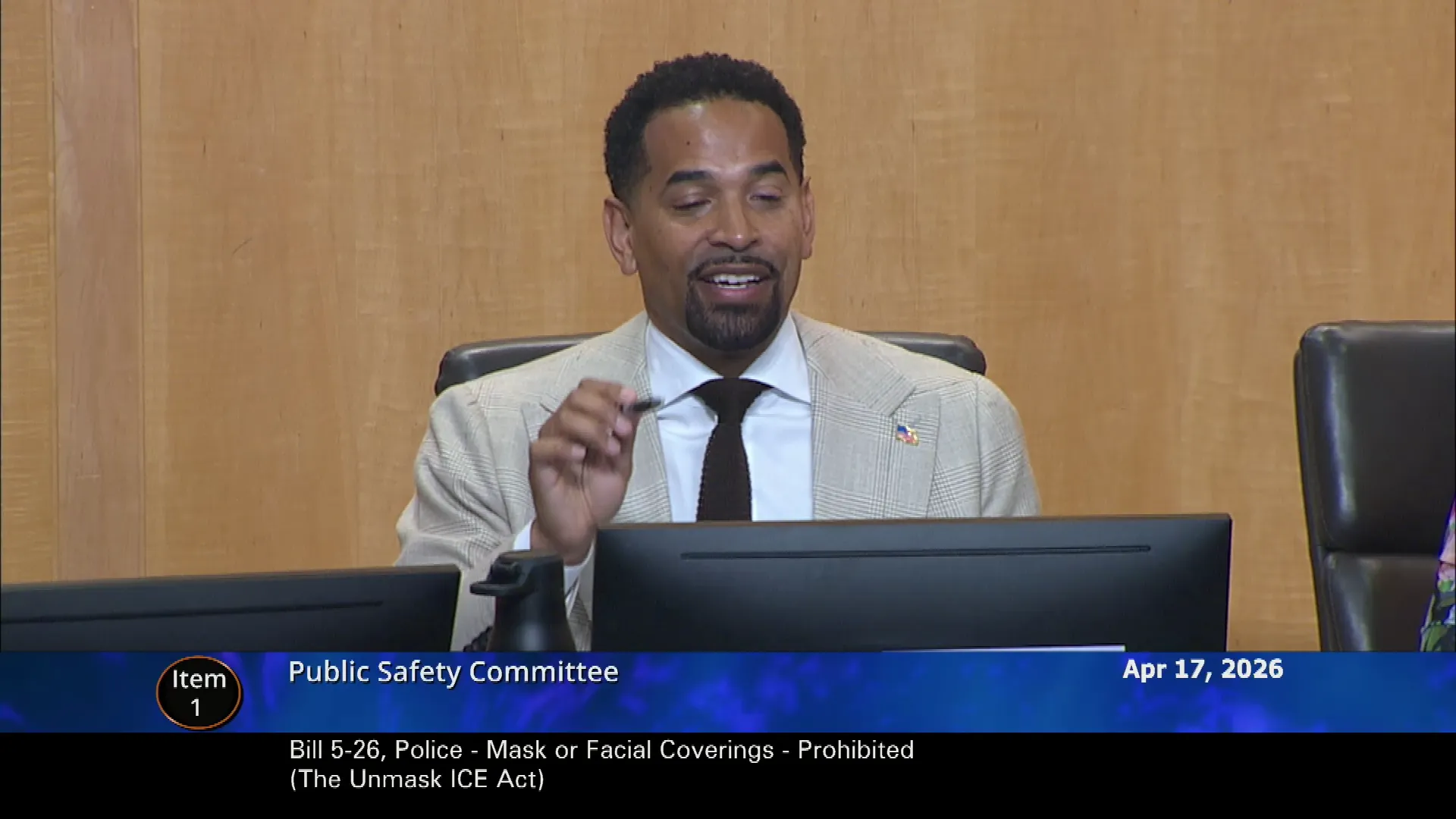
STREAMING COPY IN PREPARATION — RECORDING AVAILABLE FROM THE ORIGINAL SOURCE
Montgomery County Public Safety Committee Work Session on Bill 5-26 (Unmask ICE Act) – April 17, 2026
The Montgomery County Public Safety Committee met on Friday, April 17, 2026, from 9:30 a.m. to 10:44 a.m. in the 3rd Floor Council Hearing Room, Rockville, Maryland, to consider Bill 5-26, “Police – Mask or Facial Coverings – Prohibited (The Unmask ICE Act).” Although the agenda listed the meeting as running until 12:30 p.m., the approved minutes recorded adjournment at 10:44 a.m. Present were Councilmember Sidney Katz, Chair; Councilmember Dawn Luedtke; Councilmember Kristin Mink; and Councilmember Will Jawando. Also participating were Dr. Stoddard, Assistant Chief Administrative Officer; Chief of Patrol Francke of the Montgomery County Police Department (MCPD); and Legislative Attorney McCartney-Green. The committee recommended approval of the bill, 3-0, with amendments, with full Council action tentatively scheduled for April 28, 2026.
Public Comments & Testimony
- Staff reported that a public hearing on Bill 5-26 was held on March 3, 2026, with approximately 20 speakers who overwhelmingly supported the bill, along with numerous written testimonies.
- Supporters cited fear caused by masked federal officers and said the bill would make it easier for community members to quickly identify whether someone was a Montgomery County police officer or a federal agent.
Discussion Items
Bill 5-26 would prohibit federal, state, and local law enforcement officers from wearing masks or facial coverings while on duty in Montgomery County. Existing exceptions cover medical-grade masks such as surgical or N95 respirators, masks needed during fires, water rescues, biological or chemical incidents, and SWAT operations. A proposed county-related exception was added for extreme temperature plan events.
State law and preemption were central to the discussion. Maryland Senate Bill 1, passed by the Maryland General Assembly on April 13, 2026, but not yet signed by the Governor, would impose a similar mask ban and require identification, beginning October 1, 2026. Councilmember Jawando proposed a sunset clause so that Montgomery County’s bill would no longer be effective once the Maryland Police Training and Standards Commission adopts a uniform statewide policy. Dr. Stoddard said the County Attorney’s Office has opined that a local policy would remain in force until the state uniform policy is issued, and the process could take several months. Councilmember Dietke asked about the Oct. 1 preemption issue and whether the county could continue to wait for the state policy; the committee agreed the sunset language was acceptable and a housekeeping bill could be brought later if needed.
The committee also considered an amendment to align with state law by requiring law enforcement officers to wear identification with name, badge number, and agency on the outermost layer of clothing while performing duty, to verbally provide that identification upon request, and to exempt plainclothes, non-uniformed, and undercover officers. Law enforcement bodies have existing Maryland law and MCPD policies already require identification, and Councilmember Jawando and others argued the amendment would aim at federal agents and improve transparency. Councilmember Merson cautioned that Montgomery County cannot regulate federal law enforcement directly, but supported the amendment because it does not change MCPD procedures and signals accountability.
Enforcement mechanisms were the main stimulus. Councilmember Jawando proposed issuing a civil citation to law enforcement officers who violate the county law and to impose a Class A violation fine, which is $500. Councilmember Katz proposed an online reporting portal so officers or members of the public could file non-confrontational reports, with the Office of the County Attorney using the reports to enforce county law or refer matters to the Police Citizen Board. Councilmember Luedtke, Assistant Chief Francke, and Dr. Stoddard expressed concern that direct citation attempts could create dangerous confrontations with federal agents, could exceed the county’s legal authority, and could be impossible to identify masked federal law enforcement for probable-cause purposes. The committee adopted the portal approach, with County Attorney discretion, while preserving the ability to issue citations under existing general enforcement authority if enough evidence exists. Councilmember Luedtke asked for clarification about the evidentiary standard the county uses, noting that state law uses “reasonable cause” and county law does not; the committee said it would seek additional County Attorney guidance before full Council.
The committee also discussed broadening exceptions so officers are not disciplined for reasonable workplace protections or cold-weather duty. Councilmember Franke raised concerns about the accuracy of actual “declared weather emergency” wording and said officers ought to be allowed to cover their faces in extreme temperatures or environmental conditions consistent with MCPD practice and county extreme temperature plan. The committee approved an amendment adding Section 35-13E(b)(6) for any other item worn to follow applicable occupational health and safety laws or reasonable workplace accommodations, and to adjust the cold-weather exception to include events consistent with the County’s extreme temperature plan.
Key Decisions
- Recommended approval of Bill 5-26, as amended, by a vote of 3-0.
- Adopted Councilmember Jawando’s amendment to sunset Bill 5-26 once the Maryland Police Training and Standards Commission adopts a uniform policy.
- Adopted amendments aligning the identification requirements with state law, including the exemption for plainclothes, the uniformed, and undercover officers.
- Adopted Council member Katz’s amendment to create an online reporting portal; reports may be used by the Office of the County Attorney for enforcement or referral to the Police Accountability Board.
- Amended exceptions to include events consistent with the County’s extreme temperature plan and occupational health and safety or reasonable workplace exemption.
- Supported expedited the bill as an expedited bill.
- Clarified the definitions of “law enforcement officer” and created an exemption for officers engaged in undercover or covert operations.
- Decided the bill will move to the full Council with a next-step vote tentatively scheduled for April 28, 2026.
Meeting Transcript
Well, good morning, everyone, and welcome to the Public Safety Committee work session of Friday, April 17th, 2026. Today we have one topic on the agenda, Bill 526, police mask or facial coverings prohibited. It's also called the unmask ICE Act. As we begin, I'd like to thank Ms. McCartney Green for preparing the staff report for the topic today. And for once again and always assembling most informative packets for us. And less the other committee members have any vis or any of the visiting council members have any opening comments. I'm going to ask the uh Ms. McCartney Green to lead us through. And I don't know if anybody else wants to come forward and sit on the panel. I can say that you maybe want to. Yeah, yeah, yeah. Rock, paper, scissors. Now I want to know how well you did on it. Is anybody have any opening comments? No. Could you do? No, okay. Um could mural and shear Sautters is the Chief Ministry of Officer. Good morning. Sorry, Darren Frank, Chief of Patrol, Montgomery County Police. Okay. Very good. And Ms. McGurney Green, please. Good morning. Yes, it's Friday. So I had to double check. Yes. It's been that kind of week. Oh, to say the least. As mentioned before the committee today's Bill 526 mask or facial coverings prohibited the Unmask Act. The bill would seek to prohibit federal, state, or local law enforcement agencies from wearing masks or facial covers while on duty. There was a public hearing that was held on March 3rd, and the council received about 20 speakers that overwhelmingly spoke in support of the bill. And we also receive uh numerous testimonies from individuals that uh supported the bill because in part uh fear caused by the presence of masked federal officers and the fact that the bill would enhance community members' ability to quickly identify whether someone is a Montgomery County police or federal agent. Uh the exceptions that are provided in the bill, and I'll just kind of go through them so that we're all on the same page, but uh a mask uh some of the exceptions uh that are allowed under the bill is a medical grade masks that are a surgical or N95 respirator designed to present uh disease or transmission of airborne disease, uh masks designed to protect against exposure or smoke during a fire, masks are necessary to perform duties during a water rescue option, and a mask related to exposure to biological or chemical agents during an incident where agents, such agents may be present. Um, and also a mask to be worn um from exposure to cold during a declared weather emergency. Um there is a special exception there for uh SWAT team that use master in the course of their um duty. Uh in terms of the impact statements, they uh did not expect many impacts for fiscal, um, economic or climate, and the racial equity and social justice did say that it would have a positive impact on in the county. Just a little bit of background. This has been well talked about in the news and the media, but I do want to just shed some light to act of litigation that's in California very briefly. Um State of California enacted uh mask ban, which they uh Senate Bill 627, it's called the No Secret Police Act uh back in September, which would also do the same thing similar to this bill in terms of prohibiting law enforcement officers. Um federal, out of state, and local police. Uh the bill was challenged. Uh U.S. uh United States government channeled challenged the bill on a few uh issues, uh somewhere constitutional and and uh related to the Supremacy Act. Uh the decision in that case uh was to um court ruled that there I'm sorry, Ms. Play. But the court the court ruled that there um was a discrimination because this did not apply to state California police officers. Uh there was also another act that was passed, the vigilante act, and that required federal officers to visibly display ID IDs while on duty.
openpublica.com