Transportation & Environment Committee Work Session on FY27 Budgets – April 20, 2026
STREAMING COPY IN PREPARATION — RECORDING AVAILABLE FROM THE ORIGINAL SOURCE
Transportation & Environment Committee Work Session on FY27 Budgets – April 20, 2026
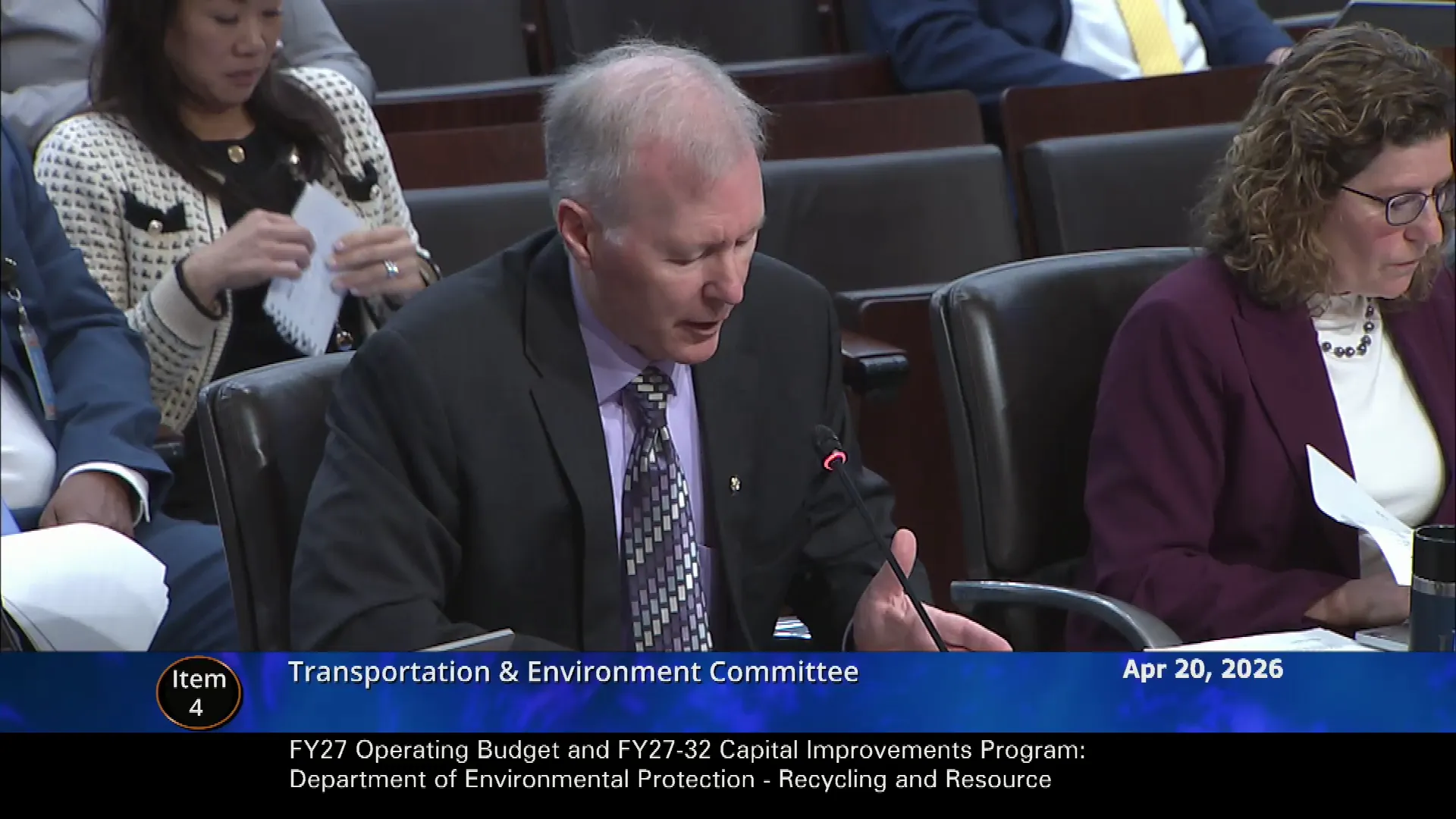
The Montgomery County Transportation and Environment (T&E) Committee met on Monday, April 20, 2026, from 9:35 a.m. to 11:30 a.m. to review four items in the FY27 operating budget and capital improvements program (CIP) related to the Department of Environmental Protection (DEP). The committee discussed the DEP General Fund, Climate Change Planning Non-Departmental Account (NDA), Water Quality Protection Fund and charge, and Solid Waste Collection and Disposal funds, including the proposed closure of the Resource Recovery Facility (RRF).
Consent Calendar
- The committee recommended approval of the FY27 DEP General Fund budget and the Climate Change Planning NDA budget ($488,344, unchanged from FY26) as proposed by the County Executive, noting no programmatic or staffing enhancements.
- The committee recommended approval of the FY27 Solid Waste Collection Fund budget as proposed by the County Executive.
- The committee recommended approval of a $1.0 million CIP shift: $1.0 million in current revenue from the Stormwater Management Retrofit project to the Comprehensive Flood Management Plan for feasibility studies in the Sligo Creek watershed, offset by long-term financing.
Discussion Items
- DEP General Fund: Senior Legislative Analyst Levchenko presented a 3.5% overall decrease from FY26, primarily due to the wind-down of the electric leaf blower program. Director Macedonia confirmed $300,000 in rebates and $65,000 for outreach remain in FY27. Chair Glass, Councilmember Balcombe, and Councilmember Stewart expressed strong support for DEP's work and opposed any further reductions. The committee approved the budget.
- Climate Change Planning NDA: Climate Change Officer Sarah Kogel-Smooker highlighted interdepartmental initiatives funded by the NDA, including extreme heat outreach for outdoor workers, Mezzanet weather monitoring stations, and support for the Loiderman Resilience Hub. The committee approved the unchanged budget.
- Water Quality Protection Fund and Charge: The Water Quality Protection Charge is recommended to increase from $147 to $157. A key point of discussion was the M-NCPPC allocation: the Executive recommended a $308,572 increase, but Montgomery Planning requested an additional $2.1 million. Councilmembers Balcombe and Glass questioned the impact on residents and sought clarity on whether shifting $2.1 million from the administrative services tax to the Water Quality Protection Fund would be revenue-neutral. The committee deferred a recommendation on the budget and charge pending a staff analysis of the fiscal implications for residents and M-NCPPC.
- Solid Waste Collection Fund: The committee approved the collection fund budget. Councilmember Balcombe confirmed that the proposed RRF closure would not affect the collection fund in FY27.
- Solid Waste Disposal Fund and RRF Closure: The County Executive's budget assumes mid-year closure of the RRF (December 31, 2026) and transition to long-haul trucking, with an additional $43.9 million for long-haul contracts and $3.6 million in decommissioning costs in FY27. DEP noted that maintaining current operations (full-year RRF) would require an additional $4.4 million. Councilmember Glass stated his commitment to closing the RRF, citing health and environmental justice concerns. Councilmembers Balcombe and Stewart argued that the decision should be made by the full Council without a committee recommendation, given the complexity and need for all 11 members to deliberate. Committee Chair Glass noted that a majority of the full Council had previously requested a full Council discussion.
Key Outcomes
- Approved FY27 DEP General Fund budget, Climate Change Planning NDA budget, Solid Waste Collection Fund budget, and the CIP adjustment (all as recommended by the County Executive).
- Deferred action on the Water Quality Protection Fund budget and Water Quality Protection Charge, pending a staff analysis of the impact on residential tax bills if M-NCPPC's requested $2.1 million were funded.
- No committee recommendation on the Solid Waste Disposal Fund budget or the proposed closure of the RRF. The committee split: Chair Glass supported closure; Councilmembers Balcombe and Stewart preferred full Council deliberation. The issue will proceed directly to the full Council without a committee recommendation.
- Next step: A full Council work session on the FY27 budget is scheduled for early May 2026.
Meeting Transcript
Good morning, everybody. It is Monday, April 20th. Welcome to the Transportation and Environment Committee. We have four items on our agenda this morning. The first three are under the Department of Environmental Protection Fund, the Department of Environmental Protection General Fund, the Climate Change Planning, NDA, and the Department of Environmental Protection, Water Quality Protection Fund and Water Quality Protection Charge. And so we'll start with DEP and Mr. Lubchenko. Good morning if you want to walk us through the packet. Good morning. And I thought maybe quick introduction since we have a fair number of folks from DEP here today, and then I'll walk us through the packet for those first three items. Good morning, Jennifer Macedonia, Director of the Department of Environmental Protection. I'll turn it to Amy. Good morning, Amy Stevens, Division Chief for the Water Restoration Division. Good morning, Lindsay Robinette Shaw, Section Chief for the Buildings and Transportation Programs Group. All right. So as you mentioned, the first three items today are the DEP General Fund, the climate change planning non-departmental account, which is also general fund supported, and then the water quality protection fund, which is a self-supporting enterprise fund. First, we'll talk about the two DEP portions of the budget. Overall, that is a decrease of about 3.5 million. We'll talk about all the puts and takes in a minute. And across both the funds. First, we'll talk about the general fund side of the budget. That budget, and I've got the summary numbers here on page three of the packet across all of these department and funds. There are no programmatic or staffing or significant staffing additions or reductions or enhancements to the general fund portion of the budget, as we'll we'll talk about in a little bit. As you know, the uh uh council president's instructions for uh how we're reviewing budgets this year is that uh ads and enhancements uh that are identified by the committees uh would be going to the reconciliation list for uh further discussion and debate uh going forward. Uh however, in this case, staff does not have immediate recommendations regarding any items since the staff does not feel these items rise to that level of being enhancements or um additions. Certainly, if the committee were to add something, that would have to go on the reconciliation list as well. The committee can also choose to reduce items, and we'll talk about that, some options there in a minute. Uh those reductions, the committee could opt either just to make them as straight reductions or could opt to put them on the reconciliation list for for further discussion. Um as I mentioned, there's a slight decrease in the general fund budget, uh, although uh I I do want to point to uh page six of the packet. This lays out uh basically a crosswalk from the FY26 budget to the FY27 budget. Uh and it's it's listed as table one at the top of the page. Uh and uh as you can see, a lot of these adjustments and you and these are adjustments you'll see in other budgets across uh county departments. Uh a lot of them are what we would call technical adjustments or same services types of adjustments where you're trying to do the same thing in 27 that you're doing in 26, but there could be some increases or decreases related to that. Uh and then also we have some significant cross-cutting items that you see across departments, such as the FY27 compensation adjustment. Those adjustments will be dealt with at the count by the council at a macro level, and then the department budgets will be adjusted accordingly. Uh so the committee does not need to take up, for instance, the FY27 compensation adjustment for the DEP General Fund, which is adding about 160,000 uh if it were to remain unchanged from what the executive recommended. You also have some of the technical adjustments I mentioned, like laps. Each year, the department in coordination with OMB identifies a lapse rate or a vacancy rate that it'll experience for the upcoming year. It's a projection based on historical experience with vacancies and OMB does uh try to establish some uh general rules across uh the departments to identify what uh the laps would be. Uh so that if you are increasing laps, you are decreasing costs. If you are decreasing laps, you're increasing your costs in the department since you're expecting a higher amount of your uh personnel costs to be spent. Then we have a lot of annualizations from prior uh from the prior year, FY26. For instance, if you have a compensation increase in 26, that will then uh build into FY27 as well. Similarly, if you have new positions or position changes in one year, that can affect uh the budget in FY27. Uh you also have uh impacts on contracts. Uh the DEB general fund, much of its operating budget is in contracts. And uh so you do have adjustments there, often for CPI related adjustments, and uh DEP can speak to those as part of uh what we're seeing here. Uh and then a couple of other um items noted here, uh internal service funds, motor pool, printing and mail, risk management, those are all items that are budgeted centrally and then spread to the departments by OMB. So you see those in each of the departments as well. Another cross-cutting issue the executive has recommended is a two and a half percent inflationary adjustment for nonprofits.
openpublica.com