GO Committee Reviews FY27 Compensation and CBAs – April 20, 2026
STREAMING COPY IN PREPARATION — RECORDING AVAILABLE FROM THE ORIGINAL SOURCE
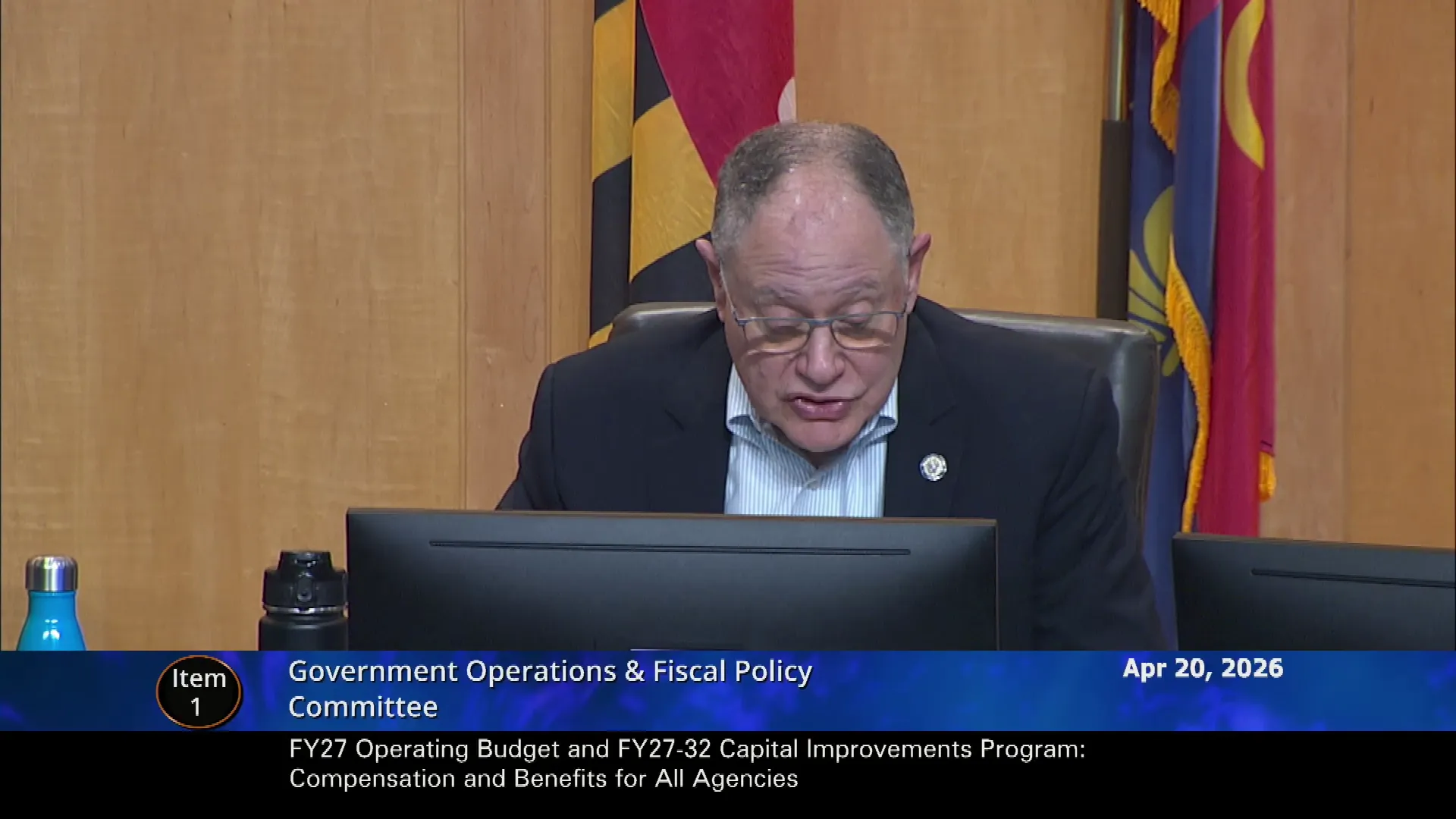
Government Operations & Fiscal Policy Committee Meeting – April 20, 2026
The Government Operations and Fiscal Policy (GO) Committee met on April 20, 2026, at 1:30 p.m. in 3CHR to review the FY27 Operating Budget and FY27-32 Capital Improvements Program, focusing on two related agenda items: (1) Compensation and Benefits for All Agencies and (2) Collective Bargaining Agreements. No votes were taken; the committee received presentations from council staff, heard from the Office of Labor Relations and union representatives, and discussed key policy and fiscal implications. The full Council will review these items on Tuesday, April 22, 2026.
Discussion Items
Compensation and Benefits Overview
- Central staff presented a detailed analysis of the County Executive's recommended FY27 compensation package, which totals approximately $4.9 billion (a 4.5% increase over FY26). General wage adjustments (GWAs) and service increments vary by union: FOP/Police Leadership Service up to 6.5%; IAFF (firefighters) up to 6%; McGeo (non-public safety) up to 6.35%; deputy sheriffs up to 10.5%; correctional officers up to 7.92%. Non-represented employees receive 6.35%.
- Staff noted that county GWAs have exceeded inflation over the past decade (37.5-40% compounded vs. 31% CPI).
- Salary schedule adjustments were proposed for deputy sheriffs (1.6-4%, cost $238,000) and correctional officers (1.57%, cost $500,000) to address recruitment and pay compression.
- Longevity increments: the Executive proposes advancing the third IAFF longevity increment from 24 to 22 years of service, costing $548,000 in FY27 and $1.2 million annualized, affecting 76 IAFF members. Actuarial analysis shows an additional $651,000 in FY27 and $3.5 million over five years for pension/retiree health costs. OLR justified this as incentivizing retirement at 25 years due to physical demands.
- Retirement benefit enhancements:
- For McGeo and non-represented RSP/GRIP participants: county contribution increases from 8% to 9% in January 2027 and 10% in January 2028; employee contribution rises to 5% then 6%. Annualized cost $7.3 million in FY27, rising to $14.5 million when fully implemented. Also adds a post-retirement annuity option for GRIP members, making it more like a pension.
- Pension modifications for deputy sheriffs and correctional officers: removing minimum age for retirement with 25 years of service, allowing purchase of credited service, and transferring correctional health nurses to the correctional officers plan. Actuarial cost: minimal in FY27-29, but $81,000/year by FY30. No retiree health cost estimate provided.
- Retiree health benefit extension for part-time school health and crossing guard employees hired before 2023: allows eligibility after 7 years instead of the standard 10 years. One-time MOU for a small cohort (estimated 70 individuals). OLR noted this was a compromise to resolve grievances about inadequate notification during COVID.
- Health and wellness provisions: IAFF agreement includes funding for annual NFPA-standard physical exams while on duty and blood testing for PFAS (forever chemicals); also up to $800 reimbursement every 36 months for multi-cancer blood testing (cost $291,000).
- Attendance incentive program for emergency communication center personnel: bonuses up to $2,000 per year for limited unscheduled leave.
- Miscellaneous provisions: training pay differential for mechanics/technicians, canine handler pay, increased stipends for peer support specialists ($3,500/year) and child welfare caseworkers ($3,500/year), hazard pay differential ($8/hour) for certain HHS employees, charge nurse differential, holiday pay for seasonal aquatics staff, tuition assistance ($150,000), and tool/shoe allowances.
Fiscal Sustainability
- Staff presented the compensation cost sustainability analysis required by Council Resolution 19-753. FY27 tax-supported compensation costs grow 3.7%, while revenue growth (with proposed tax/fee increases) is 5.1% in FY27 but averages 3% over six years. A 0.7% annual gap over six years would compound to a $216 million shortfall by FY32.
- Staff highlighted long-term cost implications, especially from retirement enhancements that add at least $12 million in FY29 and beyond. They also noted that some fiscal impact statements do not include full pension and retiree health costs.
- Options for reductions were presented if the Council does not adopt the Executive's proposed tax increases, including reducing GWAs, eliminating service/longevity increments, or scaling back benefit enhancements.
Committee Member Questions and Commentary
- Chair Stewart asked about OLR's justification for the IAFF longevity change, specifically the mention of workers' compensation and operational challenges. OLR committed to follow up with fire department data.
- Councilmember Evans asked about operational changes (e.g., wellness programs) to support firefighters' health and retention beyond monetary incentives. OLR noted the cancer screenings and physical exams but will get more detail.
- Councilmember Katz noted his family's MCPS ties and emphasized the need for multi-year budget planning, stating that the budget is a puzzle that does not fit together as desired. He acknowledged the difficulty of the council's role in approving negotiated agreements.
- Council President Fani-González questioned the timing of negotiations: the council receives negotiated agreements and must decide on the largest budget items without prior input. She also asked about retirement plan participation rates (staff will provide) and noted that the NFPA physicals are more extensive than standard insurance-covered exams.
- Council Vice President Balcombe did not ask questions.
- OLR's Mr. Rand explained the background of the part-time retiree health exception, noting it was a compromise to fix a system failure where employees were not properly informed about retirement plan enrollment.
- Jeff Butler, IAFF Local 1664 President, clarified the difference between NFPA occupational physicals and standard physicals, and that insurance would not cover the former.
Key Outcomes
- No votes were taken. The committee concluded its review and will forward the information to the full Council for its work session on Tuesday, April 22, 2026.
- Staff will provide follow-up data on firefighter retention/wellness programs, retirement plan participation percentages, and a more detailed breakdown of the longevity change's impact.
- The Council must act on the collective bargaining agreements by May 1, 2026, per county code.
Meeting Transcript
Good afternoon, everyone, and welcome to this session of government operations and fiscal policy. Today we have two items, but they're very related on our agenda. First is a review of a compensation and benefits for all agencies, and then a review of the collective bargaining agreements. We are joined today by the council president, Councilmember Natalie Fanny Gonzalez, and our Vice President, Councilmember Balcom. Thank you for joining the committee today. The committee today will be reviewing, as I said, compensation and benefits. We will not be taking any votes today. There are many things to consider as we look at this. I want to thank our central staff for their work on this. And I also want to take a moment to thank all of our unions. Many folks who are represented here today for your work. We know the process of collective bargaining is one that takes many months and is one that you participate in with our Office of Labor Relations, who is also represented today. And so we just want to express first our thanks for doing that work as we, as the council now takes on the reviewing of the collective bargaining agreements and compensation and benefits. The full council will also be reviewing this next Tuesday. And again, I just want to thank everyone who is here today. And I will now turn it over to our council staff, Mr. Howard. Terrific. Good afternoon, everyone. And today Mr. Trump and I will walk through a summary of the compensation and benefits for all agencies as proposed in the county executives recommended FY27 budget. Our focus as we do each year is going to be primarily on county government because those are the items that the council has final decision authority over, although we are going to share as much information as we can about some of the other agencies as well, with the understanding that the final decisions on those on pay and benefits for those agencies are made by their respective governing bodies. So we're going to walk through the staff report. We'll try to do our best to summarize things and not go through every single piece. But it does take a little bit longer to go through this presentation than most budgets just because it is very complex. There's a lot of different pieces, and it's such a significant part of the budget, and it's important to go through and make sure everyone hears all the different details and as you have to embark on decisions on these issues going forward. So to begin with, um on page two, we have a summary of FY27 recommended compensation costs across across the agencies. And the FY27 recommended budget includes about $4.9 billion in compensation costs, which is a 4.5% increase over FY26 cumulatively. Those are that's the high-level numbers we're we're going to be talking about. And you can see the table one breaks down the increases by agency. Thank you, Mr. Howard. Good afternoon, Council members. Walking through them again in a bit of detail. For the fraternal order of police and police leadership service, FOP, and the PLS, the executive recommends a general wage adjustment of 3% and a five 3.5% service increment for those not atop of grade for a total maximum of 6.5% increase. For the IAFF and fire and rescue, the executive recommends a 2.5% GWA general wage adjustment and a service increment, also 3.5% for a total maximum of 6% for those not atop of grade. For McGeo, we're going to divide up everybody other than the deputy sheriffs and the correctional officers. The executive recommends a 2 and 0.85% general wage adjustment along with a 3.5% service increment for a maximum total of 6.35%. The McGeeO agreement also includes two separate salary schedule adjustments. In essence, taking the salary schedule and raising them up an increment. For the deputy sheriffs, that salary schedule adjustment, depending on the position and years of service can range between about 1.6% to a little over 4%. So again, total for an employee not at top of grade, between a little under 8% to about 10.5%. For correctional officers, the salary schedule adjustment is a uniform 1.57% for all for most all on this on the schedule, meaning a total maximum for those not atop of grade of 7.92%, and then for non-represented 6.35%, the general wage adjustment and the service increment. Of note, federal employees will receive a 1% COLA or GWA this year and a 1.5% increment, and state of Maryland employees will receive a 1.5% to 2% COLA general wage adjustment and a 2.5% increment. Continuing on page 4, our memo includes a comparison of general wage adjustments and inflation over the past decade. And what we found is that the general wage adjustments awarded to county government employees have exceeded the rate of inflation over the past decade, decade. From FY16 to FY26, the compounded rate of GWAs for the FOP, IAFF, and McGeo have ranged between 37.5% to near 40%. Over that same decade, the CPI is increased by compounded rate of 31%. Moving on to page 5. So, as mentioned previously, the executive recommends salary schedule adjustments.
openpublica.com