FY27 Green Bank NDA Budget Review - April 21, 2026
STREAMING COPY IN PREPARATION — RECORDING AVAILABLE FROM THE ORIGINAL SOURCE
FY27 Green Bank NDA Budget Review - April 21, 2026
A joint work session of the Transportation and Environment (T&E) and Government Operations and Fiscal Policy (GO) committees reviewed the FY27 Operating Budget and FY27-32 Capital Improvements Program for the Montgomery County Green Bank Non-Departmental Account. The County Executive recommended a $2,485,474 (14.7%) increase from FY26 to restore the county's allocation to 10% of fuel energy tax revenues. The committee unanimously approved the budget as recommended.
Discussion Items
- Budget Proposal: Legislative Analyst Stephen Kenny explained the executive's recommendation includes a $2.29 million restoration to reverse partial cuts made in FY26 (a $1.08 million reduction due to lower fuel energy tax revenues and a $1.14 million affordability reduction) plus a $193,670 marginal increase for FY27 projected revenue growth. The proposal aligns with the existing policy of allocating 10% of fuel energy tax revenues to the Green Bank.
- Council Leadership Comments: Councilmember Kate Stewart reframed the narrative, noting the council worked to restore funding last year after the executive's initial reduction, emphasizing the council's commitment to the Green Bank.
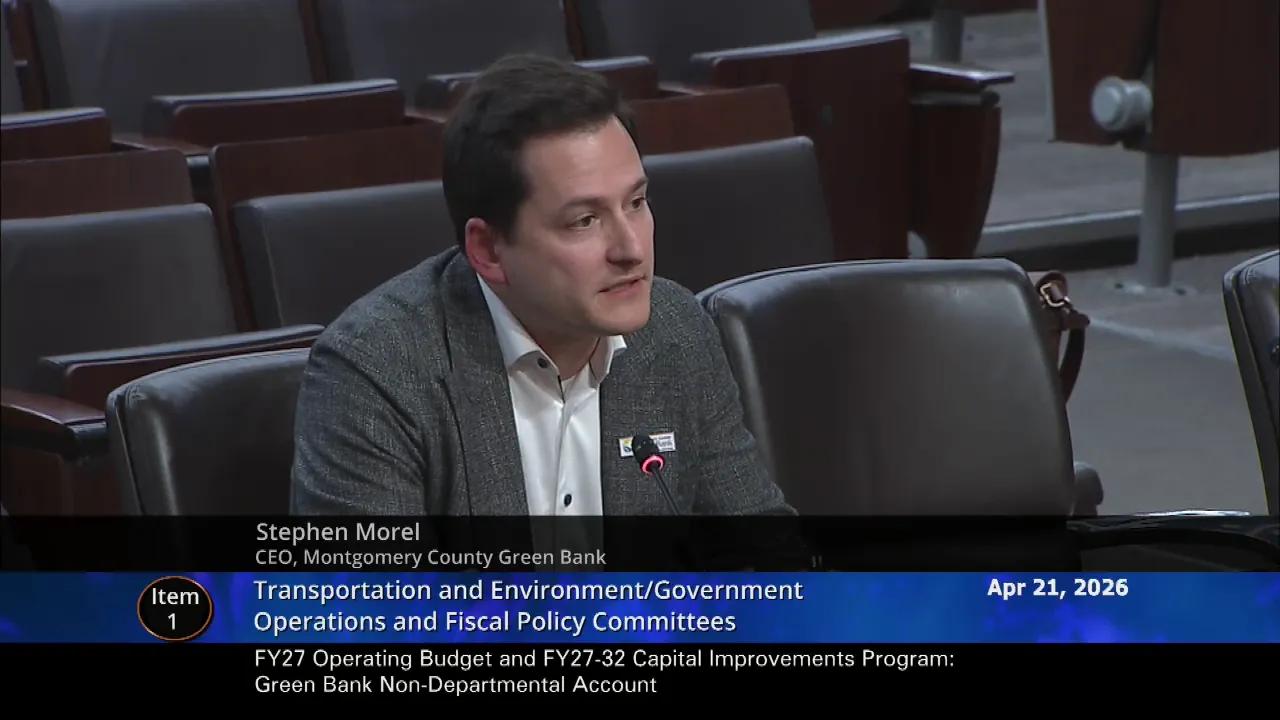
- Green Bank CEO Remarks: Mr. Morel highlighted the importance of consistent 10% allocation for capital markets confidence and leveraging public dollars: currently achieving approximately 4x leverage on a portfolio basis, targeting 5x in FY27. Planned FY27 deployment of $25–30 million from energy tax and other sources is expected to support $150–200 million in project value. Portfolio allocation: ~45%+ for BEPS compliance, 20–25% for resilience, 15–20% for solar, 10–15% for EV charging. Technical assistance program (up to $5 million purchase order window) supports BEPS feasibility studies and audits; half already spent. A new pilot with Permitting Services aids disadvantaged communities. Operating costs are kept lean at 15–20% of annual revenues, with no major FTE increases.
- Question and Answer: Councilmember Balcombe asked about average project size ($1.5 million to $5 million range). Mr. Morel noted supply chain concerns are mitigated by cooperative buying power of regional renewable energy companies, though large retrofits can take 1–4 years to complete.
Key Outcomes
- The committee unanimously approved the FY27 Operating Budget for the Green Bank NDA as submitted by the County Executive, without objection. No items were added to the reconciliation list per the council president's budget approach.
Meeting Transcript
Good afternoon, everybody. It is Tuesday, April 17th. Welcome to a joint committee session of the Transportation and Environment and Government Operations and Fiscal Policy Committee work session. We have one item on the agenda today, and that is reviewing the Montgomery County Green Bank's NDA budget. As everybody knows, the Montgomery County Green Bank uses a mix of public and private funds to help reduce greenhouse gas emissions in Montgomery County. And the county executive recommends an increase of $2,485,474 or 14.7% from the FY26 approved budget. And I'll turn it over to Mr. Kenny. Thank you. So as you noted, um just under $2.5 million increase in the executive's uh recommended budget uh for the green bank. Um NDA um as you noted there's uh this contributions uh from the county uh to the green bank uh are by policy uh meant to be uh 10% of the fuel energy tax uh revenues uh in any given year. Um I will note before proceeding, uh just uh and this is spelled out on on page two of the staff report, but uh this committee recently uh reviewed uh a bill, bill two twenty-six um that expanded uh the the uh applicable uses of this county uh allocation to the green bank to be able to cover resiliency activities. Um the green bank has has uh made clear that they can do this and and um make these investments uh within the 10% uh allocation given by the county. Um and so this is uh can be done all within the existing policy framework. Um so uh the executives recommended uh increase of of just under 2.5 million dollars uh is intended um to uh re-baseline uh the county's allocation to that 10% uh of the fuel energy tax revenues. Um the uh council uh last year uh took a uh reduction, two reductions uh to the Green Bank NDA budget. Uh the first was a 1.08 million dollar uh reduction uh given lower the lower projected fuel energy tax revenues in FY26. Uh and the other was a one point one point one four million dollar reduction due to affordability. Uh this reduction was half of what the executive had proposed, um which was just shy of 2.3 million dollars. So the council was able to restore half of the executive's reduction in last year's budget, uh, but this still put uh the the county's allocation to the green bank below uh the 10% threshold. Um so uh the executive's recommendation uh for this year uh fits into two pieces. Um happy to go through them both and then uh pause for for questions or comments. Um the first is to re-baseline uh the county's uh contribution from FY26, um, reversing both uh the uh affordability reduction uh and uh the reduction due to lower than anticipated uh revenues uh because the the revenues were much closer to uh the annual growth level than uh the uh than was originally projected. Um those revenues uh are are included in the the table on table three on page three of the staff report. Um this is uh reflected as a uh $2.29 million uh restoration. Um then the second component of this is a uh $193,670 uh increase to align uh the contribution uh to the green bank to FY27 levels, marking the marginal increase uh from fuel energy tax uh revenues from uh the actual uh receipts in FY26 to the uh projected uh receipts in FY27. Um so uh per the council president's uh budget approach, neither of these items um are recommended to be uh added to the reconciliation list. Um the committee may uh make changes as as it sees fit, uh, but council staff recommendations are uh that to for the committee to to recommend approval of these items as as recommended by the executive. Thank you very very much, Mr. Kenny. Before I turn it over to Mr. Morel, I was remiss in not uh asking my co-chair if she had anything to to add. I'll just quickly um say thank you to uh the chair and um I guess I'll say this here, and Ms. Morrell, I'll turn it over to you. I think it's important that we accurately depict what happened last year. Because the county executive gave us a budget in which he actually did reduce, and I know Mr. Kenny, you said that, but the way the packet reads, um the council um ultimately voted yes on the budget. But we did all we could to get the green bank back its money after the county executive gave us a budget that reduced it. Um and I think we had many conversations here about the not just in these two committees that we had last year, um, but the full council about how important the green bank is and the work that you do, and Mr. Morel, I'm gonna give you your moment to shine in a second, but I just I did want to note that at the outset because I think the narrative is very important because there has been a commitment by this council to the green bank and to fund it for the work it does. Um so I just I wanted to start by saying that and reset us. I knew you were gonna say something important and worthwhile, and it is good to reframe it that way. Mr. Morel, welcome. Oh, thank you very much. I will uh keep my comments brief and I'd be very happy to uh answer questions. Um I certainly would agree with the comments made and very much appreciate the recommendation that's in front of the council at this stage. One of the points I made last year about keeping consistent with a 10% allocation is that's actually very important for secondary markets, particularly the capital markets, to have confidence in what we're doing from an appropriations basis. So we can always go to the capital markets and try and raise money based on the strength of the projects that we're doing because we know they're strong and we work hard at that, but that's not going to be really scalable to the type of scale we need to meet our GHG targets as well as climate resilience within the county. Instead, if they know that we're relatively consistent around 10% in an appropriation, we can leverage that for capital markets issuances.
openpublica.com