Montgomery County GO Committee FY27 Budget and Grants Review – April 24, 2026
STREAMING COPY IN PREPARATION — RECORDING AVAILABLE FROM THE ORIGINAL SOURCE
GO Committee FY27 Budget and Grants Review – April 24, 2026
The Government Operations and Fiscal Policy (GO) Committee met on Friday, April 24, 2026, from 9:30 a.m. to 11:13 a.m. in the County Council Hearing Room, Rockville, Maryland, as part of the FY27 Operating Budget and FY27-32 Capital Improvements Program review. Councilmember Kate Stewart chaired the meeting; Councilmembers Shebra Evans and Sidney Katz also participated. Staff from the Office of Racial Equity and Social Justice, the Office of Grants Management, the Office of Management and Budget, and council staff presented the items. All decisions were made without an enumerated roll-call vote.
Office of Racial Equity and Social Justice (ORESJ) FY27 Operating Budget
- The County Executive recommended an FY27 operating budget of $1,766,779 for ORESJ, an increase of $90,331, or 5.39%, over the FY26 approved budget. This included $1,526,780 in personnel costs, a 6.2% increase, for 8.5 FTEs, and $239,999 in operating costs, a 0.7% increase. The office’s Operating Budget Equity Tool score was 11 out of 11.
- Director Ward said the office is fully staffed and has created about 11 training mechanisms, together with a community engagement team working on community engagement tools and implementation of the Racial Equity and Social Justice Act.
- In discussion, staff reported that survey responses identified staffing/capacity as a barrier for 53% of departments and resources as a barrier for 45%; 33% cited competing other factors. Director Ward emphasized that OBET narrative analysis often points out where additional resources could strengthen racial equity work.
- The committee recommended approval of the budget as submitted by the County Executive, with no items placed on the reconciliation list.
Executive Regulation 30-25: Extending the Deadline for Racial Equity Action Plans
- Executive Regulation 30-25, transmitted by the County Executive on March 25, 2026, would extend the deadline for department racial equity action plans from 2025 to 2027. Staff noted that the regulation is under general method two, requiring council approval or disapproval within 60 days, and that the regulation contains a statement of no fiscal impact and a draft resolution.
- Director Ward reported that about 10 of 41 applicable departments have completed racial equity action plans and that many more remain in progress. ORESJ staff said they plan to provide templates, training, technical assistance and a guidance manual to the remaining departments.
- The committee recommended approval of the extension and asked that the deadline be expressed as a definite date — December 31, 2027 — if legally possible in the resolution. Final Council action was tentatively scheduled for May 2026.
Community Grants Non-Departmental Account (NDA)
- The County Executive recommended an increase of $301,283, or 2.25%, for the Community Grants NDA. The proposal includes a $1.5 million continuation of the Nonprofit Federal Resiliency Grants program, originally created during the fall 2025 special appropriation in response to the 43-day federal shutdown.
- Director Murphy and OGM described that 21 applications were received for the resiliency grant, but many applicants could not demonstrate that they had suffered the required federal funding loss or that their expenses were eligible under the original NOFO. OGM plans to release a revised NOFO allowing projected, in addition to demonstrated, federal funding losses if the funding is approved.
- The committee approved the County Executive’s recommended reductions, including $819,545 for the FY24 Underserved Community Projects awards, whose three-year grant term ended, and other legacy-renewal and community-grant reductions. OGM reported that 10 of its previous 97 legacy renewal awards were not recommended for renewal.
- Council staff had noted that the committee could reduce the $1.5 million resiliency item by $500,000 under the council president’s guidance. The committee decided instead to place the full $1.5 million on the reconciliation list for final decision by the full Council.
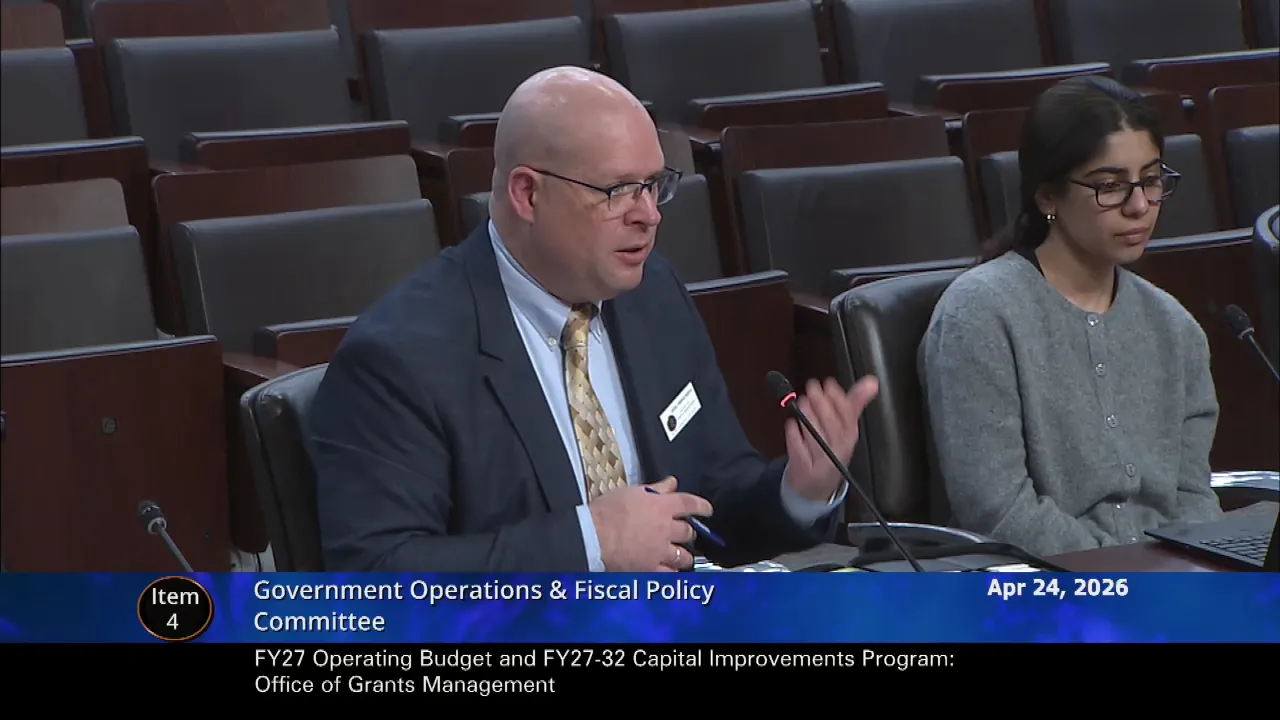
Office of Grants Management (OGM) FY27 Operating Budget
- The County Executive recommended a slight decrease of $2,000, or 0.17%, from the FY26 approved OGM budget. The office has six FTEs, with no net change; compensation adjustments total about $74,000.
- The committee approved the Consolidated Software shift recommended by the County Executive, transferring $150,000 for the Euna grants management software from the Departments of Environmental Protection, Transportation, and Police to OGM. The shift provides countywide access and allows OGM to share use of the private grant database. Note: the transcript contains varying dollar references for this shift, while the approved minutes state the shift as $150,000.
- Director Murphy highlighted the scale of OGM’s work, including FY25 federal award expenditures of $232 million, over 500 applications processed, and expansion of Department grants assistance, and he recounted that a direct calculation would require property taxes by about 8.9% or income taxes by about 0.95% to replace that federal spending if it were lost.
- OGM also reported on reduced use of outside grant writers — from seven assignments in FY24, then five in FY25, and one in FY26 — because departments are building in-house capacity, supported by OGM trainings and grants attorneys.
- The report also referenced public hearing on the OGM budget held noon April 7, 8 and 9, 2026; no public commentary accompanied this committee session.
- The committee recommended approval without further reduction.
Cost Sharing: MCG
- Staff disclosed packet errors and corrected important figures: the FY26 approved amount was $6.4 million, not the lower figure originally printed, and the FY27 County Executive recommendation was $5.5 million. The County Executive recommended a $900,000 reduction, or about 14% from the FY26 approved base.
- The committee reviewed a $2.5 million recommendation, split between $2 million in federal aid and $500,000 in County funds, for the CASA Inc. workforce development center renovations at the former county animal shelter on Rothbard Drive in Rockville.
- The packet proposed $200,000 as a direct appropriation to the Charles E. Smith Life Communities Reimagining Ring House project. State funding for that project was reported at $950,000 in the FY27 capital budget. The issue was that the County Executive proposed taking the $200,000 out of the $2 million allocated for non-arts competitive cost-sharing capital grants, reducing the competitive pool to $1.8 million.
- Chair Stewart expressed concern that the NOFO for the competitive cost-sharing grant had already opened, making the reduction confusing to applicants. She moved to address $200,000 to the reconciliation list and preserve the full $2 million for the competitive non-arts grant pool. The committee agreed.
- Staff was directed to work with OMB on additional transparency and detailed project information for the full Council packet before further Council action.
Key Outcomes
- Recommended approval of the FY27 ORESJ Operating Budget as submitted.
- Recommended approval of Executive Regulation 30-25, with a proposed specific deadline of December 31, 2027, and full Council action tentatively in May 2026.
- Recommended the Community Grants NDA FY27 budget, with the $1.5 million federal resiliency item placed on the reconciliation list and the Executive recommended reductions accepted.
- Recommended approval of the OGM FY27 Operating Budget and the $150,000 software-funding shift recorded in the minutes.
- Recommended approval of the Cost-Sharing MCG consolidated votes, but added clarity: restored the full $2 million competitive capital-grants pool and moved a $200,000 direct appropriation for Charles E. Smith Life Communities to the reconciliation list.
- With that, the committee adjourned. The exact local times were 9:30 a.m. to 11:13 a.m. on Friday, April 24, 2026.
Meeting Transcript
Good morning, everyone. Happy Friday. This morning we have our government operations and fiscal policy committee. We will continue discussing operating budgets and have one other item from the Office of Racial Equity and Social Justice that we will be discussing today. So we'll start with them and then we'll move on to our Office of Grants Management. I will turn it over to our central staff, Miss Mendy Singleton, to walk through the packet. Hi, good morning, Chair Stewart, Council Members Katz and Evans. Yes, we are here to talk about the operating budget for the Office of Racial Equity and Social Justice. I will talk about the executive summary and then the budget. So the county executive recommends an increase of $90,331 or $500 or 5.39% from the FY26 approved operating budget for the Office of Racial Equity and Social Justice. The county executive's budget includes no items that must be placed on the reconciliation list per the council's budget approach. The increases recommended for ORESJ consists entirely of compensation adjustments and non-discretionary operating expenses. The operating budget equity tool analysis scores ORASJ with an 11, indicating that ORASJ has a proactive and strategic commitment to advancing racial equity and social justice. I'll say a little bit about that in a minute. And then with respect to the summary of the FY27 recommended budget, the general fund 1,766,779 or a change from the FY26 budget of 5.39%. Personnel costs 1.1,526,780 or an increase of 6.2% for 8.5 FTEs. And the operating costs 239,999 or 0.7 increase from the FY26 approved budget. With respect to the department background, those are at circle two. And then a little bit more about the operating equity tool, operating edge equity budget tool, the OBET, just indicates effective leadership of the countywide implementation of the RESJ RESJ Act in Montgomery County and undertaking numerous GARE framework activities and enables other departments through its trainings, technical assistance tools, analysis, and expertise to do so. And I think you all know that GARE is the government alliance on race and equity. Again, with respect to the budget items, I just shared those with you. Again, there are no changes that are required to be placed on the reconciliation list, and the staff recommends approving the budget as recommended by the county executive. Great. Thank you so much for that overview. I'll first uh turn it over to uh Director Ward if you have anything uh you want to share with us. Pretty straightforward budget, and then we'll open up to colleagues uh for questions. Sure. Um just want to uh express that we are at our 8.5 fully staffed uh team, I think are ably um implementing the racial equity and social justice law. We uh of course have our policy team who uh implements our operating budget tool, our capital improvement tool, as well as uh write our RIAs. Uh we have a training team that has uh put together, gosh, now we've created about 11 trainings, most of which are also are delivered facilitated by our team with one with the help of one contractor and are also available via self-guided training, meaning you can get online and take those trainings when and however you would like. Uh and our newest component is our community engagement folks, and we have a community engagement team that is putting together a community engagement tool in our effort to implement our to implement the community engagement uh phase of the law as well as reacting to the OLO report on community engagement in the county overall. Um feel confident about our work. Happy to answer any questions uh that you may have about any piece of the work that we are in charge of implementing. Great, thank you. And I look forward when we're not in budget to have you back again. This spring got a little busy, but it's always nice to have you all back when we're not deep in budget to explore some of the work you're doing. And I think especially with the community engagement work, you know, that um Office of Legislative Oversight report we got was very well done, and being able to actually implement some of that is great. One question I had an alternative colleagues is um just wanted to um dig into the operating equity budget tool and um see from your perspective how that has gone. I think for our committee, uh we've had we've discussed it with the departments that come before the committee. Um we're glad to see many of our departments that come before us are are getting a uh score of a seven or more, and those that are more in the six range and lower um really have identified some of the issues um in terms of what they have to document and things they need to do. Um I think this committee is hearing less from um departments uh who are smaller that uh they're running into issues um with trying to figure it out and they're working with your office and other departments um to move forward. So I think that is a movement in a good direction. I think in past years we've heard more from some of especially some of our smaller departments that they were really struggling. Um, and I think we're we're hearing less of that um this year. Um so yeah, we'd like to know like how how you thought it was good went this year and curious to know why we went back to scores, because last year we didn't do scores, and then yeah, so just curious about that. Sure. I will say that I think that um overall the county uh has a higher comfort level that departments have a higher comfort level with the tool. Uh we changed the tool, we tweaked the tool just a little bit every year, but quite frankly, the GARE framework remains, right? How are you normalizing, operationalizing, and um organizing in this space? And so we feel like people are becoming used to this type of um inquisition and also putting together better responses, meaning really talking to us about what they're doing and how they're doing it.
openpublica.com